MAAP #185: Gold Mining Deforestation in the Southern Peruvian Amazon: 2021-2022 Update

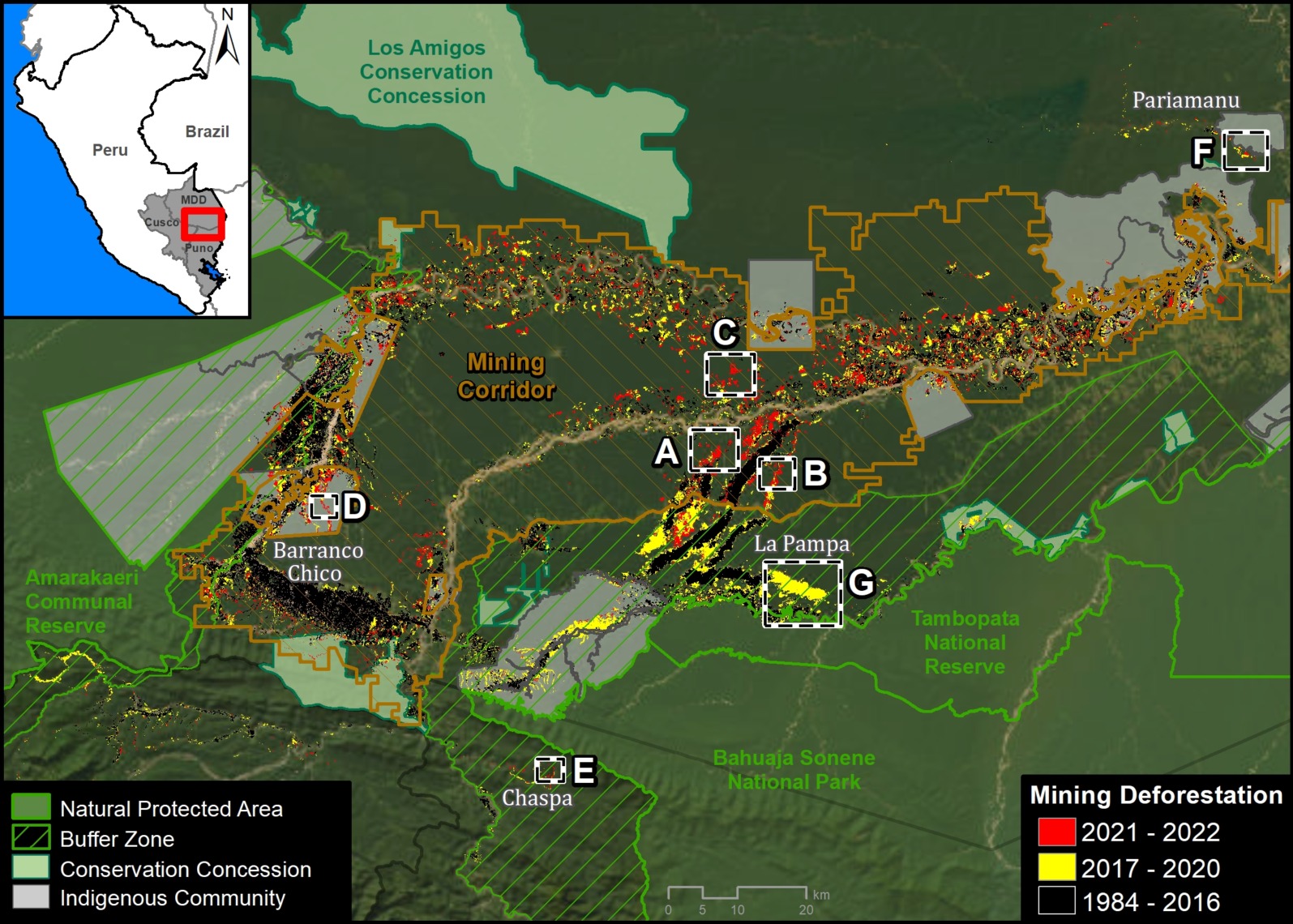
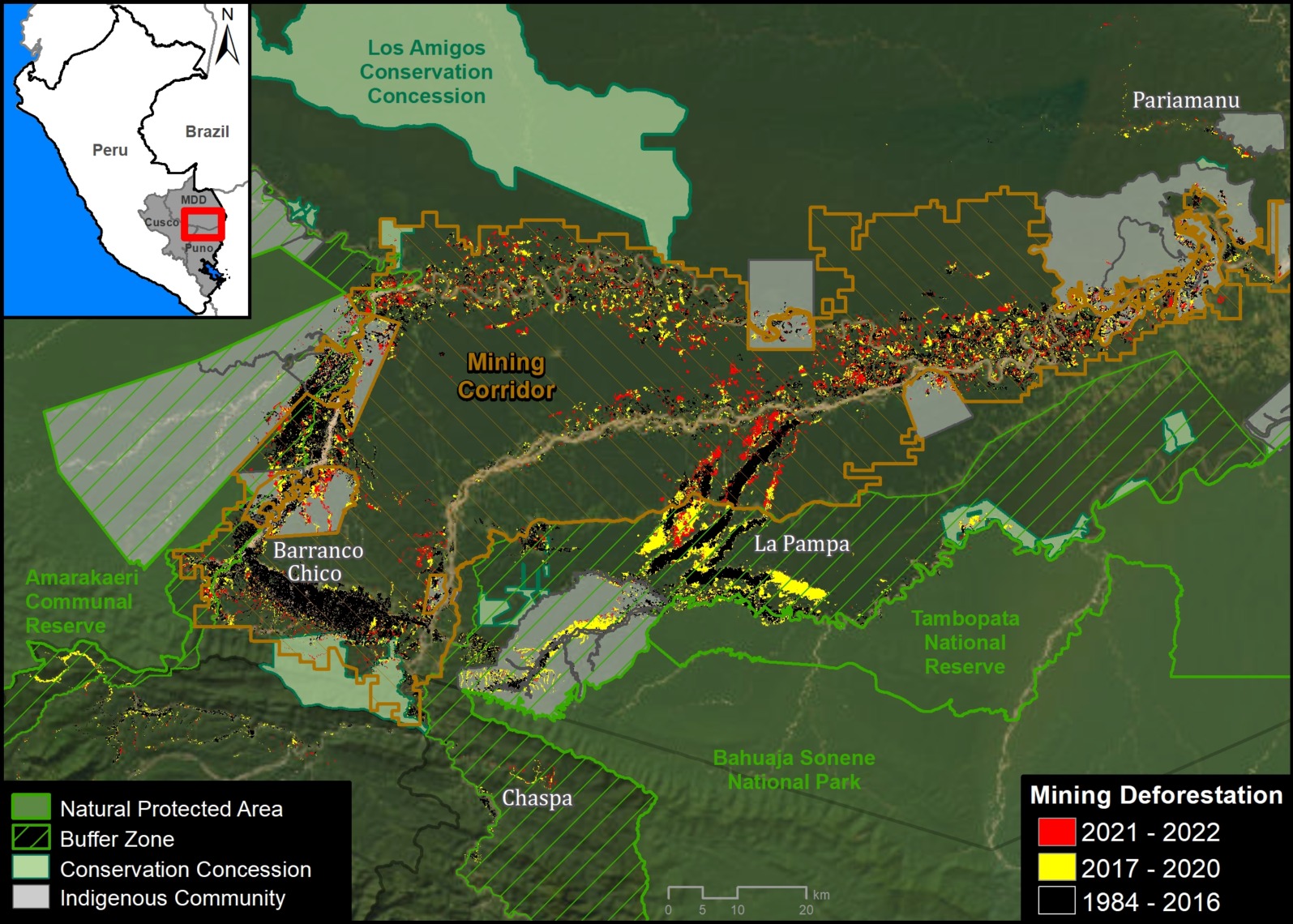
Base Map. Gold Mining Deforestation in the Southern Peruvian Amazon, 2021-2022 update. Zooms indicated by insets A-F. Click on image to enlarge. Data: ACA/MAAP, CINCIA.

Gold mining continues to be one of the main causes of deforestation in the southern Peruvian Amazon, especially in the Madre de Dios region.

Here, we provide a comprehensive look at the most recent (2021-2022) gold mining-related deforestation in the area, combining two important types of data for the first time:

  1. Deforestation within the Mining Corridor, a large area delimited by the Peruvian government to organize and promote mining. Mining activity in this corridor, officially known as the “Small-scale and Artisanal Mining Zone in the department of Madre de Dios,” can be formal, informal, or illegal.1
    j
  2. Deforestation outside the Mining Corridor, which represents our estimate of illegal mining. According to current regulations (Legislative Decree No. 1336), illegal mining occurs in one or more territorial categories such as protected natural areas, indigenous reserves, and natural bodies of water (such as lakes or rivers). Therefore, for this report, the presence of mining-related deforestation in protected natural areas and their buffer zones, as well as indigenous communities, is considered an indicator of illegality. However, it is important to recognize the possibility that some of these findings may be covered by current regulations regarding mining formalization.2 Therefore, it is recommended to consider the findings of illegal deforestation as referential.

These two study areas cover a total of 1.38 million hectares and include all detected mining areas in the southern Peruvian Amazon.

We highlight several important findings (see Base Map and Table 1):

  • Table 1. Data: ACA/MAAP.

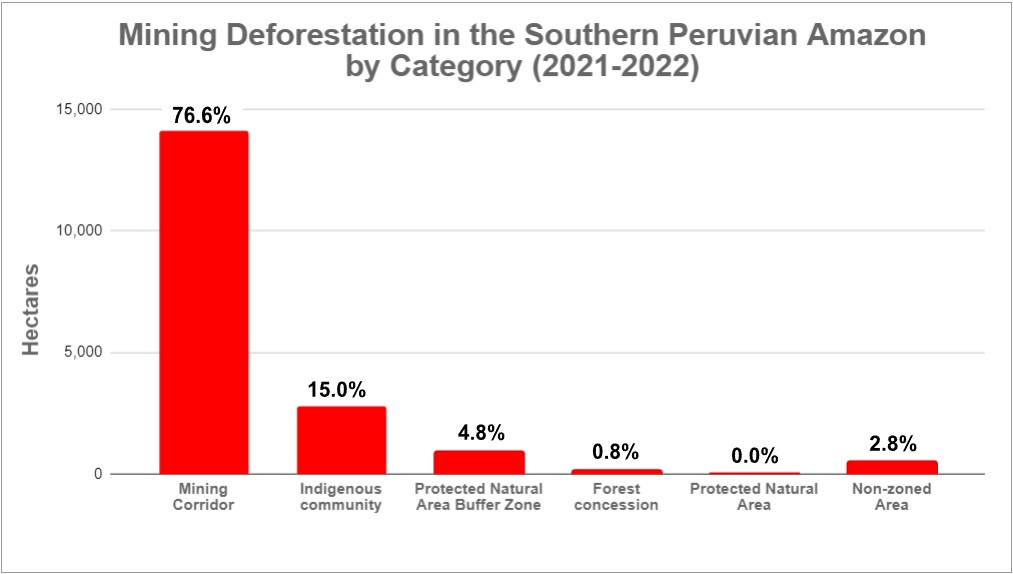
    We estimate a total deforestation of 18,421 hectares (45,520 acres) due to gold mining in the southern Peruvian Amazon in the last two years (2021-2022).
    l

  • Of this total, the majority of mining-related deforestation (76.6%, or 14,117 hectares) occurred within the Mining Corridor.
    l
  • The remaining deforestation (23.4%, or 4,304 hectares) took place outside the Mining Corridor. Breaking down this percentage, 15% is found in indigenous communities, 4.8% in buffer zones of protected natural areas, 0.8% in forest concessions, and 2.8% in non-zoned areas.
    j
  • Furthermore, we found that mining within protected natural areas, such as the Tambopata National Reserve and the Amarakaeri Communal Reserve, has been effectively controlled by the Peruvian government through the National Service of Protected Natural Areas (SERNANP).
    j
  • It is important to highlight that mining has stopped in the core of La Pampa (the most critical zone during the years 2014-2018) following Operation Mercury in early 2019 and the subsequent Restoration Plan in 2021.
    j
  • Compared to the years prior to Operation Mercury (2017-2018), there has been an approximate decrease of 4.5% (866 hectares) in mining-related deforestation. Most notably, there has been a major reduction in mining outside the corridor (from 47.7% to 23.4%), and a greater concentration within the corridor (from 52.3 to 76.6%).That is, an apparent major reduction in illegal mining.

Mining Corridor

Our main finding is that the vast majority (76.6%) of gold mining-related deforestation in the southern Peruvian Amazon occurred within the Mining Corridor.

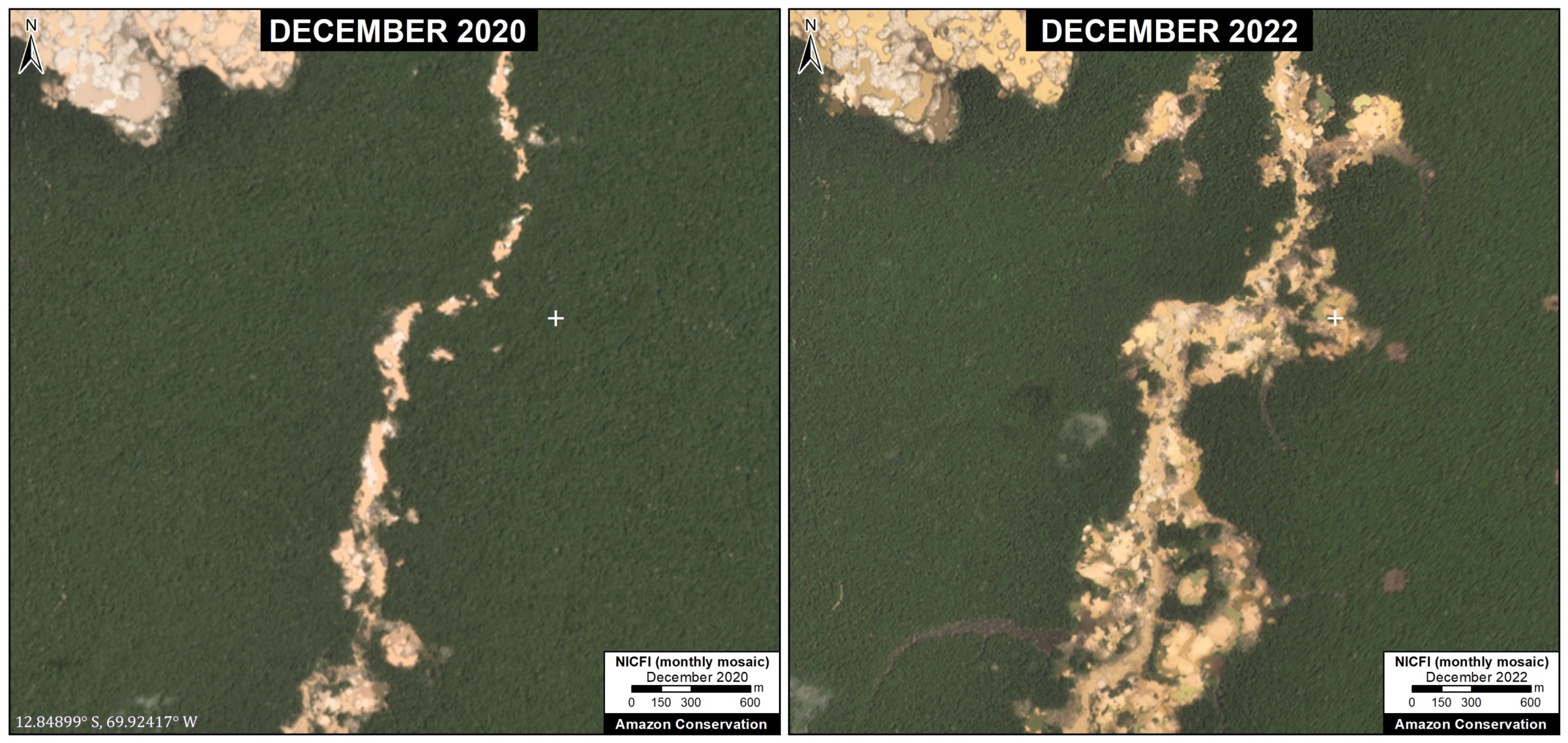
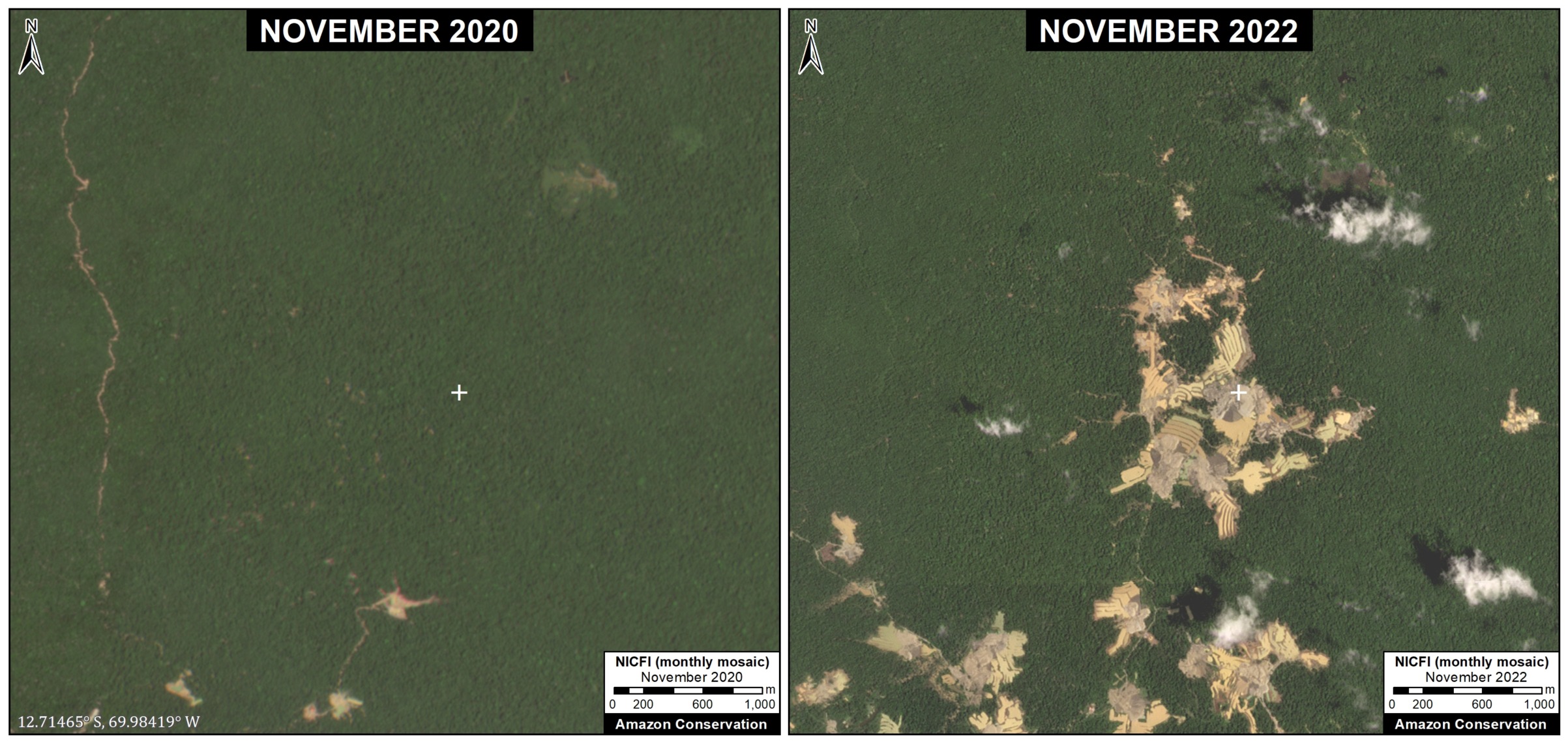
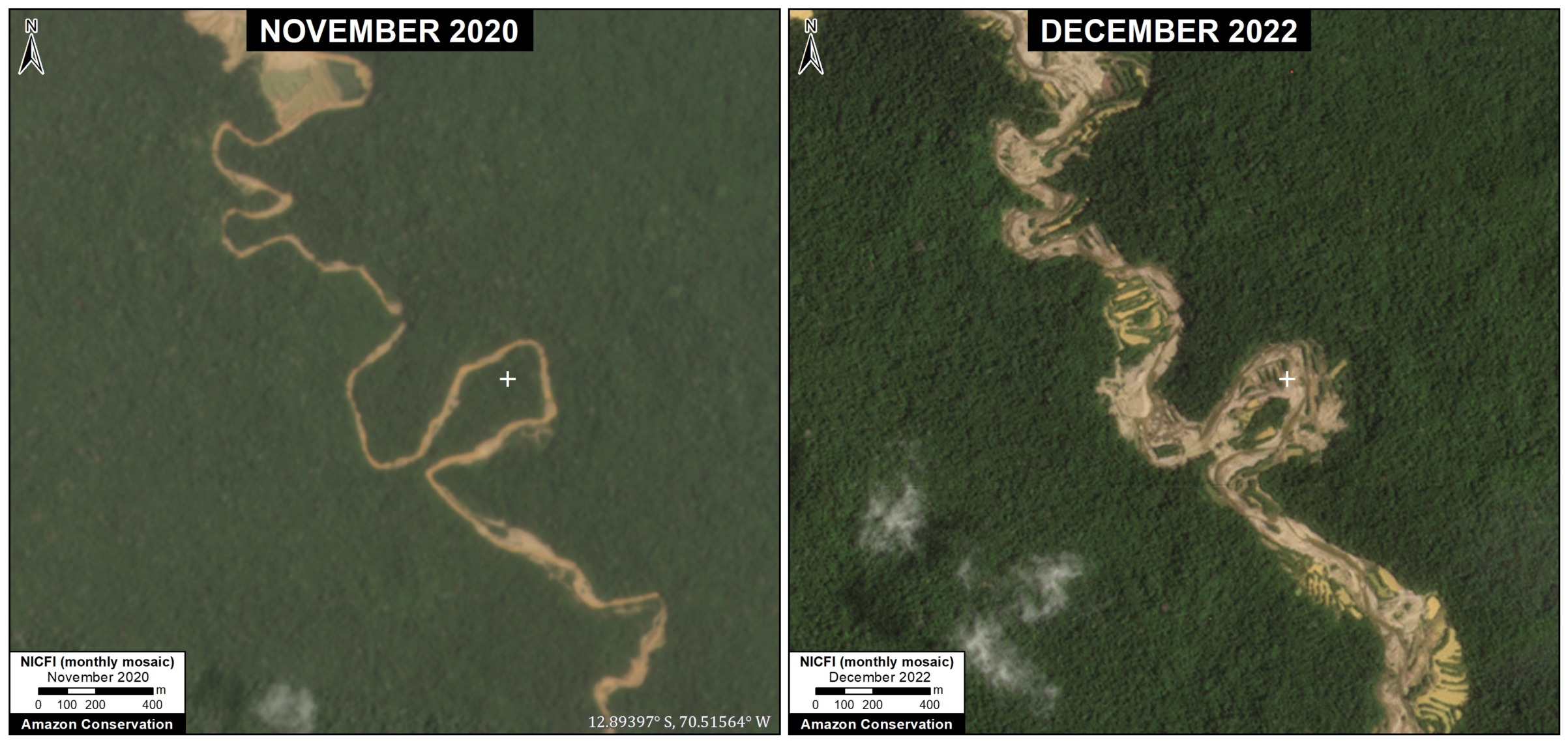
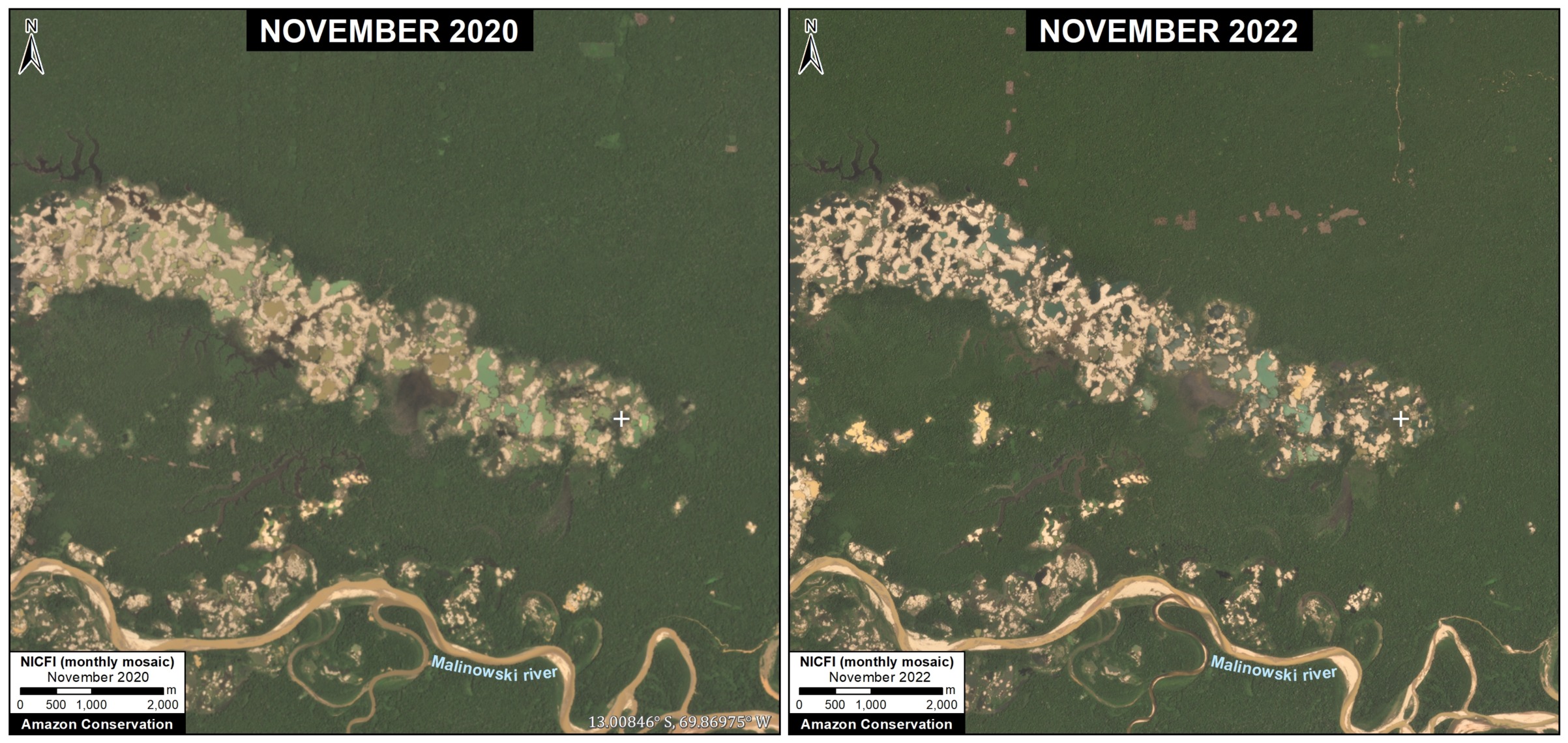
We estimate that the deforestation due to mining is 14,117 hectares within the Mining Corridor in the last two years (2021-2022). Below, we present a series of zooms of some emblematic examples of recent mining-related deforestation in the corridor (Images A-C).

Image A: Mining Corridor

Image B: Mining Corridor

Image C: Mining Corridor

Outside of the Mining Corridor

The remaining deforestation due to mining (23.4%) is located outside the Mining Corridor. Breaking this down, 15% (2,769 hectares) occurred within indigenous territories, 4.8% (876 hectares) in buffer zones of protected areas, 0.8% (141 hectares) in forest concessions (for Brazil nuts), and 2.8% (517 hectares) in non-zoned areas during the last two years.

Regarding indigenous communities, the most affected were Barranco Chico (816 hectares) and San José de Karene (602 hectares), followed by Tres Islas (482 hectares), San Jacinto (177 hectares), Kotsimba (174 hectares), Puerto Luz (171 hectares), Boca Inambari (140 hectares), Shiringayoc (126 hectares), Arazaire (57 hectares), and El Pilar (23 hectares).

Regarding the buffer zones of protected areas, the most affected were the buffer zones of the Tambopata National Reserve, the Bahuaja Sonene National Park, and the Amarakaeri Communal Reserve. On the other hand, it has been found that mining within the actual protected areas, such as the Tambopata National Reserve and the Amarakaeri Communal Reserve, has been effectively controlled by the Peruvian government through the National Service of Natural Protected Areas (SERNANP).

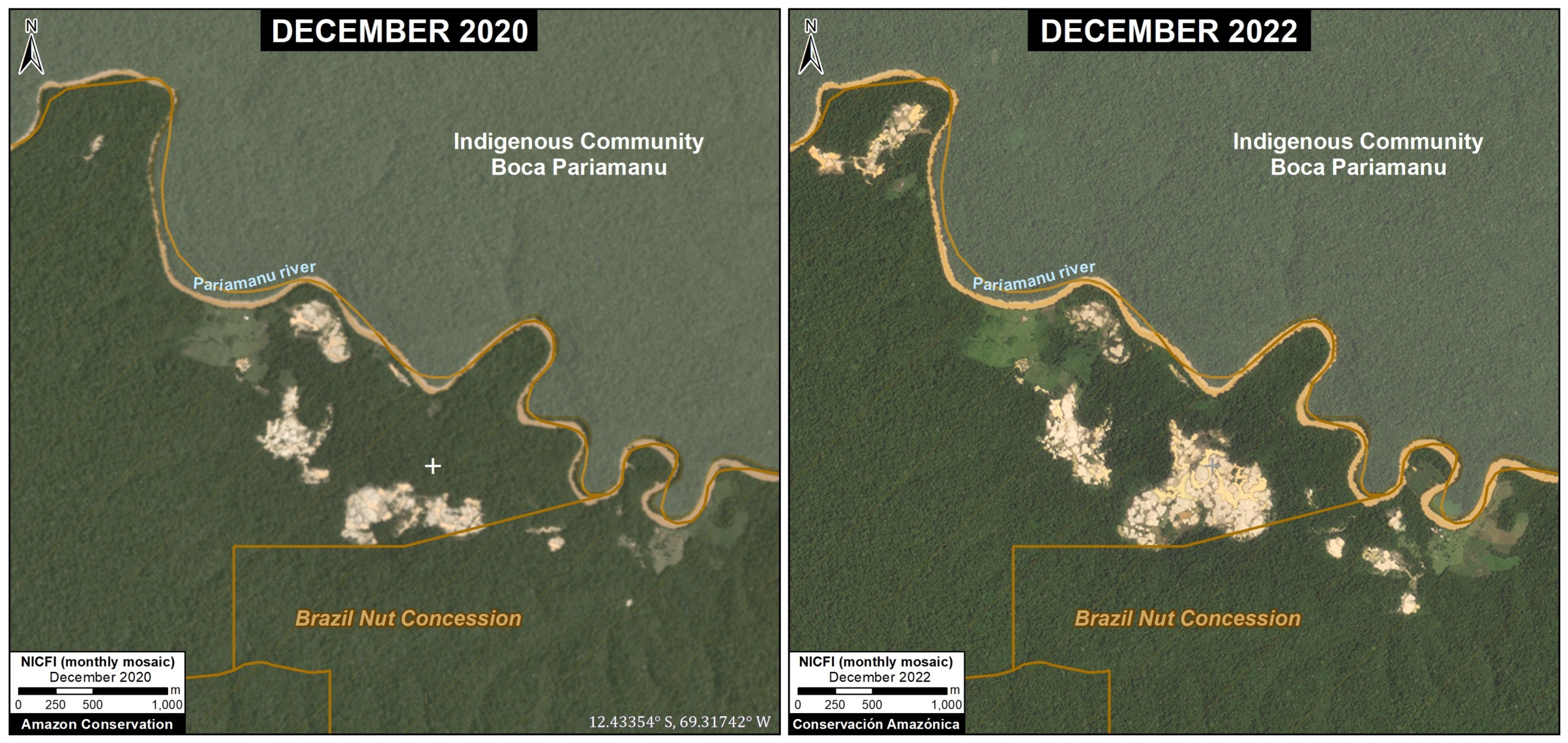
Regarding forest concessions, deforestation due to mining was identified in 141 hectares within Brazil nut concessions in the Pariamanu and Pariamarca river basins.

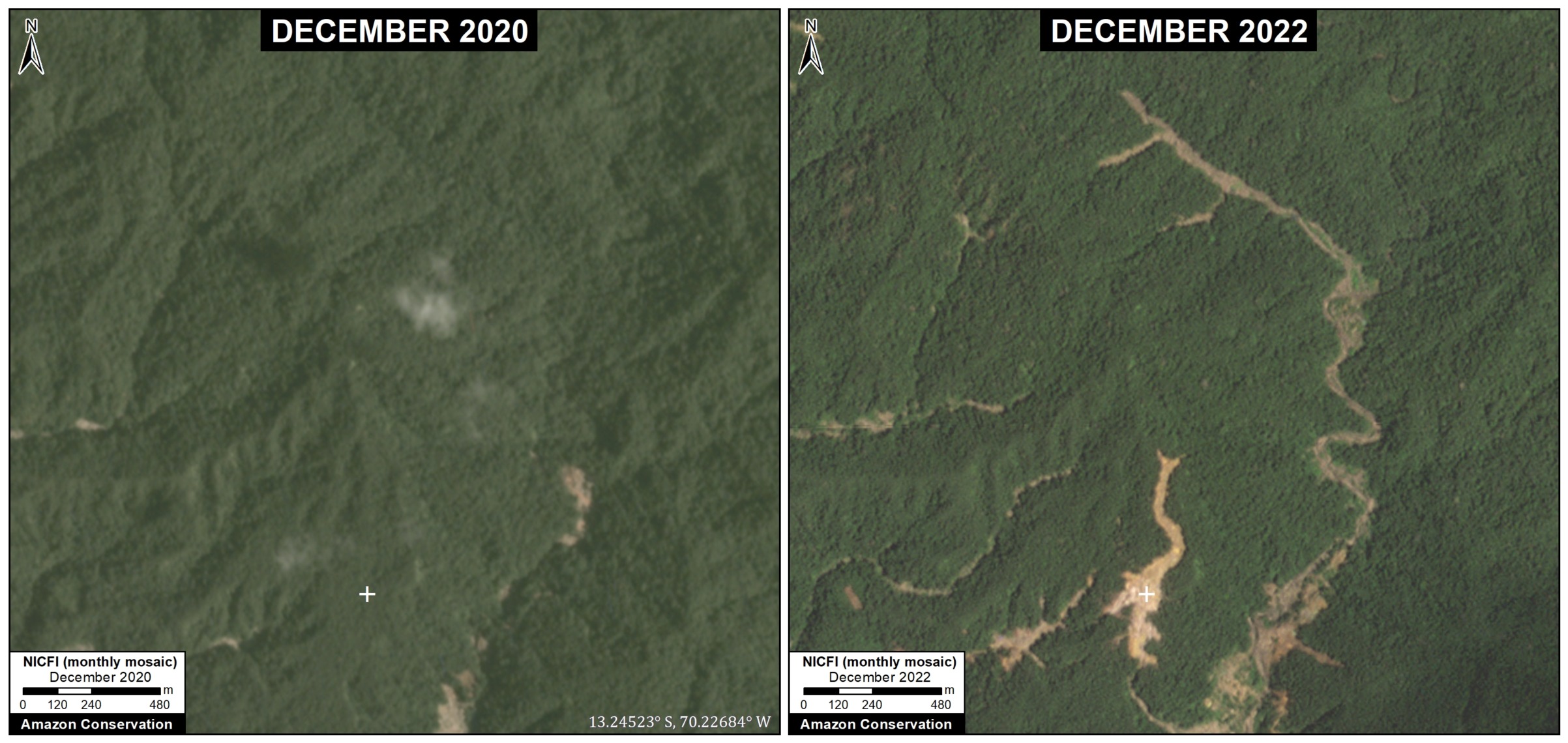
Next, we continue with a series of zooms showing some emblematic examples of recent deforestation due to mining in the following prohibited areas: indigenous communities (Barranco Chico, Image D), buffer zone of the Bahuaja Sonene National Park (Chaspa, Image E), and Brazil nut concessions (Pariamanu, Image F).

We also present an important area in the buffer zone of the Tambopata National Reserve known as La Pampa (Image G). La Pampa was the epicenter of destructive deforestation due to gold mining between 2014 and 2018. We show that after Operation Mercury, which began in early 2019, the expansion of gold mining in La Pampa was essentially halted.

Image D: Barranco Chico (Indigenous Community)

Image E: Chaspa (Buffer Zone of Bahuaja Sonene National Park)

Image F: Pariamanu (Brazil Nut Concession)

Image G: La Pampa (Buffer Zone of Tambopata National Reserve)

Annex

We show a version of the Basemap without the zoom insets.

Base Map (without insets). Deforestation by Gold Mining in the Southern Peruvian Amazon, with Update 2021-22. Click image to enlarge. Data: ACA/MAAP, CINCIA.

Notes

1The Mining Corridor, designated by Legislative Decree No. 1100 as the “Zone for small-scale and artisanal mining in the department of Madre de Dios,” categorizes mining activities as follows:

  • Formal: Completed formalization process with approved environmental and operational permits.
  • Informal: In the process of formalization; Operates only in authorized extraction areas, uses permitted machinery, and is considered an administrative offense, not a crime.
  • Illegal: Operates in prohibited areas such as bodies of water (e.g., rivers or lakes), uses prohibited machinery, is considered a criminal offense, and is punishable by imprisonment.

2 Due to the possibility that these activities could be existing operations prior to the declaration of Natural Protected Areas and their buffer zones.

3 The data for 2017-2018 were obtained from the Amazonian Scientific Innovation Center – CINCIA.

Methodology

Mining Corridor

We used LandTrendR, a temporal segmentation algorithm that identifies changes in pixel values over time, to detect forest loss within the Mining Corridor in 2021 and 2022 using the Google Earth Engine platform. It is important to note that this method was originally designed for Landsat images with moderate resolution (30 meters)1, but we adapted it for higher spatial resolution NICFI-Planet monthly mosaics (4.7 meters).2

Additionally, we created a baseline for the period 2016-2020 to eliminate old deforested areas (prior to 2021) due to rapid changes in the natural regrowth process.

Finally, we manually separated forest loss due to mining and other causes in 2021 and 2022 to specifically report on direct impacts related to mining. For this part of the analysis, we used various resources to aid the manual process, such as radar image alerts (RAMI) from the SERVIR Amazonia program, historical data from CINCIA from 1985 to 2020, forest loss data from the Peruvian government (National Forest Conservation Program for Climate Change Mitigation), and the University of Maryland.

  1. Kennedy, R.E., Yang, Z., Gorelick, N., Braaten, J., Cavalcante, L., Cohen, W.B., Healey, S. (2018). Implementation of the LandTrendr Algorithm on Google Earth Engine. Remote Sensing. 10, 691.
  2.  Erik Lindquist, FAO, 2021

Outside the Mining Corridor

These places were identified as the main active fronts of deforestation due to gold mining, based on historical data from the Amazon Scientific Innovation Center – CINCIA and automatic alerts of forest loss generated by both the University of Maryland (GLAD alerts) and the Peruvian government platform (PNCBMCC-Geobosques).

The analysis combines the LandTrendr method (described earlier) with a photo interpretation based on high-resolution satellite images from Planet (3 meters). In each of the sites, we have detected, identified, and analyzed deforestation due to gold mining between 2021 and 2022. For areas with overlap between native communities and buffer zones, priority was given to the areas of the native communities.

Acknowledgements

We thank S. Novoa, C. Zavala, O. Liao, K. Nielsen, S. Otoya, and C. Ipenza for their valuable contributions and comments to this report, and R. McMullen for translation. We also thank C. Ascorra and M. Pillaca from the Amazon Scientific Innovation Center – CINCIA for providing us with historical mining data from 1985 to 2021.

This report was prepared with the technical support of USAID through the Prevent Project. Prevent (Proyecto Prevenir in Spanish) works with the Government of Peru, civil society, and the private sector to prevent and combat environmental crimes for the conservation of the Peruvian Amazon, particularly in the regions of Loreto, Madre de Dios, and Ucayali.

Disclaimer: This publication is made possible by the generous support of the American people through USAID. The contents are the sole responsibility of the authors and do not necessarily reflect the views of USAID or the United States Government.


Citation

Finer M, Mamani N (2023) Gold Mining Deforestation in the Southern Peruvian Amazon: 2021-2022 Update. MAAP: 185.

MAAP #183: Protected Areas & Indigenous Territories Effective Against Deforestation Across Amazon

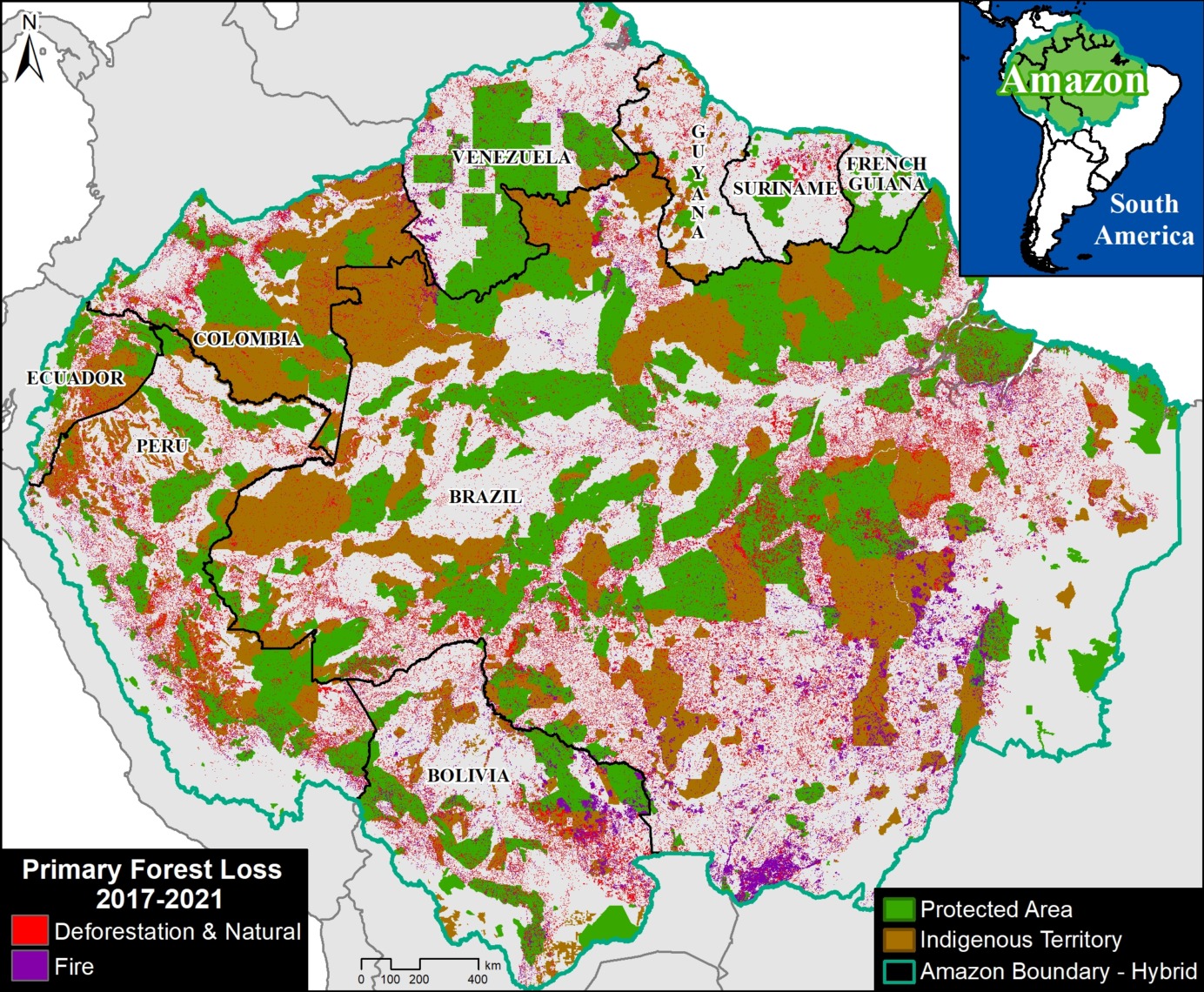
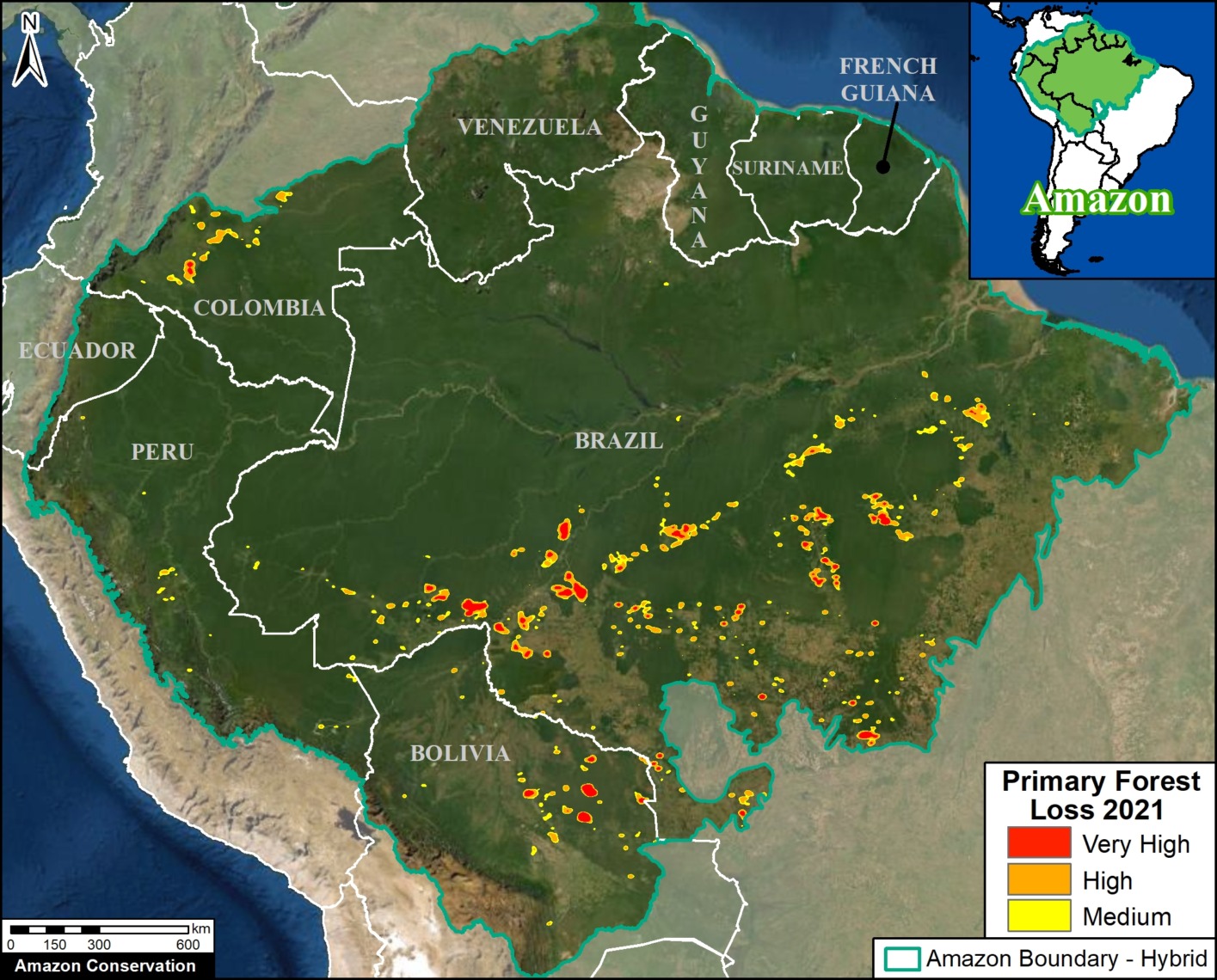
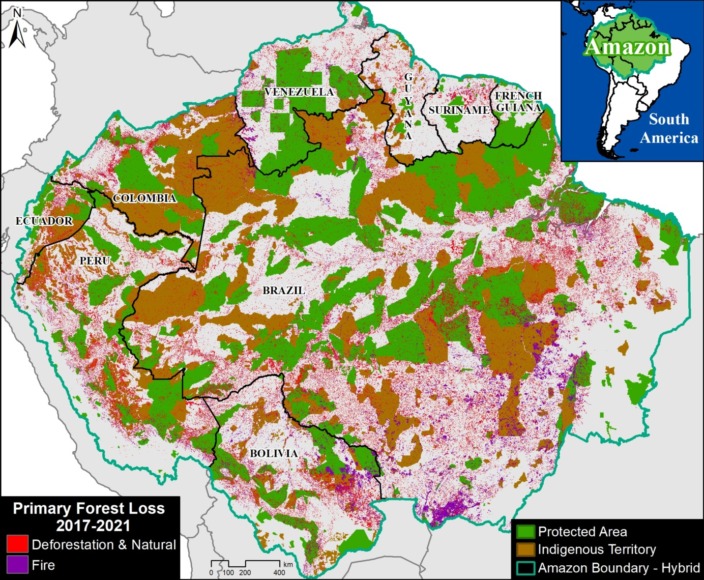
Base Map. Primary forest loss (2017-21) across the Amazon, in relation to protected areas and indigenous territories.

As deforestation continues to threaten primary forest across the Amazon, key land use designations are one of the best hopes for the long-term conservation of critical remaining intact forests.

Here, we evaluate the impact of two of the most important: protected areas & indigenous territories.

Our study looked across all nine countries of the Amazon biome, a vast area of 883.7 million hectares (see Base Map).

We calculated primary forest loss over the past 5 years (2017-2021).

For the first time, we were able to distinguish fire vs non-fire forest loss. For non-fire, while this does include natural events (such as landslides and wind storms), we consider this our best proxy for human-caused deforestation.

We analyzed the results across three major land use categories:

1) Protected Areas (national and state/department levels), which cover 197 million hectares (23.6% of Amazon).

2) Indigenous Territories (official), which cover 163.8 million hectares (19.6% of Amazon).

3) Other (all remaining areas outside protected areas and indigenous territories), which cover 473 million hectares (56.7% of Amazon).

In summary, we found that deforestation was the primary driver of forest loss, with fire always being a smaller subset. Averaged across all 5 years, protected areas and indigenous territories had similar levels of effectiveness, reducing primary forest loss rate by 3x compared to areas outside of these designations.

Below, we show the key results across the Amazon in greater detail, including a breakdown for the western Amazon (Bolivia, Colombia, Ecuador, and Peru) and the Brazilian Amazon.

Key Findings

Amazon Biome

We documented the loss of 11 million hectares of primary forests across all nine countries of the Amazon biome between 2017 and 2021. Of this total, 71% was non-fire (deforestation and natural) and 29% was fire.

For the major land use categories, 11% of the forest loss occurred in both protected areas and indigenous territories, respectively, while the remaining 78% occurred outside these designations.

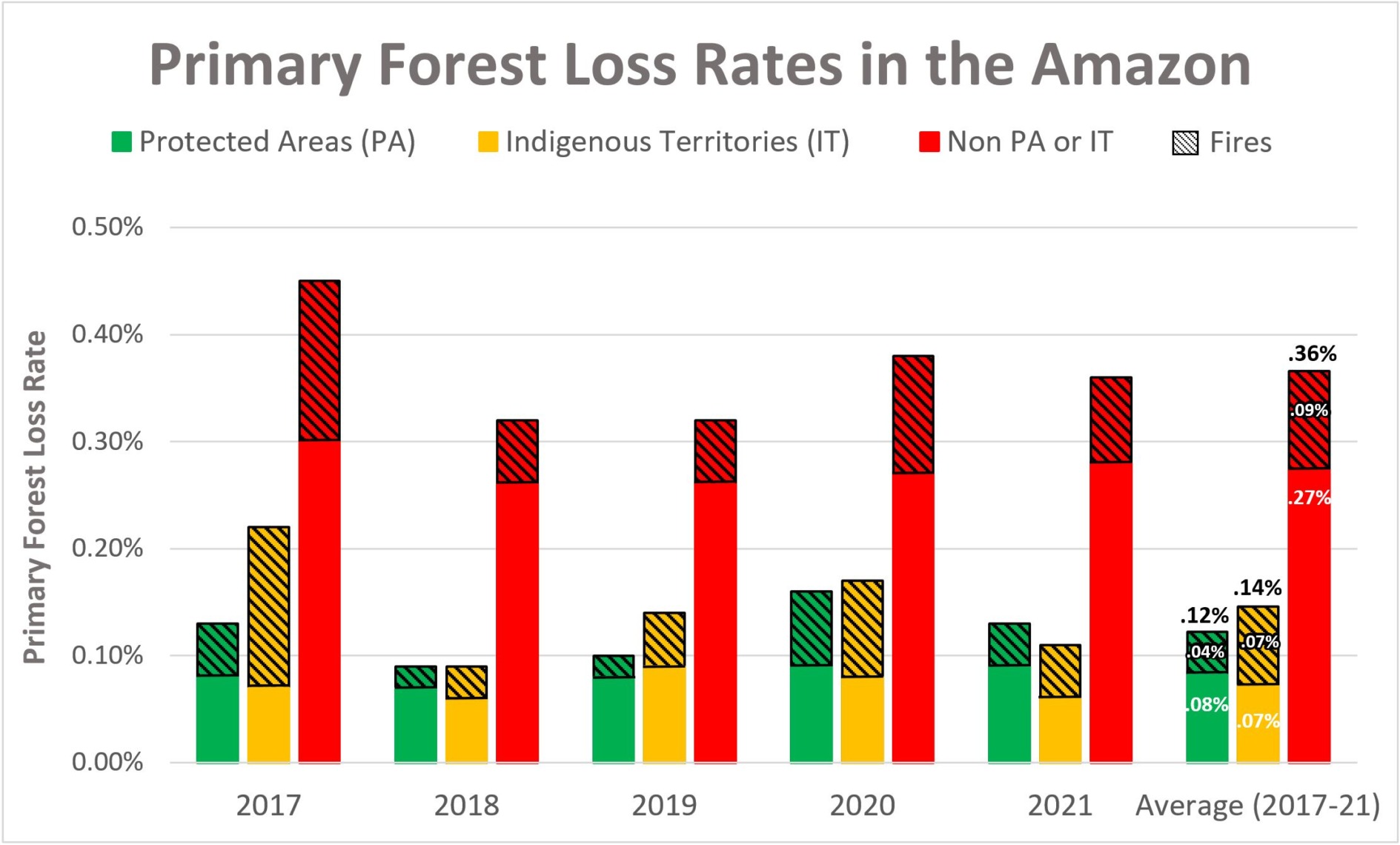
To standardize these results for the varying area coverages, we calculated annual primary forest loss rates (loss/total area of each category). Figure 1 displays the results for these rates across all nine countries of the Amazon biome.
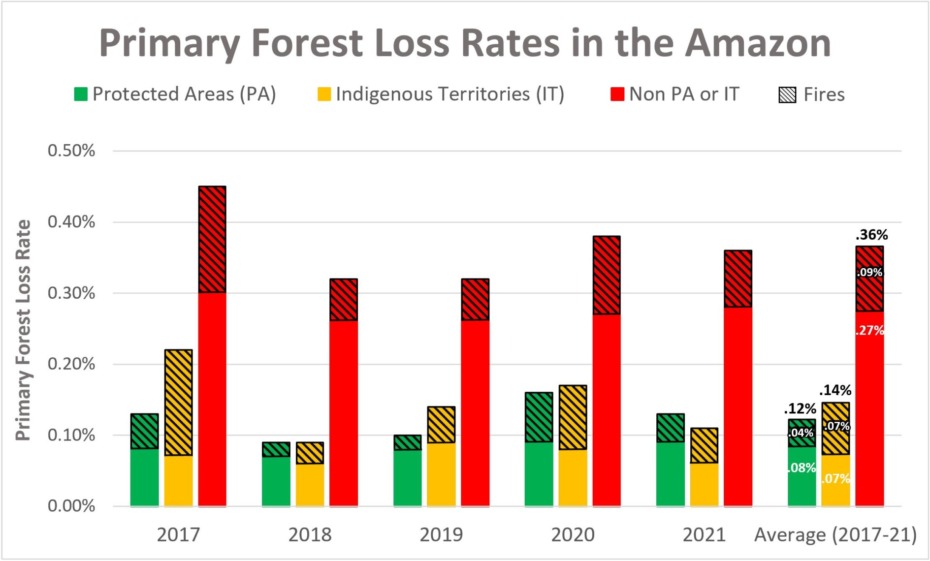
Figure 1. Primary forest loss rates across the Amazon, 2017-21.

Broken down by year, 2017 had the highest forest loss rates, with both a severe deforestation and fire season. In addition, 2021 had the second highest deforestation rate, while 2020 had the second highest fire loss rate.

Averaged across all five years, protected areas (green) had the lowest overall primary forest loss rate (0.12%), closely followed by indigenous territories (0.14%).

Interestingly, indigenous territories (orange) actually had a slightly lower deforestation rate compared to protected areas (0.7 vs 0.8%), but higher fire loss rate (o.7 vs .04%), resulting in the overall higher forest loss rate noted above.

Outside of these designations (red), the primary forest loss rate was triple (.36%), especially due to much higher deforestation.

Western Amazon

Breaking the results down specifically for the western Amazon (Bolivia, Colombia, Ecuador, and Peru), we documented the loss of 2.6 million hectares of primary forests between 2017 and 2021. Of this total, 80% was non-fire (deforestation and natural) and 20% was fire.

For the major land use categories, 9.6% occurred in protected areas, 15.6% in indigenous territories, and the remaining 74.8% occurred outside these designations.

Figure 2 displays the standardized primary forest loss rates across the western Amazon.
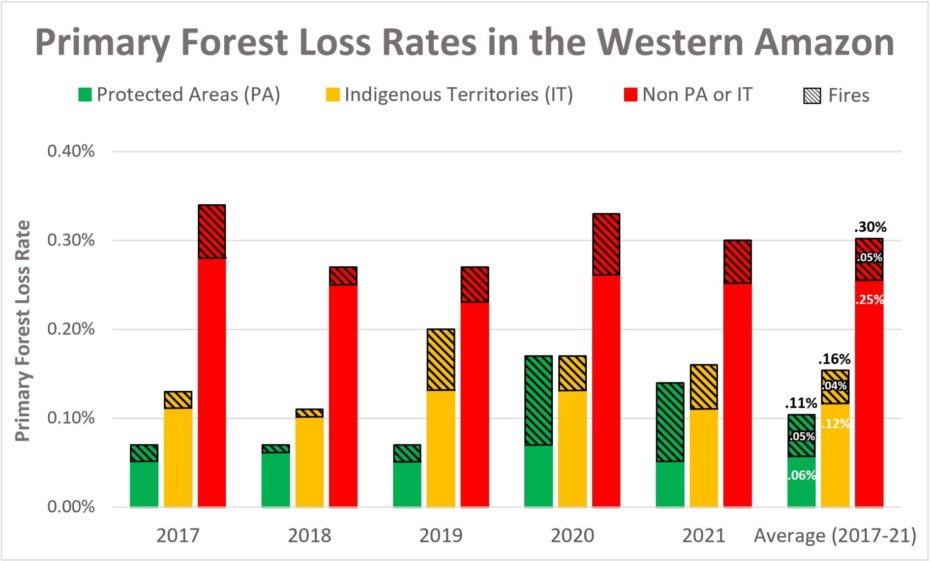
Figure 2. Primary forest loss rates across the Western Amazon, 2017-21.

Broken down by year, 2017 had the highest deforestation rate and overall forest loss rates. But 2020 had the highest fire loss rate, mainly due to extensive fires in Bolivia. 2021 also had a relatively high deforestation rate. Also, note the high level of fires in protected areas in 2020 and 2021, and indigenous territories in 2019.

Averaged across all five years, protected areas had the lowest overall primary forest loss rate (0.11%), followed by indigenous territories (0.16%).

Outside of these designations, the primary forest loss rate was .30%. That is, triple the protected areas rate and double the indigenous territories rate.

Brazilian Amazon

Breaking the results down specifically for the Brazilian Amazon, we documented the loss of 8.1 million hectares of primary forests between 2017 and 2021. Of this total, 68% was non-fire (deforestation and natural) and 32% was fire.

For the major land use categories, 9.4% occurred in indigenous territories, 11.2% occurred in protected areas, and the remaining 79.4% occurred outside these designations.

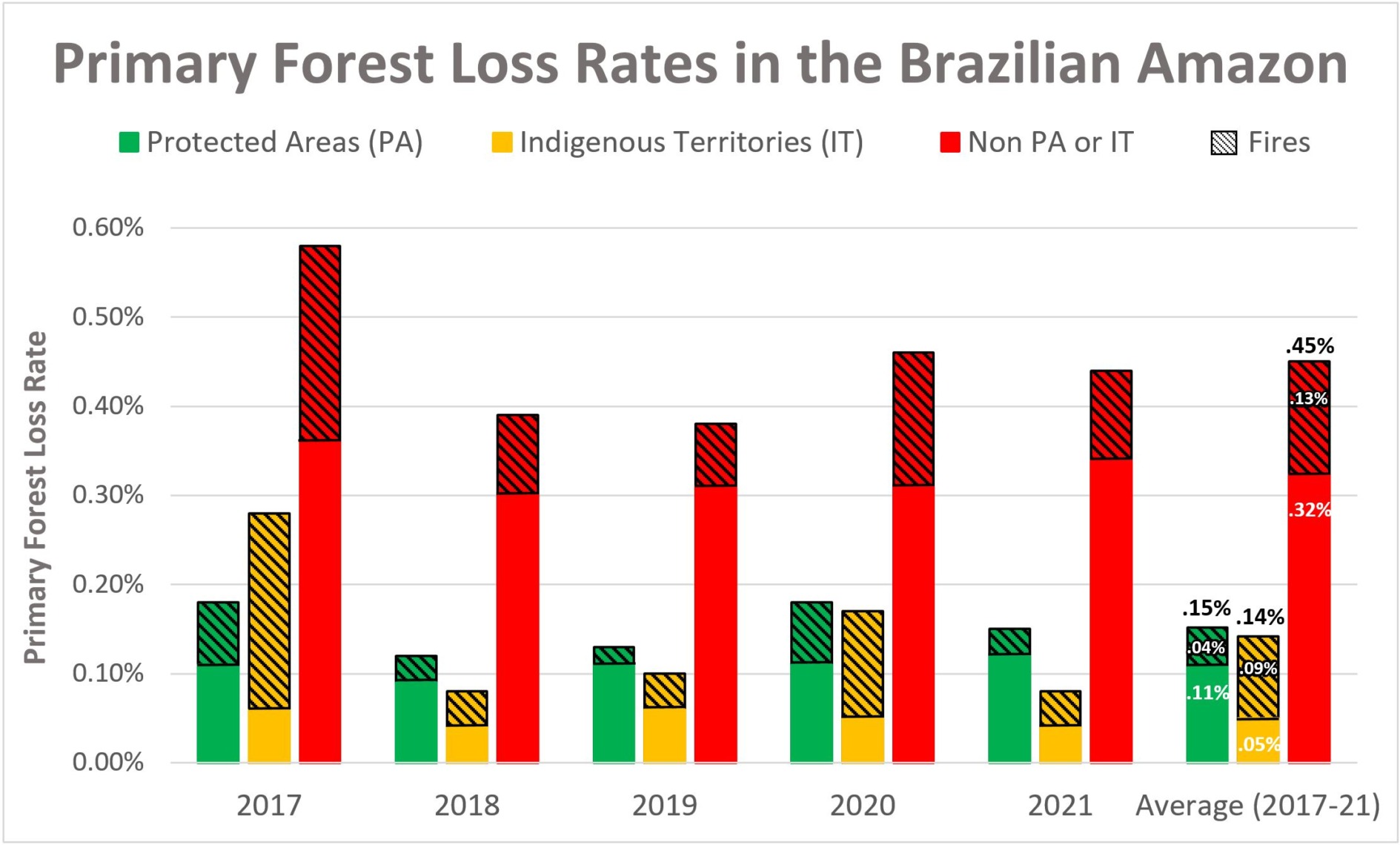
Figure 3 displays the standardized primary forest loss rates across the Brazilian Amazon.
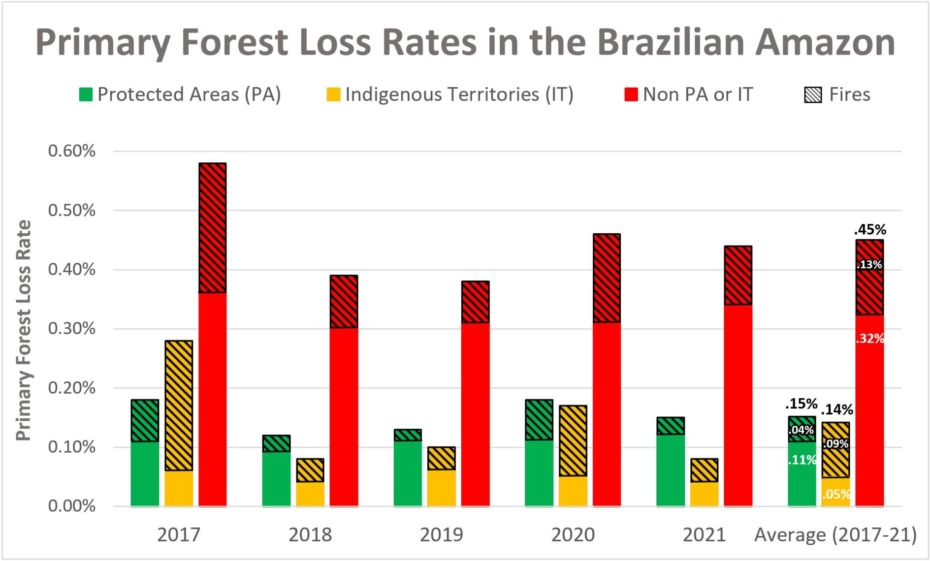
Figure 3. Primary forest loss rates in the Brazilian Amazon, 2017-21.

Broken down by year, 2017 had the highest forest loss rate recorded in the entire study (.58%), due to both elevated deforestation and fire. Note that indigenous territories were particularly impacted by fire in 2017.

2020 had the next highest forest loss rate, also driven by an intense fire season. Fires were not as severe the following year in 2021, but deforestation increased.

Averaged across all five years, indigenous territories had the lowest overall primary forest loss rate (0.14%), closely followed by protected areas (0.15%).

Interestingly, indigenous territories had a lower deforestation rate compared to protected areas (0.5 vs 0.11%), but higher fire impact (0.09 vs 0.04%).

Outside of these designations (red), the primary forest loss rate was triple (.45%).

Methodology

To estimate deforestation across all three categories (protected areas, indigenous territories, and other), we used annual forest loss data (2017-21) from the University of Maryland (Global Land Analysis and Discovery GLAD laboratory) to have a consistent source across all countries (Hansen et al 2013).

We obtained this data, which has a 30-meter spatial resolution, from the “Global Forest Loss due to Fires 2000–2021” data download page. It is also possible to visualize and interact with the data on the main Global Forest Change portal.

The annual data is disaggregated into forest loss due to fire vs. non-fire (other disturbance drivers). It is important to note that the non-fire drivers include both human-caused deforestation and forest loss caused by natural forces (landslides, wind storms, etc.).

We also filtered this data for only primary forest loss, following the established methodology of Global Forest Watch. Primary forest is generally defined as intact forest that has not been previously cleared (as opposed to previously cleared secondary forest, for example). We applied this filter by intersecting the forest cover loss data with the additional dataset “primary humid tropical forests” as of 2001 (Turubanova et al 2018). Thus, we often use the term “primary forest loss” to describe this filtered data.

Data presented as primary forest loss rate is standardized per the total area covered of each respective category per year (annual). For example, to properly compare raw forest loss data in areas that are 100 hectares vs 1,000 hectares total size respectively, we divide by the area to standardize the result.

Our geographic range extends from the Andes to the Amazon plain and reaching the transitions with the Cerrado and the Pantanal. This range includes nine countries of the Amazon (or Pan-Amazon region as defined by RAISG) and consists of a combination of the Amazon watershed limit, the Amazon biogeographic limit and the Legal Amazon limit in Brazil. See Base Map above for delineation of this hybrid Amazon limit, designed for maximum inclusion.

Additional data sources include:

  • National and state/department level protected areas: RUNAP 2020 (Colombia), SNAP 2022 (Ecuador), SERNAP & ACEAA 2020 (Bolivia), SERNANP 2022 (Peru), INPE/Terrabrasilis 2022 (Brazil), SOS Orinoco 2021 (Venezuela), and RAISG 2020 (Guyana, Suriname, and French Guiana.)
  • Indigenous Territories: RAISG & Ecociencia 2022 (Ecuador), INPE/Terrabrasilis 2022 (Brazil), RAISG 2020 (Colombia, Bolivia, Venezuela, Guyana, Suriname, and French Guiana), and MINCU & ACCA 2021 (Peru). For Peru, this includes titled native communities and Indigenous/Territorial Reserves for indigenous groups in voluntary isolation.

For analysis, we categorized Protected Areas first, then Indigenous Territories to avoid overlapping areas. Each category was disaggregated by year created/recognized to match the annual report of forest loss, for example. If a Protected area was created in December 2018, it would be considered within the analysis for the year 2019.

Acknowledgements

This work was supported by the Andes Amazon Fund (AAF), Norwegian Agency for Development Cooperation (NORAD), and International Conservation Fund of Canada (ICFC).

We thank M. MacDowell and M. Cohen for helpful comments on this report.

Citation

Finer M, Mamani N (2023) Protected Areas & Indigenous Territories Effective Against Deforestation Across Amazon. MAAP: 176.
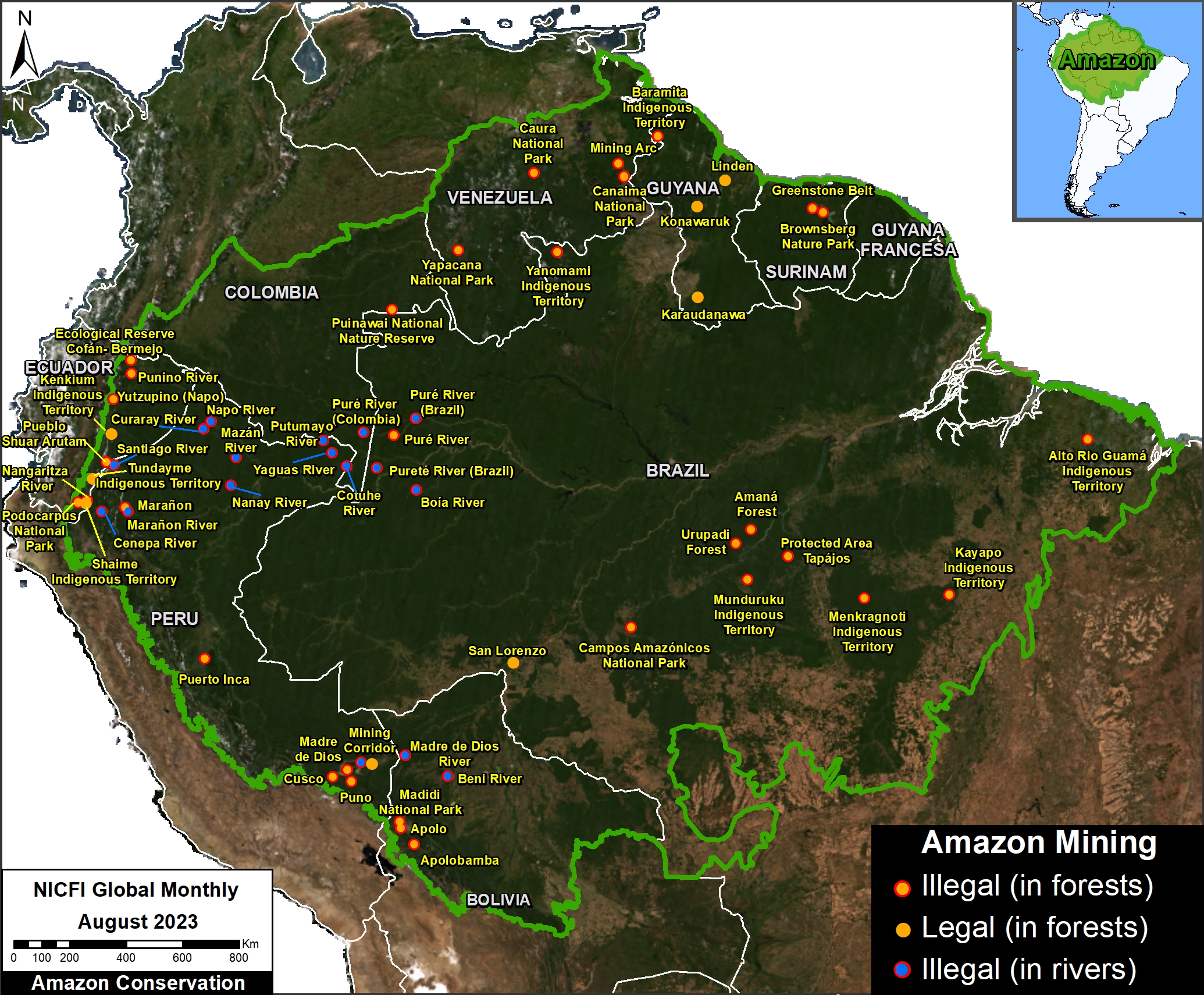
MAAP #178: Gold Mining Deforestation Across the Amazon

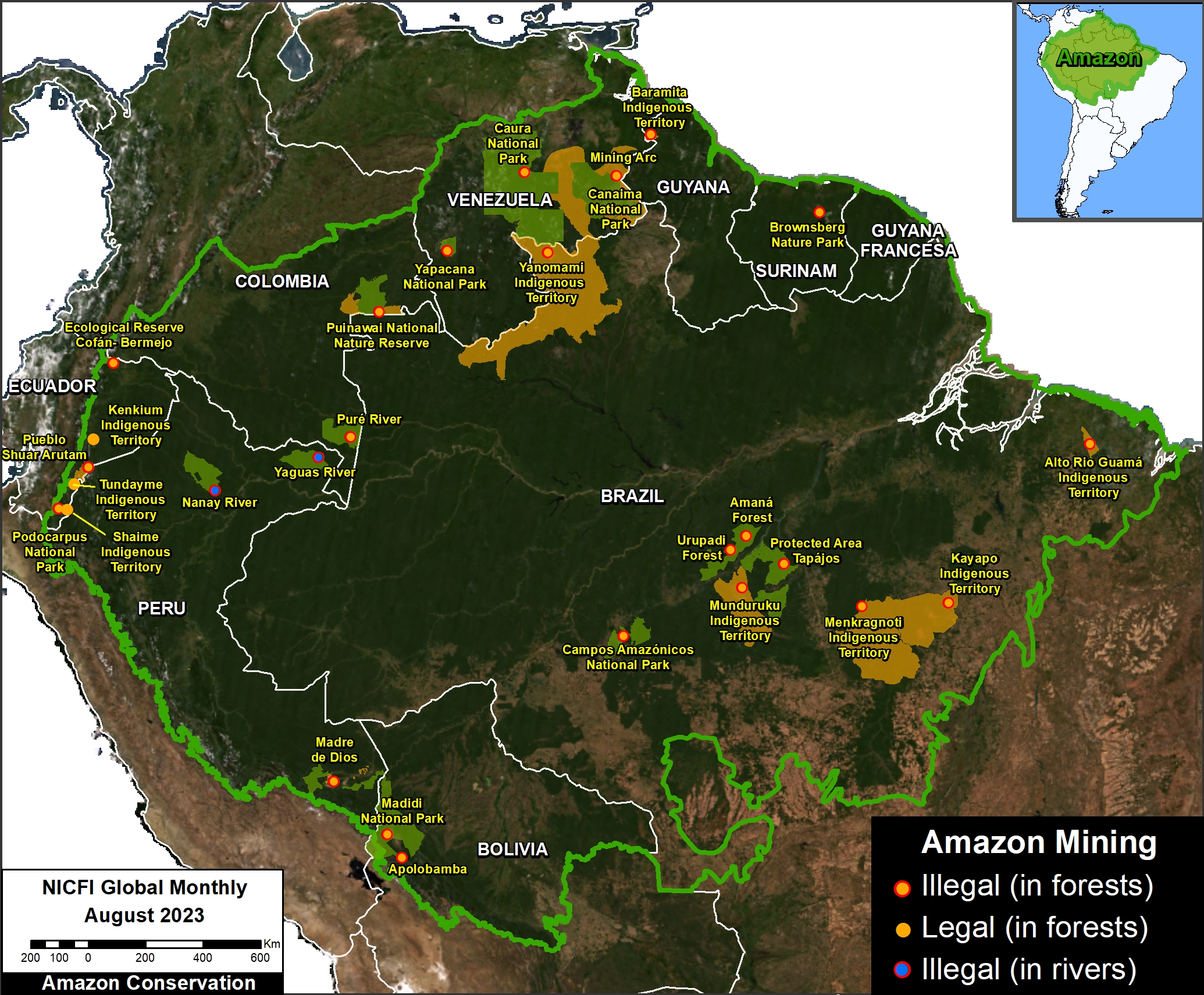
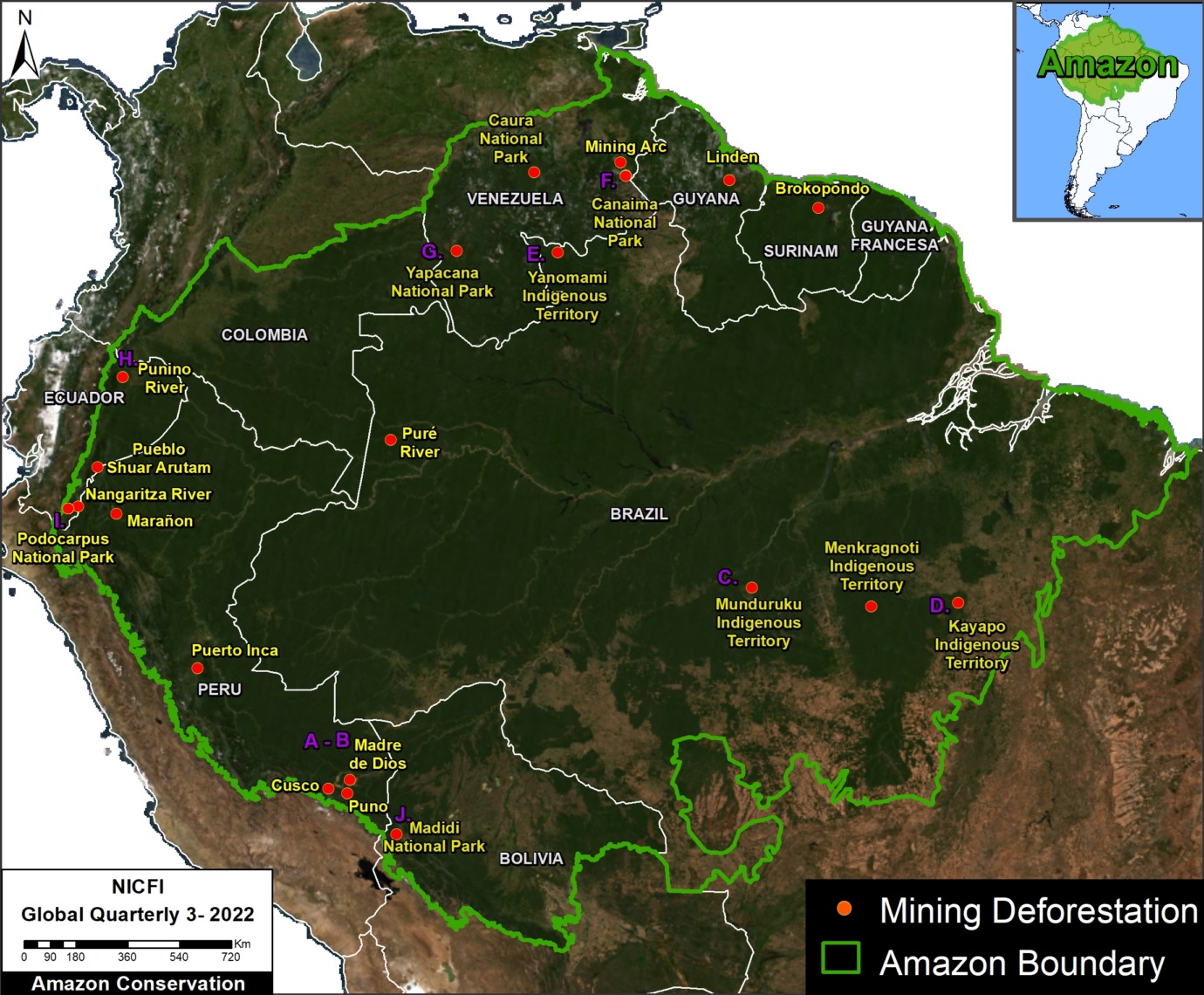
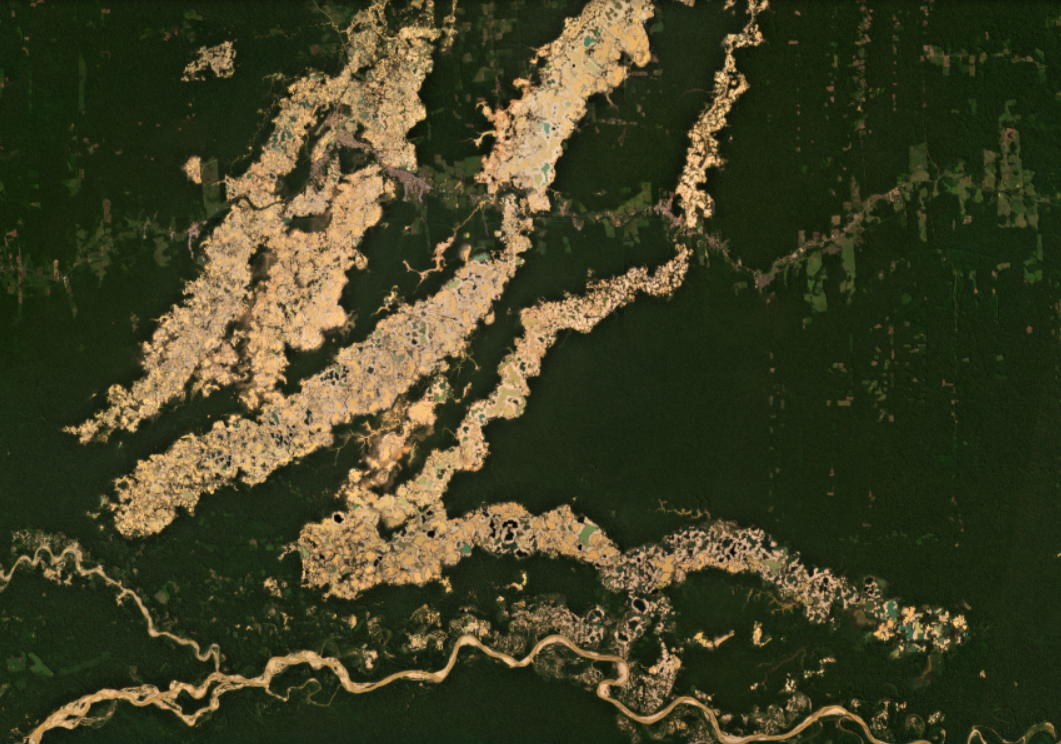
Base Map. Mining deforestation hotspots across the Amazon. Letters A-J indicate locations of case studies below. Click image to enlarge.

Gold Mining is one of the major deforestation drivers across the Amazon.

Although not typically at the scale of agricultural deforestation, gold mining has the potential to severely impact critical areas such as protected areas & indigenous territories.

Relatedly, gold mining often targets remote areas, thus impacting largely intact and carbon-rich primary forests.

Here, for the first time, we present a large-scale overview of the major gold mining deforestation hotspots across the entire Amazon biome.

We found that gold mining is actively causing deforestation in nearly all nine countries of the Amazon (see Base Map).

In  this report, we focus on five countries: Peru, Brazil, Venezuela, Ecuador, and Bolivia, featuring case studies of the most severe active gold mining fronts.

In most cases, this mining is likely illegal given that it is occurring in protected areas and indigenous territories.

Note that we focus on mining activity that is causing deforestation of primary forests. There are additional critical gold mining areas that are occurring in rivers, such as in northern Peru and southern Colombia, that are not included in this report.

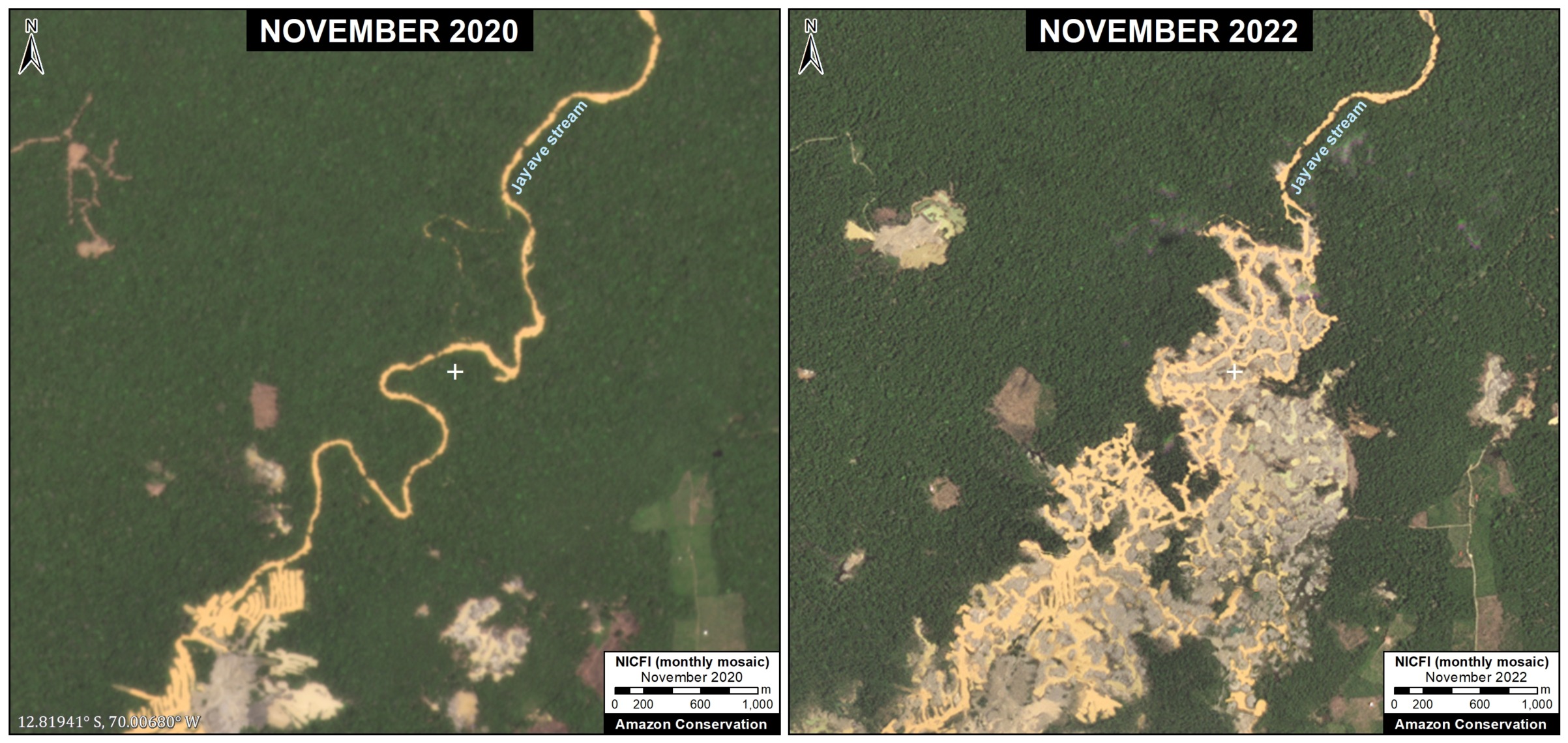
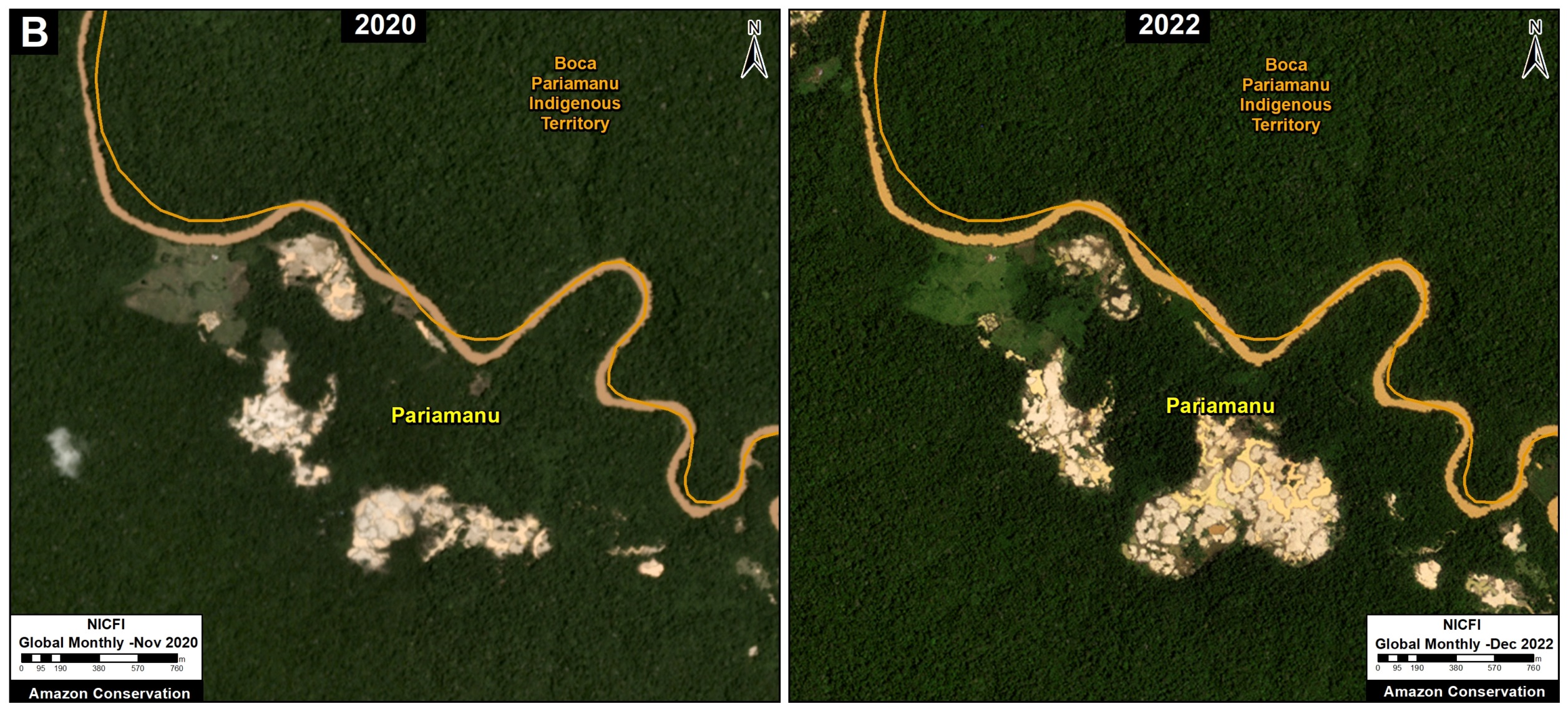
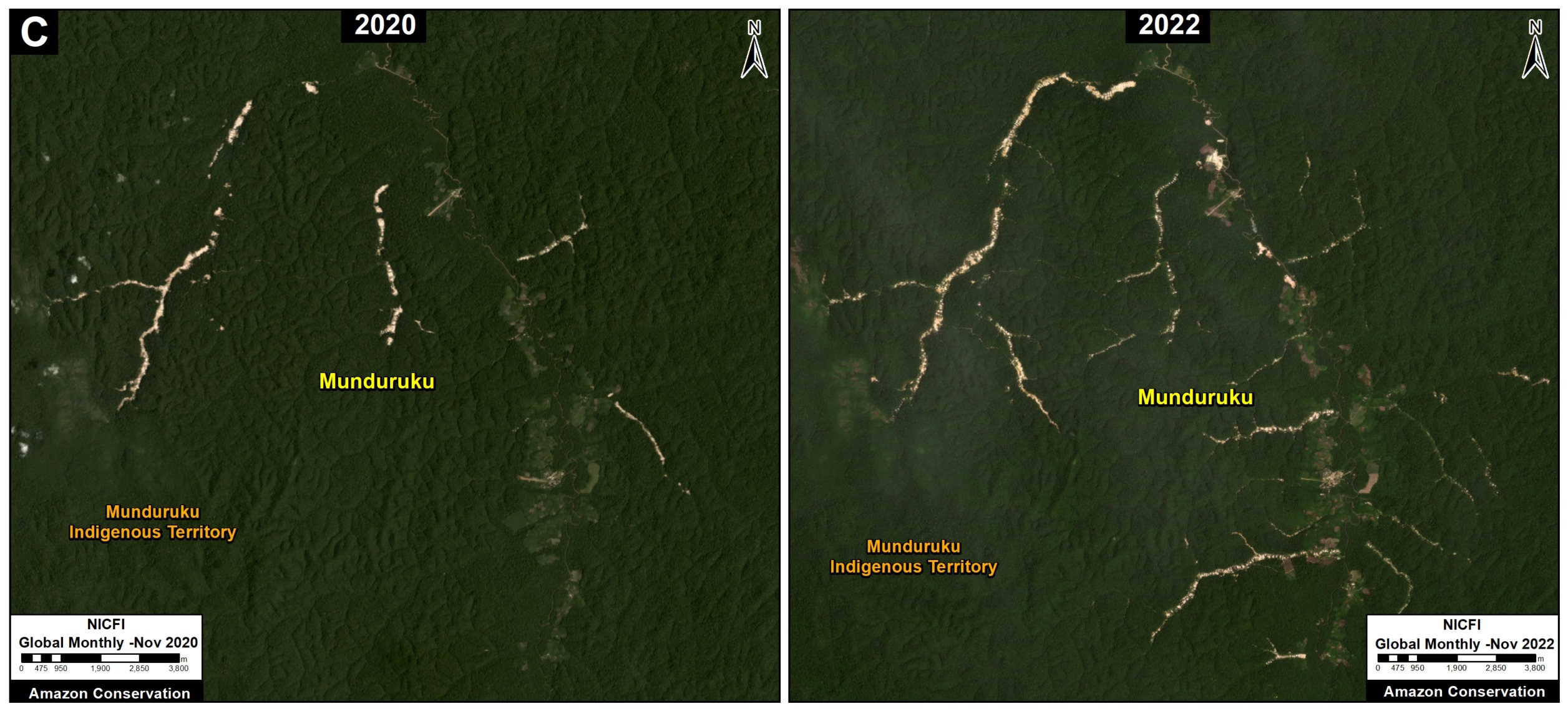
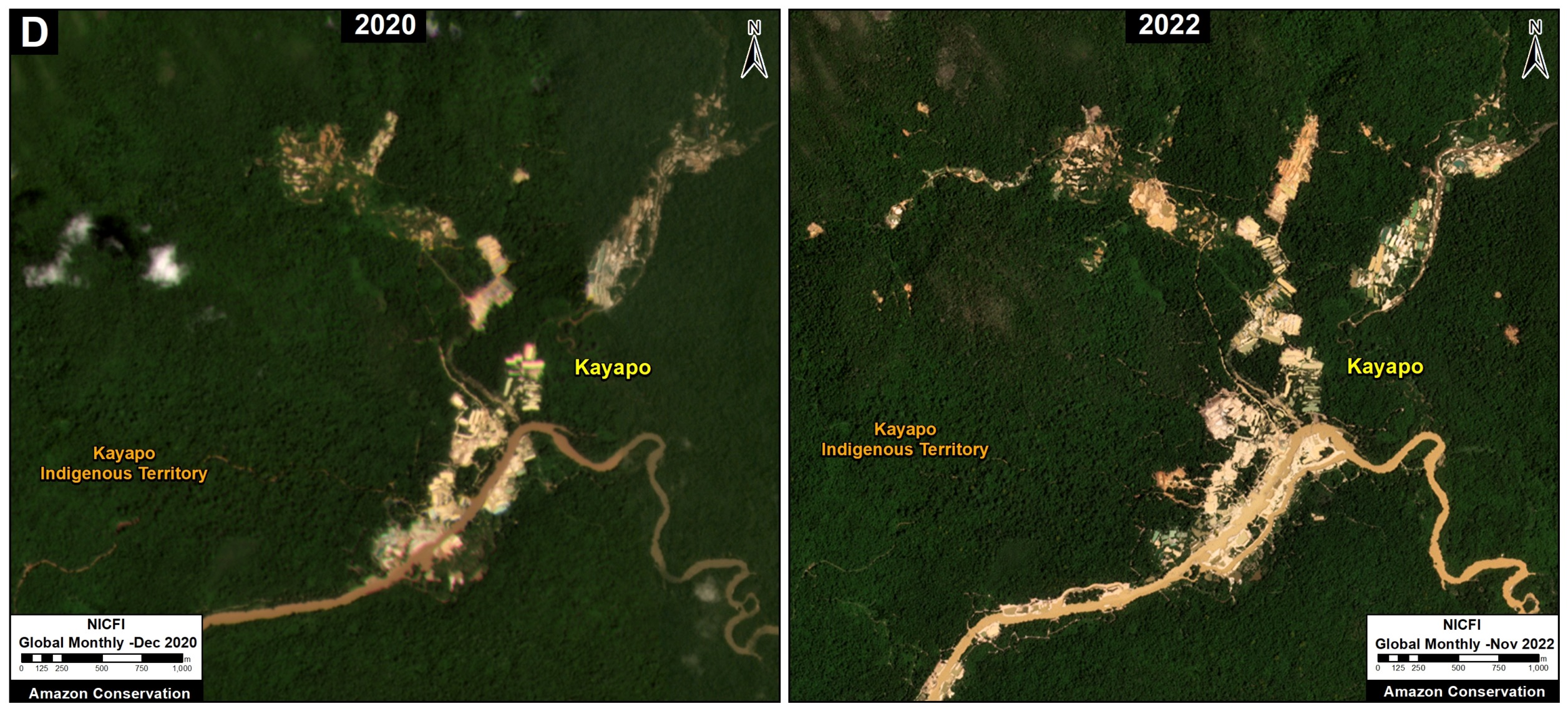
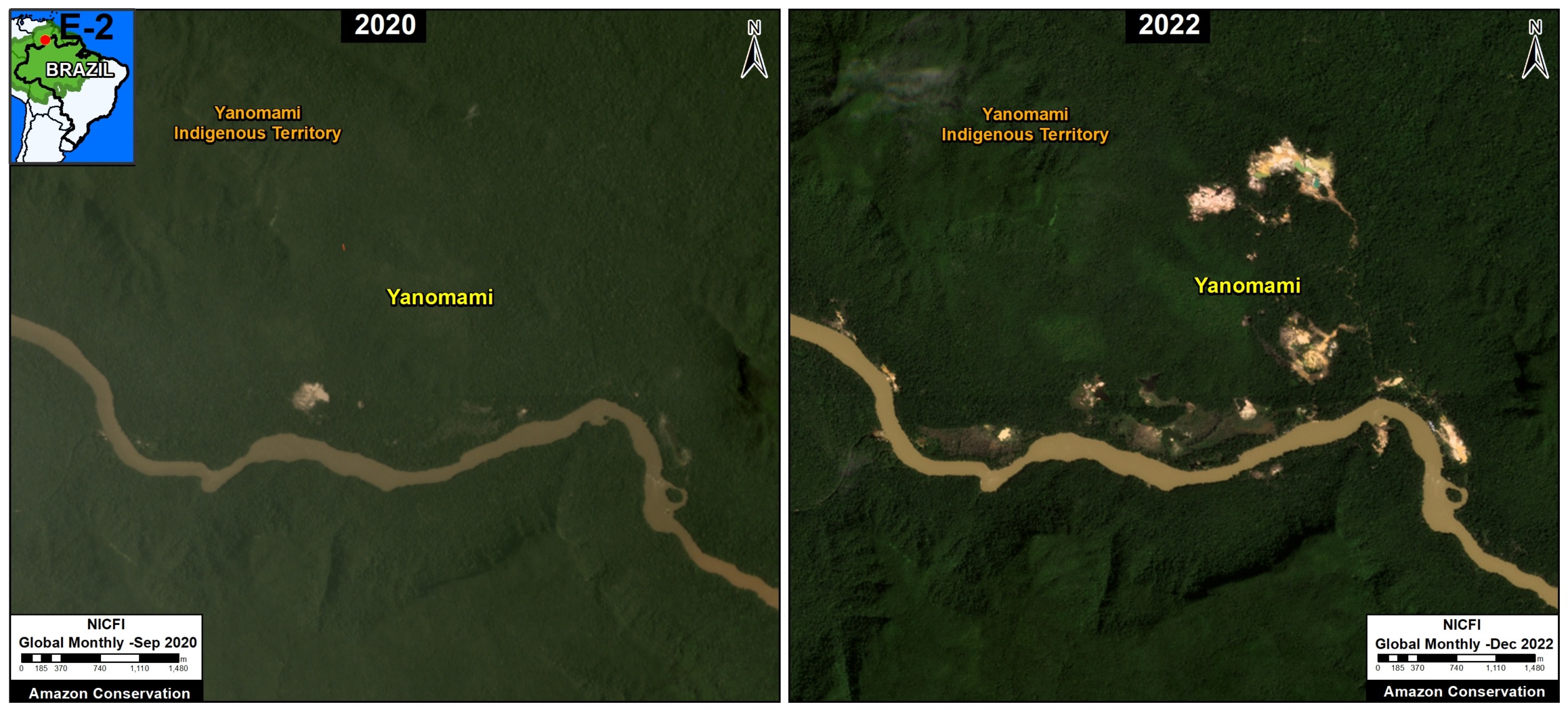
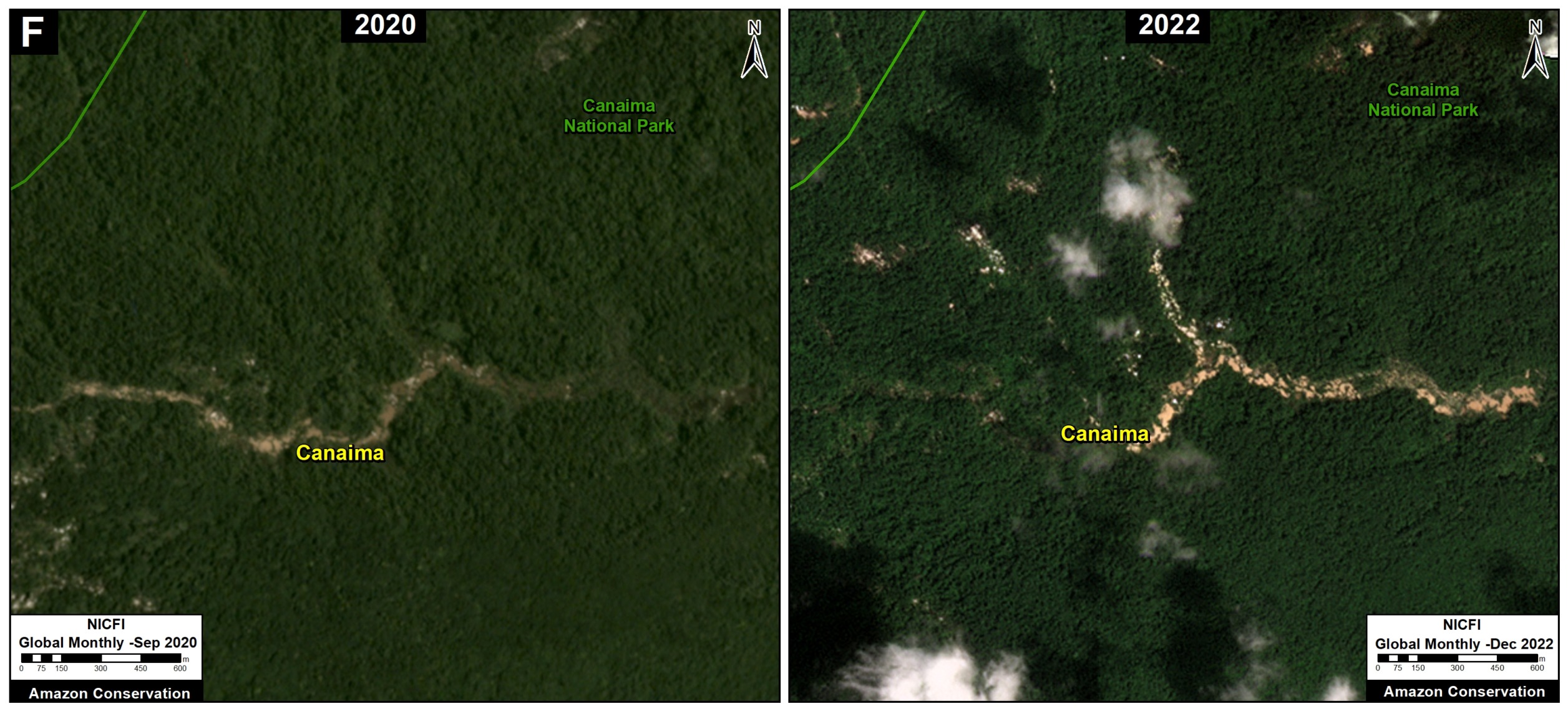
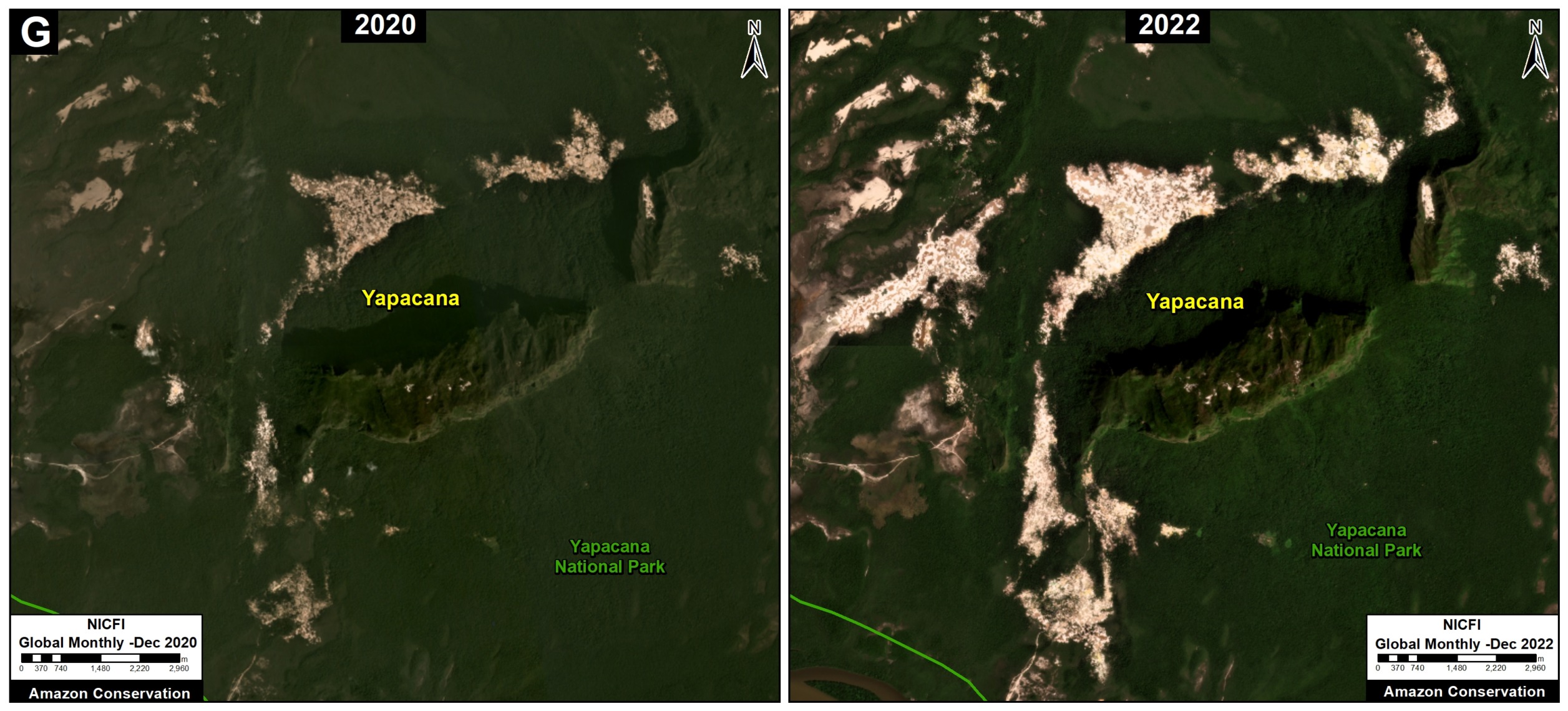
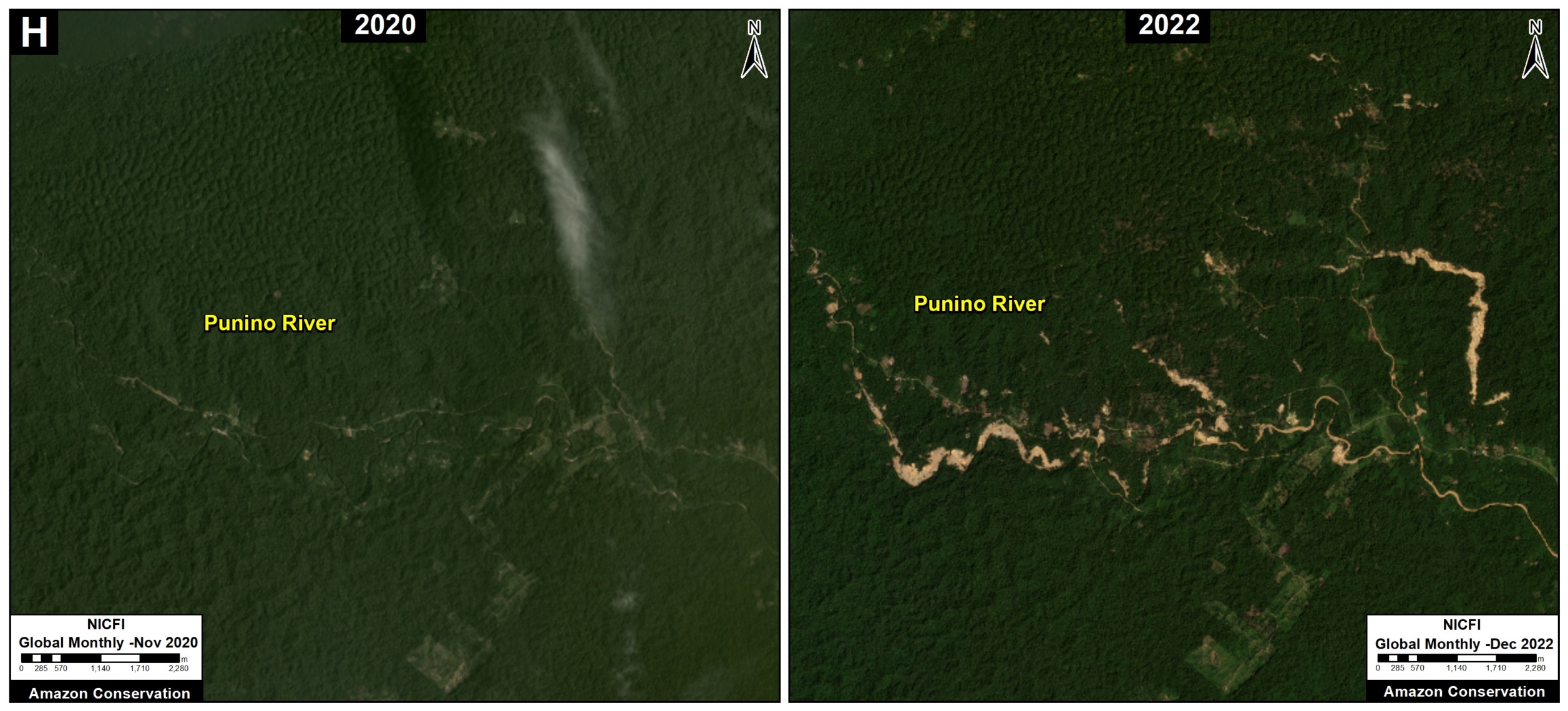
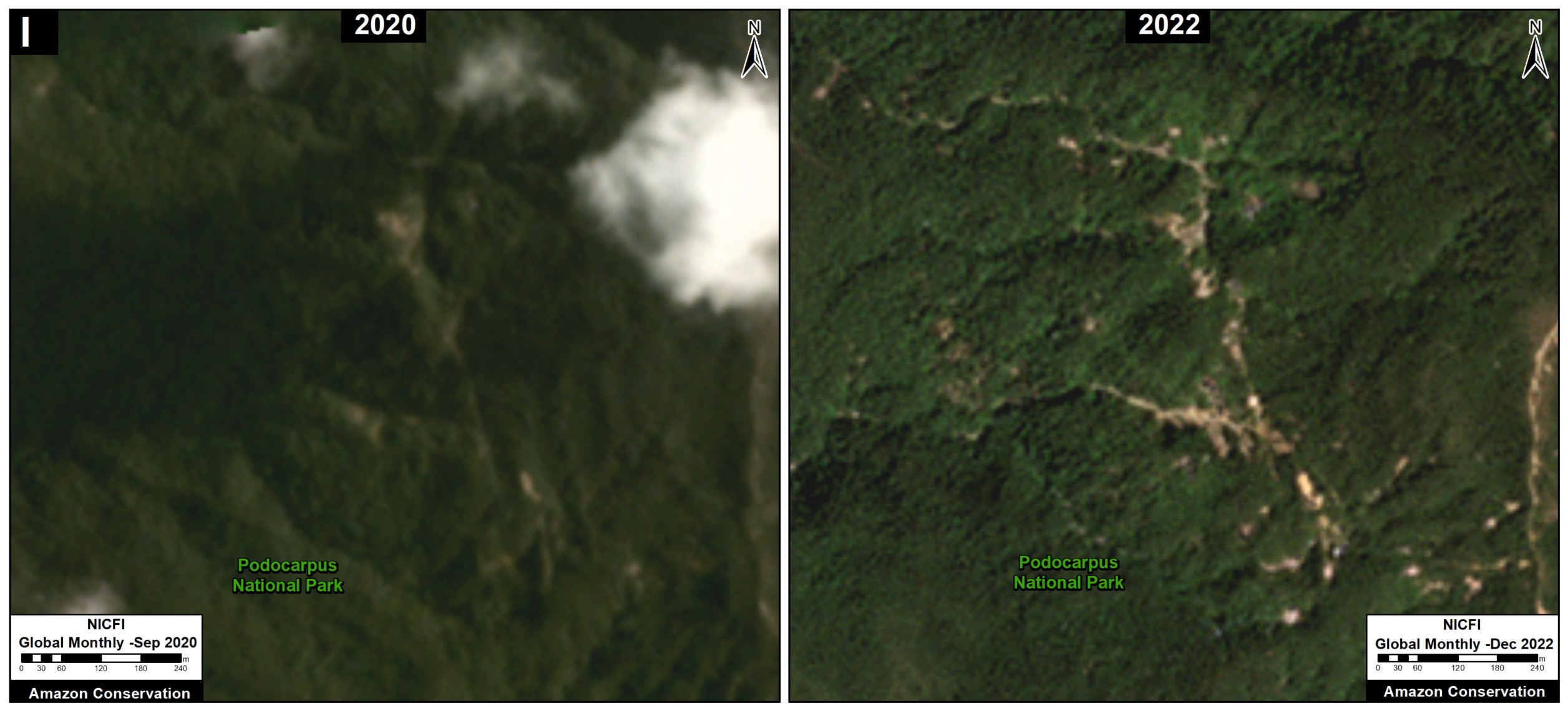
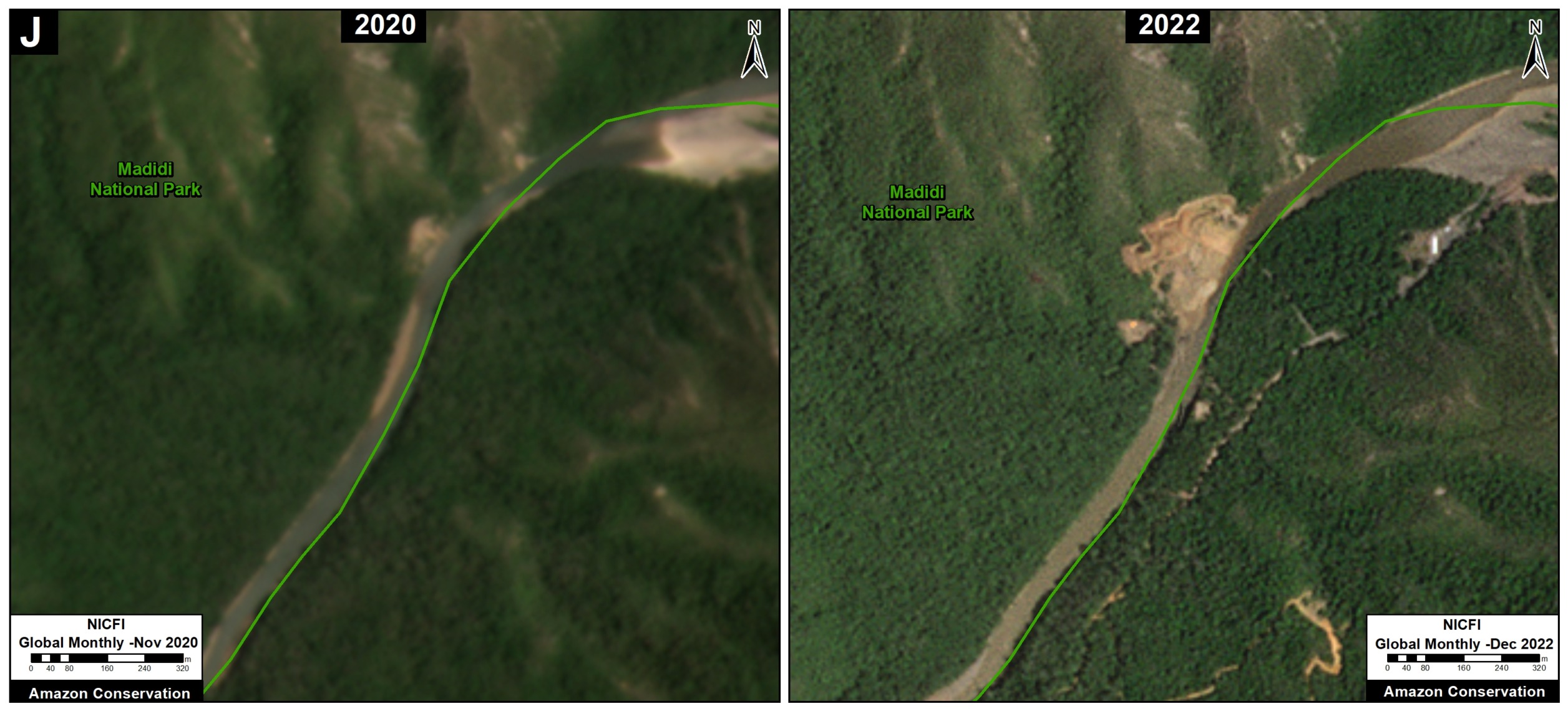
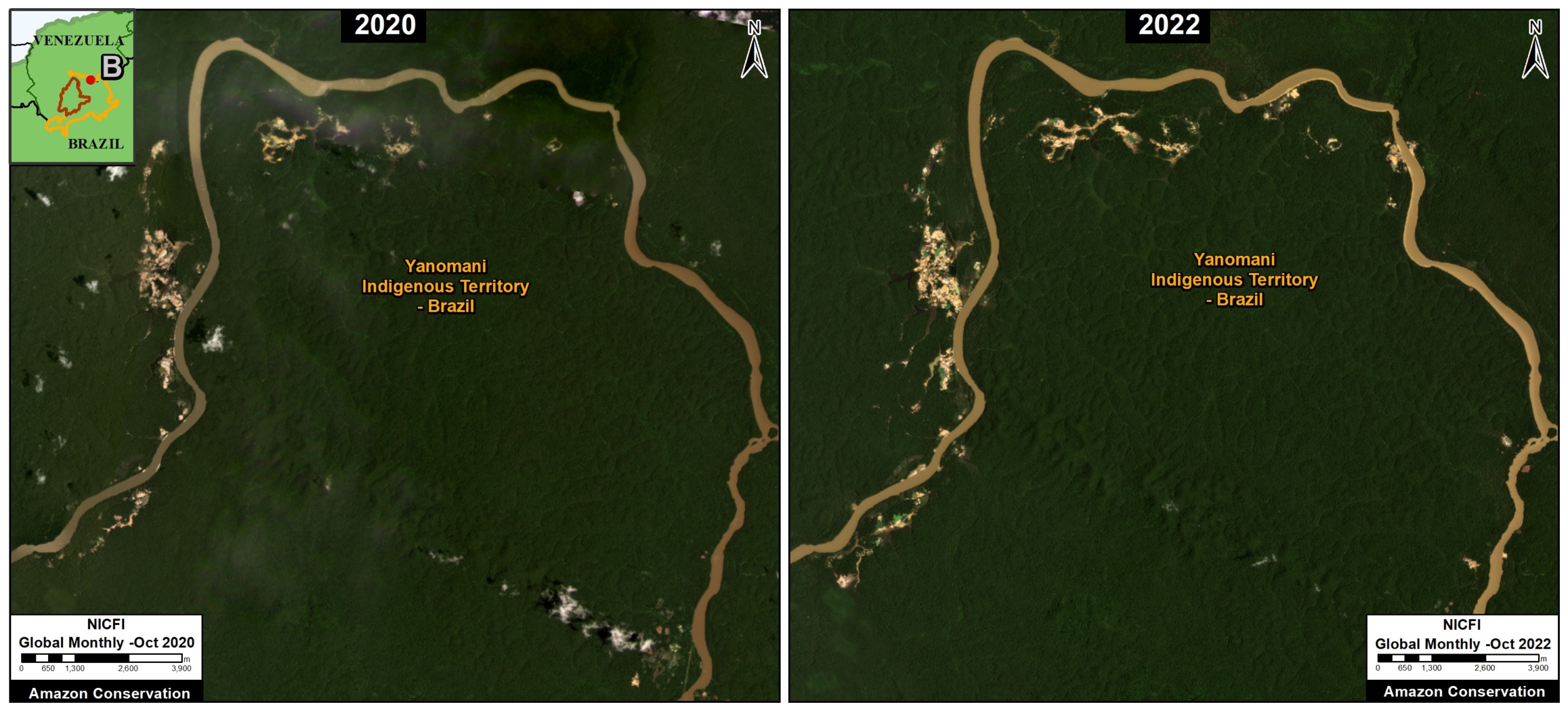
Below, we show a series high-resolution satellite images of the Amazon case studies. Each example highlights recent gold mining deforestation; that is comparing 2020 (left panel) with 2022 (right panel).

Case Studies, in High-resolution

Peruvian Amazon

Southern Peru (specifically, the region of Madre de Dios) is one of the most severe and emblematic examples of gold mining deforestation in the Amazon, clearing thousands of hectares of primary forest (see MAAP #154). The active mining fronts have evolved substantially over the past 20+ years. Most recently, gold mining has impacted areas such as Mangote and Pariamanu.

A. Mangote

B. Pariamanu

Brazilian Amazon

In the vast Brazilian Amazon, illegal gold mining deforestation is most severe across a number of indigenous territories, most notably: Munduruku (Pará state), Kayapó (Pará), and Yanomami (Roraima).

C. Munduruku Indigenous Territory


D. Kayapó Indigenous Territory


E. Yanomami Indigenous Territory

Venezuelan Amazon

Mining is one of the major deforestation drivers in the Venezuelan Amazon (MAAP #155). This mining impact is occurring in the designated Orinoco Mining Arc, but also key protected areas such as Caura, Canaima, and Yapacana National Parks.

F. Canaima National Park


G. Yapacana National Park

Ecuadorian Amazon

We have been documenting the numerous mining deforestation hotspots in the Ecuadorian Amazon that appear to be intensifying in recent years. Two key examples are along the Punino River (Napo and Orellana provinces) and further south in Podocarpus National Park.

H. Punino River

I. Podocarpus National Park

Bolivian Amazon

One of the newest gold mining deforestation hotspots is along the Tuichi River in Madidi National Park.

J. Madidi National Park

Methodology

Mining deforestation hotspots were identified based on MAAP’s ongoing monitoring efforts, and assisted by Amazon Mining Watch.

Acknowledgements

We thank A. Folhadella, S. Novoa, D. Larrea, C. De Ugarte, and M. Teran for helpful comments on this report, and Conservación Amazónica – ACCA for data on mining sites in northern Peru.

This work was supported by Norad (Norwegian Agency for Development Cooperation) and ICFC (International Conservation Fund of Canada).

Citation

Finer M, Ariñez A, Mamani N (2023) Mining Deforestation Across the Amazon. MAAP: 178.

MAAP #182: Gold Mining Deforestation in the Ecuadorian Amazon

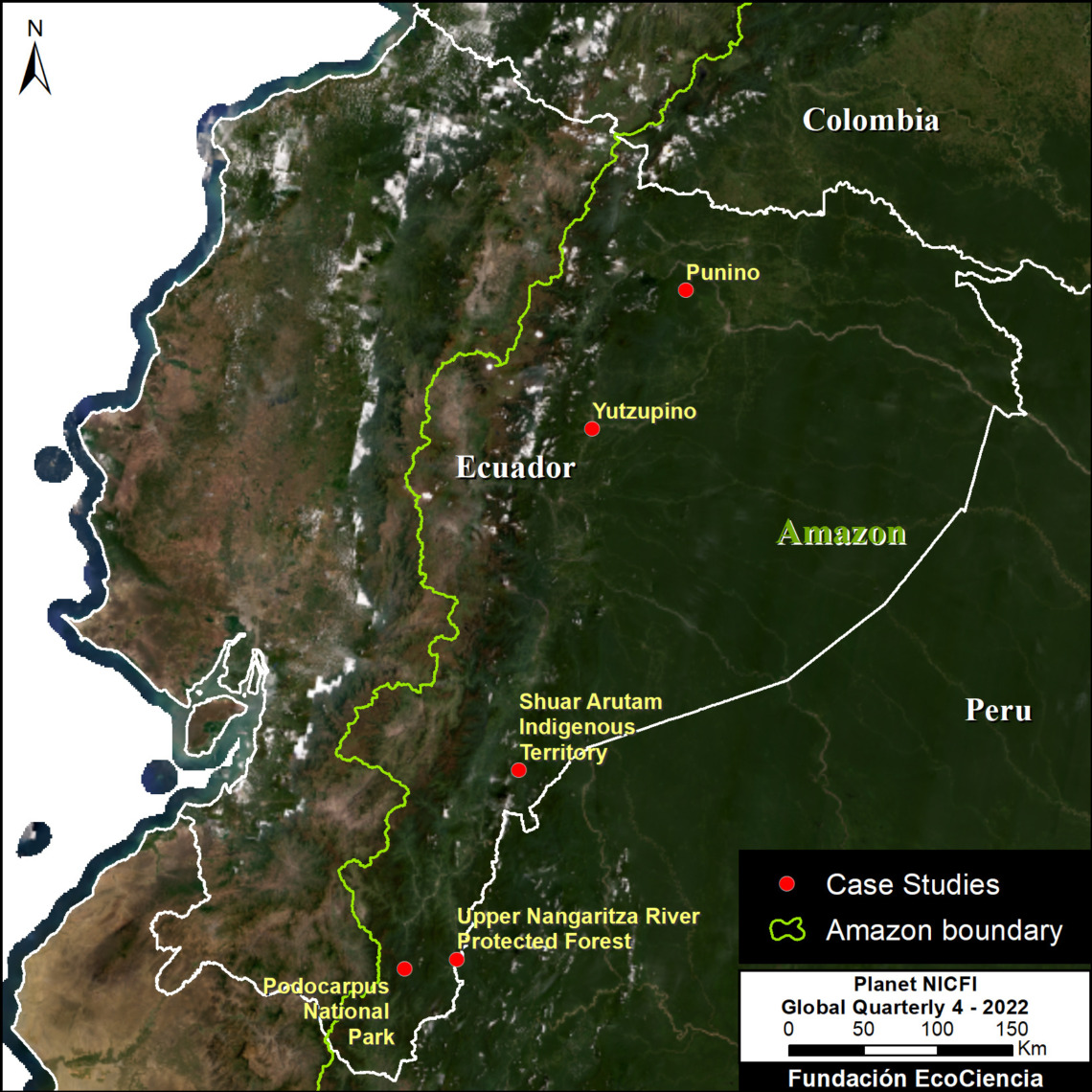
Base Map. Major cases of recent gold mining deforestation in Ecuadorian Amazon.

Gold mining is one of the major deforestation drivers across the Amazon, with well-known cases in Peru, Brazil, and Venezuela.

In a recent series of technical articles*, in collaboration with the Ecuadorian organization Foundation EcoCiencia, we have also shown that gold mining is escalating in the Ecuadorian Amazon.

Here, we summarize the results from the series and present 5 major cases of recent gold mining deforestation in Ecuador (see Base Map).

These cases, which include gold mining expansion in protected areas, indigenous territories, and primary forests, are:

  • Punino River, located between Napo and Orellana provinces, has experienced the rapid mining deforestation expansion of 217 hectares since 2019.
    l
  • Yutzupino, located in Napo province, has experienced mining deforestation of 125 hectares since 2021. Surrounding sites in Napo have added 490 hectares since 2017.
    l
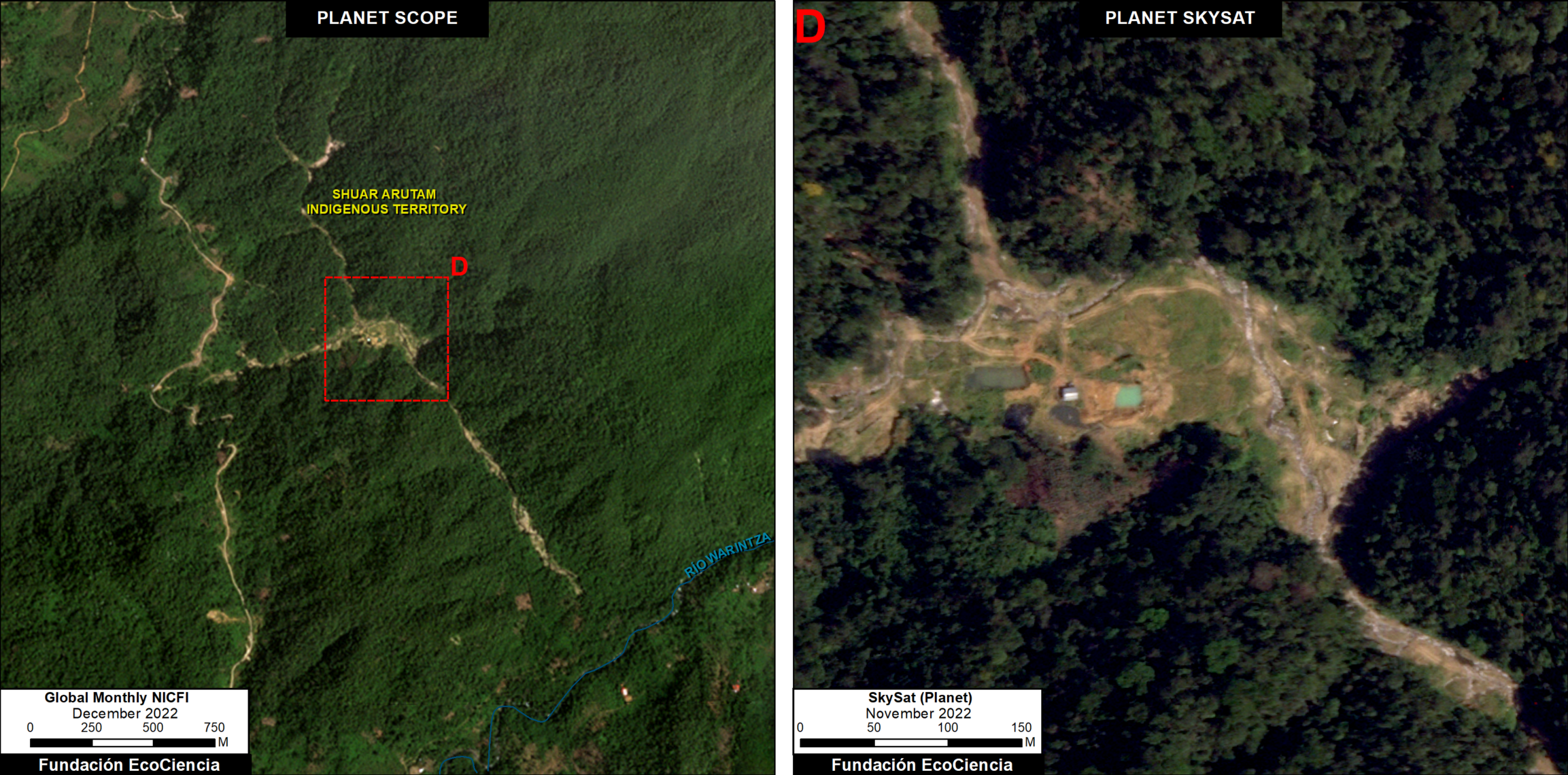
  • Shuar Arutam Indigenous Territory, located in Morona Santiago province, has experienced 257 hectares of mining deforestation since 2021.
    l
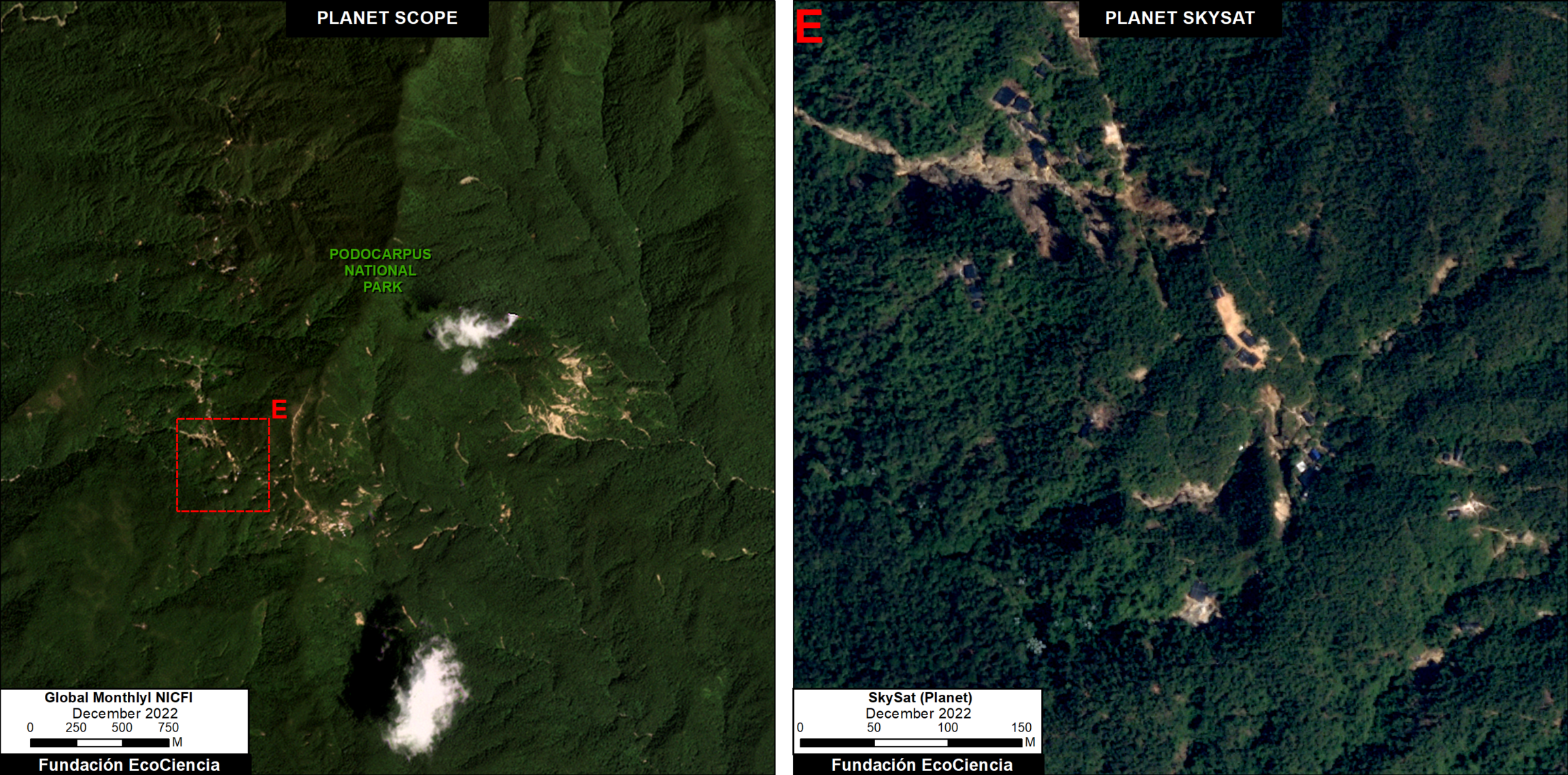
  • Podocarpus National Park, located in Zamora Chinchipe province, has experienced 25 hectares of mining deforestation within the park since 2019.
    k
  • Upper Nangaritza River Protected Forest, also located in Zamora Chinchipe has experienced 545 hectares of mining deforestation since 2018.

In total, we have documented the recent gold mining deforestation of 1,660 hectares (4,102 acres) in the Ecuadorian Amazon. This is equivalent to 2,325 soccer fields.

For each case, we show high-resolution satellite images of the recent gold mining deforestation.

Case Studies – Recent Gold Mining Deforestation in the Ecuadorian Amazon

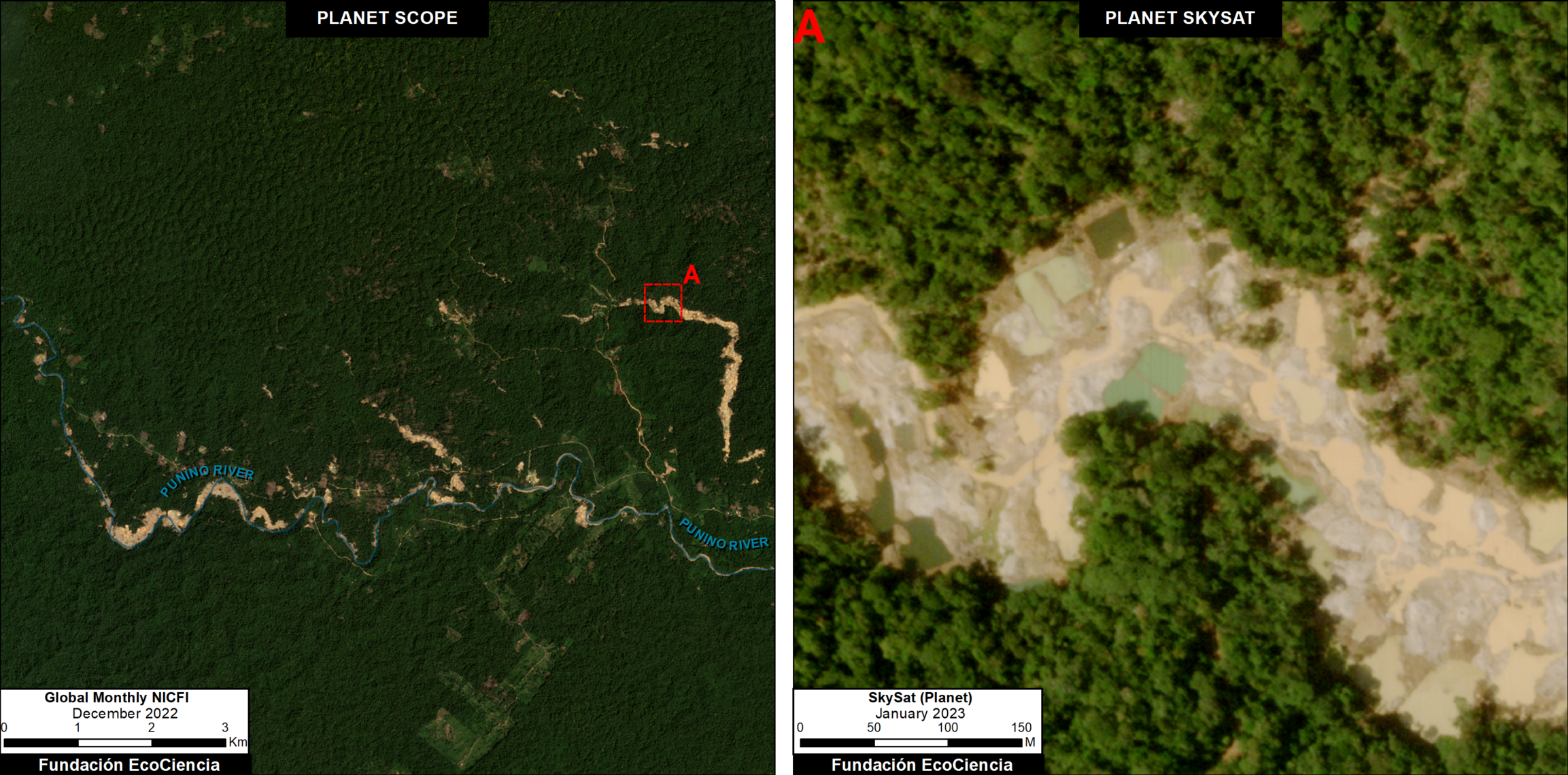
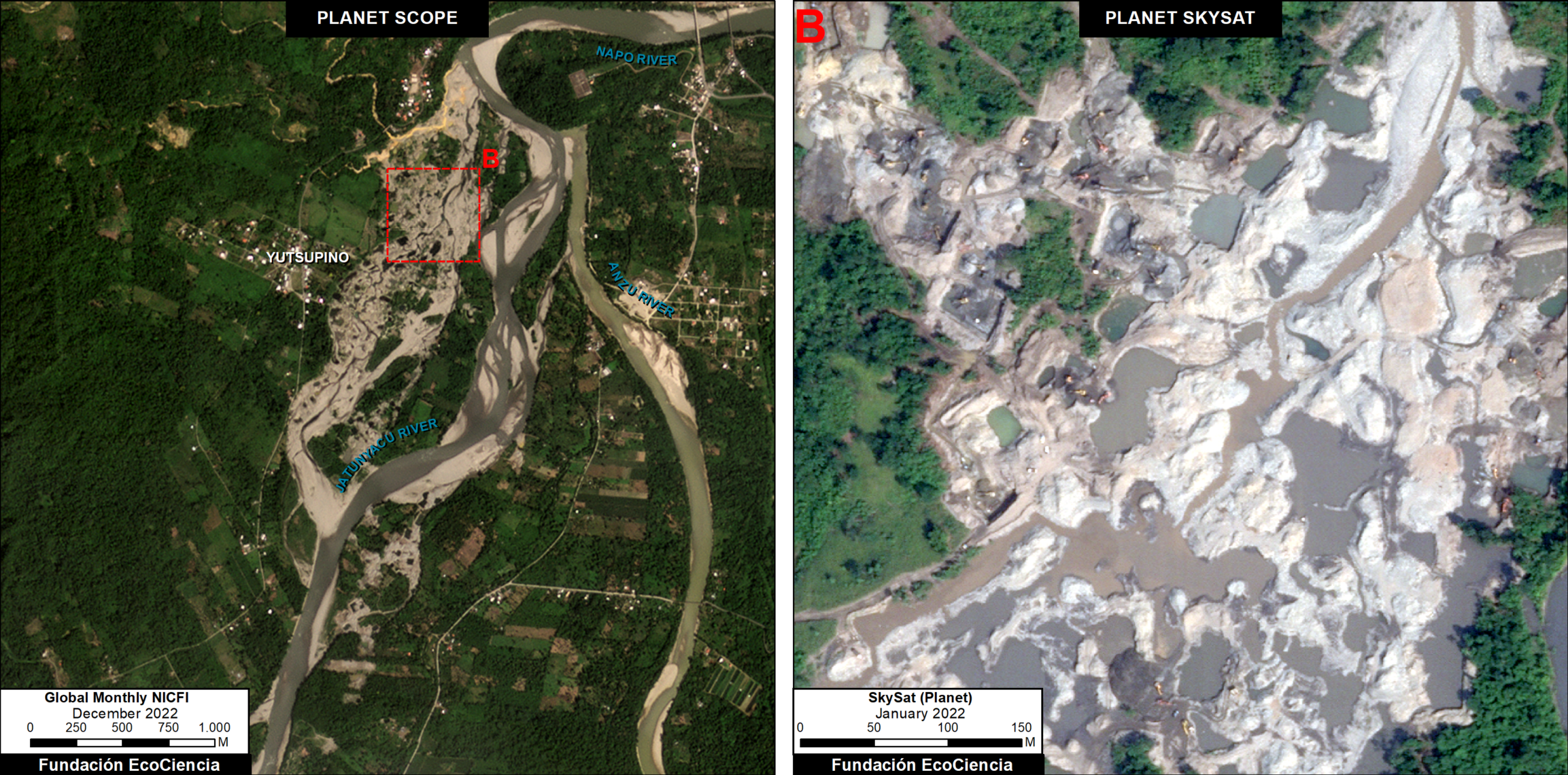
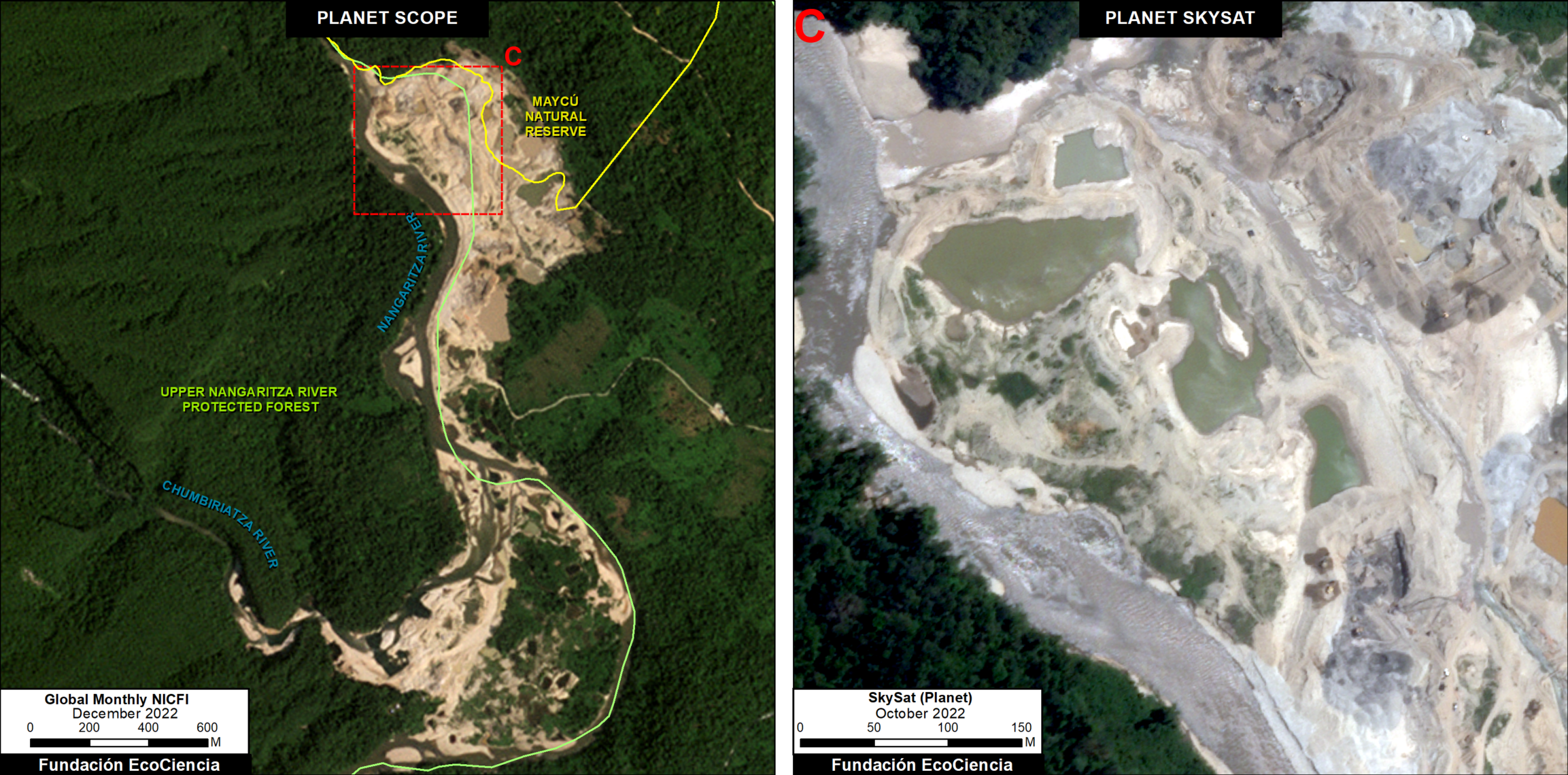
For each of the five cases presented below, we show both a high-resolution (3 meters) example of the recent mining deforestation (left panel) and very-high resolution (0.5 meters) zoom of the mining activity (right panel).

Punino River

Along the Punino River, located between Napo and Orellana provinces, we have documented the rapid mining deforestation expansion of 217 hectares since November 2019. Alarmingly, much of this activity (85%) occurred most recently in 2022. See MAAP #176 for more details.

Case 1. Punino River.

Yutzupino/Napo

In this area, located in Napo province, we have documented the mining deforestation of 125 hectares since October 2021, including major impacts along the Jatunyacu River. Surrounding sites in Napo have added 490 hectares since 2017. See MAAP #151 and MAAP #162 for more details.

Case 2. Yutzupino/Napo.

Upper Nangaritza River Protected Forest

In Upper Nangaritza River Protected Forest, also located in Zamora Chinchipe province, we have documented the mining deforestation of 545 hectares since 2018 along the Nangaritza River. See MAAP #167 for more details.

Case 3. Upper Nangaritza River Protected Forest.

Shuar Arutam Indigenous Territory

In the Shuar Arutam Indigenous Territory, located in Morona Santiago province, we have documented the mining deforestation of 257 hectares since 2021. See MAAP #170 for more details.

Case 4. Shuar Arutam Indigenous Territory.

Podocarpus National Park

In Podocarpus National Park, located in Zamora Chinchipe province, we have documented the mining deforestation of 25 hectares since 2019 within the park, including the presence of over 200 mining camps. See MAAP #172 for more details.

Case 5. Podocarpus National Park.

*MAAP Technical Reports

MAAP #176: Expansión Alarmante de Minería en la Amazonía Ecuatoriana (Caso Punino)
https://www.maapprogram.org/2023/mineria-ecuador-punino/

MAAP #172: Minería ilegal de oro en el Parque Nacional Podocarpus, Ecuador
https://www.maapprogram.org/2023/mineria-podocarpus-ecuador/

MAAP #170: Actividad Minera en Territorio Shuar Arutam (Amazonia Ecuatoriana)
https://www.maapprogram.org/2022/mineria-shuar-arutam-ecuador/

MAAP #167: Actividad Minera en el Bosque Protector Cuenca Alta del Río Nangaritza (Ecuador)
https://www.maapprogram.org/2022/minera-nangaritza-ecuador/

MAAP #162: Dinámica de la actividad minera en la  provincia de Napo (Ecuador)
https://www.maapprogram.org/2022/mineria-napo-ecuador/

MAAP #151: Minería Ilegal en la Amazonía Ecuatoriana
https://www.maapprogram.org/2022/mineria-ecuador/

Acknowledgments

This report is part of a series focused on the Ecuadorian Amazon through a strategic collaboration between the organizations Fundación EcoCiencia and Amazon Conservation, with the support of the Norwegian Agency for Development Cooperation (Norad).

MAAP #181: Illegal Gold Mining in Yanomami Indigenous Territory (Brazil)

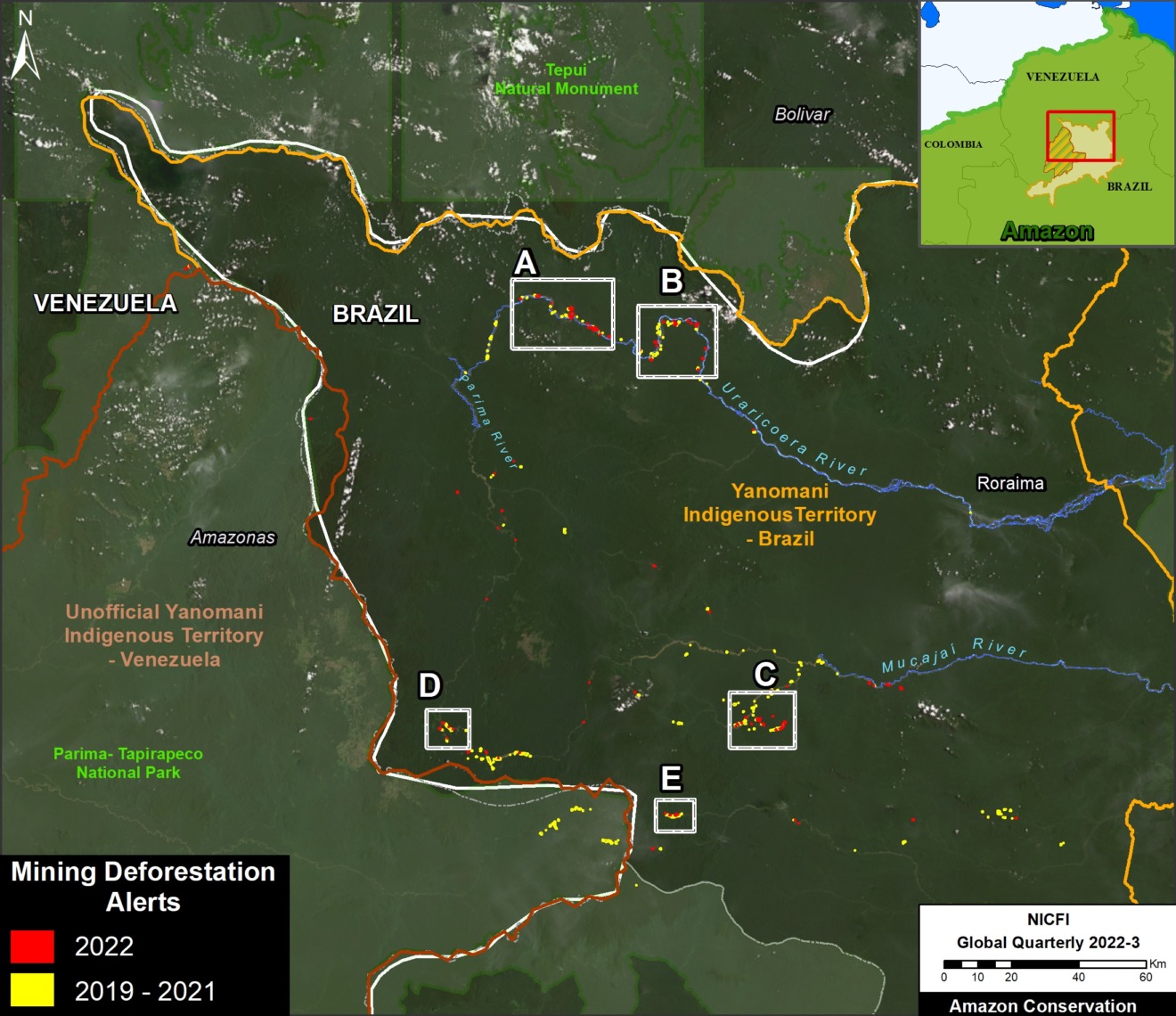
Base Map. Illegal mining deforestation alerts in Yanomami Indigenous Territory (northern Brazilian Amazon).

The Brazilian government recently launched a series of raids against illegal gold mining in Yanomami Indigenous Territory, located in the northern Brazilian Amazon (see inset of Base Map).

These raids highlight the severe consequences brought by illegal mining activity, particularly deforestation, contamination, malnutrition, and disease.

Here we present the results of a new machine learning algorithm that analyzes satellite imagery archives across large areas to quickly and precisely detect new gold mining deforestation fronts.

The resolution of these mining deforestation alerts is 10 meters, based on the European Space Agency’s freely available Sentinel-2 satellite imagery data.

These alerts reveal the extent of the gold mining deforestation in Yanomami Indigenous Territory is much greater than realized (see Base Map).

In the Base Map, the red dots indicate the most recent gold mining deforestation alerts, occurring in 2022.

Note that while the raids appear to be concentrated along the Uraricoera River, active gold mining deforestation is actually occurring all throughout the vast northern section of the territory, including the Parima and Mucajai Rivers as well.

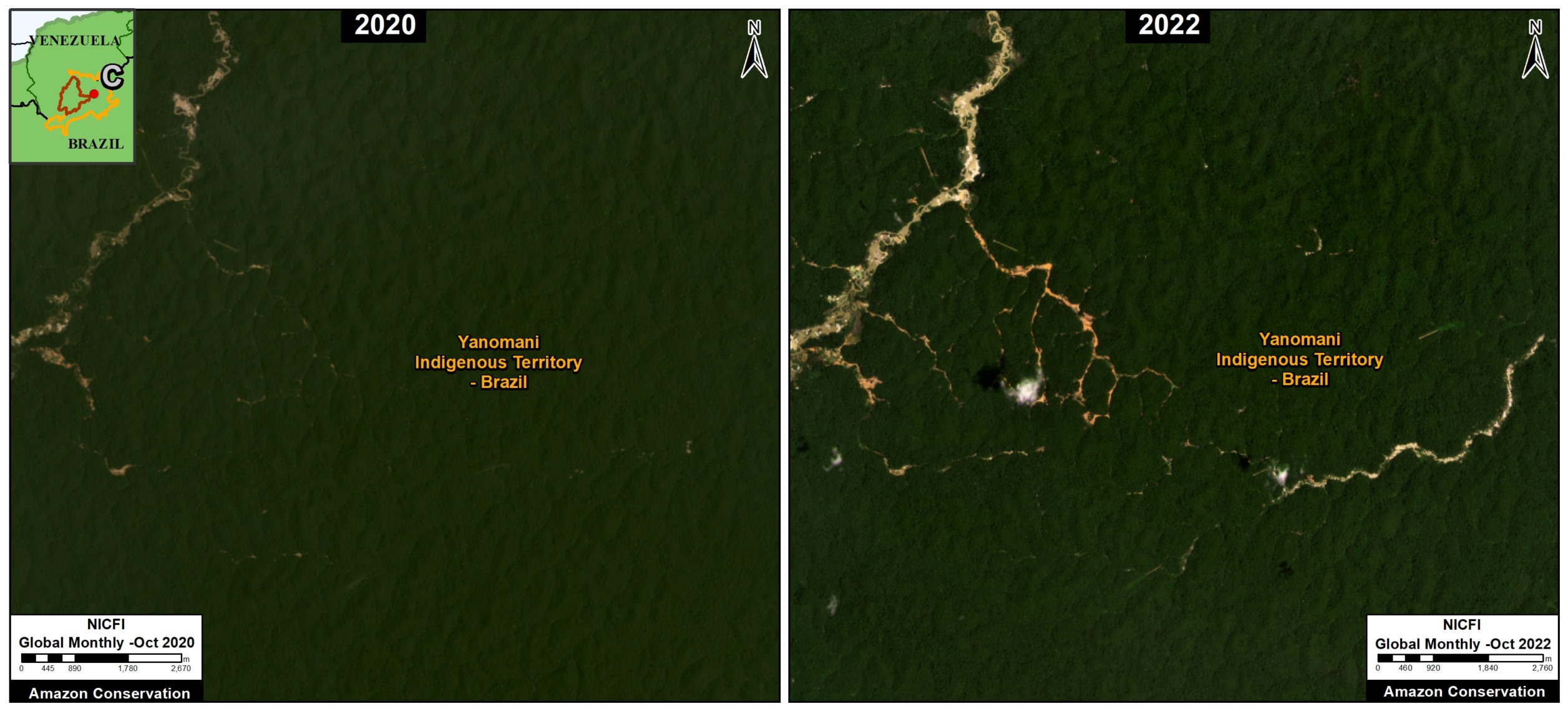
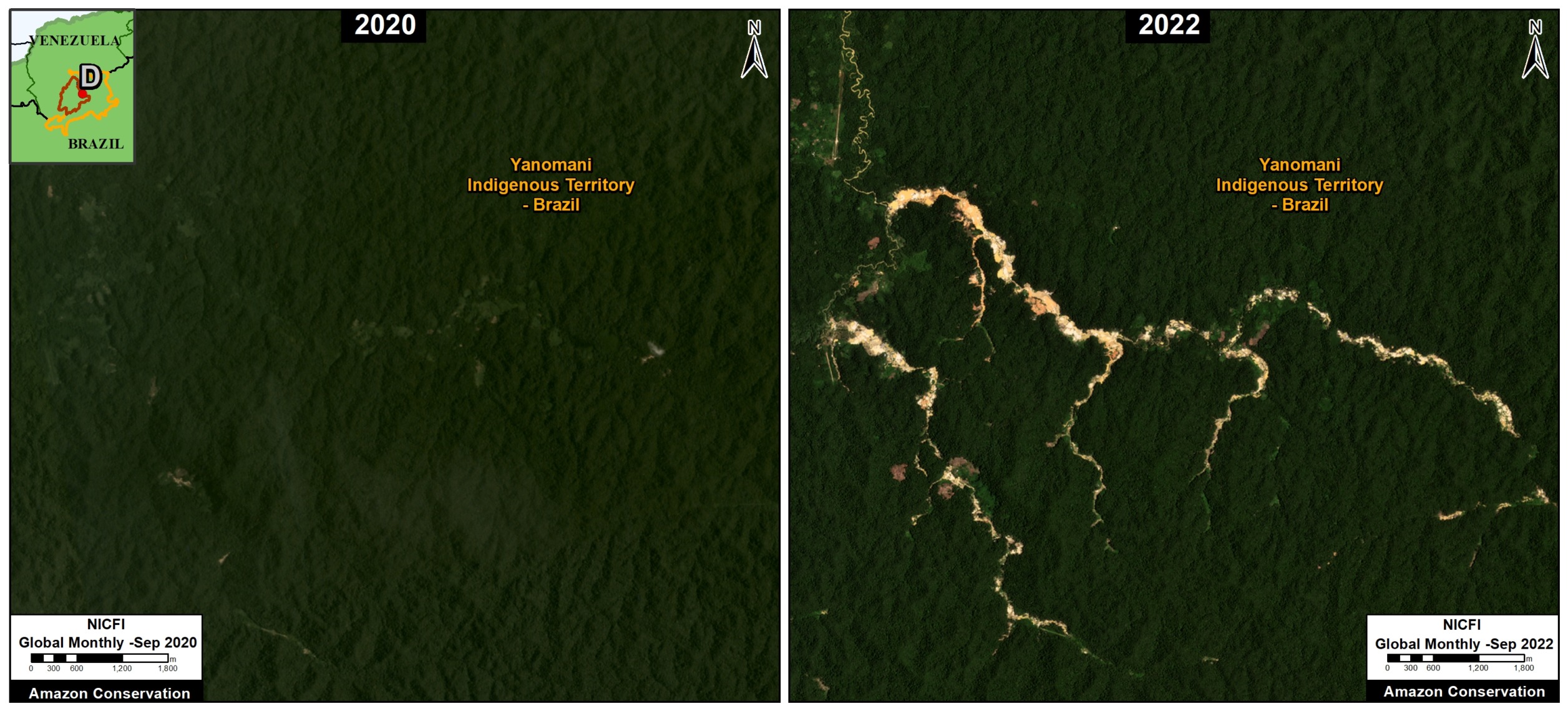
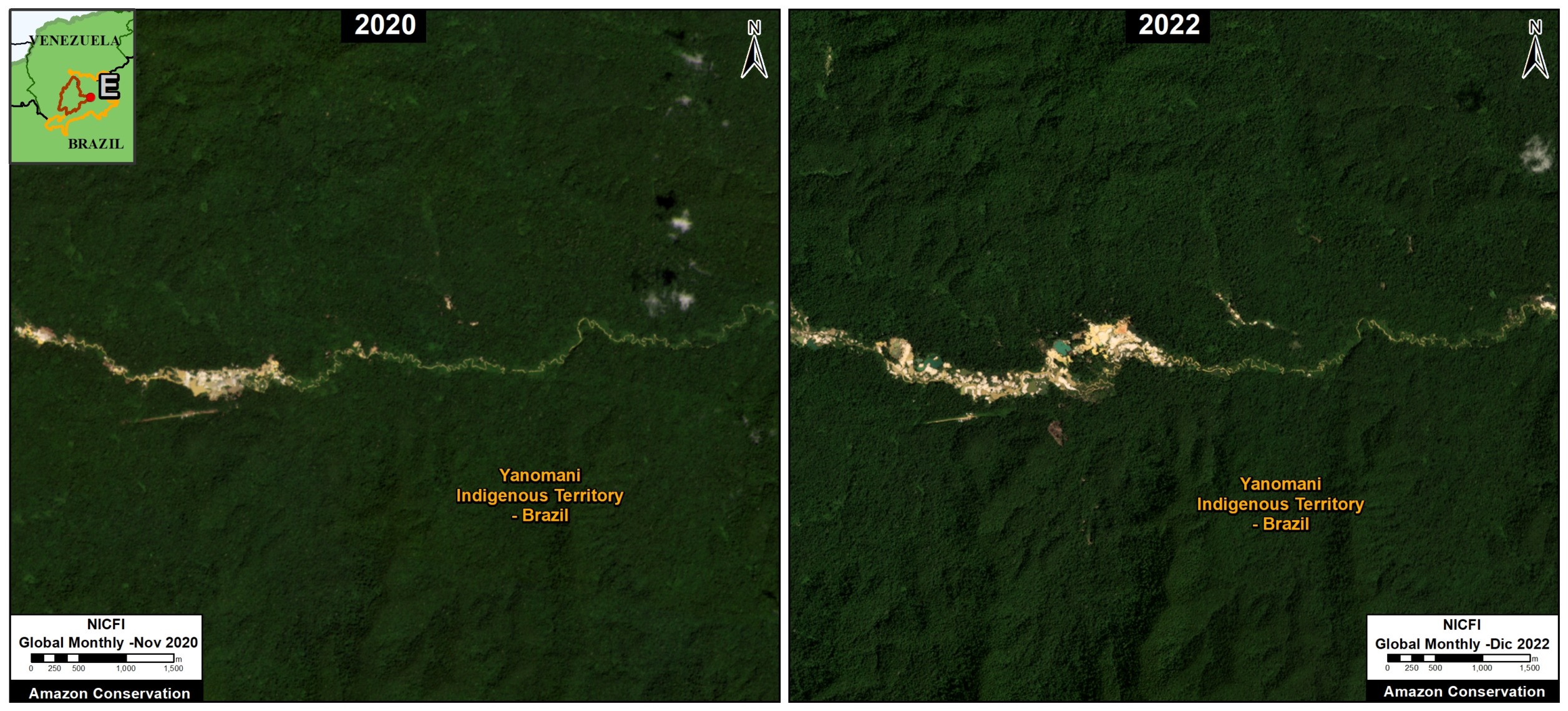
We estimate the new gold mining deforestation of over 2,000 hectares since 2019. Much of this deforestation (67%, or 1,350 hectares) occurred most recently in 2022.

Below, we show five examples of this recent gold mining deforestation with high-resolution satellite imagery (3 meters) that confirm the alert detections.

Zooms of Illegal Gold Mining Deforestation, 2020 – 2022

Below, we show five examples of this recent gold mining deforestation with high-resolution (3 meter) satellite imagery that confirm the alert detections (see insets A-E in the Base Map). Note that two of the examples are on the the Uraricoera River, while the other three examples are from other parts of the territory.

Zoom A

Zoom B

Zoom C

Zoom D

Zoom E

Methodology

Gold mining deforestation alerts were generated by Amazon Mining Watch’s updated machine learning algorithim based on Sentinel-2 satellite imagery data.

The Amazon Mining Watch is a partnership between the Pulitzer Center´s Rainforest Investigations Network and Earthrise Media. These two nonprofit organizations have joined forces to bring together the power of machine learning and investigative journalism to shed light on large-scale environmental problems in the Amazon.


MAAP #157: New and Proposed Roads Across the Western Amazon

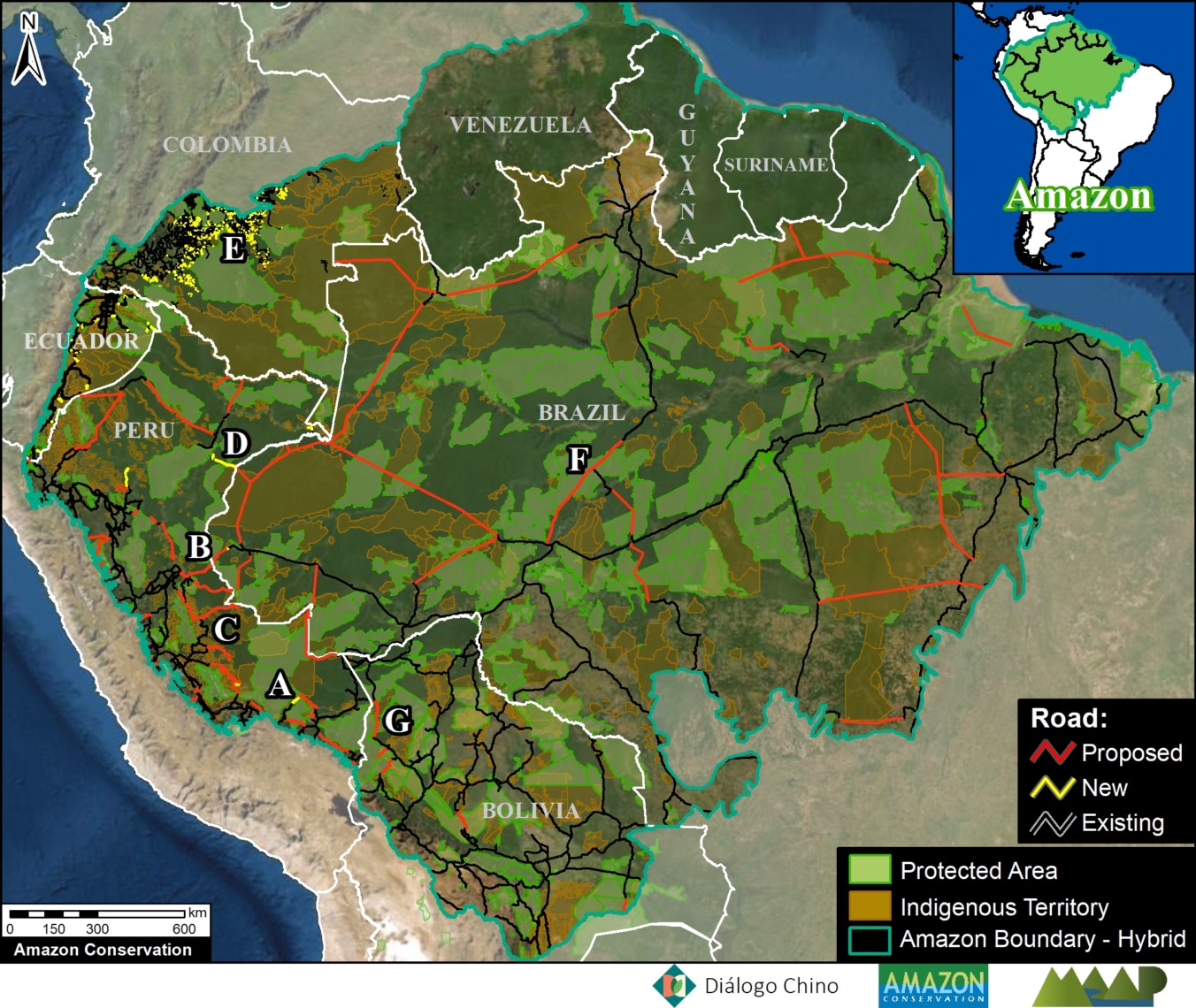
Amazon Roads Base Map 1.

Extensive deforestation, especially along the major road networks, has shockingly turned the eastern Brazilian Amazon into a net carbon source (see MAAP #144).

Fortunately, the greater Amazon across all nine countries is still a net carbon sink, largely thanks to the still intact core of the western Amazon.

The biggest long-term threat to this core Amazon is likely new roads, as they are a leading cause of opening up vast and previously remote areas to deforestation and degradation (Vilela et al 2020).

Here, we present an initial analysis of new and proposed roads across the western Amazon.

Although it’s difficult to predict what proposed projects are actually likely to eventually move forward, we do find the potential of a major road expansion across the core western Amazon (see Base Map 1).

Moreover, even by just focusing on the most advanced or actively discussed projects, we find the risk of major negative impact.

Below, we discuss our initial Amazon Roads Base Map and present a series of zooms showing the primary forest at risk if select road projects move forward.


Amazon Roads Base Map

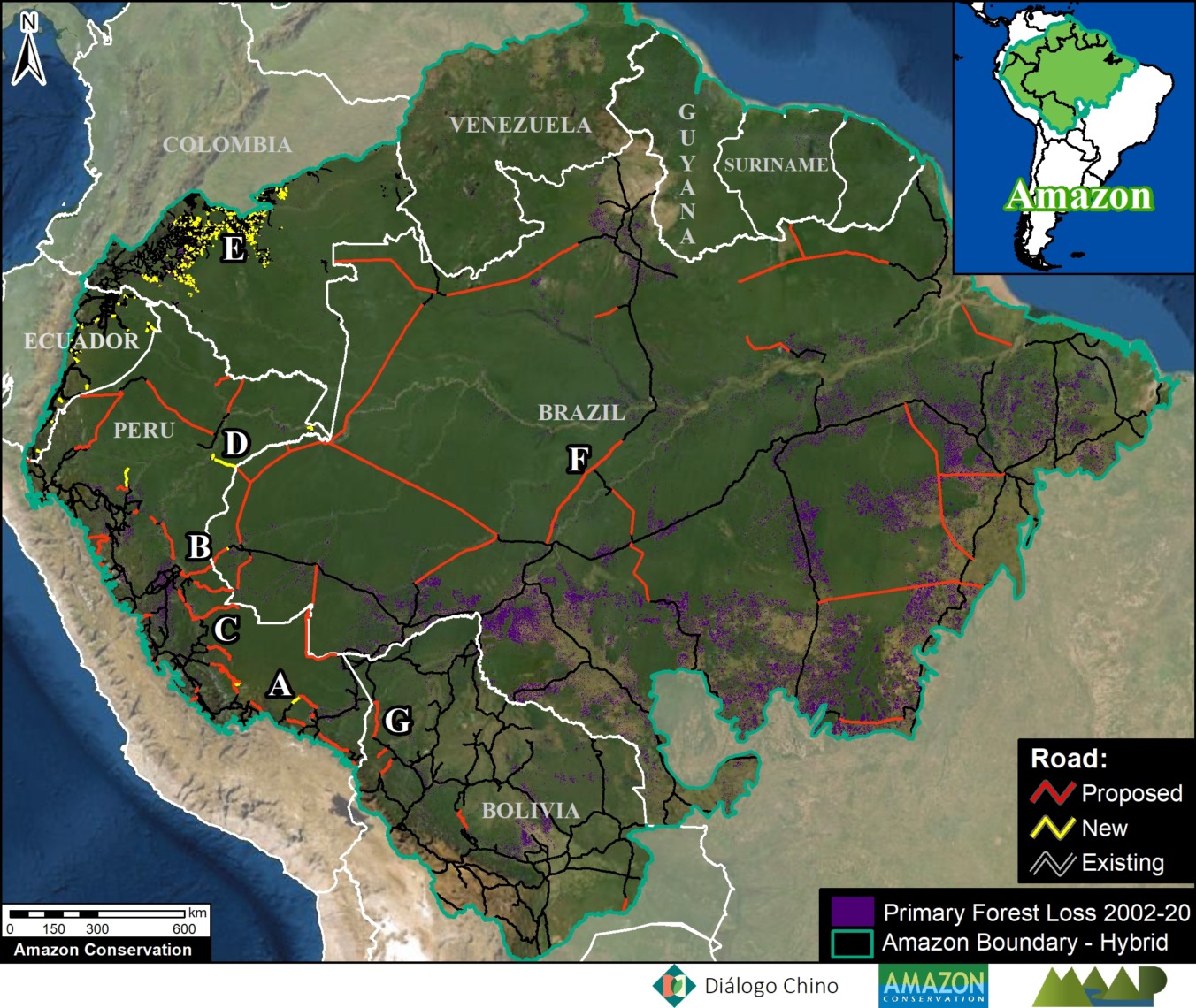
Base Map 2 highlights new, proposed, and existing roads (red, yellow, and black lines, respectively), in relation to protected areas and indigenous territories for context. We focus on the still largely intact core of the western Amazon (Bolivia, Colombia, Ecuador, Peru, and western Brazil).

Most of the new roads were constructed in the past five years and were digitized from satellite imagery. Note that for some of these new roads, just initial construction of a rough road started and there is still potential for future impacts from road improvement and paving.

Most of the proposed roads were obtained from official government data sets. As noted above, it’s difficult to predict what proposed road projects are actually likely to eventually move forward. Nonetheless, it is clear to see there is the potential to greatly divide the remaining core western Amazon with the portfolio of proposed roads.

Amazon Roads Base Map 2. Data: ACA/MAAP, MTC, MINAM, MI, ABT, GAD Napo, FCDS, EcoCiencia, Diálogo Chino, CSF, RAISG, ACCA, ACEAA.

Zooms of High-Impact New & Proposed Roads

In this section, we focus on the currently most advanced or actively discussed projects (see Letters A-F on Amazon Roads Base Map). We highlight their potential impacts to vast sections of the core western Amazon protected areas and indigenous terrritories.

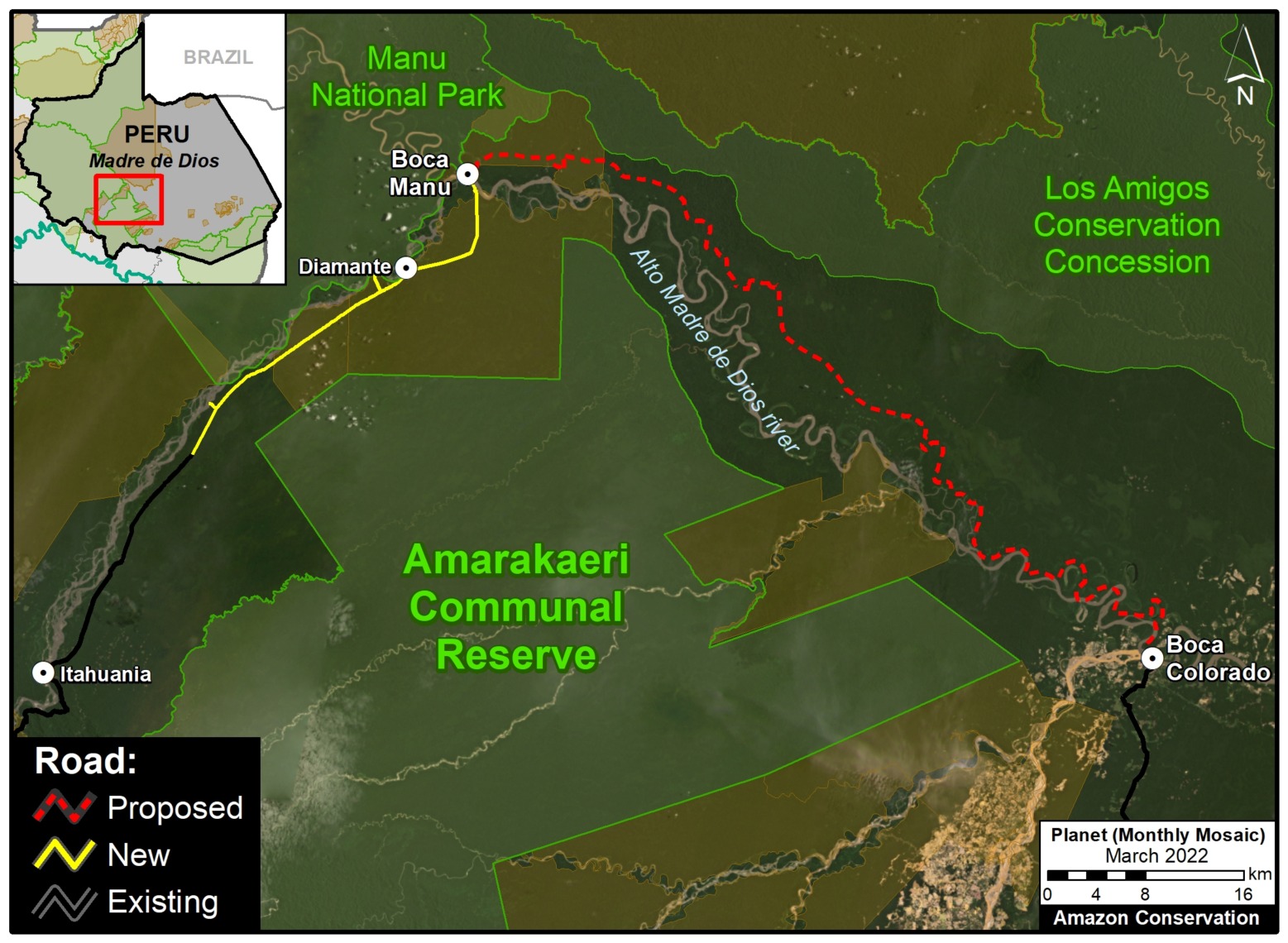
A. Boca Manu Road (Peru)

The new/proposed road that we refer to here as the Boca Manu road would serve as a new connection between Cusco and Madre de Dios regions. It is notable due its sensitive route between Manu National Park and Amarakaeri Communal Reserve to Boca Manu, and from there between Los Amigos Conservation Concession and Amarakaeri Communal Reserve to Boca Colorado. In addition to likely impacting these protected areas and the concession, the road also has the potential to impact the nearby territory of  indigenous groups in voluntary isolation. See this recent report from Diálogo Chino for more information about this road and its status and impacts.

Zoom A. Boca Manu Road. Data: MTC, MINAM, ACA, ACCA, RAISG.

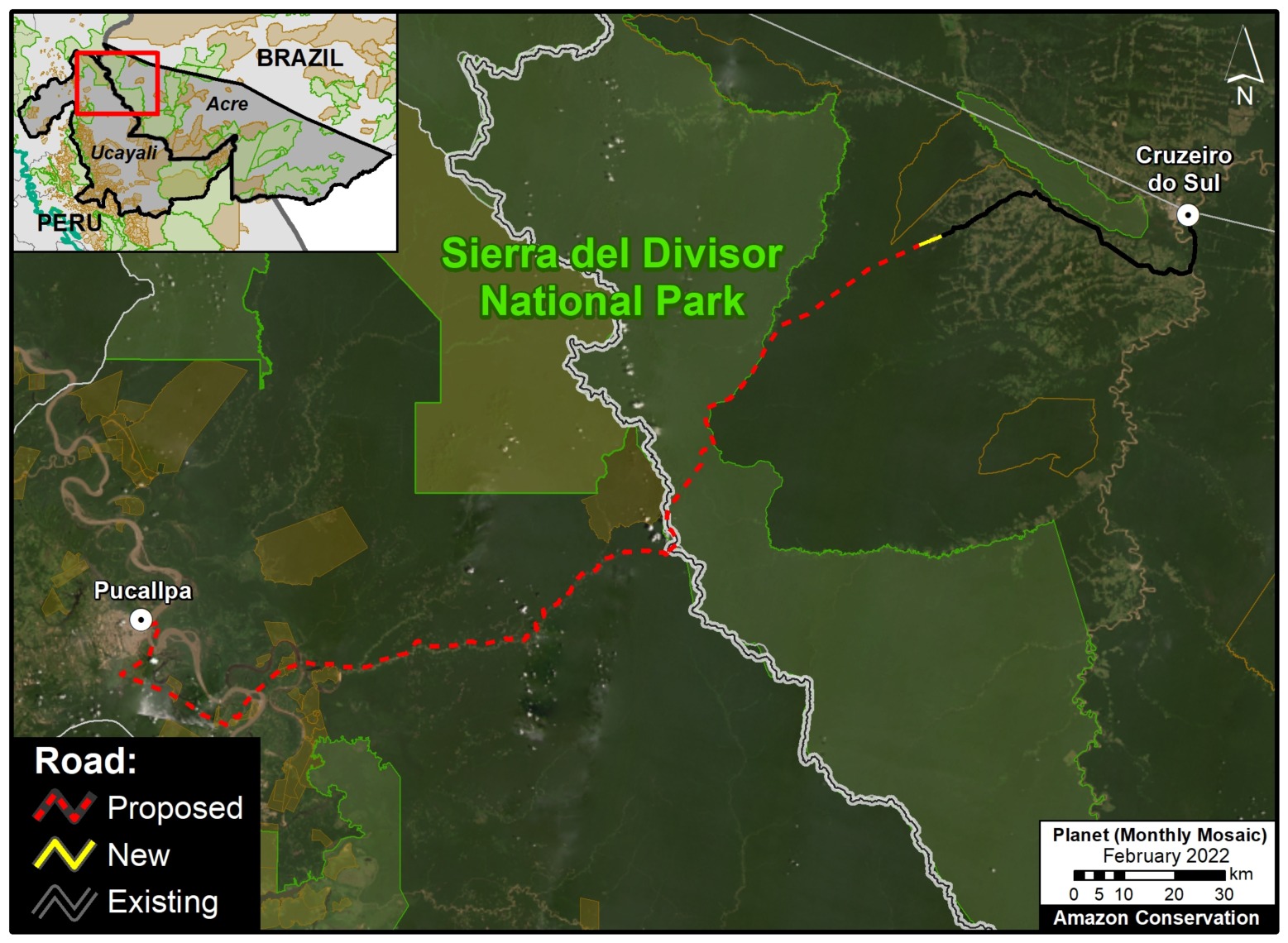
B. Pucallpa – Cruzeiro do Sul Road (Peru – Brazil)

This proposed road would connect the Peruvian city of Pucallpa with the edge of the existing road network in western Brazil, near the town of Cruzeiro do Sul. Although the potential route has several options, it would sure cut through or near Sierra del Divisor National Park in Peru and the adjacent Serra do Divisor National Park in Brazil. This area is characterized by vast primary forests, thus creating a new binational route connecting the deforestation fronts in each country could obviously trigger significant impacts. See this recent report from Diálogo Chino for more information about this road and its status and impacts.

Zoom B. Pucallpa – Cruzeiro do Sul Road. Data: MTC, MINAM, ACA, CSF, Diálogo Chino, RAISG.

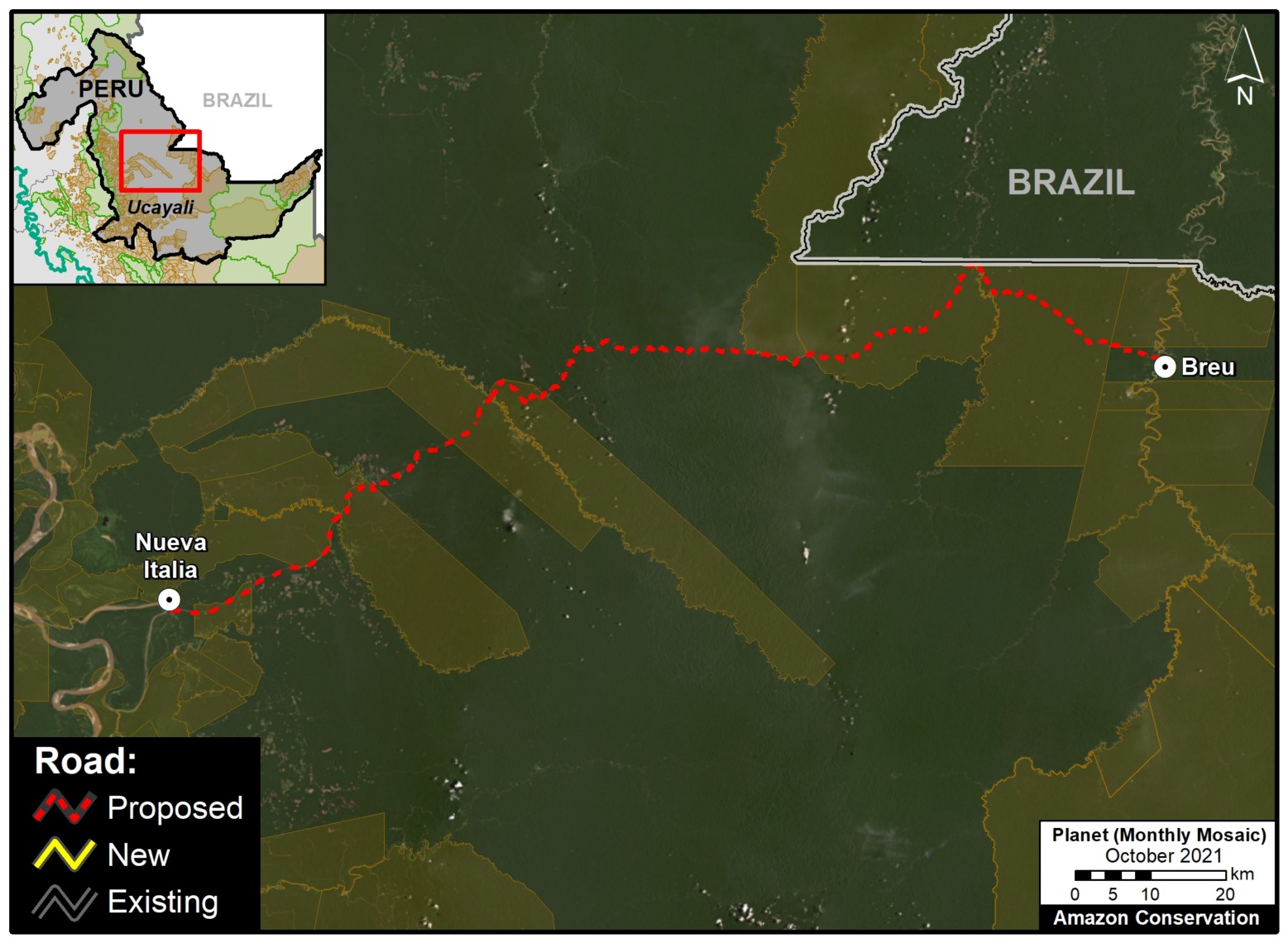
C. Yurua Road (Peru)

The new/proposed road that we refer to here as the Yurua road would connect the Peruvian towns of Nueva Italia on the Ucayali River and Breu on the Yurua River. This 200 km route was originally built as a logging road in the late 1980s to access remote timber areas in the central Peruvian Amazon, but had fallen into disrepair by the early 2000s. A recent MAAP analysis (see MAAP #146) found that between 2010 and 2021 much of the route had been rehabilitated, triggering elevated deforestation along the way. If this road were ever to be paved then impacts would likely continue to rise, including with native communities along the route. See MAAP #146 for more information about this road and its status and impacts.

Zoom C. Yurua Road. Data: MTC, MINAM, ACA, ACCA, RAISG.

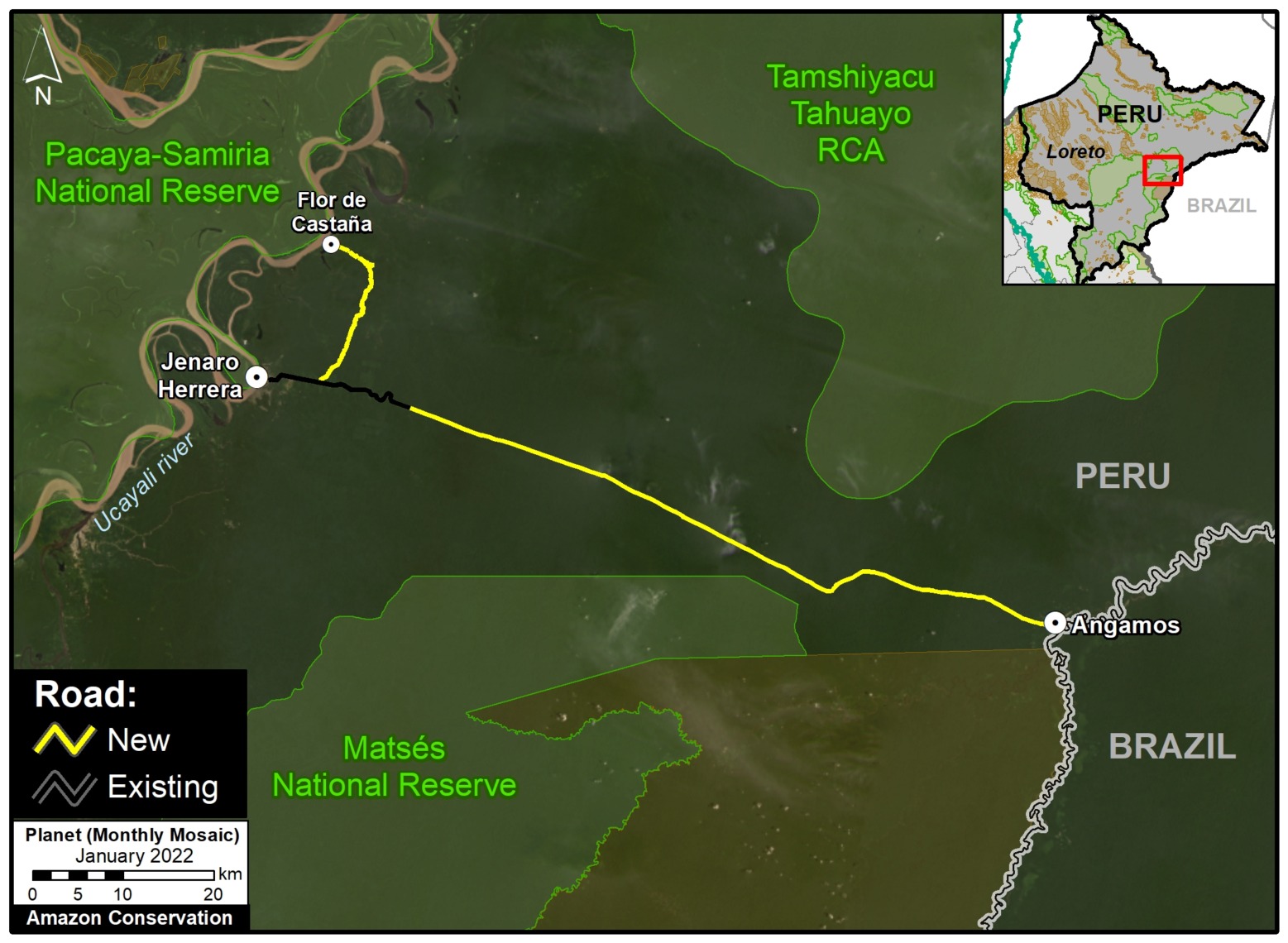
D. Genaro Herrera – Angamos Road (Peru)

This new/proposed road would build off an old track through the vast forests connecting the northern Peruvian towns of Genaro Herrera and Angamos, in the region of Loreto. In 2021, clearing began along this route, advancing over 100 kilometers from both ends. If completed and paved, the final road project would impact protected areas on both sides (including the Matsés National Reserve to the south) and pose a major threat to indigenous people in voluntary isolation reportedly living to the north. See this recent report for more information about this road and its status and impacts.

Zoom D. Genaro Herrera – Angamos Road. Data: MTC, ACA, RAISG.

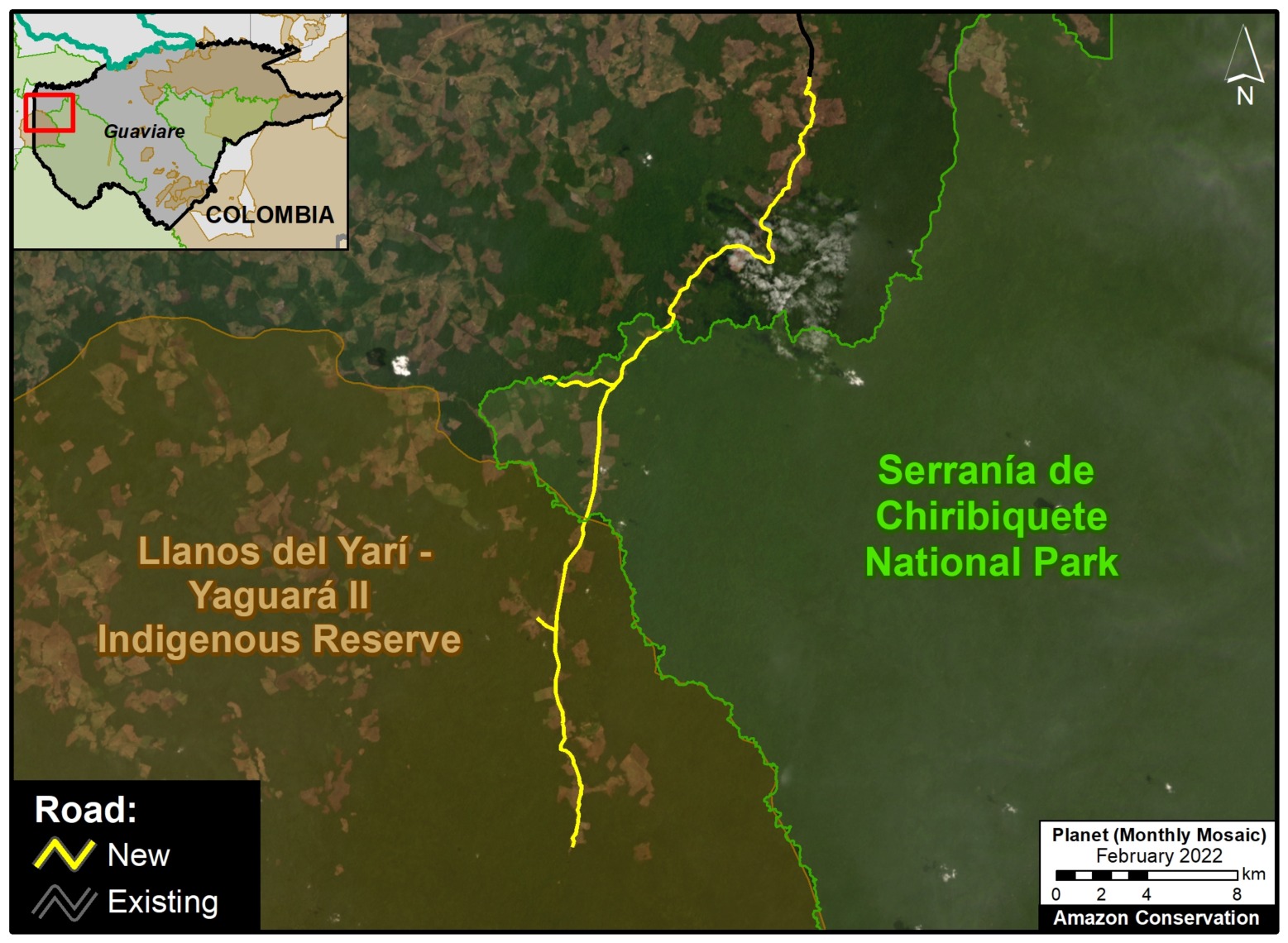
E. Cachicamo – Tunia Road (Chiribiquete National Park, Colombia)

Chiribiquete National Park, located in the heart of the Colombian Amazon, has been experiencing increasing deforestation pressures, partly due to expanding road networks around and even within the park. For example, the Cachicamo-Tunia Road, constructed in 2020, has triggered a new deforestation front in the northwest section of the park. Note this road is also impacting an adjacent Indigenous Reserve.

Zoom E. Cachicamo – Tunia Road. Data: FCDS, RAISG, ACA.

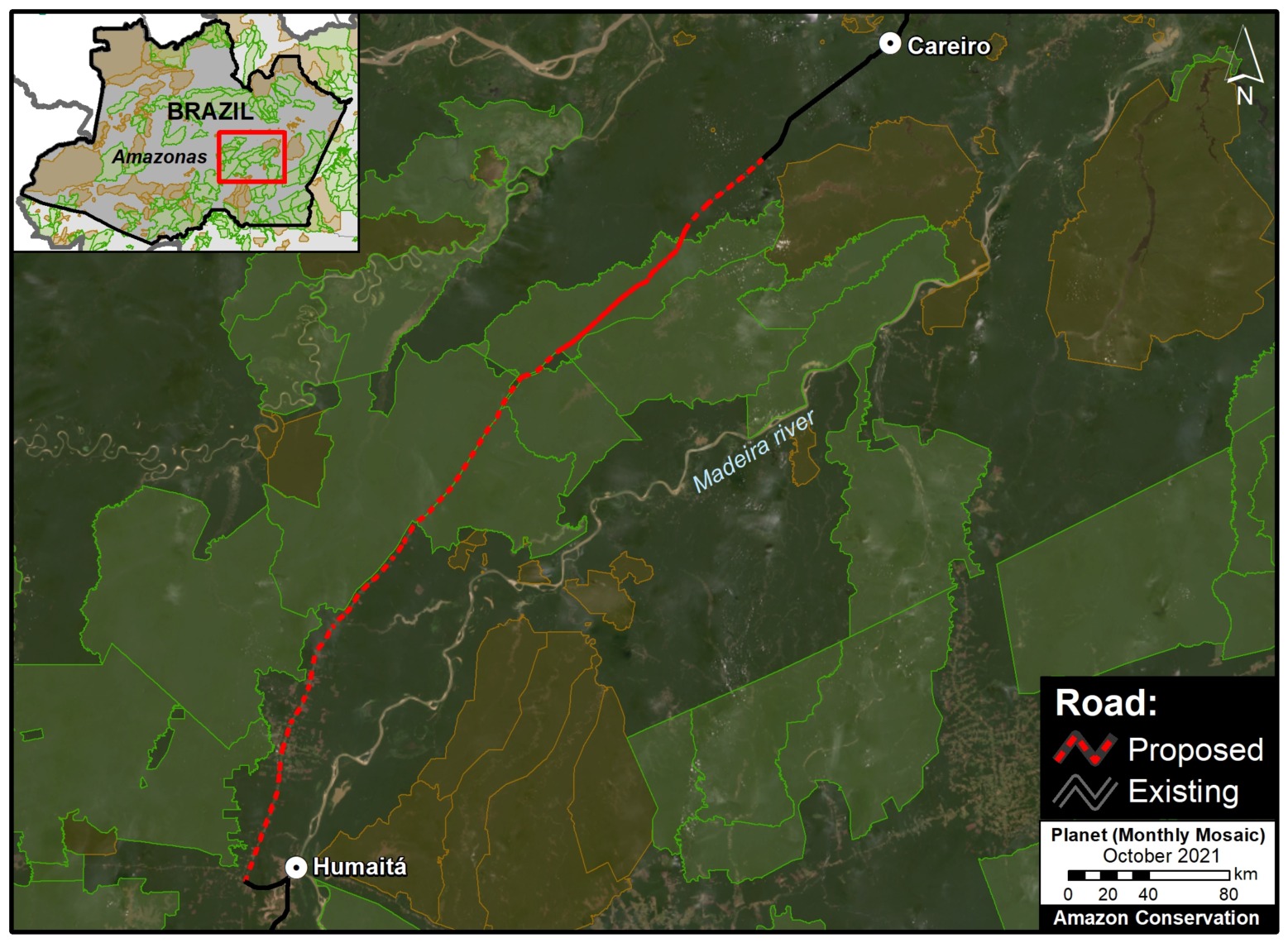
F.  Manaus – Porto Velho Road (BR-319, Brazil)

Arguably the most controversial project on the list: paving the middle section of BR-319 in the heart of the Brazilian Amazon. This nearly 900 km road connects the remote city of Manaus (otherwise only reachable by air or water) with the rest of Brazilian road network in Humaitá and Porto Velho to the south. It was built in the early 1970s but abandoned and impassable by the late 1980s, isolating Manaus once again. Since 2015, a basic maintenance program has made the road generally passable, but the main project remains: paving the 400 km middle section that passes through the core western Amazon. This paving would effectively connect Manaus with the existing highways in the south, and most likely trigger massive forest loss by extending the arc of deforestation northwards, including within and around the protected areas that surround the road. This road project has been the subject of numerous recent press reports, including investigative pieces by the Washington Post and El Pais.

Zoom F. Manaus – Porto Velho Road. Data: Ministério da Infraestrutura, ACA, RAISG.

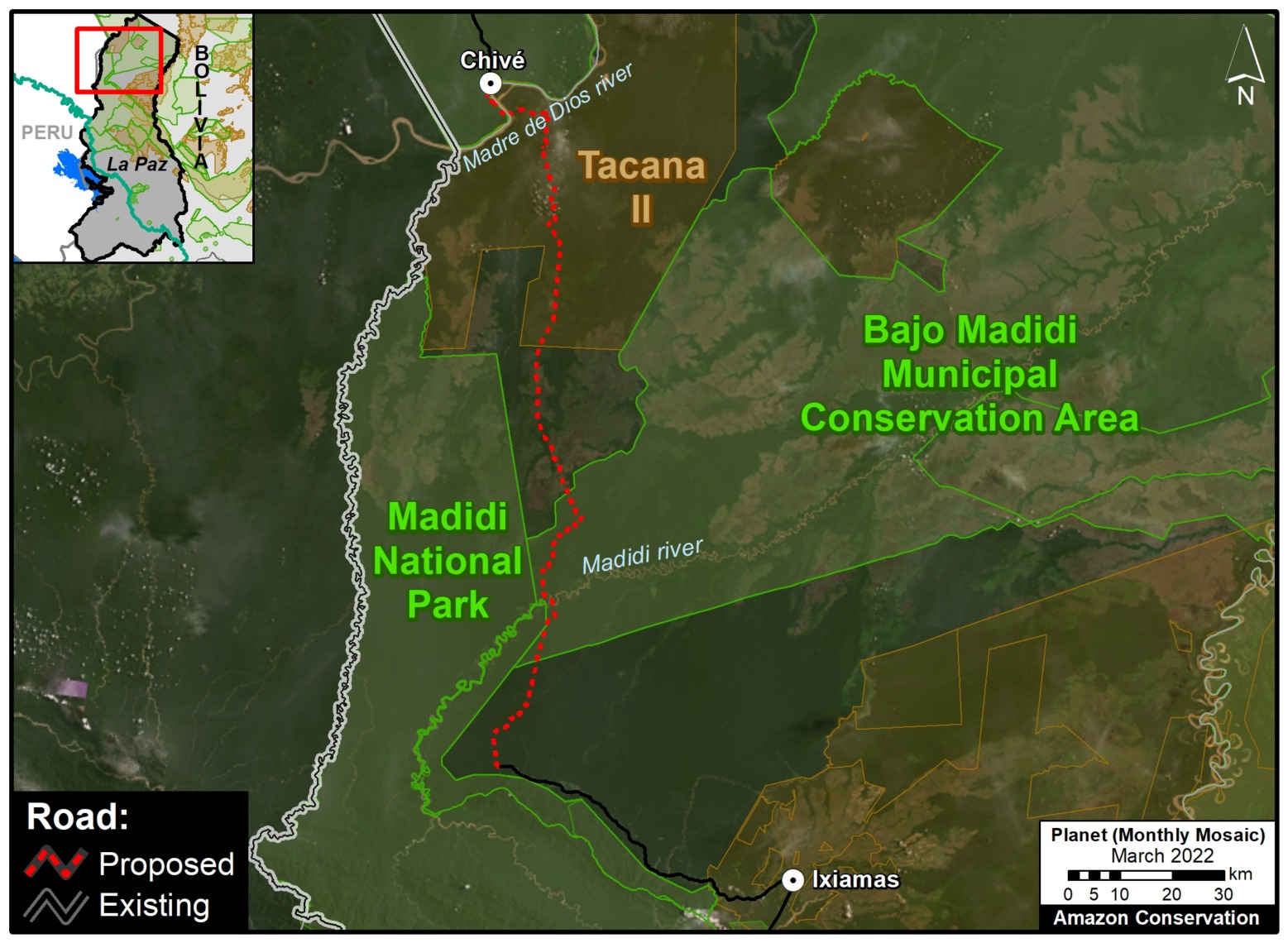
G. Ixiamas – Chivé Road (Bolivia)

In recent years, Bolivia has been seeking financing for a 250 km road linking the current frontier town Ixiamas with the isolated town Chivé, located near the Peruvian border on the Madre de Dios river. This road would cross extensive tracts of primary Amazon forest and savannah in the north of the La Paz department, including the newly created Bajo Madidi Municipal Conservation Area and the Tacana II indigenous territory.

Zoom G. Ixiamas – Chivé Road. Data: ABT, ACEAA, ACA, RAISG.

Methodology

Our analysis and maps focus on the western Amazon (Bolivia, Colombia, Ecuador, Peru, and western Brazil).

Most of the new roads were constructed in the past five years and were digitized from satellite imagery. Note that for some of these new roads, just initial rehabilitation/improvement of a rough road started and there is still potential for future impacts from paving.

Most of the proposed roads were obtained from official government data sets (and complemented by civil society reports).

We credit the following data sources: Ministerio de Transportes y Comunicaciones (Peru), Geobosques/MINAM (Peru), Ministério da Infraestrutura (Brazil),  Autoridad de Fiscalización y Control Social de Bosques y Tierra – ABT (Bolivia), Gobierno Autonomo Descentralizado Provincial de Napo (Ecuador), Fundación para la Conservación y el Desarrollo Sostenible – FCDS (Colombia), Fundación EcoCiencia (Ecuador), Diálogo Chino, Conservation Strategy Fund, RAISG, Conservación Amazónica – ACCA (Peru), Conservación Amazónica – ACEAA (Bolivia), and Amazon Conservation (digitalization of some new and proposed roads).

Reference:
Vilela et al (2020) A better Amazon road network for people and the environment. PNAS 17 (13) 7095-7102.

Acknowledgments

We especially thank Diálogo Chino for their support of this report. We also thank E. Ortiz, S. Novoa, S. Villacis, D. Larrea, M. Terán, and D. Larrea for helpful comments on earlier drafts of the text and images.

Citation

Finer M, Mamani N (2022) New and Proposed Roads Across the Western Amazon. MAAP: 157.

MAAP #154: Illegal Gold Mining in the Peruvian Amazon – 2022 update

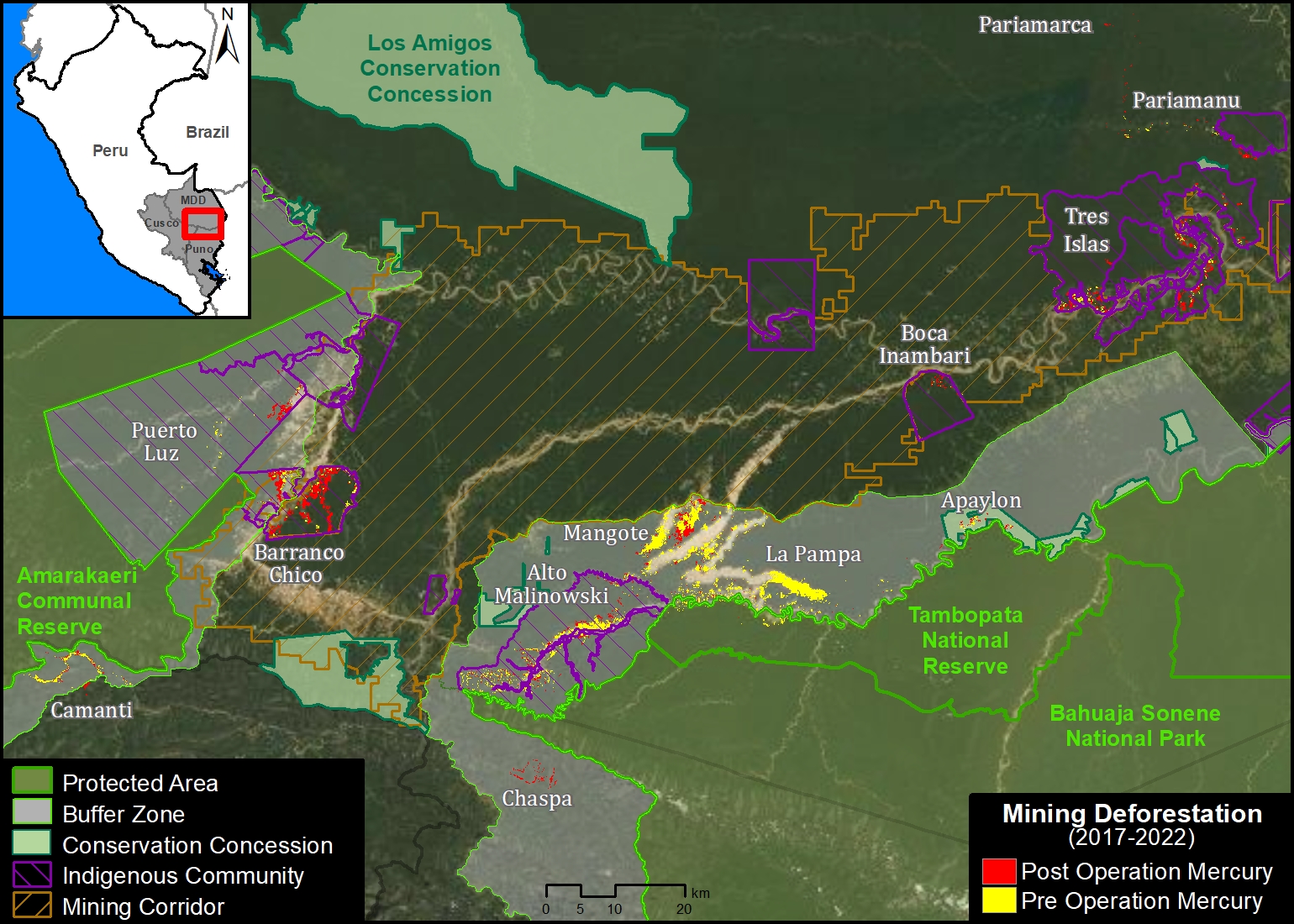
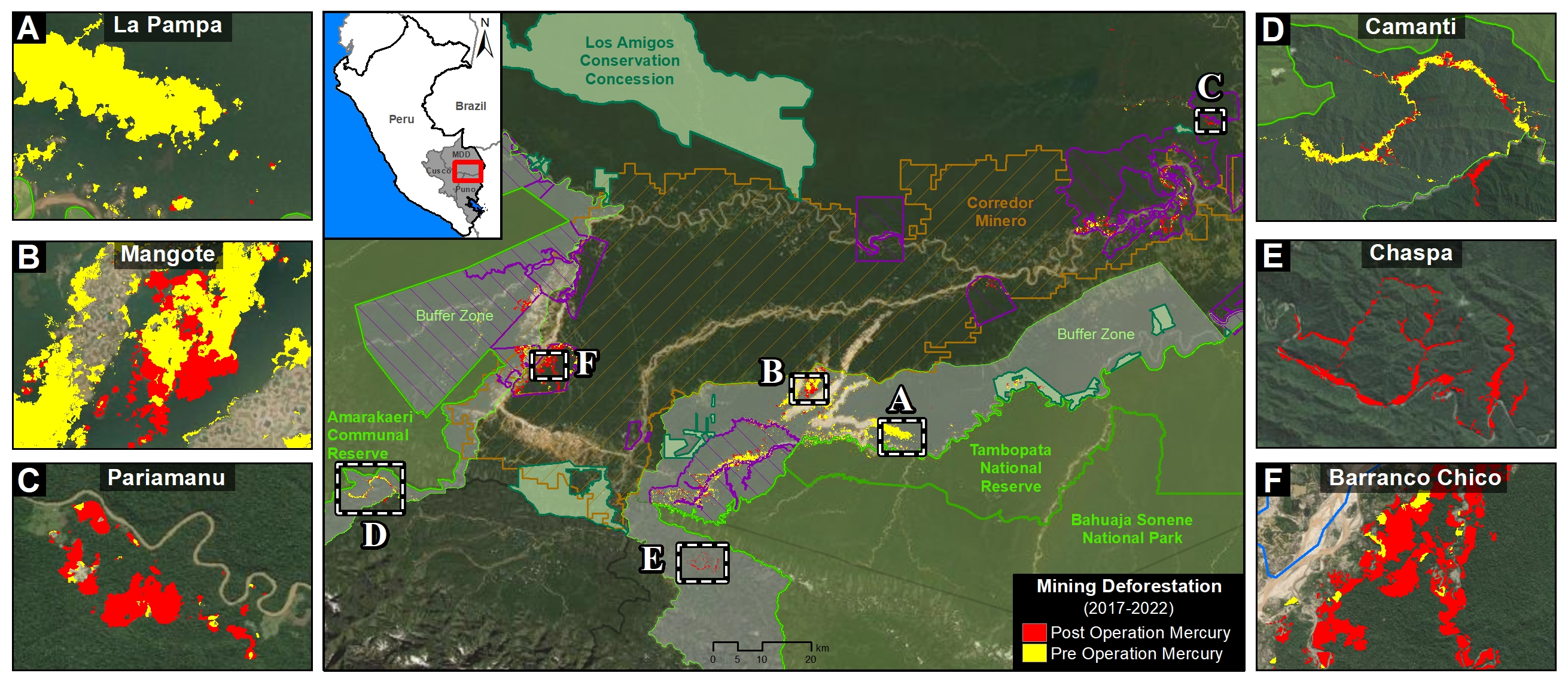
Base Map. Locations of illegal gold mining sites in the southern Peruvian Amazon analyzed in this report. Click to enlarge. Data: MAAP/ACA.

Illegal gold mining reached crisis levels in the southern Peruvian Amazon in 2017 and 2018, clearing over 1,200 hectares (3,000 acres) in the most critically impacted area, known as La Pampa (located in the buffer zone of Tambopata National Reserve, region of Madre de Dios).

In early 2019, the Peruvian government launched Operation Mercury, an unprecedented long-term crackdown on illegal mining, with an initial focus in La Pampa.

Here, we present an updated analysis of illegal gold mining in the Peruvian Amazon. Specifically, we compare rates of deforestation before vs after Operation Mercury at the most important illegal mining sites (see Base Map).

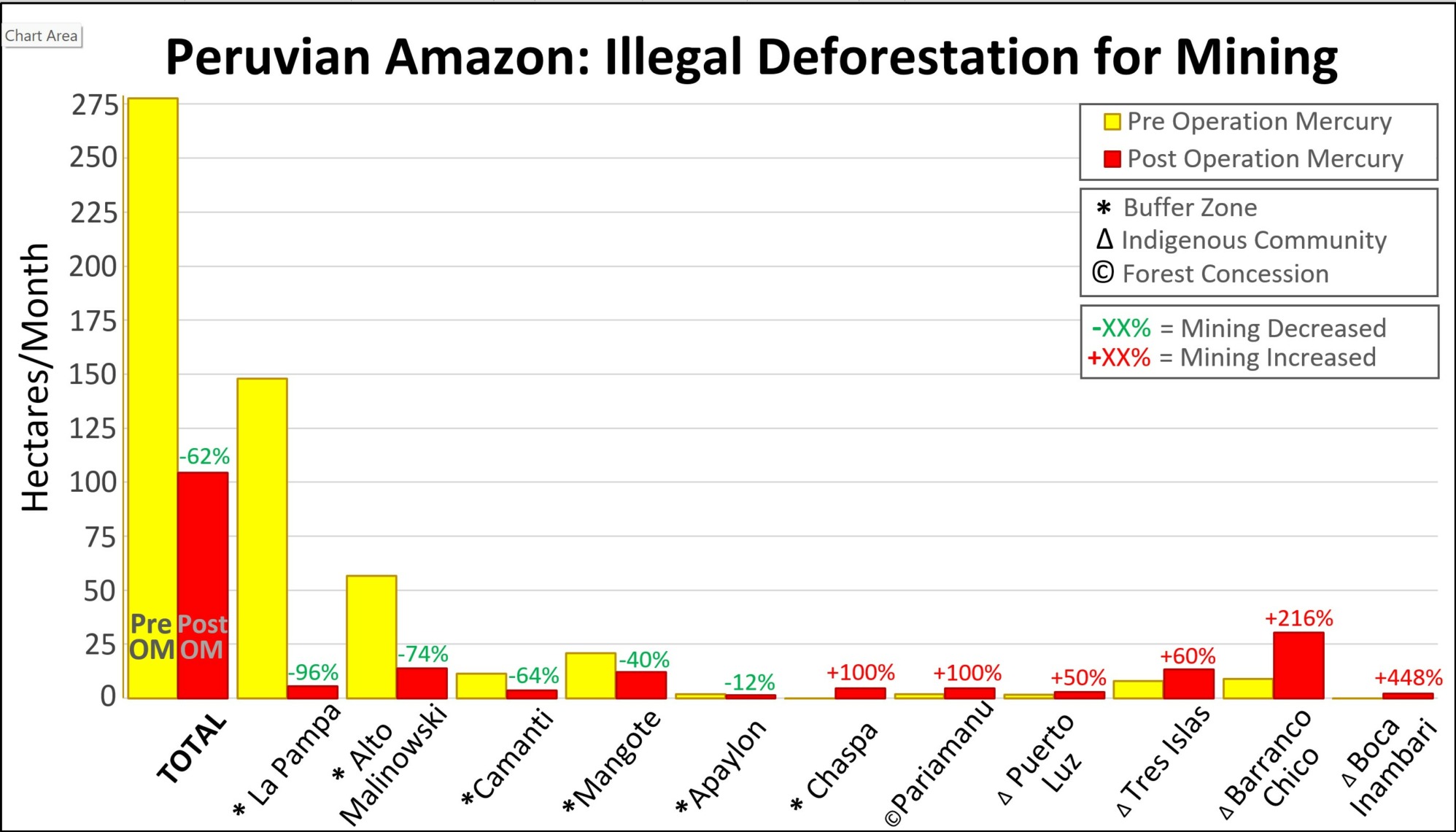
We found that illegal gold mining deforestation decreased 62% overall across all sites following Operation Mercury, including a remarkable 96% decrease in La Pampa.

However, illegal mining deforestation has increased at several key sites, most notably indigenous territories.


Results: Base Map

The Results Map below illustrates the major findings. Red indicates gold mining deforestation post-Operation Mercury (3,688 hectares between March 2019 and December 2021), while yellow indicates the pre Operation baseline (6,933 hectares between January 2017 and February 2019).

Note that deforestation in the most critical illegal mining front, La Pampa (Tambopata National Reserve buffer zone), has essentially been stopped. However, mining continues in other key areas such as Mangote, Pariamanu, Camanti (Amarakaeri Commuanl Reserve buffer zone), Chaspa (Bahuaja Sonene National Park buffer zone), leading to new government interventions in each of these areas.

Regarding Native Communities, the most impacted after Operation Mercury include Barranco Chico (1,098 hectares), Tres Islas (503 hectares), Puerto Luz (136 hectares), and Kotsimba (inside the Alto Malinowski area; 518 hectares). The government has recently conducted two raids in Barranco Chico, indicating they are aware of this situation.

Results Map. Major gold mining fronts in the southern Peruvian Amazon before (yellow) and after (red) Operation Mercury. Data: MAAP. Click to enlarge.

Results: Graph

The Results Graph below further details the major findings:

  • Overall, gold mining deforestation decreased 62% across all sites following Operation Mercury (from 279 to 105 hectares per month).
    h
  • Most notably, mining deforestation decreased 96% in La Pampa, the most critically impacted area (from 149 to 6.5 hectares per month).
    j
  • Mining deforestation decreased 81% in the other sites within the buffer zones of key protected area (Tambopata National Reserve, Bahuaja Sonene National Park, and Amarakaeri Communal Reserve).
    j
  • Mining deforestation increased 100% in two new critical fronts, Pariamanu and Chaspa.
    g
  • Mining deforestation increased 128% in the four Native Communities (Barranco Chico, Boca Inambari, Tres Islas, and Puerto Luz).
Results Graph. Data: ACA/MAAP.

Very High Resolution Satellite Imagery (Skysat)

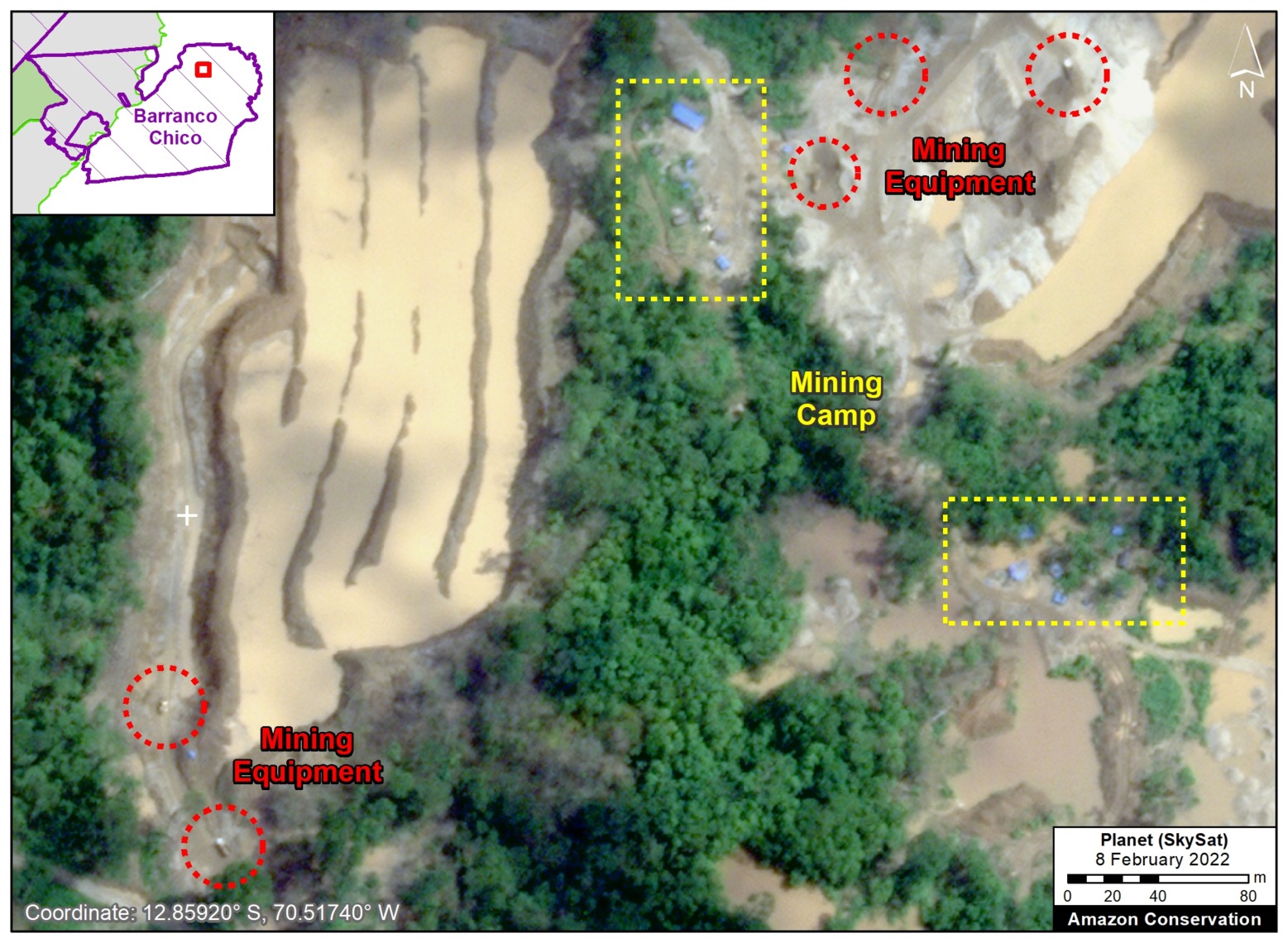
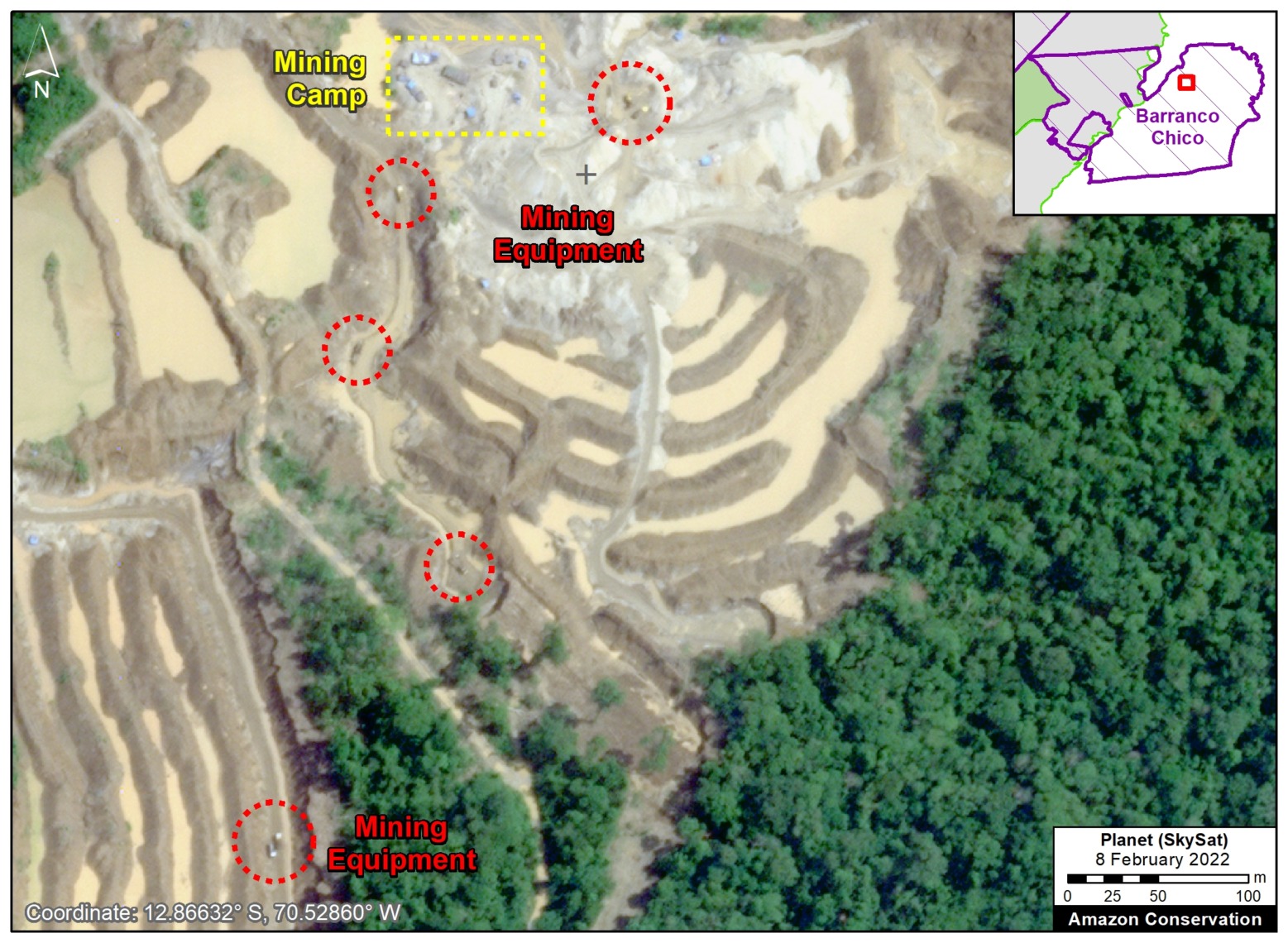
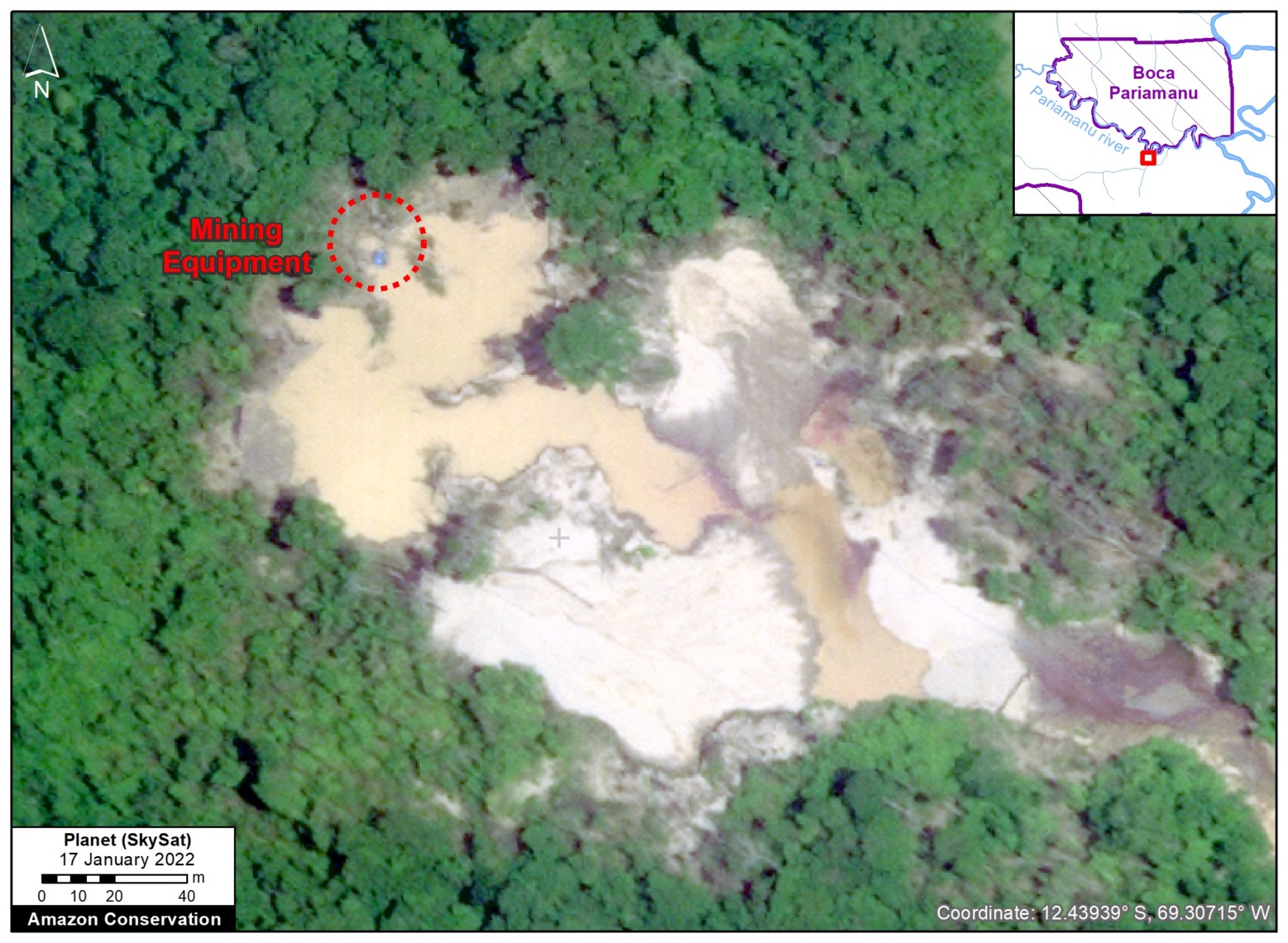
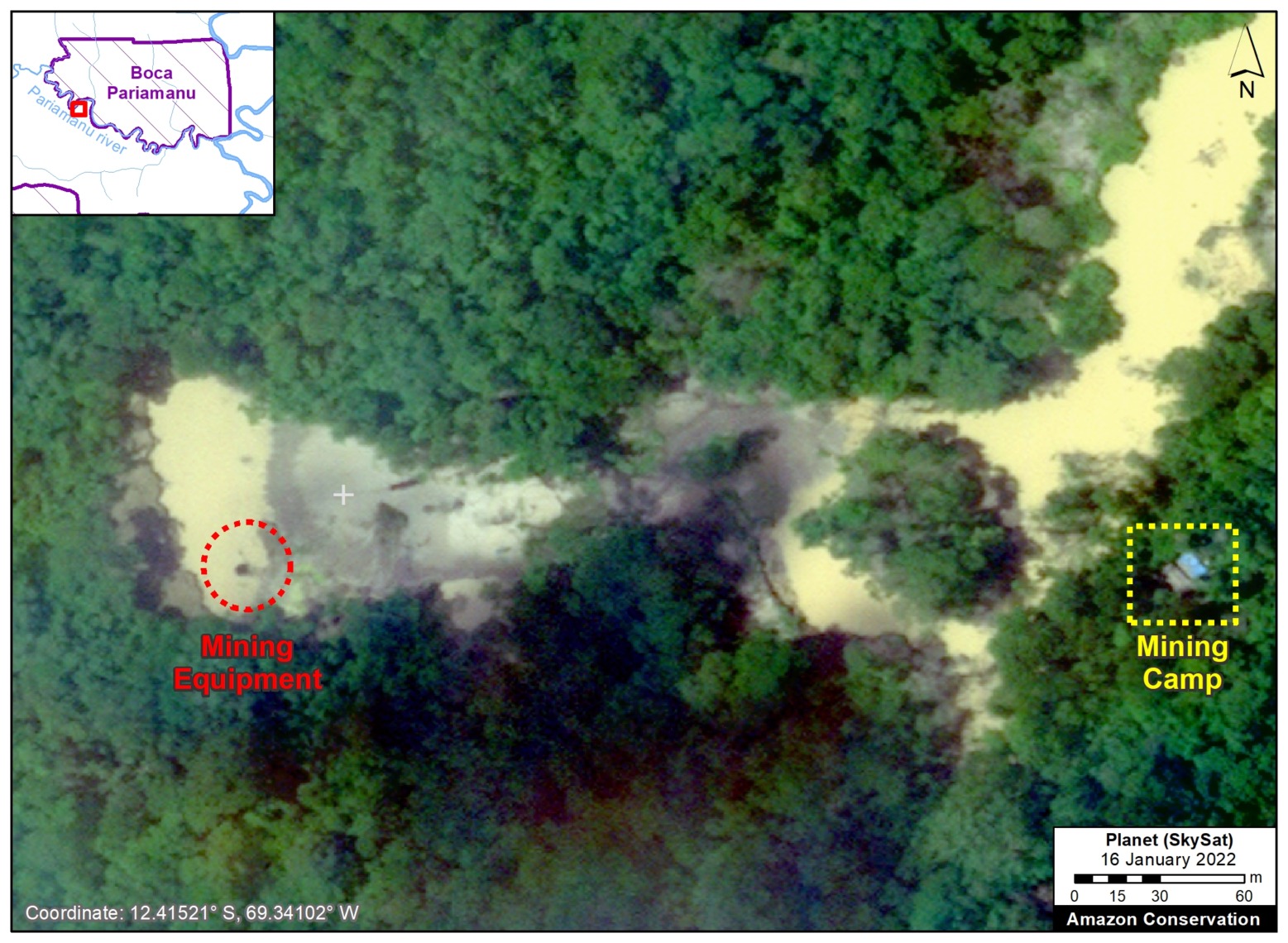
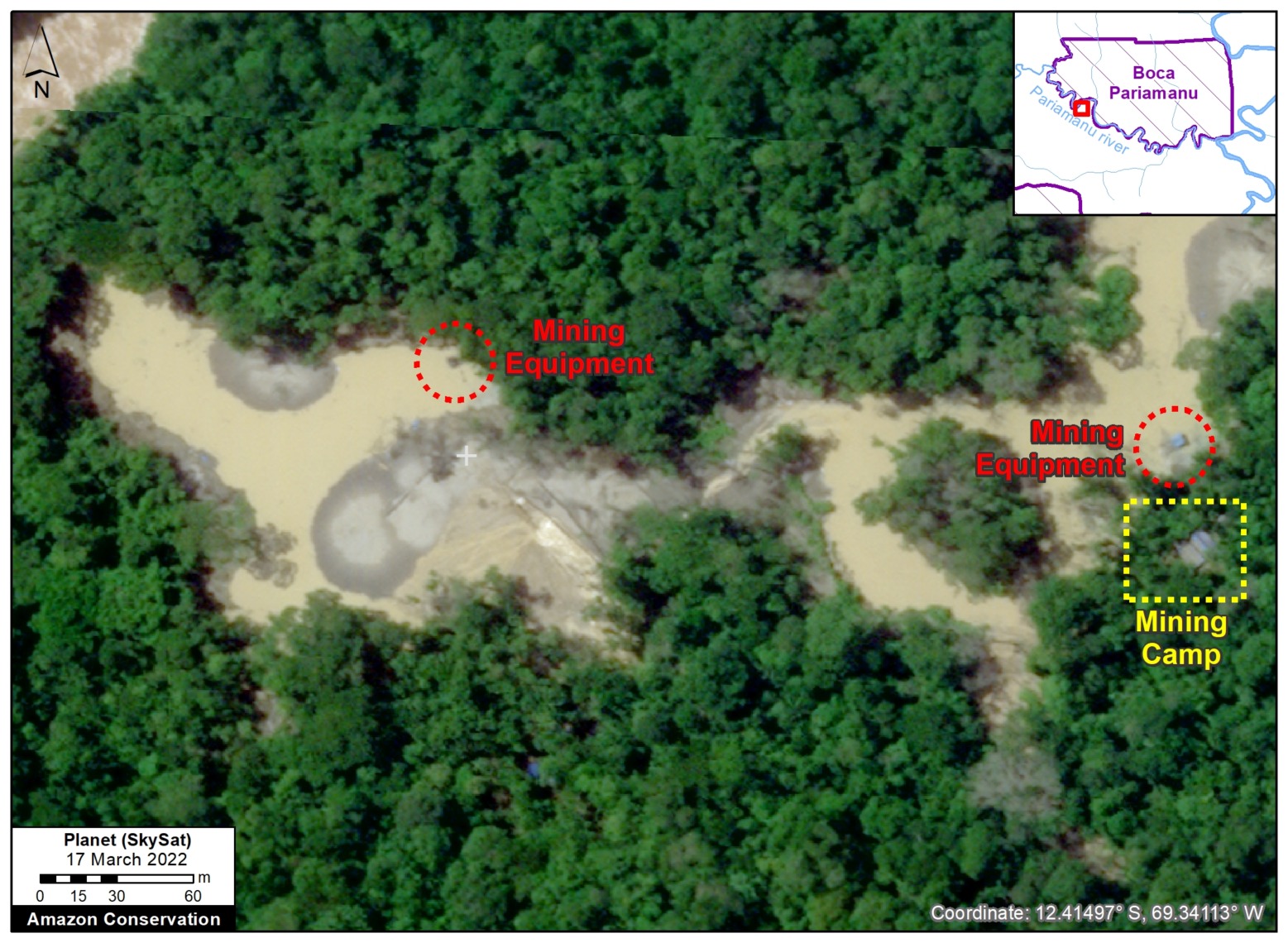
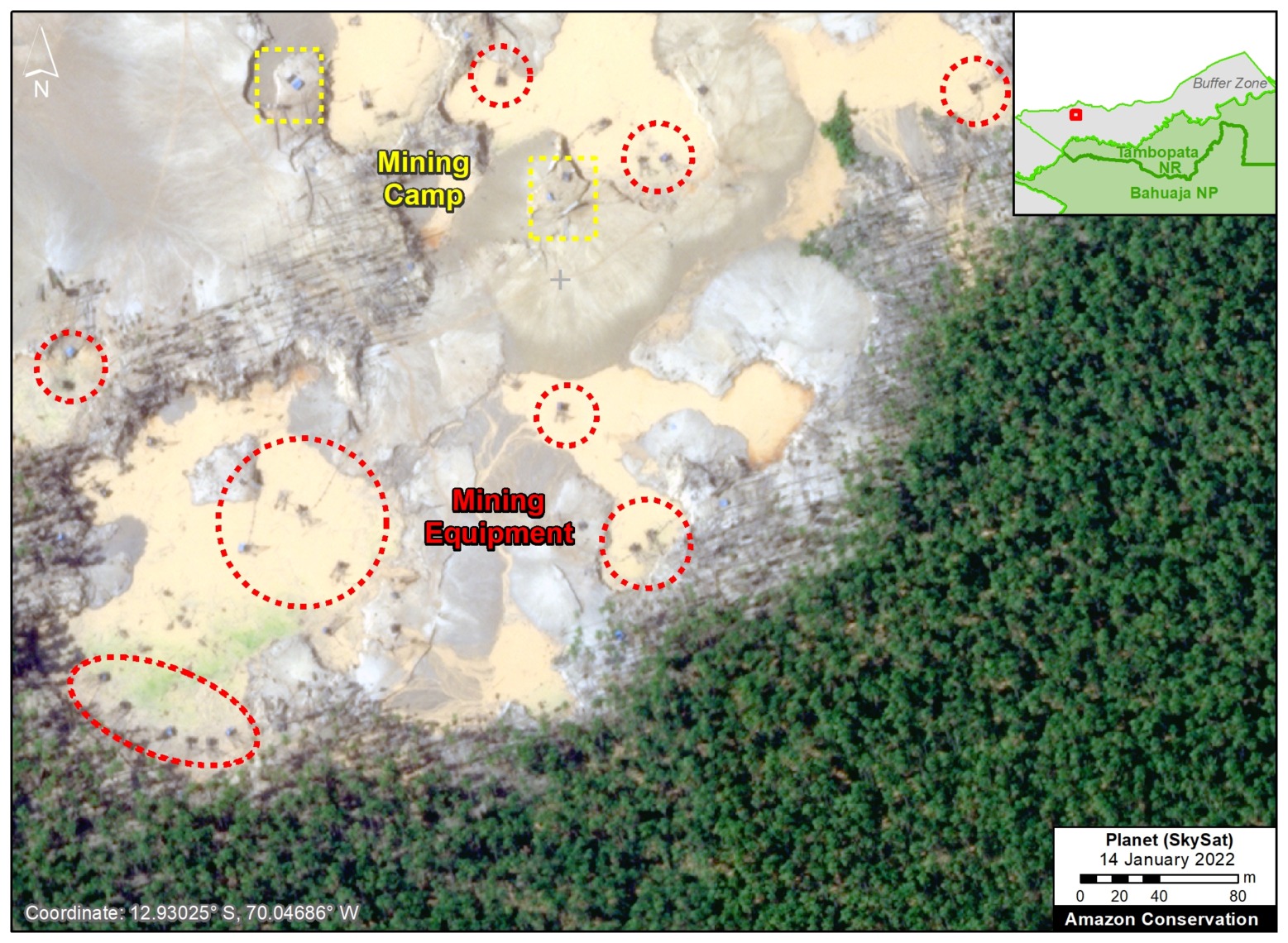
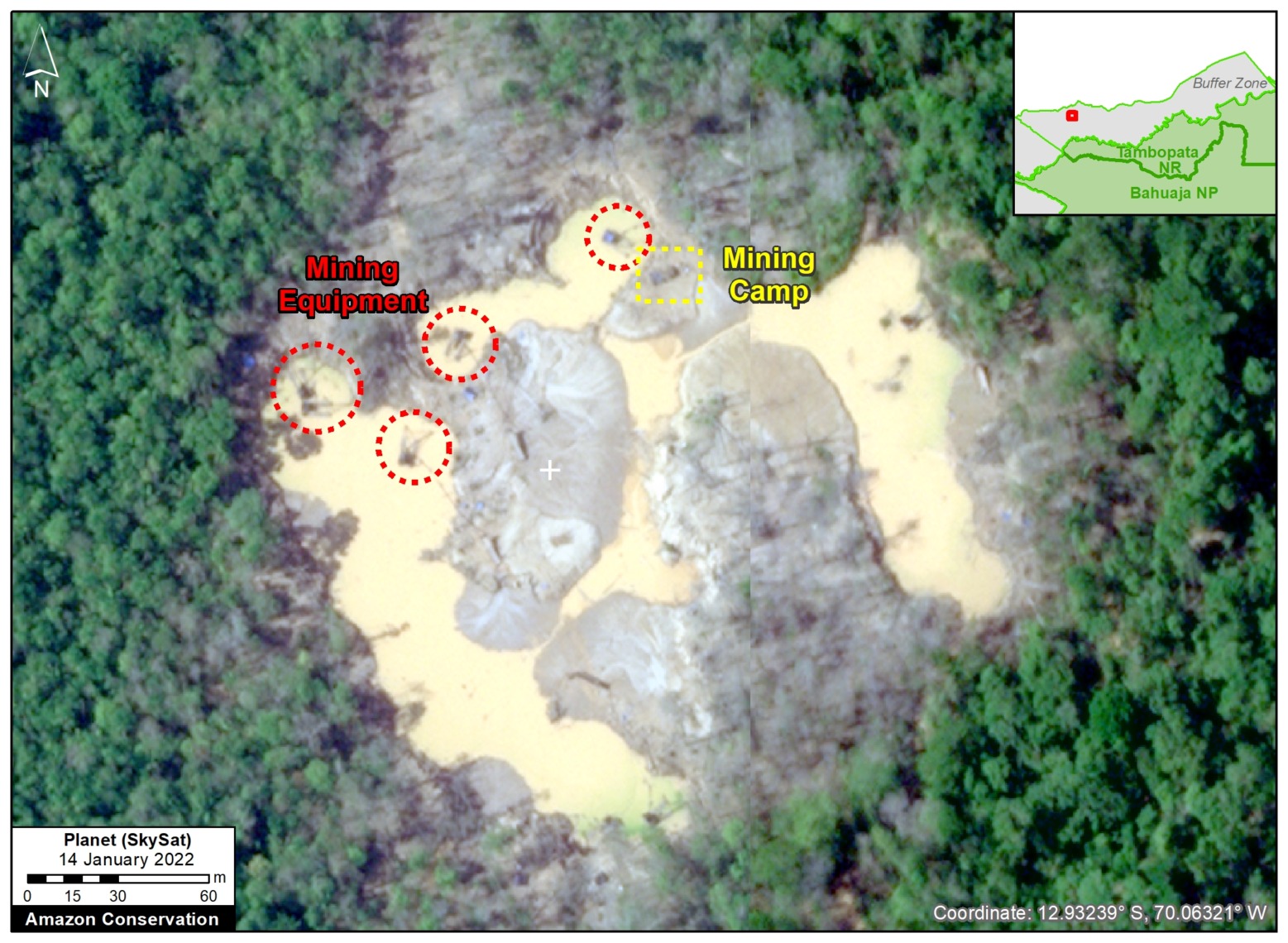
Below, we show a striking series of recent (January to March 2022) and very high resolution (0.5 meter Skysat) images of three primary current illegal mining sites: Barranco Chico, Pariamanu and Mangote. These images reveal machinery and infrastructure (indicated by red circles) as well as camps (indicated by yellow squares) directly associated with illegal gold mining activity.

Native Community Barranco Chico

Native Community Barranco Chico 1. Data: MAAP/ACA, Skysat/Planet.
Native Community Barranco Chico 2. Data: MAAP/ACA, Skysat/Planet.

Pariamanu

Pariamanu 1. Data: MAAP/ACA, Skysat/Planet.
Pariamanu 2. Data: MAAP/ACA, Skysat/Planet.
Pariamanu 3. Data: MAAP/ACA, Skysat/Planet.

Mangote

Mangote 1. Data: MAAP/ACA, Skysat/Planet.


Mangote 2. Data: MAAP/ACA, Skysat/Planet.


Methodology

We analyzed high-resolution imagery (3 meters) from the satellite company Planet obtained from their interface Planet Explorer. Based on this imagery, we digitized gold mining deforestation across ten major sites: La Pampa, Mangote, Alto Malinowski, Camanti, Pariamanu/Pariamarca, Apaylon, Chaspa, Barranco Chico, and Boca Inambari. These were identified as the major active illegal gold mining deforestation fronts based on analysis of automated forest loss alerts generated by University of Maryland (GLAD alerts) and the Peruvian government (Geobosques) and additional land use layers. The area referred to as the “mining corridor” is not included in the analysis because the issue of legality is more complex.

Across these sites, we identified, digitized, and analyzed all visible gold mining deforestation between January 2017 and the present (December 2021). We defined before Operation Mercury as data from January 2017 to February 2019, and after Operation Mercury as data from March 2019 to the present. Given that the former was 26 months and the latter 32 months, during the analysis the data was standardized as gold mining deforestation per month.

The data is updated through December 2021.

Acknowledgments

We thank O. Liao, S. Otoya, J. Guerra, K. Nielsen, S. Novoa, M.E. Gutierrez, Z. Romero, and G. Palacios for their helpful comments on this report.

This report was conducted with technical assistance from USAID, via the Prevent project. Prevent works with the Government of Peru, civil society and the private sector to prevent and combat environmental crimes for the sake of the conservation of the Peruvian Amazon, particularly in the regions of Loreto, Madre de Dios and Ucayali.

This publication is made possible with the support of the American people through USAID. Its content is the sole responsibility of the authors and does not necessarily reflect the views of USAID or the US government.

Citation

Finer M, Mamani N, Spore J (2021) Peruvian Amazon Illegal Gold Mining update. MAAP: #154.

MAAP #153: Amazon Deforestation Hotspots 2021

Amazon Base Map. Deforestation hotspots across the Amazon in 2021 (as of September 18). Data: UMD/GLAD, ACA/MAAP.

We present a first look at the major 2021 Amazon deforestation hotspots.*

The Amazon Base Map illustrates several key findings:p

  • We estimate the loss of over 1.9 million hectares (4.8 million acres) of primary forest loss across the nine countries of the Amazon biome in 2021.
    k
  • This matches the previous two years, bringing the total deforestation to 6 million hectares (15 million acres) since 2019, roughly the size of the state of West Virginia.
    p
  • In 2021, most of the deforestation occurred in Brazil (70%), followed by Bolivia (14%), Peru (7%), and Colombia (6%).
    p
  • In Brazil, hotspots are concentrated along the major road networks. Many of these areas were also burned following the deforestation.
    j
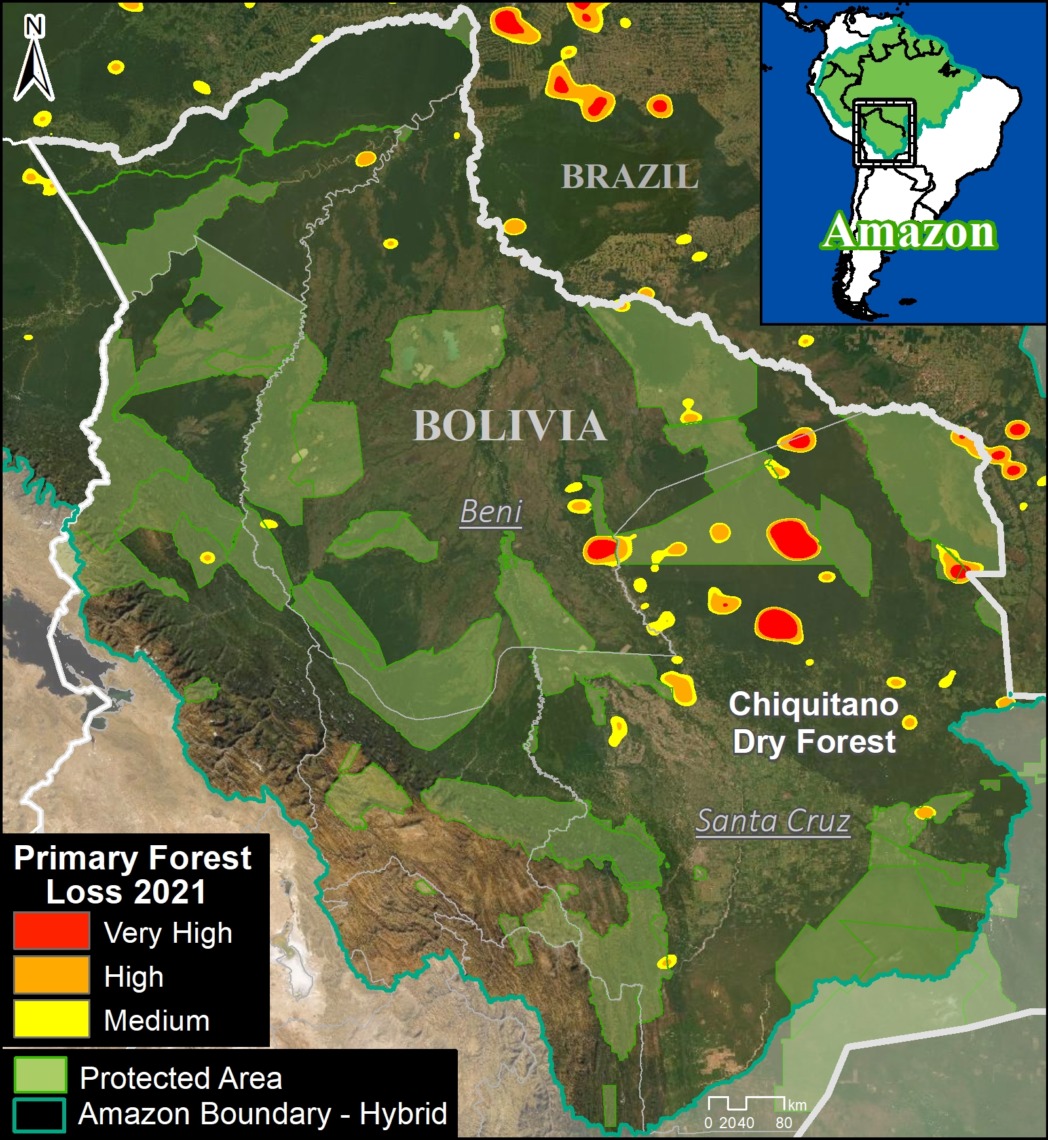
  • In Bolivia, fires once again impacted several important ecosystems, including the Chiquitano dry forests.
    p
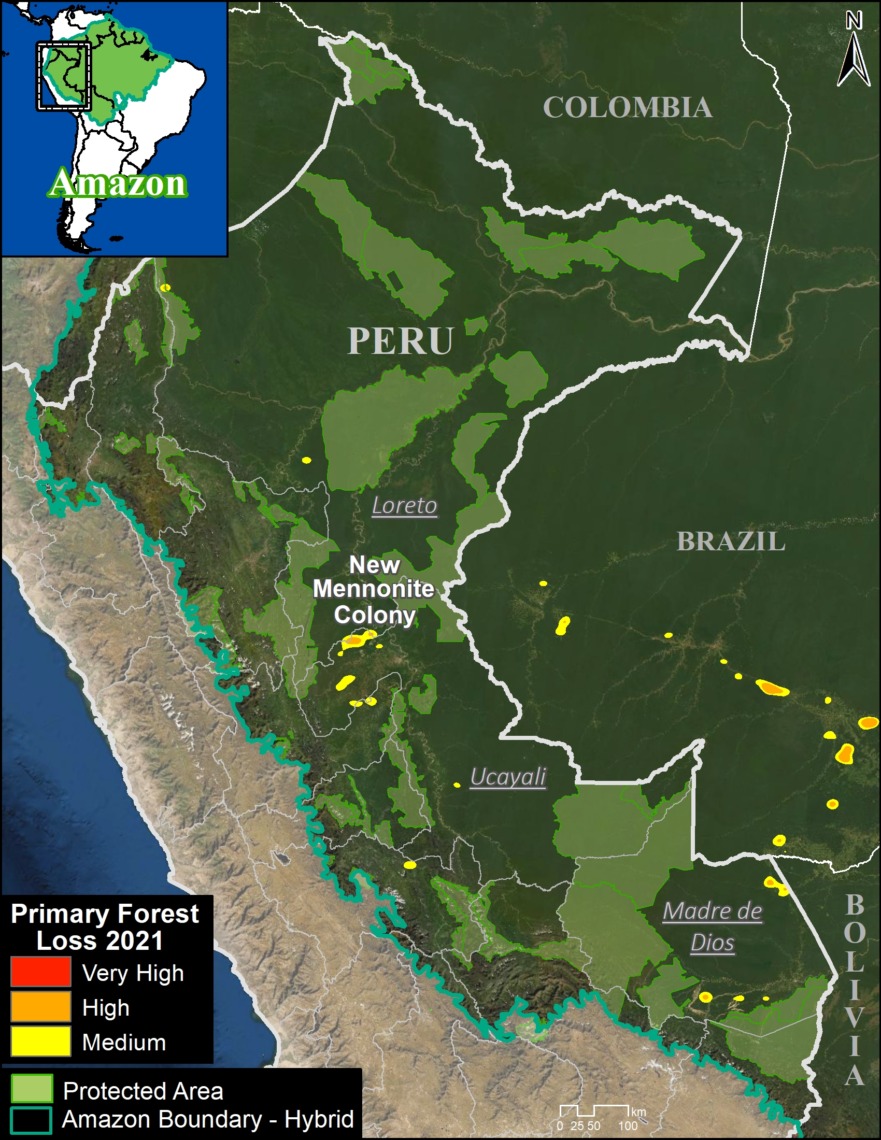
  • In Peru, deforestation continues to impact the central region, most notably from large-scale clearing for a new Mennonite colony.
    p
  • In Colombia, there continues to be an arc of deforestation impacting numerous protected areas and indigenous territories.

Below, we zoom in on the four countries with the highest deforestation (Brazil, Bolivia, Peru, and Colombia), with additional maps and analysis.

Brazil Base Map. Deforestation hotspots in Brazilian Amazon. Data: UMD/GLAD, ACA/MAAP.

Brazilian Amazon

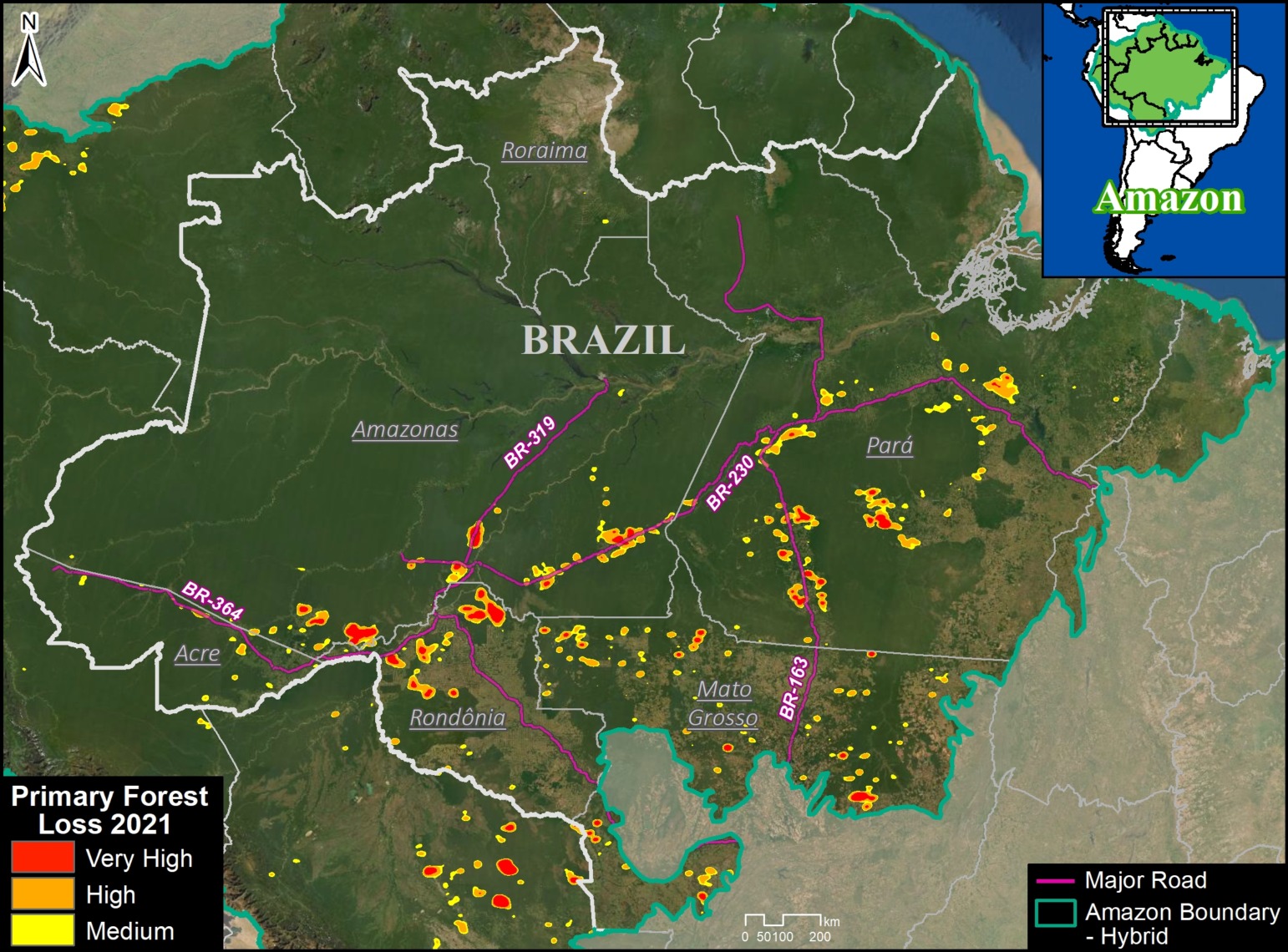
The Brazil Base Map shows the notable concentration of deforestation hotspots along the major roads (especially roads 163, 230, 319, and 364) in the states of Acre, Amazonas, Pará, and Rondônia.


Bolivia Base Map. Deforestation hotspots in Bolivian Amazon. Data: UMD/GLAD, ACA/MAAP.

Bolivian Amazon

The Bolivia Base Map shows the concentration of hotspots due to major fires in the Chiquitano dry forest biome, largely located in the department of Santa Cruz in the southeast section of the Amazon.


Peru Base Map. Deforestation hotspots in the Peruvian Amazon. Data: UMD/GLAD, ACA/MAAP.

Peruvian Amazon

The Peru Base Map shows the concentration of deforestation in the central Amazon (Ucayali region).

We highlight the rapid deforestation (365 hectares) for a new Mennonite colony in 2021, near the town of Padre Marquez (see MAAP #149).

Also, note some additional hotspots in the south (Madre de Dios region), but these are largely from expanding agriculture instead of the historical driver of gold mining.

Indeed, gold mining deforestation has been greatly reduced due to government actions, but this illegal activity still threatens several key areas and indigenous territories (MAAP #130).


Colombia Base Map. Deforestation hotspots in northwest Colombian Amazon. Data: UMD/GLAD, ACA/MAAP.

Colombian Amazon

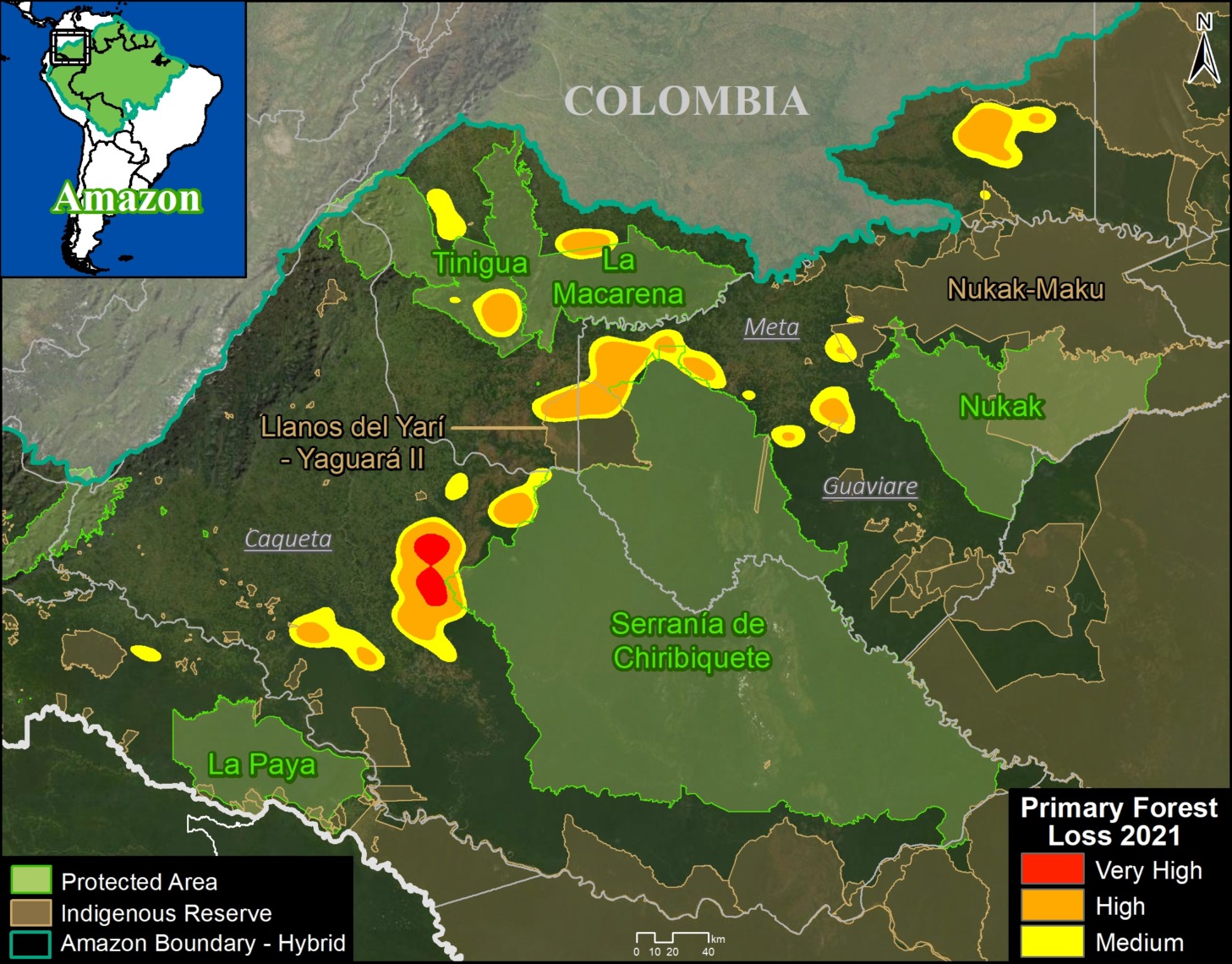
As described in previous reports (see MAAP #120), the Colombia Base Map shows there continues to be an “arc of deforestation” in the northwest Colombian Amazon (Caqueta, Meta, and Guaviare departments).

This arc impacts numerous Protected Areas (particularly Tinigua and Chiribiquete National Parks) and Indigenous Reserves (particularly Yari-Yaguara II and Nukak Maku).


*Notes and Methodology

The analysis was based on 10-meter resolution primary forest loss alerts (GLAD+) produced by the University of Maryland and also presented by Global Forest Watch. These alerts are derived from the Sentinel-2 satellite operated by the European Space Agency.

We emphasize that this data represents a preliminary estimate and more definitive annual data will come later in the year.

We also note that this data does include forest loss caused by natural forces and burned areas.

Our geographic range for the Amazon is a hybrid between both the biogeographic boundary (as defined by RAISG) and watershed boundary, designed for maximum inclusion.

To identify the deforestation hotspots, we conducted a kernel density estimate. This type of analysis calculates the magnitude per unit area of a particular phenomenon, in this case, forest cover loss. We conducted this analysis using the Kernel Density tool from the Spatial Analyst Tool Box of ArcGIS. We used the following parameters:

Search Radius: 15000 layer units (meters)
Kernel Density Function: Quartic kernel function
Cell Size in the map: 200 x 200 meters (4 hectares)
Everything else was left to the default setting.

For the Base Map, we used the following concentration percentages: Medium: 5-7%; High: 7-14%; Very High: >14%.

Acknowledgements

This work was supported by NORAD (Norwegian Agency for Development Cooperation) and ICFC (International Conservation Fund of Canada).

Citation

Finer M, Mamani N, Spore J (2022) Amazon Deforestation Hotspots 2021. MAAP: 153.

MAAP #150: New Oil Platforms Deeper into Yasuni National Park (Ecuador), towards Uncontacted Indigenous Zone

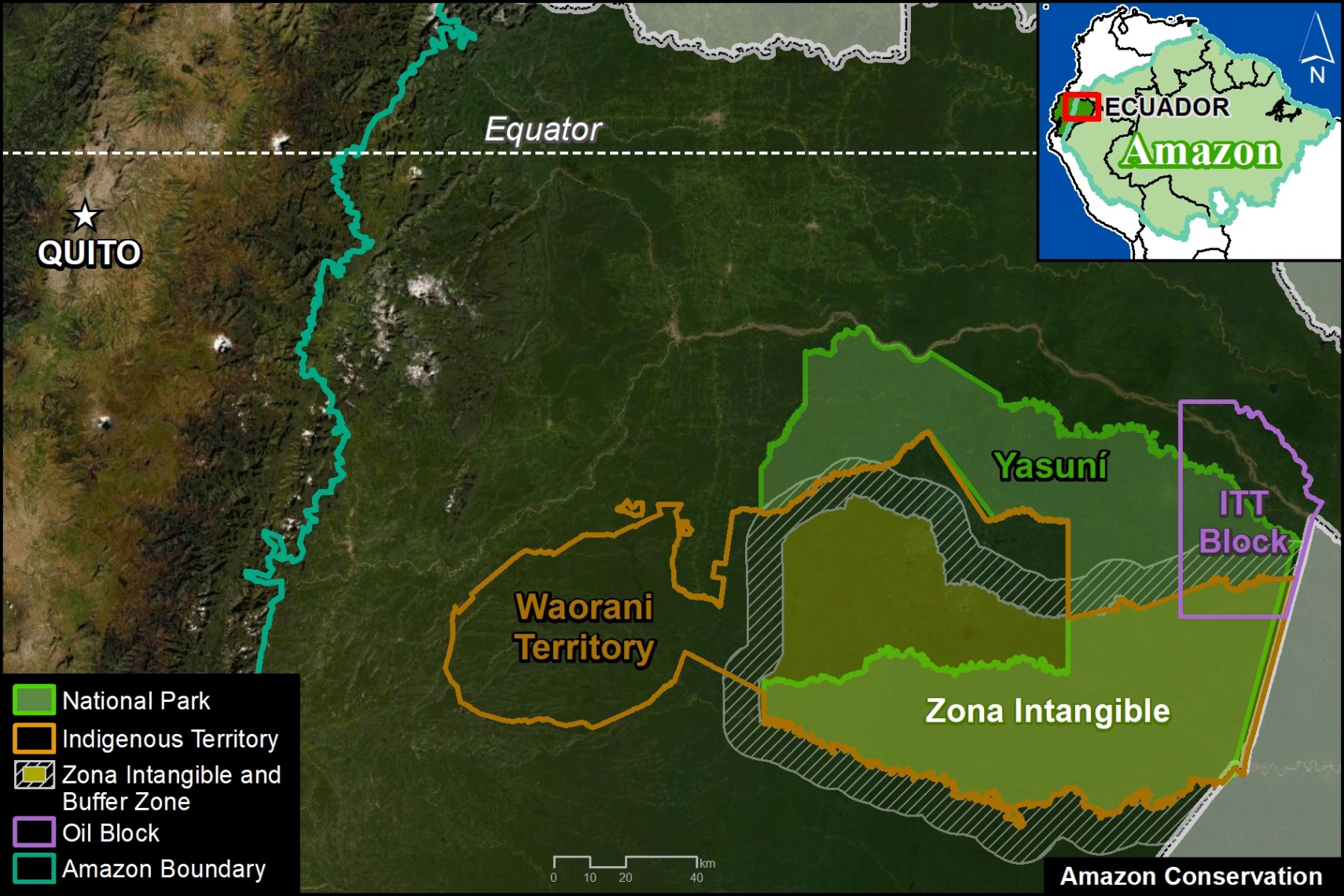
Base Map. Location of Yasuni National Park, ITT Block, and Zona Intangible in the Ecuadorian Amazon.

Yasuni National Park, located in the heart of the Ecuadorian Amazon, is one of the most biodiverse places in the world thanks to its unique location at the intersection of the Amazon, Andes Mountains, and the equator (see Base Map).

In addition, it is part of the ancestral territory of the Waorani indigenous peoples. The entire southern portion of Yasuni National Park has been declared an Untouchable Zone (Zona Intangible) to protect the territory of the relatives of the Waorani who live in voluntary isolation (Tagaeri-Taromenane).

In a series of previous reports, we have shown the construction of oil drilling platforms (and associated access road) in the ITT Block. This controversial block, run by the state oil company Petroecuador, is located in the remote and largely intact northeast sector of Yasuni National Park.

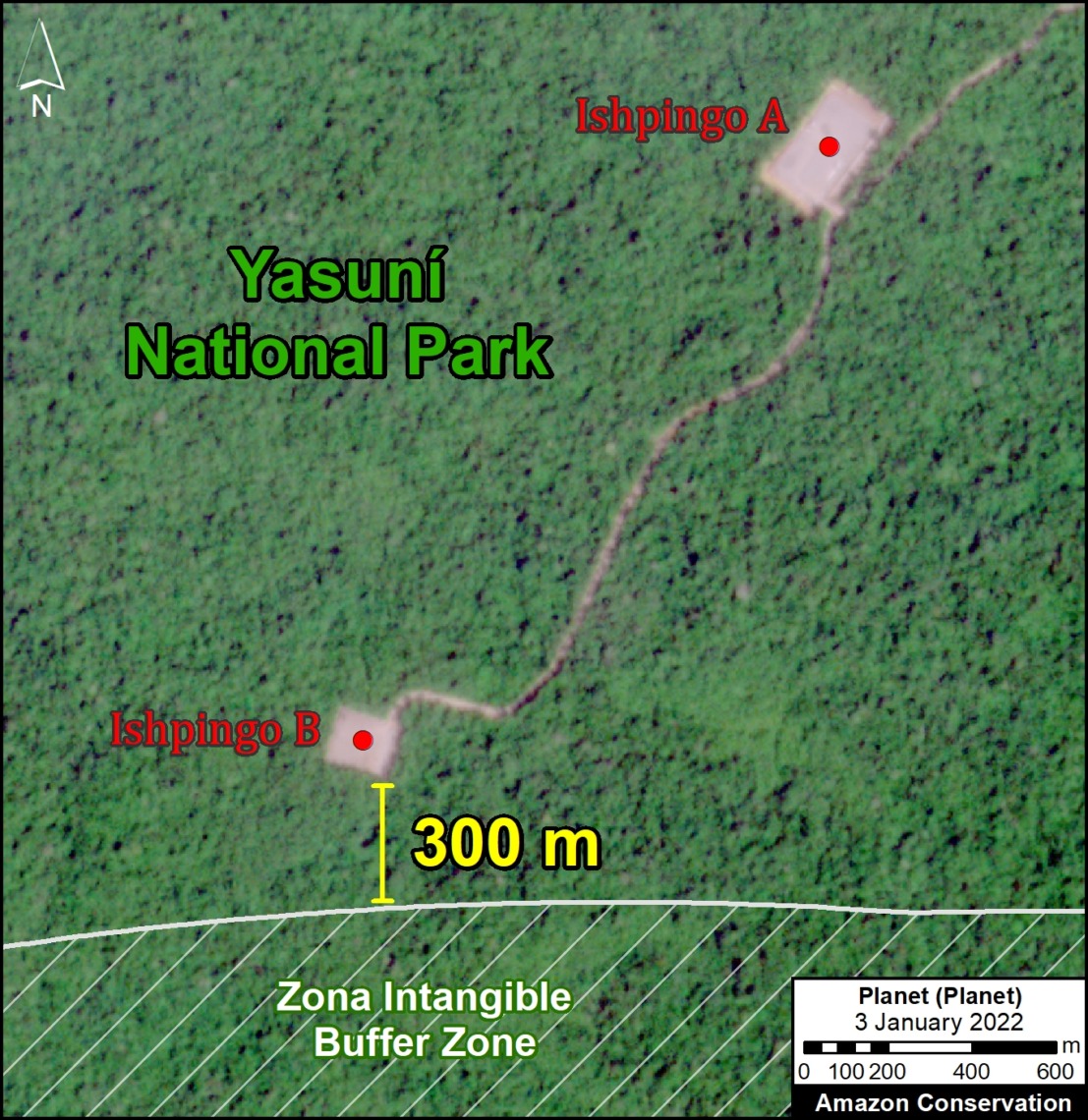
In this report, based on the latest satellite images, we show the most recent construction within the ITT Block: an oil drilling platform known as Ishpingo B. This platform is located just 300 meters from the buffer zone of the Zona Intangible.

We also issue a warning about the future construction of additional oil drilling platforms that would enter the buffer zone and reach the limit of the Zona Intangible itself.

Image 1. Data: Planet, MAAP/ACA.

Ishpingo Platforms A & B

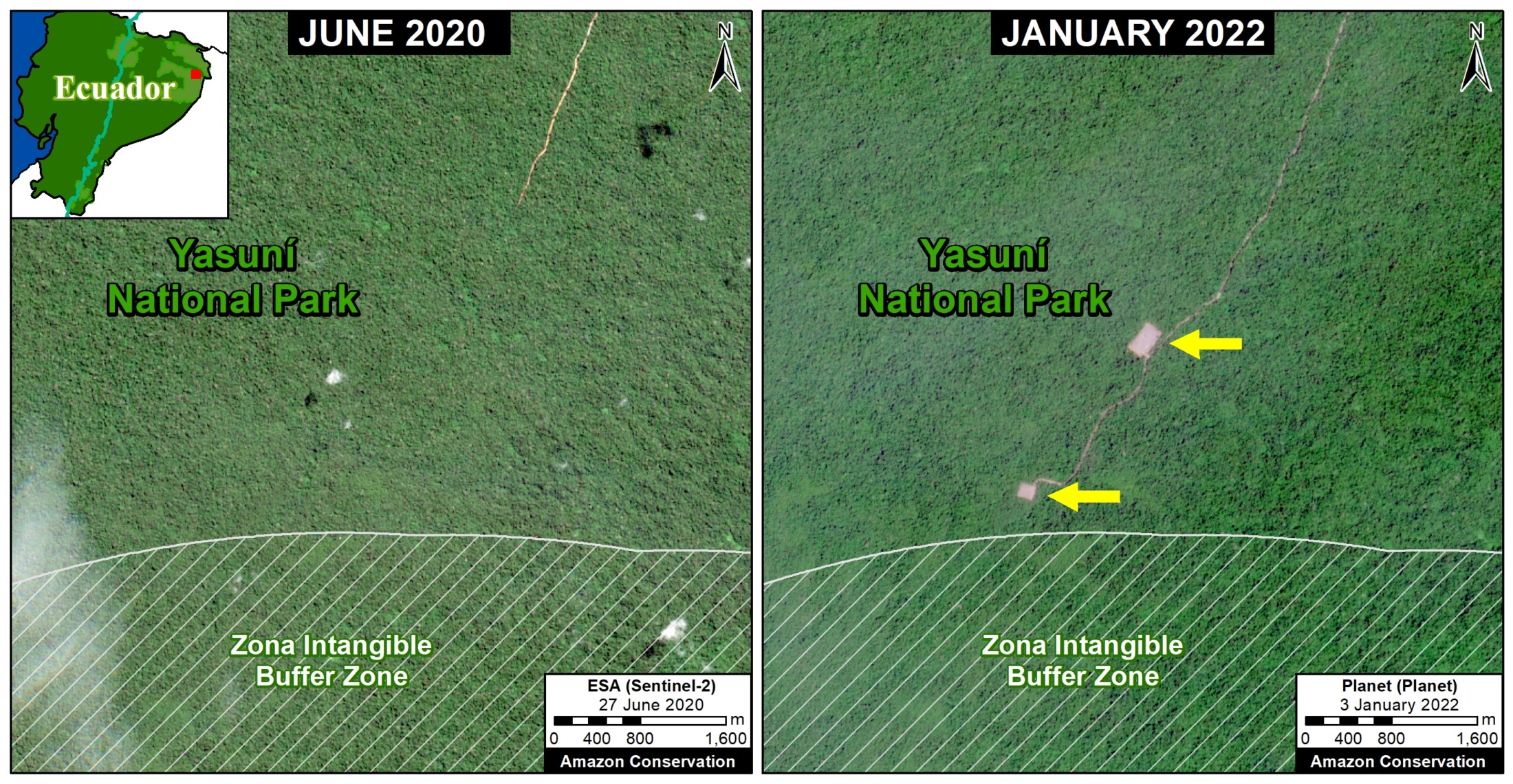
The following images show the construction of the two new oil drilling platforms (Ishpingo A and B) in the heart of the Yasuni National Park (ITT Block).

Image 1 (on the right) shows that the newest and southernmost platform (Ishpingo B) is located just 300 meters from the buffer zone of the Zona Intangible.

Image 2 (below) shows the construction of the two new platforms and associated access road between June 2020 (left panel) and January 2022 (right panel).

It is worth mentioning that the construction of these platforms has a corresponding environmental license in accordance with the “Environmental Impact Study and Environmental Management Plan of the Ishpingo North Development and Production Project.”

Image 2. Data ESA, Planet, MAAP/ACA.
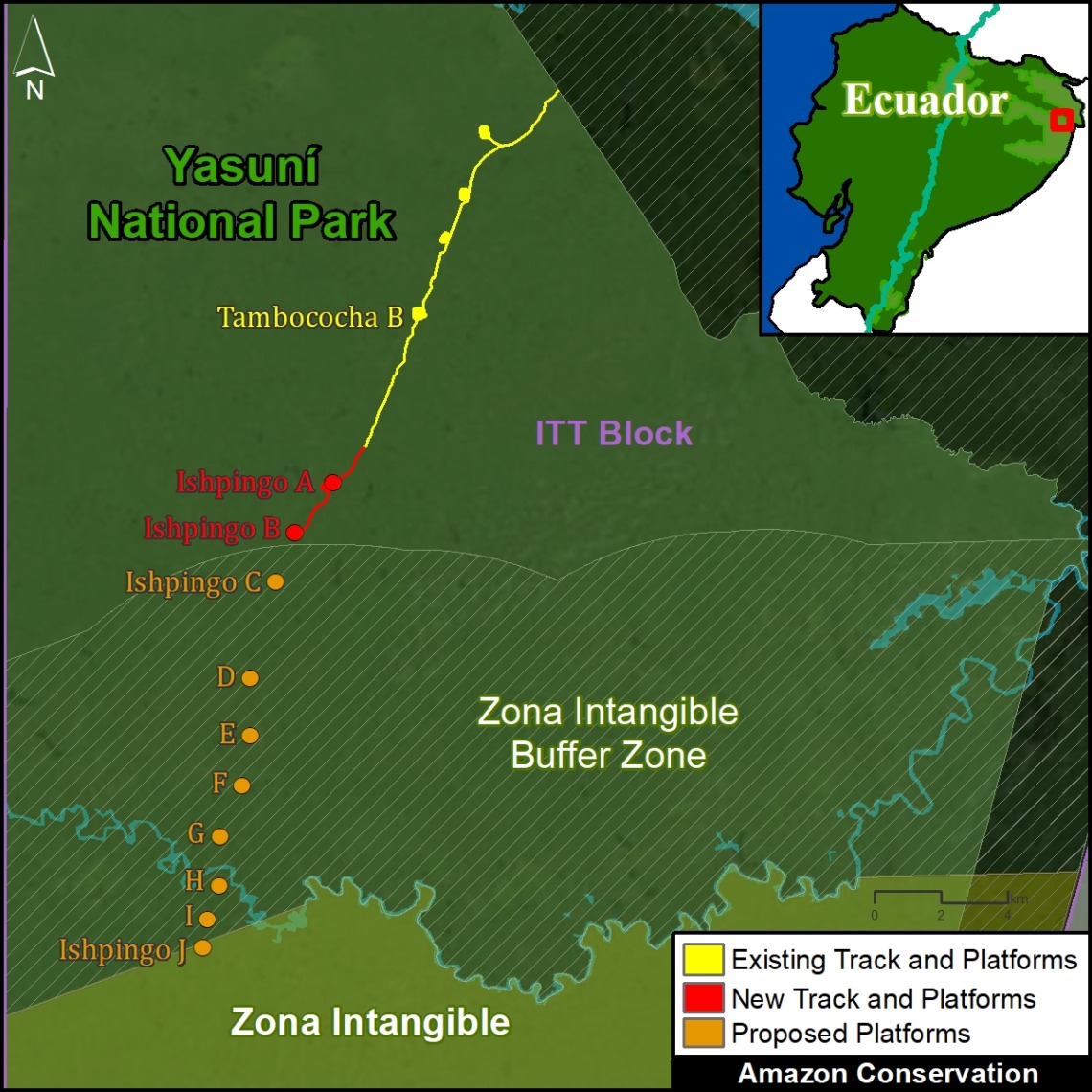
Image 3. Data: MAAP/ACA, Energy and Environmental Consulting.

Towards the Zona Intangible

Image 3 shows (in red) the location of the two new platforms (Ishpingo A and B) in relation to Yasuni National Park and the Zona Intangible.

Once again, note that the newest and southernmost platform (Ishpingo B) is located just 300 meters from the buffer zone of the Zona Intangible.

Alert: It is critical to emphasize that a previous version of the Environmental Impact Study includes plans for the construction of eight additional platforms (Ishpingo C-J), all located within the buffer zone towards the limit of the Zona Intangible Zone.

In fact, in early 2022, the head of Petroecuador has begun to publicly state the importance of moving forward with these extremely controversial plans.

Acknowledgments

We thank M. Bayón and P. Bermeo for useful information about the Environmental Impact Studies.

This report is part of a series focused on the Ecuadorian Amazon through a strategic collaboration between the organizations Fundación EcoCiencia and Amazon Conservation, with the support of the Norwegian Agency for Development Cooperation (Norad) and the International Conservation Fund of Canada (ICFC).

Citation

Finer M, Mamani N, Josse C, Villacis S (2022) New Oil Platforms Deeper into Yasuni National Park (Ecuador), towards Uncontacted Indigenous Zone. MAAP: 150.

MAAP #147: Amazon Deforestation Hotspots 2021 (1st Look)

Base Map. Deforestation hotspots across the Amazon in 2021 (as of September 18). Data: UMD/GLAD, ACA/MAAP.

We present a first look at the major deforestation hotspots across all nine countries of the Amazon in 2021 (as of September 18).*

The Base Map illustrates several key findings thus far in 2021:p

  • We estimate the loss of over 860,000 hectares (2.1 million acres) of primary forest loss across the nine countries of the Amazon.
    p
  • Amazon deforestation has been concentrated in three countries: Brazil (79%), Peru (7%), Colombia (6%).
    p
  • The vast majority of deforestation (79%) occurred in the Brazilian Amazon, where massive hotspots stretched across the major road networks. Many of these areas were also burned following the deforestation.
    p
  • There continues to be an arc of deforestation in the northwestern Colombian Amazon, impacting numerous protected areas and indigenous territories.
    p
  • In the Peruvian Amazon, deforestation continues to impact the central region, most notably from a new Mennonite colony and large-scale rice plantation.
    p
  • In Bolivia, fires are once again impacting several important ecosystems, including the Beni grasslands and Chiquitano dry forests of the Amazon, and Chaco scrub forest outside the Amazon.

Below, we zoom in on the three countries with the highest deforestation (Brazil, Colombia, and Peru) and show a series of high-resolution satellite images that illustrate some of the major 2021 deforestation events.

Widespread Deforestation in the Brazilian Amazon

The Brazil Base Map shows the notable concentration of deforestation hotspots along the major roads (especially roads 163, 230, 319, and 364). Zooms A-C show high-resolution examples of this deforestation, which largely appears to be associated with clearing rainforests for pasture.

Brazil Base Map. Deforestation hotspots in Brazilian Amazon (as of September 18). Data: UMD/GLAD, ACA/MAAP.
Zoom A. Deforestation in the Brazilian Amazon near road 230 (TransAmazian Highway) between February (left panel) and September (right panel) of 2021. Data: Planet.
Zoom B. Deforestation in the Brazilian Amazon along road 319 in Amazonas state between May (left panel) and September (right panel) of 2021. Data: Planet, ESA.
Zoom C. Deforestation in the Brazilian Amazon along road 163 between November 2020 (left panel) and September 2021 (right panel). Data: Planet, ESA.
Colombia Base Map. Deforestation hotspots in northwest Colombian Amazon (as of September 18). Data: UMD/GLAD, ACA/MAAP.

Arc of Deforestation in the Colombian Amazon

As described in previous reports (see MAAP #120), the Colombia Base Map shows there continues to be an “arc of deforestation” in the northwest Colombian Amazon (Caqueta, Meta, and Guaviare departments).

This arc impacts numerous protected areas (particularly Tinigua and Chiribiquete National Parks) and Indigenous Reserves (particularly Yari-Yaguara II and Nukak Maku).

Zooms D & E show high-resolution examples of this deforestation, which largely appears to be associated with clearing rainforests for pasture.

Zoom D. Deforestation in the Colombian Amazon (Caqueta) between December 2020 (left panel) and September 2021 (right panel). Data: Planet.
Zoom E. Deforestation in the Colombian Amazon between January (left panel) and September (right panel) of 2021. Data: Planet, ESA.
Peru Base Map. Deforestation hotspots in the Peruvian Amazon (as of September 18). Data: UMD/GLAD, ACA/MAAP.

Deforestation in the central Peruvian Amazon

The Peru Base Map shows the concentration of deforestation in the central Peruvian Amazon (Ucayali, Huanuco, and southern Loreto regions).

Zooms F & G show two notable examples of this deforestation: the rapid deforestation in 2021 for a new Mennonite colony (299 hectares) and large-scale rice plantation (382 hectares), respectively.

Also note some additional hotspots in the south (Madre de Dios region) from gold mining and medium-scale agriculture.

The hotspot in the north (Loreto region) is natural forest loss from a windstorm.

Zoom F. Deforestation (299 hectares) in the Peruvian Amazon for a new Mennonite colony between January (left panel) and September (right panel) of 2021 in southern Loreto region. Data: Planet.
Zoom G. Deforestation (382 ha) in the Peruvian Amazon for a new large-scale rice plantation between January (left panel) and September (right panel) of 2021 in Ucayali region. Data: Planet.

*Notes and Methodology

The analysis was based on 10-meter resolution primary forest loss alerts (GLAD+) produced by the University of Maryland and also presented by Global Forest Watch. These alerts are derived from the Sentinel-2 satellite operated by the European Space Agency.

We emphasize that this data represents a preliminary estimate and more definitive annual data will come later next year.

We also note that this data does include forest loss caused by natural forces and burned areas.

Our geographic range for the Amazon is a hybrid between both the biogeographic boundary (as defined by RAISG) and watershed  boundary, designed for maximum inclusion.

To identify the deforestation hotspots, we conducted a kernel density estimate. This type of analysis calculates the magnitude per unit area of a particular phenomenon, in this case forest cover loss. We conducted this analysis using the Kernel Density tool from Spatial Analyst Tool Box of ArcGIS. We used the following parameters:

Search Radius: 15000 layer units (meters)
Kernel Density Function: Quartic kernel function
Cell Size in the map: 200 x 200 meters (4 hectares)
Everything else was left to the default setting.

For the Base Map, we used the following concentration percentages: Medium: 7-10%; High: 11-20%; Very High: >20%.

Acknowledgements

We thank E. Ortiz and A. Ariñez for their helpful comments on this report.

This work was supported by NORAD (Norwegian Agency for Development Cooperation) and ICFC (International Conservation Fund of Canada).

Citation

Finer M, Mamani N, Spore J (2020) Amazon Deforestation Hotspots 2021. MAAP: 147.