MAAP SYNTHESIS #2: PATTERNS AND DRIVERS OF DEFORESTATION IN THE PERUVIAN AMAZON

We present our second synthesis report, building off our first report published in September 2015. This synthesis is largely based on the 50 MAAP reports published between April 2015 and November 2016. The objective is to synthesize all the information to date regarding deforestation trends, patterns and drivers in the Peruvian Amazon.

MAAP methodology includes 4 major components: Forest loss detection, Prioritize big data, Identify deforestation drivers, and Publish user-friendly reports. See Methodology section below for more details.

Our major findings include:

  • Trends. During the 15 years between 2001 and 2015, around 4,448,000 acres (1,800,000 hectares) of Peruvian Amazon forest has been cleared, with a steadily increasing trend. 2014 had the highest annual forest loss on record (438,775 acres), followed by a slight decrease  in 2015. The preliminary estimate for 2016 indicates that forest loss remains relatively high. The vast majority (80%) of forest loss events in the Peruvian Amazon are small-scale (<5 hectares), while large-scale events (> 50 hectares) pose a latent threat due to new agro-industrial projects.
  • Hotspots. We have identified at least 8 major deforestation hotspots. The most intense hotspots are located in the central Amazon (Huánuco and Ucayali). Other important hotspots are located in Madre de Dios and San Martin. Two protected areas (Tambopata National Reserve and El Sira Communal Reserve) are threatened by these hotspots.
  • Drivers. We present an initial deforestation drivers map for the Peruvian Amazon. Analyzing high-resolution satellite imagery, we have documented six major drivers of deforestation and degradation: small/medium-scale agriculture, large-scale agriculture, cattle pasture, gold mining, illegal coca cultivation, and roads. Small-scale agriculture and cattle pasture are likely the most dominant drivers overall. Gold mining is a major driver in southern Peru. Large-scale agriculture and major new roads are latent threats. Logging roads are likely a major source of forest degradation in central Peru.

Deforestation Trends

Image 1 shows forest loss trends in the Peruvian Amazon from 2001 to 2015, including a breakdown of the size of the forest loss events. This includes the official data from the Peruvian Environment Ministry, except for 2016, which is a preliminary estimate based on GLAD forest loss alerts.
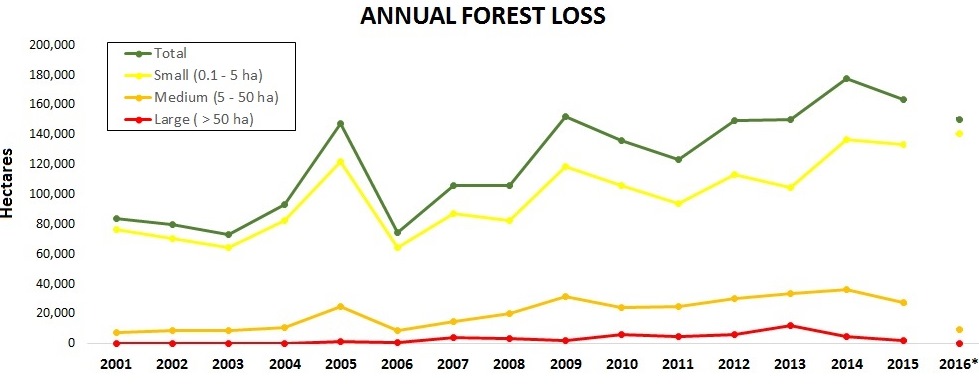
Image 1. Data: PNCB/MINAM, UMD/GLAD. *Estimate based on GLAD alerts.

During the 15 years between 2001 and 2015, around 4,448,000 acres (1,800,000 hectares) of Peruvian Amazon forest has been cleared (see green line). This represents a loss of approximately 2.5% of the existing forest as of 2001.There have been peaks in 2005, 2009, and 2014, with an overall increasing trend. In fact, 2014 had the highest annual forest loss on record (386,626 acres). Forest loss decreased in 2015 (386,732 acres), but is still the second highest recorded. The preliminary estimate for 2016 indicates that forest loss continues to be relatively high.

It is important to note that the data include natural forest loss events (such as storms, landslides, and river meanders), but overall serves as our best proxy for anthropogenic deforestation. The non-anthropogenic forest loss is estimated to be approximately 3.5% of the total.1

The vast majority (81%) of forest loss events in the Peruvian Amazon are small-scale (<5 hectares, equivalent of 12 acres), see the yellow line. Around 16% of the forest loss events are medium-scale (5-50 hectares, equivalent of 12-124 acres), see the orange line. Large-scale (>50 hectares, equivalent of 124 acres) forest loss events, often associated with industrial agriculture, pose a latent threat. Although the average is only 2%, large-scale forest loss rapidly spiked to 8% in 2013 due to activities linked with a pair of new oil palm and cacao plantations. See MAAP #32 for more details on the patterns of sizes of deforestation events.

Deforestation Patterns

Image 2 shows the major deforestation hotspots in 2012-14 (left panel) relative to 2015-16 (right panel), based on a kernel density analysis.We have identified at least 8 major deforestation hotspots, labeled as Hotspots A-H.
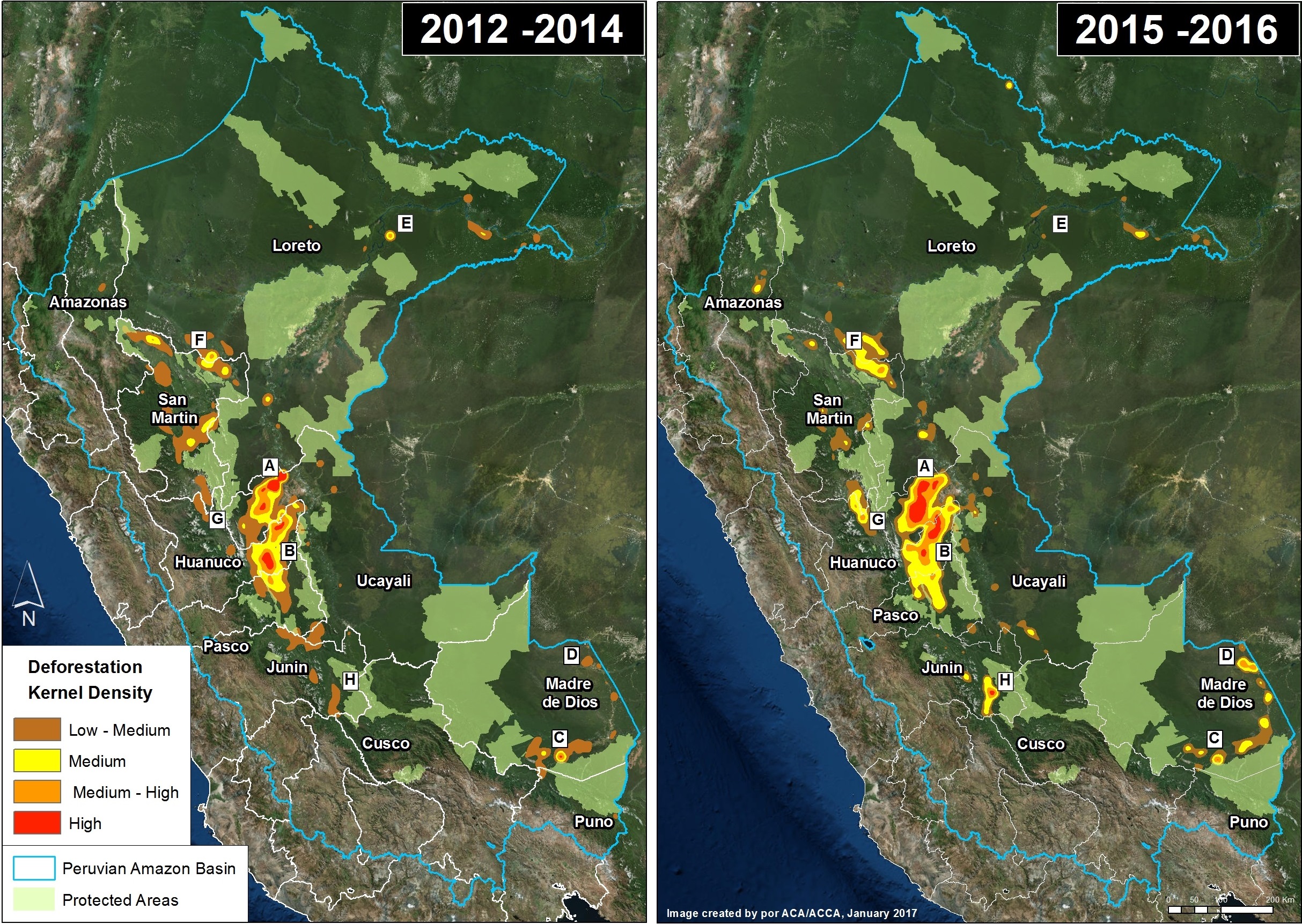
Image 2. Data: PNCB/MINAM, GLAD/UMD. Click to enlarge.

The most intense hotspots, A and B, are located in the central Amazon. Hotspot A, in northwest Ucayali, was dominated by two large-scale oil palm projects in 2012-14, but then shifted a bit to the west in 2015-16, where it was dominated by cattle pasture and small-scale oil palm. Hotspot B, in eastern Huánuco, is dominated by cattle pasture (MAAP #26).

Hotspots C and D are in the Madre de Dios region in the southern Amazon. Hotspot C indicates the primary illegal gold mining front in recent years (MAAP #50). Hotspot D highlights the emerging deforestation zone along the Interoceanic Highway, particularly around the town of Iberia (MAAP #28).

Hotspots E-H are agriculture related. Hotspot E indicates the rapid deforestation for a large-scale cacao plantation in 2013-14, with a sharp decrease in forest loss 2015-16 (MAAP #35). Hotspot F indicates the expanding deforestation around two large-scale oil palm plantation (MAAP #41). Hotspot G indicates the intensifying deforestation for small-scale oil palm plantations (MAAP #48).

Hotspot H indicates an area impacted by intense wildfires in 2016.

Protected Areas, in general, are effective barriers against deforestation (MAAP #11). However, several protected areas are currently threatened, most notably Tambopata National Reserve (Hotspot C; MAAP #46). and El Sira Communal Reserve (Hotspot B; MAAP #45).

Deforestation Drivers
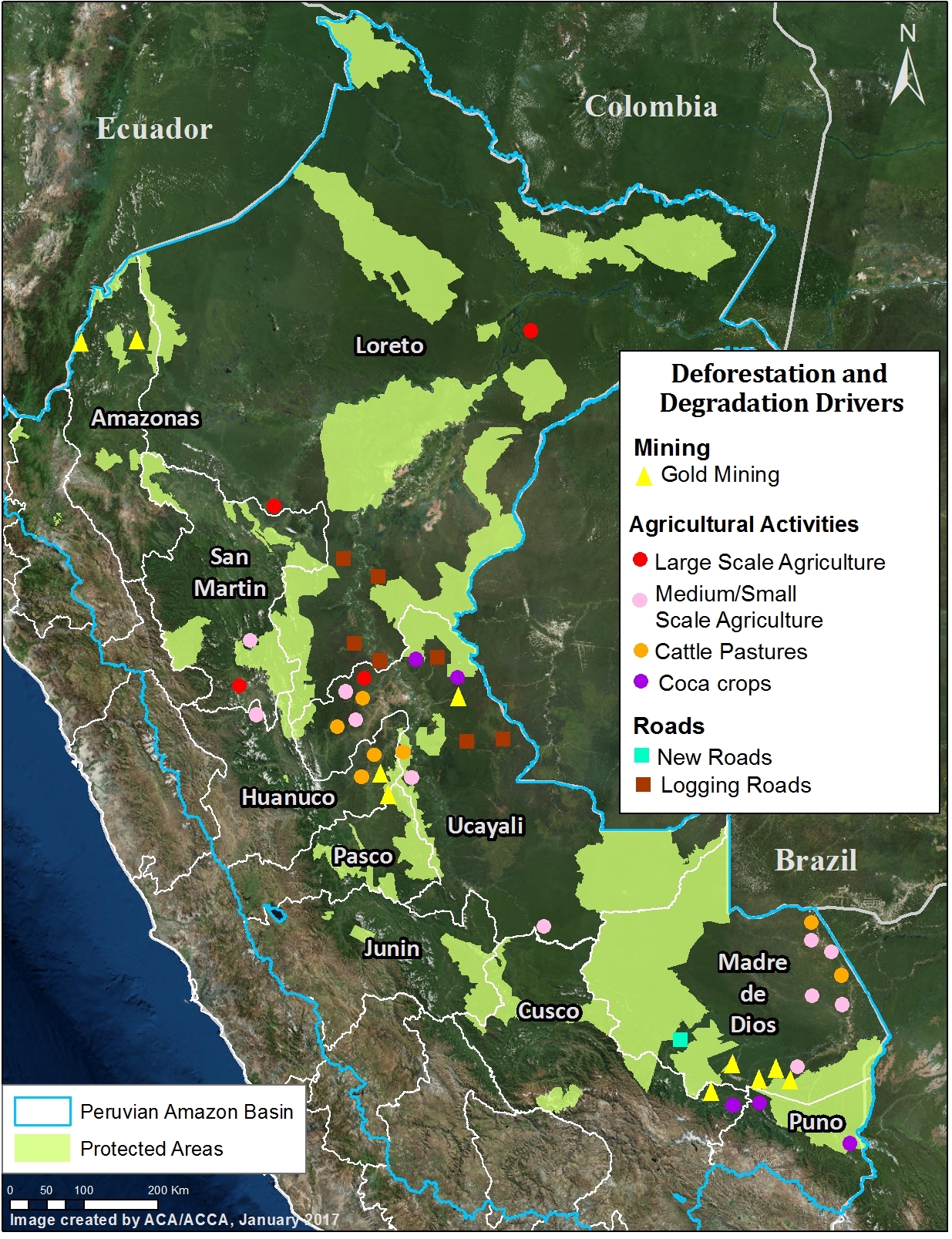
Image 3. Data: MAAP, SERNANP. Click to enlarge.

Surprisingly, there is a striking lack of precise information about the actual drivers of deforestation in the Peruvian Amazon. According to an important paper published in 2016, much of the existing information is vague and outdated, and is based solely on a general analysis of the size of deforestation events.3  

As noted above, one of the major advances of MAAP has been using high-resolution imagery to better identify deforestation drivers.

Image 3 shows the major deforestation drivers identified thus far by our analysis. As far as we know, it represents the first spatially explicit deforestation drivers map for the Peruvian Amazon.

To date, we have documented six major direct drivers of deforestation and degradation in the Peruvian Amazon: small/medium-scale agriculture, large-scale agriculture, cattle pasture, gold mining, illegal coca cultivation, and roads.

At the moment, we do not consider the hydrocarbon (oil and gas) and hydroelectric dam sectors as major drivers in Peru, but this could change in the future if proposed projects move forward.

We describe these major drivers of deforestation and degradation in greater detail below.

Small/Medium-scale Agriculture

The literature emphasizes that small-scale agriculture is the leading cause of deforestation in the Peruvian Amazon.However, there is little actual empirical evidence demonstrating that this is true.3 The raw deforestation data is dominated by small-scale clearings that are most likely for agriculture or cattle pasture. Thus, it is likely that small-scale agriculture is a major driver, but a definitive study utilizing high-resolution imagery and/or extensive field work is still needed to verify the assumption.

In several key case studies, we have shown specific examples of small-scale agriculture being a deforestation driver. For example, using a combination of high-resolution imagery, photos from the field, and local sources, we have determined that:

  • Oil Palm, in the form of small and medium-scale plantations, is one of the main drivers within deforestation Hotspot B (Ucayali; MAAP #26), Hotspot G (northern Huánuco; MAAP #48), and Hotspot F (Loreto-San Martin;MAAP #16). This was also shown for Ucayali in a recent peer-reviewed study.4 See below for information about large-scale oil palm.
  • Cacao is causing rapid deforestation along the Las Piedras River in eastern Madre de Dios (MAAP #23, MAAP #40). See below for information about large-scale cacao.
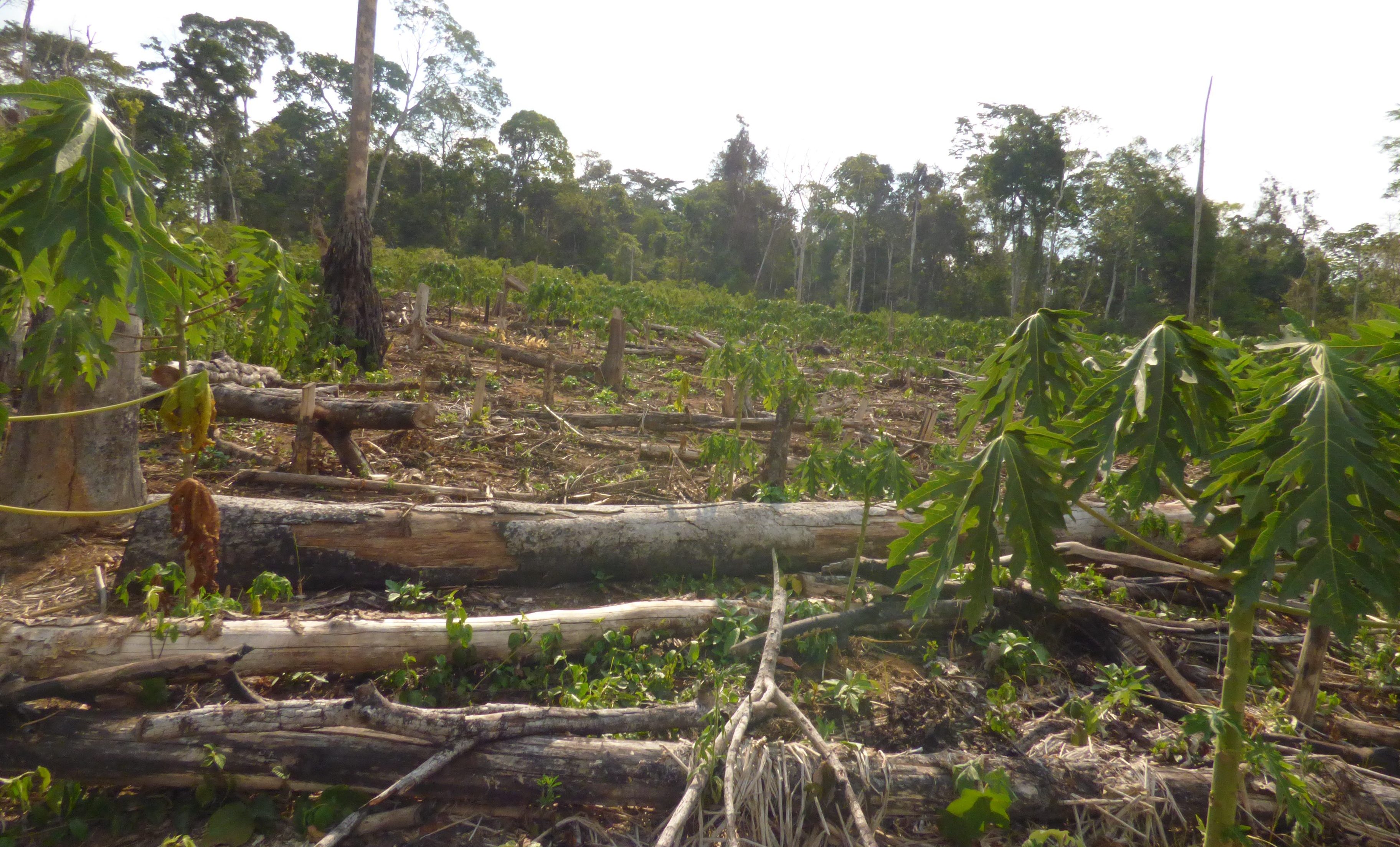
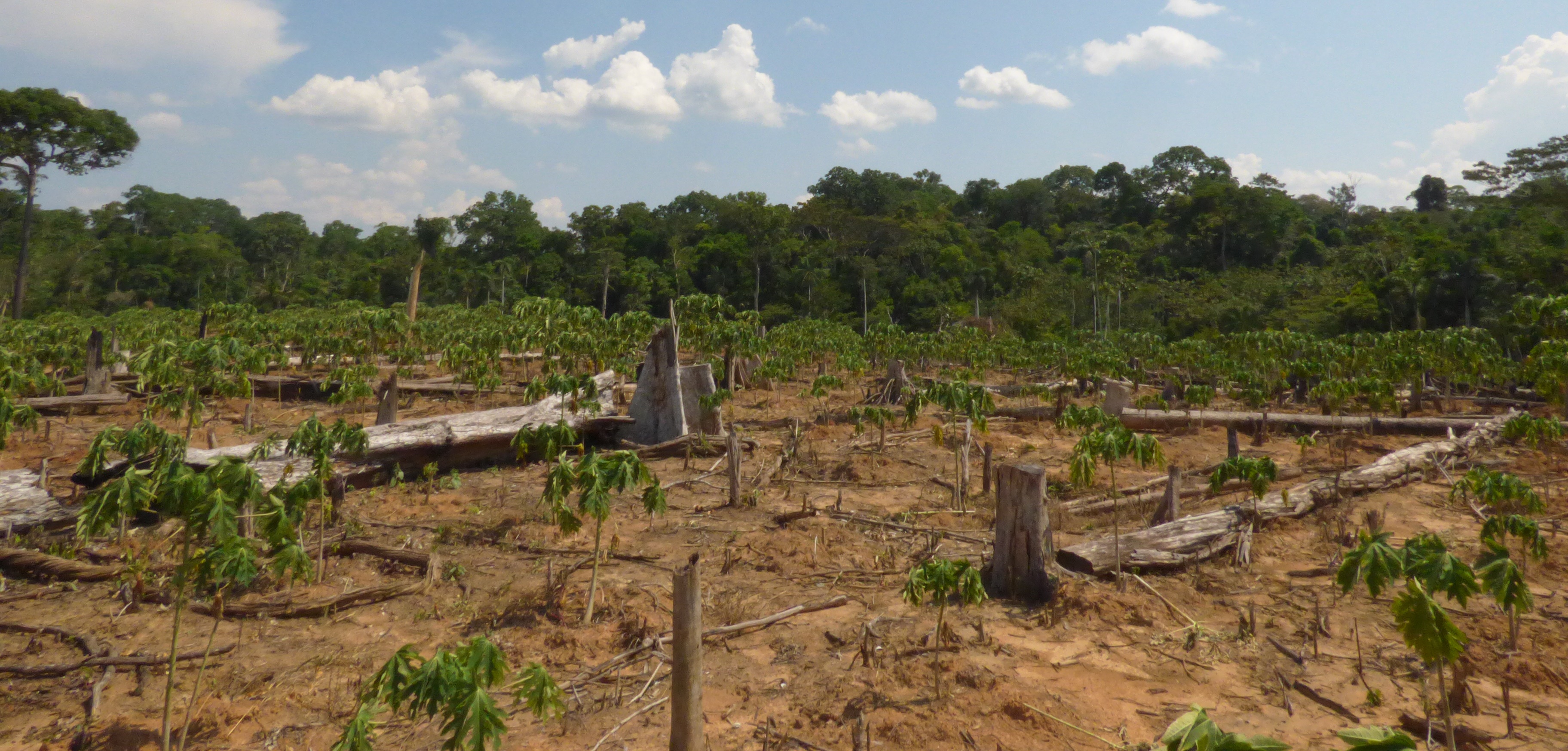
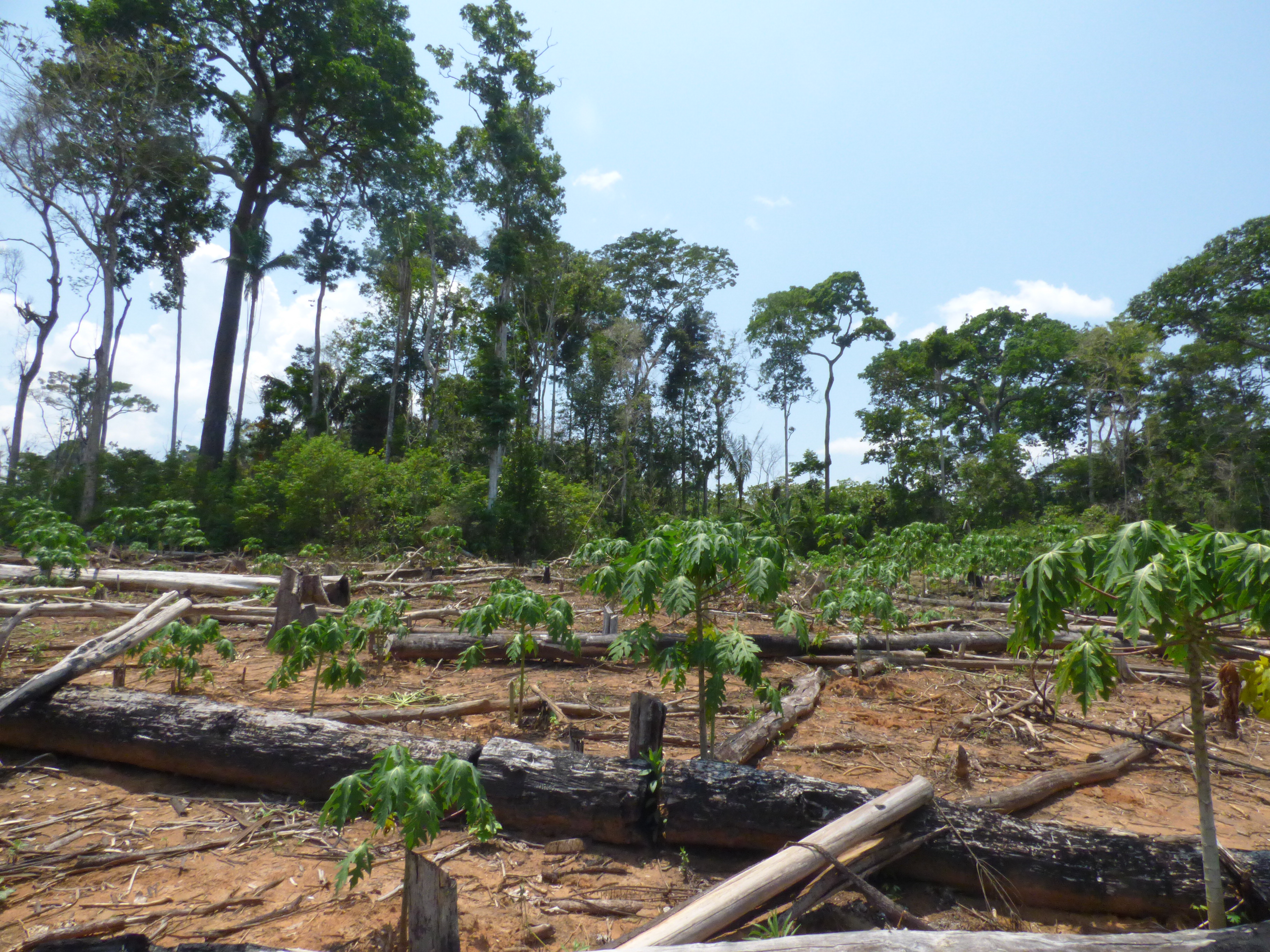
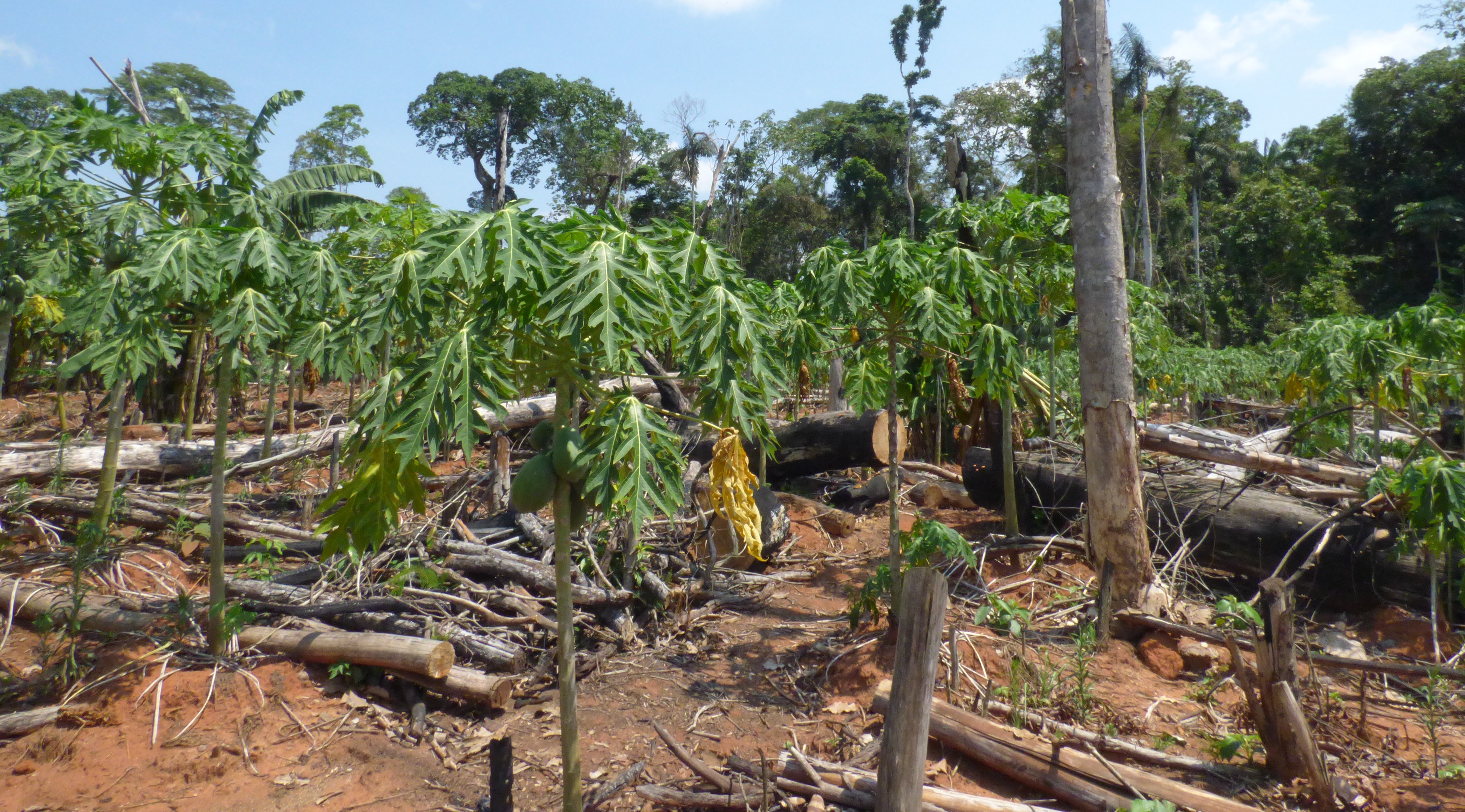
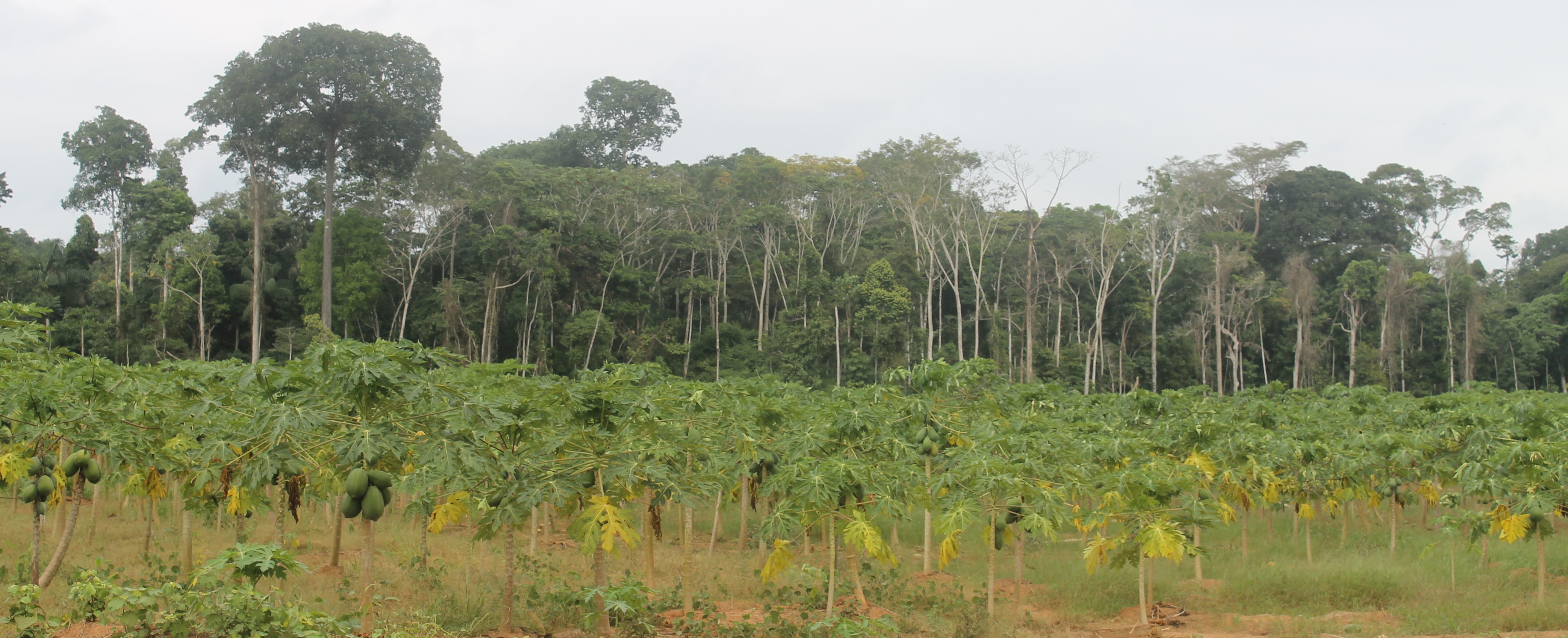
  • Papaya is an important new driver in Hotspot D, along the Interoceanic Higway in eastern Madre de Dios (MAAP #42).
  • Corn and rice plantations may also be an important driver in Hotspot D in eastern Madre de Dios (MAAP #28).

Large-scale Agriculture

Large-scale, agro-industrial deforestation remains a latent threat in Peru, particularly in the central and northern Amazon regions. This issue was put on high alert in 2013, with two cases of large-scale deforestation for oil palm and cacao plantations, respectively.

In the oil palm case, two companies that are part of the Melka group,5 cleared nearly 29,650 acres in Hotspot A in Ucayali between 2012 and 2015 (MAAP #4, MAAP #41). In the cacao case, another company in the Melka group (United Cacao) cleared 5,880 acres in Hotspot E in Loreto between 2013 and 2015 (MAAP #9, MAAP #13, MAAP #27, MAAP #35). Dennis Melka has explicitly stated that his goal is to bring the agro-industrial production model common in Southeast Asia to the Peruvian Amazon.6

Prior to these cases, large-scale agricultural deforestation occurred between 2007 and 2011, when oil palm companies owned by Grupo Palmas7 cleared nearly 17,300 acres for plantations in Hotspot H along the Loreto-San Martin border (MAAP #16). Importantly, we documented the additional deforestation of 24,215 acres for oil palm plantations surrounding the Grupo Palmas projects (MAAP #16).

In contrast, large-scale agricultural deforestation was minimal in 2015 and 2016. However, as noted above, it remains a latent threat. Both United Cacao and Grupo Palmas have expansion plans that would clear over 49,420 acres of primary forest in Loreto.8

Cattle Pasture

Using an archive of satellite imagery, we documented that deforestation for cattle pasture is a major issue in the central Peruvian Amazon. Immediately following a deforestation event, the scene of hundreds or thousands of recently cut trees often looks the same whether the cause is agriculture or cattle pasture. However, by using an archive of imagery and studying deforestation events from previous years, one can more easily determine the drivers of the forest loss. For example, after a year or two, agriculture and cattle pasture appear very differently in the imagery and thus it is possible to distinguish these two drivers.

Using this technique, we determined that cattle pasture is a major driver in Hotspots A and B, in the central Peruvian Amazon (MAAP #26, MAAP #37).

We also used this technique to determine that much of the deforestation in the northern section of El Sira Communal Reserve is due to cattle pasture (MAAP #45).

Maintenance of cattle pasture, and small-scale agriculture, are likely important factors behind the escaped fires that degrade the Amazon during intense dry seasons (MAAP #45, MAAP #47).

Gold Mining

Gold mining is one of the major drivers of deforestation in the southern Peruvian Amazon (Hotspot C). An important study found that gold mining cleared around 123,550 acres up through 2012.9 We built off this work, and by analyzing hundreds of high resolution imageres, found that gold mining caused the loss of an additional 30,890 acres between 2013 and 2016 (MAAP #50). Thus, gold mining is thus far responsible for the total loss of around 154,440 acres in southern Peru. Much of the most recent deforestation is illegal due to its occurrence in protected areas and buffer zones strictly off-limits to mining activities.

Most notably, we have closely tracked the illegal gold mining invasion of Tambopata National Reserve, an important protected area in the Madre de Dios region with renowned biodiversity and ecotourism. The initial invasion occurred in November 2015 (MAAP #21), and has steadily expanded to over 1,110 acres (MAAP #24, MAAP #30, MAAP #46). As part of this invasion, miners have modified the natural course of the Malinowski River, which forms the natural northern border of the reserve (MAAP #33). In addition, illegal gold mining deforestation continues to expand within the reserve’s buffer zone, particularly in an area known as La Pampa (MAAP #12, MAAP #31).

Further upstream, illegal gold mining is also expanding on the upper Malinowski River, within the buffer zone of Bahuaja Sonene National Park (MAAP #19, MAAP #43).

In contrast to the escalating situation in Tambopata, we also documented that gold mining deforestation has been contained in the nearby Amarakaeri Communal Reserve, an important protected area that is co-managed by indigenous communities and Peru’s national protected areas agency. Following an initial invasion of 27 acres in 2014 and early 2015, satellite imagery shows that management efforts have prevented any subsequent expansion within the protected area (MAAP #6, MAAP #44).

In addition to the above cases in Madre de Dios, gold mining deforestation is also increasingly an issue in the adjacent regions of Cusco and Puno (MAAP #14).

There are several small, but potentially emerging, gold mining frontiers in the central and northern Peruvian Amazon (MAAP #49). The Peruvian government has been working to contain the illegal gold mining in the El Sira Communal Reserve (MAAP #45). Further north in Amazonas region, there is gold mining deforestation along the Rio Santiago (MAAP #36, MAAP #49), and in the remote Condor mountain range along the border with Ecuador (MAAP #49).

Roads

Roads are a well-documented driver of deforestation in the Amazon, particularly due to their ability to facilitate human access to previously remote areas.10 Roads often serve as an indirect driver, as most of the deforestation directly associated with agriculture, cattle pasture, and gold mining is likely greatly facilitated by proximity to roads. We documented the start of a controversial road construction project that would cut through the buffer zones of two important protected areas, Amarakaeri Communal Reserve and Manu National Park (MAAP #29).

Logging Roads

In relation to general roads described above, we distinguish access roads that are constructed to gain entry to a particular project. The most notable type of access roads in Peru are logging roads, which are likely a leading cause of forest degradation as they facilitate selective logging of valuable timber species in remote areas.

One of the major recent advances in forest monitoring is the ability to quickly identify the construction of new logging roads. The unique linear pattern of these roads appears quite clearly in Landsat-based tree cover loss alerts such as GLAD and CLASlite. This advance is important because it is difficult to detect illegal logging in satellite imagery because loggers in the Amazon often selectively cut high value species and do not produce large clearings. But now, although it remains difficult to detect the actual selective logging, we can detect the roads that indicate that selective logging is taking place in that area.

In a series of articles, we highlighted the recent expansion of logging roads, including the construction of 1,134 km between 2013 and 2015 in the central Peruvian Amazon (MAAP #3, MAAP #18). Approximately one-third of these roads were within the buffer zones of Cordillera Azul and Sierra del Divisor National Parks (MAAP #15).

We documented the construction of an additional 83 km of logging roads during 2016,  (MAAP #40, MAAP #43) including deeper into the buffer zone of Cordillera Azul National Park.

Another major finding is the rapid construction of the logging roads. In several cases, we documented the construction rate of nearly five kilometers per week (MAAP #18, MAAP #40, MAAP #43).

Determining the legality of these logging roads is complex, partly because of the numerous national and local government agencies involved in the authorization process. Many of these roads are near logging concessions and native communities, whom may have obtained the rights for logging from the relevant forestry authority (in many cases, the regional government).

Coca

According to a recent United Nations report, the Peruvian land area under coca cultivation in 2015 (99,580 acres) was the lowest on record (since 2001) and part of a declining trend since 2011 (154,440 acres).11 There are 13 major coca growing zones in Peru, but it appears that only a few of them are actively causing new deforestation. Most important are two coca zonas in the region of Puno that are causing deforestation within and around Bahuaja Sonene National Park (MAAP #10, MAAP #14). Several coca zones in the regions of Cusco and Loreto may also be causing some new deforestation.

Hydroelectric Dams

Although there is a large portfolio of potential new hydroelectric dam projects in the Peruvian Amazon,12 many of not advanced to implementation phase. Thus, forest loss due to hydroelectric dams is not currently a major issue, but this could quickly change in the future if these projects are revived. For example, in adjacent western Brazil, we documented the forest loss of 89,205 acres associated with the flooding caused by two dams on the upper Madeira River (MAAP #34).

Hydrocarbon (Oil & Gas)

During the course of our monitoring, we have not yet detected major deforestation events linked to hydrocarbon-related activities. As with dams, this could change in the future if oil and gas prices rise and numerous projects in remote corners of the Amazon move forward.

Methodology

MAAP methodology has 4 major components:

  1. Forest Loss Detection. MAAP reports rely heavily on early-warning tree cover loss alerts to help us identify where new deforestation is happening. Currently, our primary tool is GLAD alerts, which are developed by the University of Maryland and Google,13 and presented by WRI’s Global Forest Watch and Peru’s GeoBosques. These alerts, launched in Peru in early 2016, are based on 30-meter resolution Landsat satellite images and updated weekly. We also occasionally incorporate CLASlite, forest loss detection software based on Landsat (and now Sentinel-2) developed by the Carnegie Institution for Science, and the moderate resolution (250 meters) Terra-i alerts. We are also experimenting with Sentinel-1 radar data (freely available from the European Space Agency), which has the advantage of piercing through cloud cover in order to continue monitoring despite persistent cloudy conditions
  2. Prioritize Big Data. The early warning systems noted above yield thousands of alerts, thus a procedure to prioritize the raw data is needed. We employ numerous prioritization methods, such as creation of hotspot maps (see below), focus on key areas (such as protected areas, indigenous territories, and forestry concessions), and identification of striking patterns (such as linear features or large-scale clearings).
  1. Identify Deforestation Drivers. Once priority areas are identified, the next challenge is to understand the cause of the forest loss. Indeed, one of the major advances of MAAP over the past year has been using high-resolution satellite imagery to identify key deforestation drivers. Our ability to identify these deforestation drivers has been greatly enhanced thanks to access to high-resolution satellite imagery provided by Planet 14
    (via their Ambassador Program) and Digital Globe (via the NextView Program, courtesy of an agreement with USAID). We also occasionally purchase imagery from Airbus(viaApollo Mapping).
  2. Publish User-Friendly Reports. The final step is to publish technical, but accessible, articles highlighting novel and important findings on the MAAP web portal. These articles feature concise text and easy-to-understand graphics aimed at a wide audience, including policy makers, civil society, researchers, students, journalists, and the public at large. During preparation of these articles, we consult with Peruvian civil society and relevant government agencies in order to improve the quality of the information.

Endnotes

MINAM-Peru (2016) Estrategia Nacional sobre Bosques y Cambio Climático.

Methodology: Kernel Density tool from Spatial Analyst Tool Box of ArcGis. The 2016 data is based on GLAD alerts, while the 2012-15 data is based on official annual forest loss data

Ravikumar et al (2016) Is small-scale agriculture really the main driver of deforestation in the Peruvian Amazon? Moving beyond the prevailing narrative. Conserv. Lett. doi:10.1111/conl.12264

4 Gutiérrez-Vélez VH et al (2011). High-yield oil palm expansion spares land at the expense of forests in the Peruvian Amazon. Environ. Res. Lett., 6, 044029.

Environmental Investigation Agency EIA (2015) Deforestation by Definition.

NG J (2015) United Cacao replicates Southeast Asia’splantation model in Peru, says CEO Melka. The Edge Singapore, July 13, 2015.

Palmas del Shanusi & Palmas del Oriente; http://www.palmas.com.pe/palmas/el-grupo/empresas

Hill D (2015) Palm oil firms in Peru plan to clear 23,000 hectares of primary forest. The Guardian, March 7, 2015.

Asner GP, Llactayo W, Tupayachi R,  Ráez Luna E (2013) Elevated rates of gold mining in the Amazon revealed through high-resolution monitoring. PNAS 46: 18454. They reported 46,417 hectares confirmed and 3,268 hectares suspected (49,865 ha total).

10 Laurance et al (2014) A global strategy for road building. Nature 513:229; Barber et al (2014) Roads, deforestation, and the mitigating effect of protected areas in the Amazon.  Biol Cons 177:203.

11 UNODC/DEVIDA (2016) Perú – Monitoreo de Cultivos de Coca 2015.

12 Finer M, Jenkins CN (2012) Proliferation of Hydroelectric Dams in the Andean Amazon and Implications for Andes-Amazon Connectivity. PLoS ONE 7(4): e35126.

13 Hansen MC et al (2016) Humid tropical forest disturbance alerts using Landsat data. Environ Res Lett 11: 034008.

14 Planet Team (2017). Planet Application Program Interface: In Space for Life on Earth. San Francisco, CA. https://api.planet.com

Citation

Finer M, Novoa S (2017) Patterns and Drivers of Deforestation in the Peruvian Amazon. MAAP: Synthesis #2.
MAAP #53: Wildfire Hotspots in the Peruvian Amazon in 2016

Imagen 53. VIIRS/NASA, SERNANP.

During 2016, Peru experienced an intense wildfire season, exacerbated by widespread drought conditions across the country.

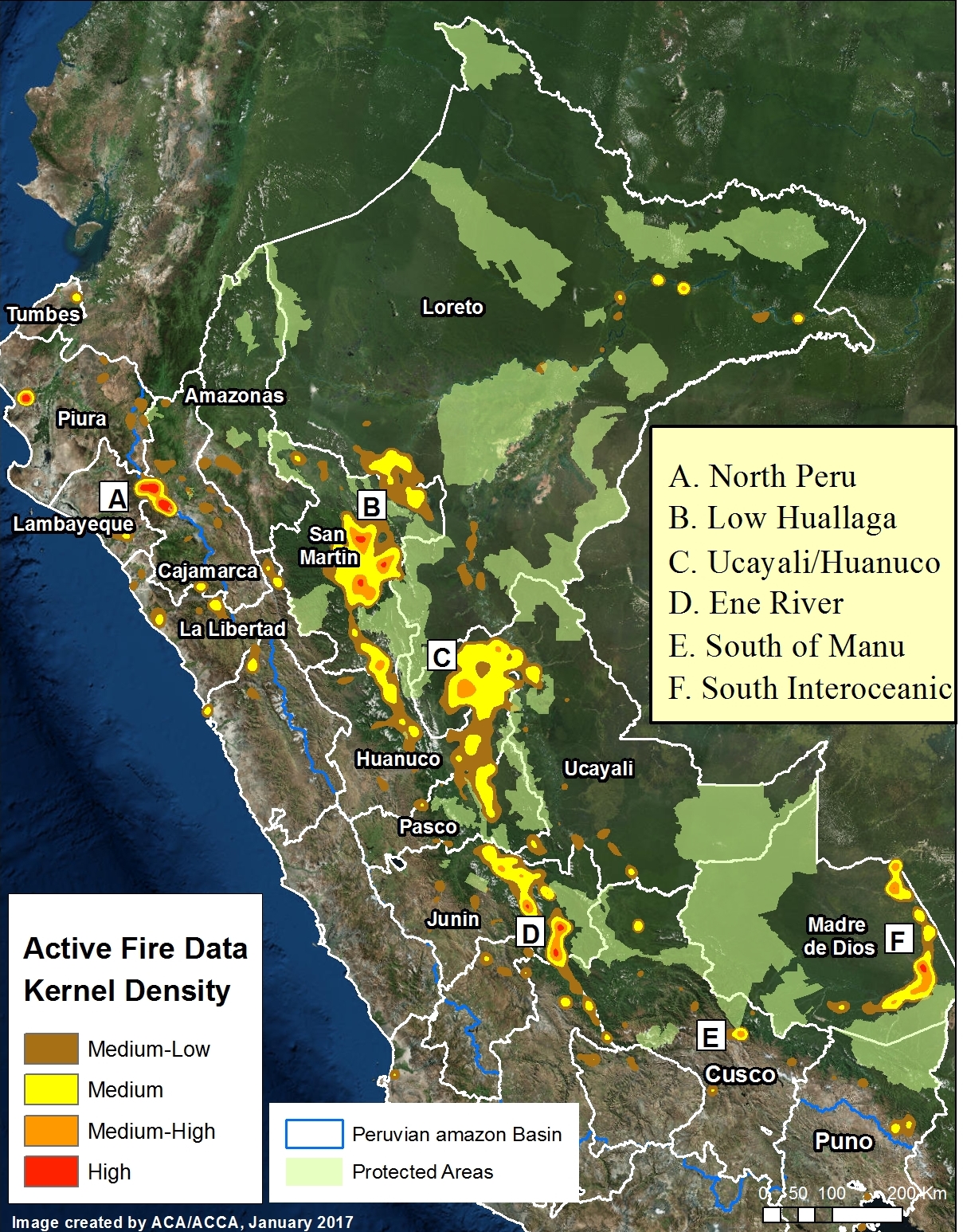
The base map (Image 53, to the left) shows the 2016 fire alert hotspots.

These alerts are generated from a moderate-resolution (375 meters) satellite sensor (VIIRS) that detects significant new heat sources.

Although there has not yet been a comprehensive evaluation of the causes of these fires, evidence indicates that many are linked to agricultural practices that allow fires to escape to surrounding natural habitats.

In the image, we highlight 5 significant fire hotspots in the Amazon basin, labeled A-E (A. Northern Peru; B. Lower Huallaga; C. Huánuco/Ucayali, D. Ene River, E. Southern Manu, F. Interoceanic Highway).

These areas are described in more detail below.


A. Northern Peru

Image 53a. Data: VIIRS/NASA, SERNANP, MODIS

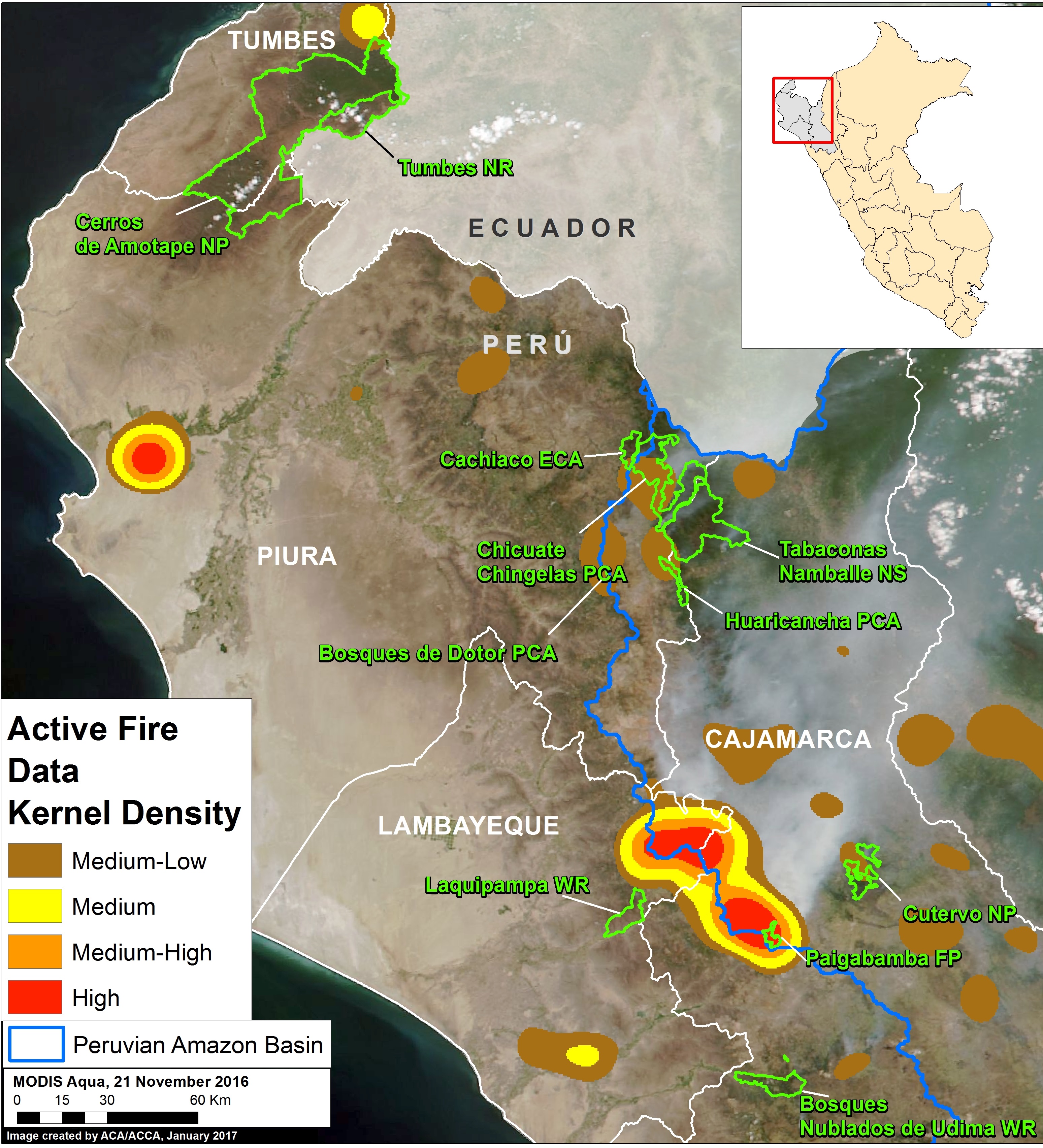
Hotspot A indicates the area in northern Peru that experienced a wave of intense fires in late 2016. Most of the fires occurred in the headwaters of the Amazon, in the Cajamarca and Lambayeque regions.

As previously reported, we estimate that 6,594 acres were burned within 11 Protected Areas (see MAAP #51 and MAAP #52).

Image 53a shows where the concentrations of heat sources were recorded.

B. Lower Huallaga

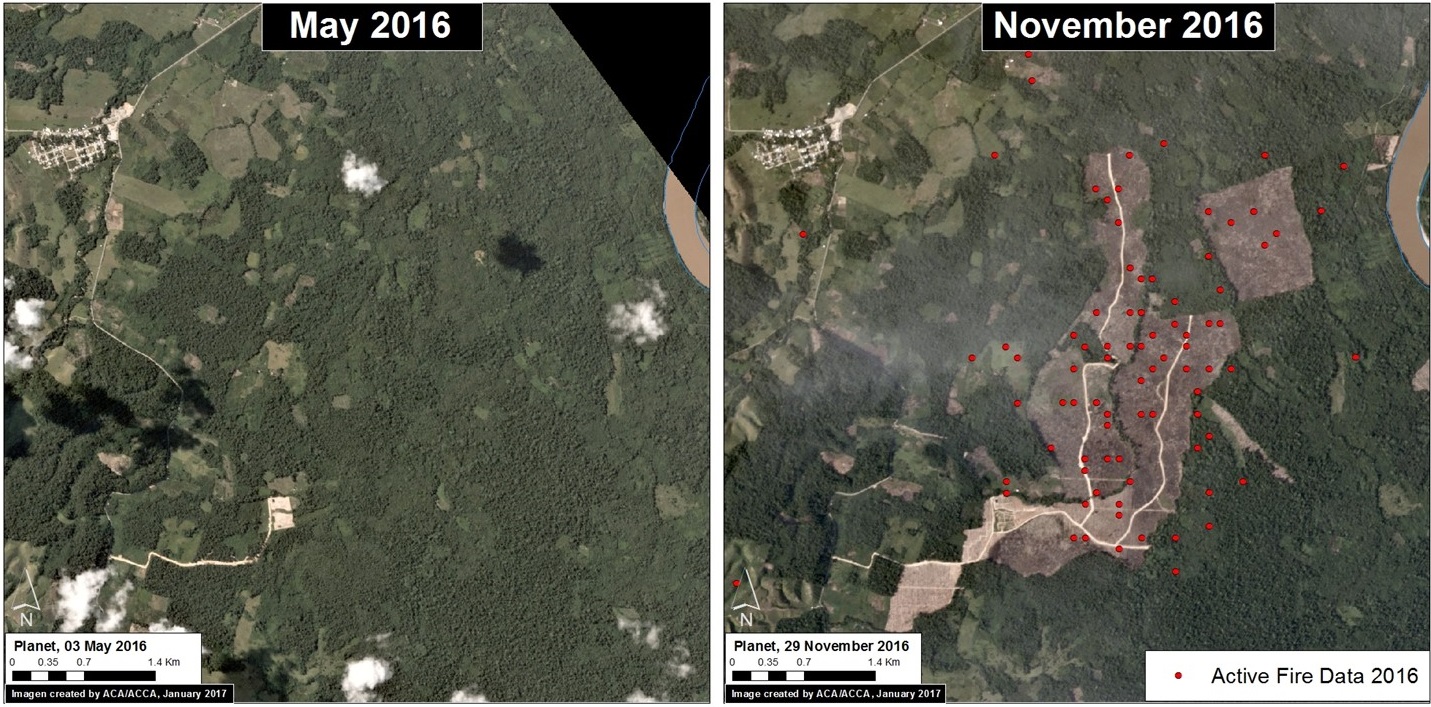
Hotspot B corresponds to the area along the lower Huallaga river basin, between the regions of Loreto and San Martín. Although most of the fires were in established agricultural areas, some impacted forest and secondary vegetation for the opening of new agricultural areas (Image 53b).

Image 53b. VIIRS/NASA, Planet

C. Huánuco/Ucayali

Hotspot C overlaps with one of the primary deforestation hotspots in the country. As previously reported, one of the primary drivers of deforestation in this area is cattle pasture (see MAAP #37). Therefore, there may be a relationship between the use of fire in agricultural activities and the high deforestation rates in this area.

D. Ene River

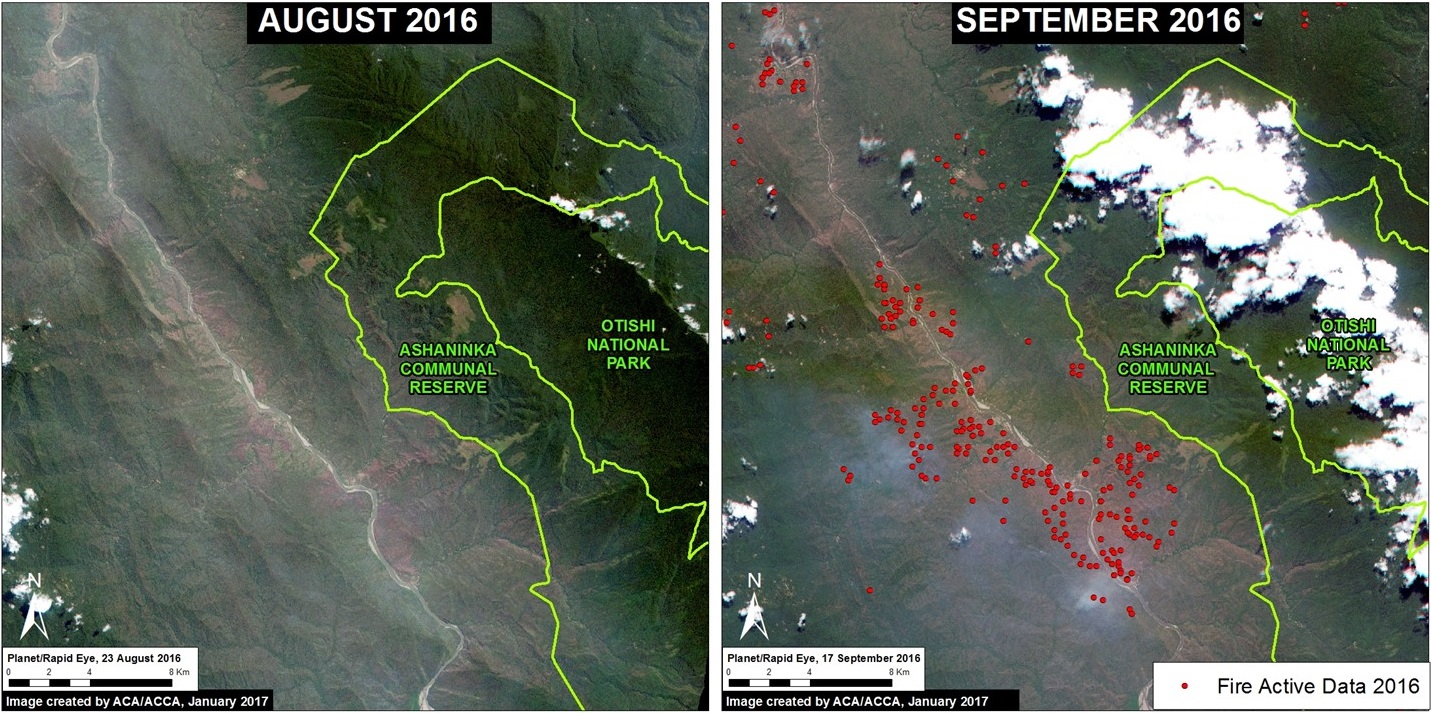
Hotspot D highlights an area that generated national and international attention in 2016, when fires along the Ene River threatened two national protected areas (Asháninka Communal Reserve and Otishi National Park) in the Junin region. Image 53d shows a comparison of before (left panel) and during (right panel) the fires. We did not document any fires entering the protected areas.

Image 53d. VIIRS/NASA, SERNANP, Planet

E. South of Manu

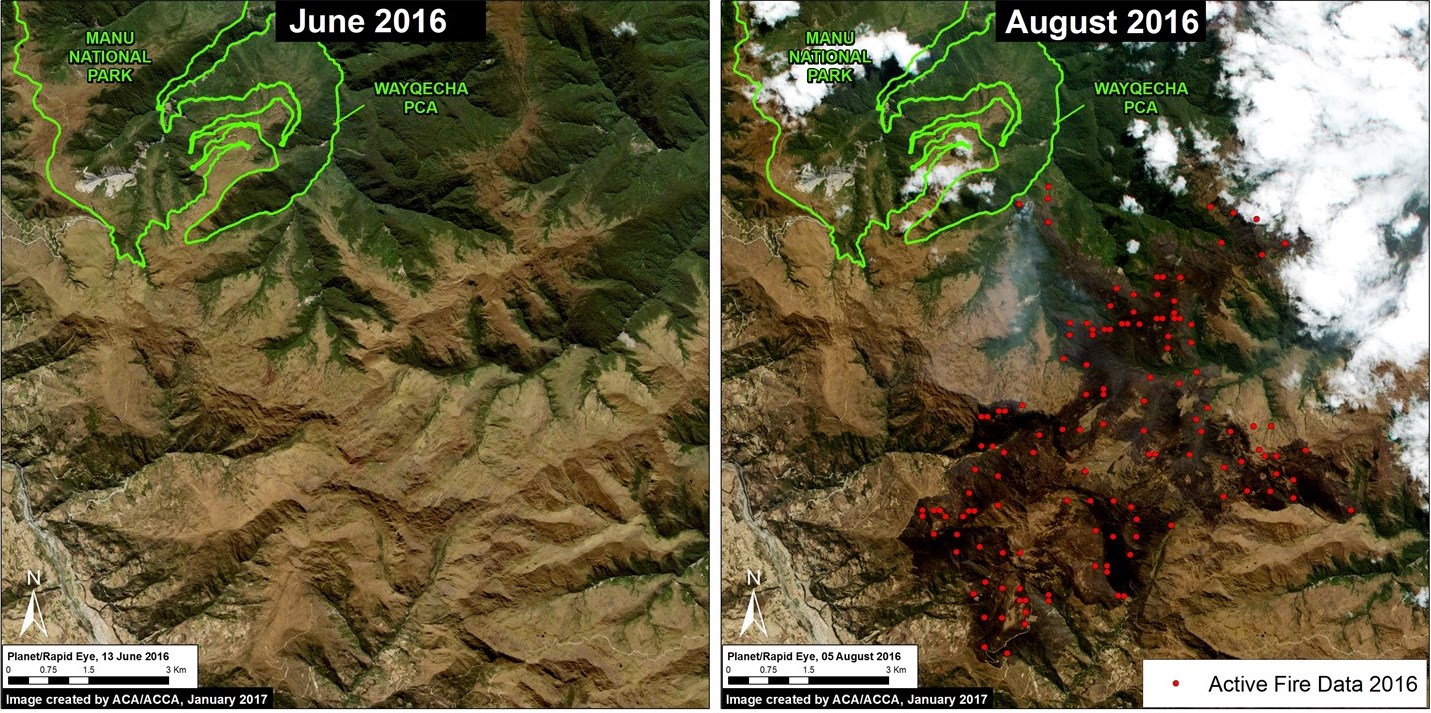
Hotspot E corresponds to an area of grassland, inter-Andean valley, and cloud forest in the buffer zone of Manu National Park and surrounding the Wayqecha Private Conservation Area. According to estimates of local officials, around 3,000 hectares burned.

Image 53e. VIIRS/NASA, SERNANP, Planet

F. Interoceanic Highway

Hotspot F indicates an area in southern Peru experiencing increasing deforestation along the Interoceanic Highway in the Madre de Dios region. We previously documented a correlation between the areas with high concentrations of fires and areas of elevated deforestation (see MAAP #47).

References

Planet Team (2017). Planet Application Program Interface: In Space for Life on Earth. San Francisco, CA. https://api.planet.com

Citation

Novoa S, Finer M, Samochuallpa E (2017) Wildfire Hotspots in Peruvian Amazon in 2016. MAAP: 53.

MAAP #48: Oil Palm Deforestation in the central Peruvian Amazon

Image 48a. Data: UMD/GLAD

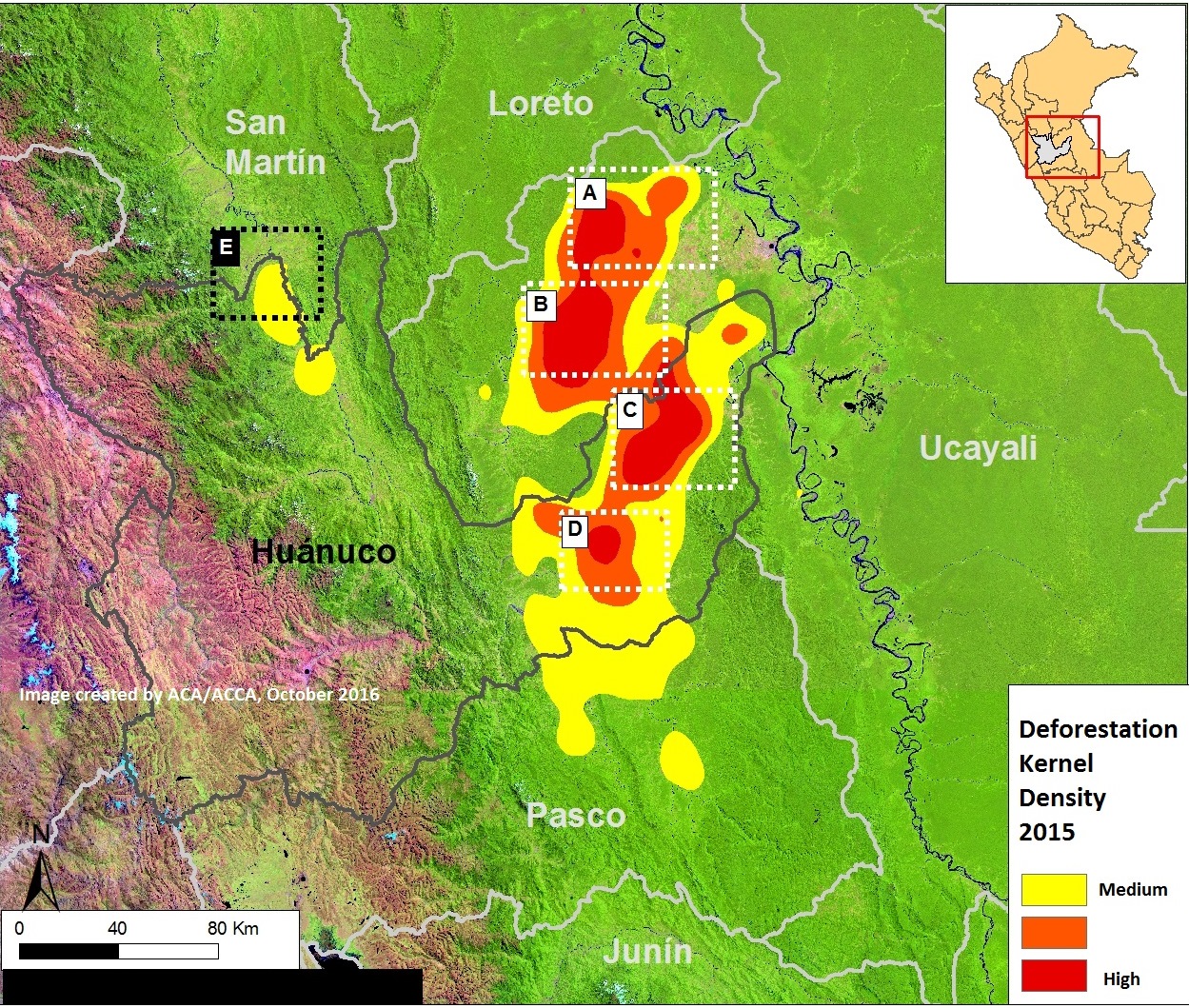
In MAAP #26, we presented a 2015 Deforestation Hotspots map for the Peruvian Amazon, which showed that the highest concentration of deforestation is located in the central Amazon region.

Here, we zoom in on one of these hotspots, located in the northern Huanuco region along its border with San Martin (see Inset E of Image 48a).*

We found that the main deforestation driver in this hotspot was the establishment of small- and medium-scale oil palm plantations.**

*Note that we analyzed the hotspots in Insets A-D in MAAP #26 and MAAP #37.

** We defined small-scale as less than 5 hectares, medium-scale as 5-50 hectares, and large-scale as greater than 50 hectares


Image 48b. Data: ACA, Hansen/UMD/Google/USGS/NASA

Oil Palm Causing Deforestation

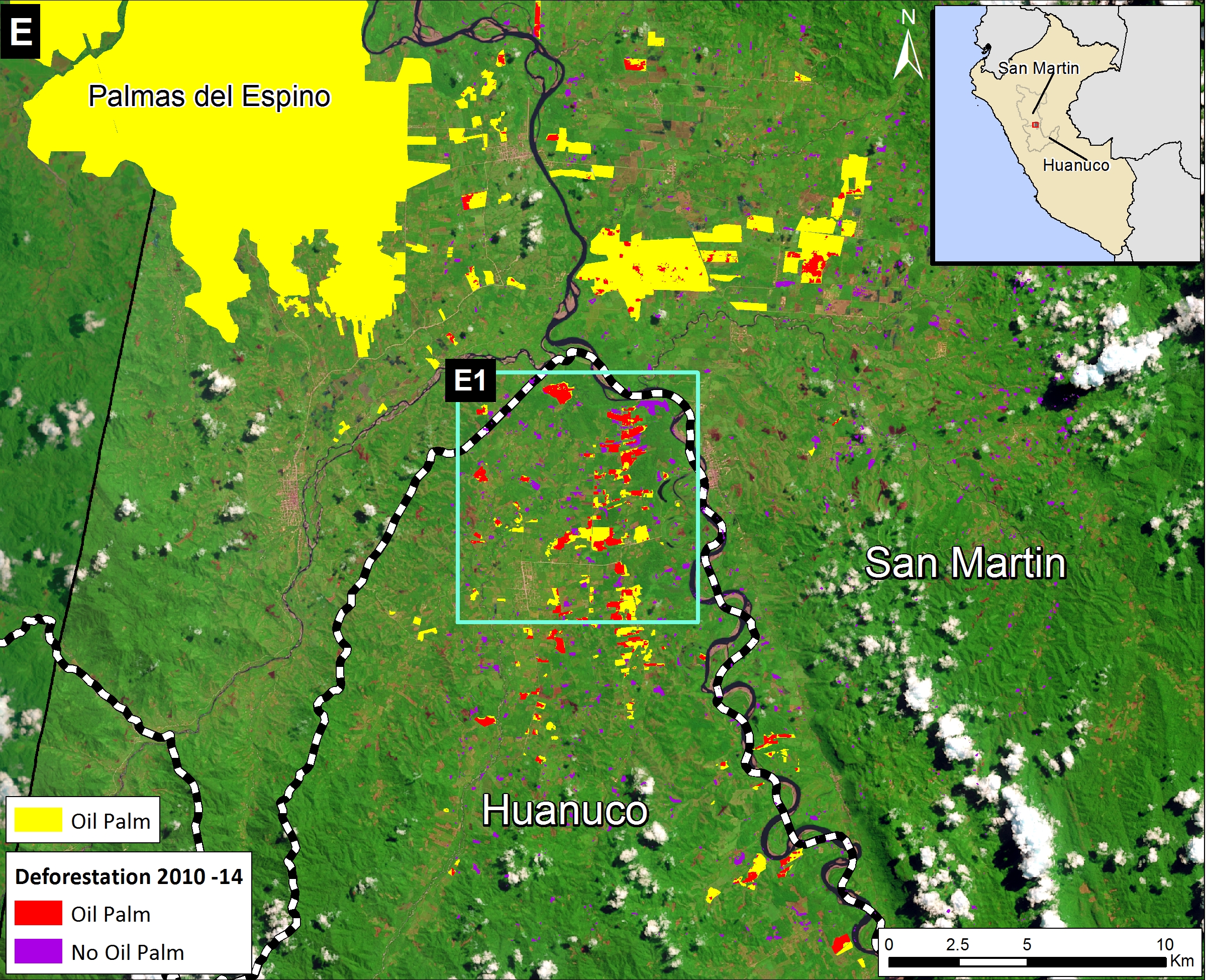
Image 48b shows our area of interest.

The San Martin side is characterized by large- and medium-scale plantations (yellow), while the Huanuco side is characterized by small- and medium-scale plantations.

Red indicates areas deforested and converted to oil palm plantations between 2010 and 2014, according to our analysis of high-resolution satellite imagery.

We estimate the deforestation of 558 hectares (1,370 acres) for establishment of oil palm plantations between 2010-2014 in northern Huanuco. Two-thirds of the plantations are medium scale (5-50 hectares) and the remaining third are small-scale (<5 hectares).***

Historical forest loss data indicates that most of the deforestation occurred in secondary forests, with a smaller percentage in primary forests.

***See MAAP #32 for more information on the importance of knowing the size of the deforestation events.


Image 48c. Data: ACA, Hansen/UMD/Google/USGS/NASA

High-Resolution Zooms

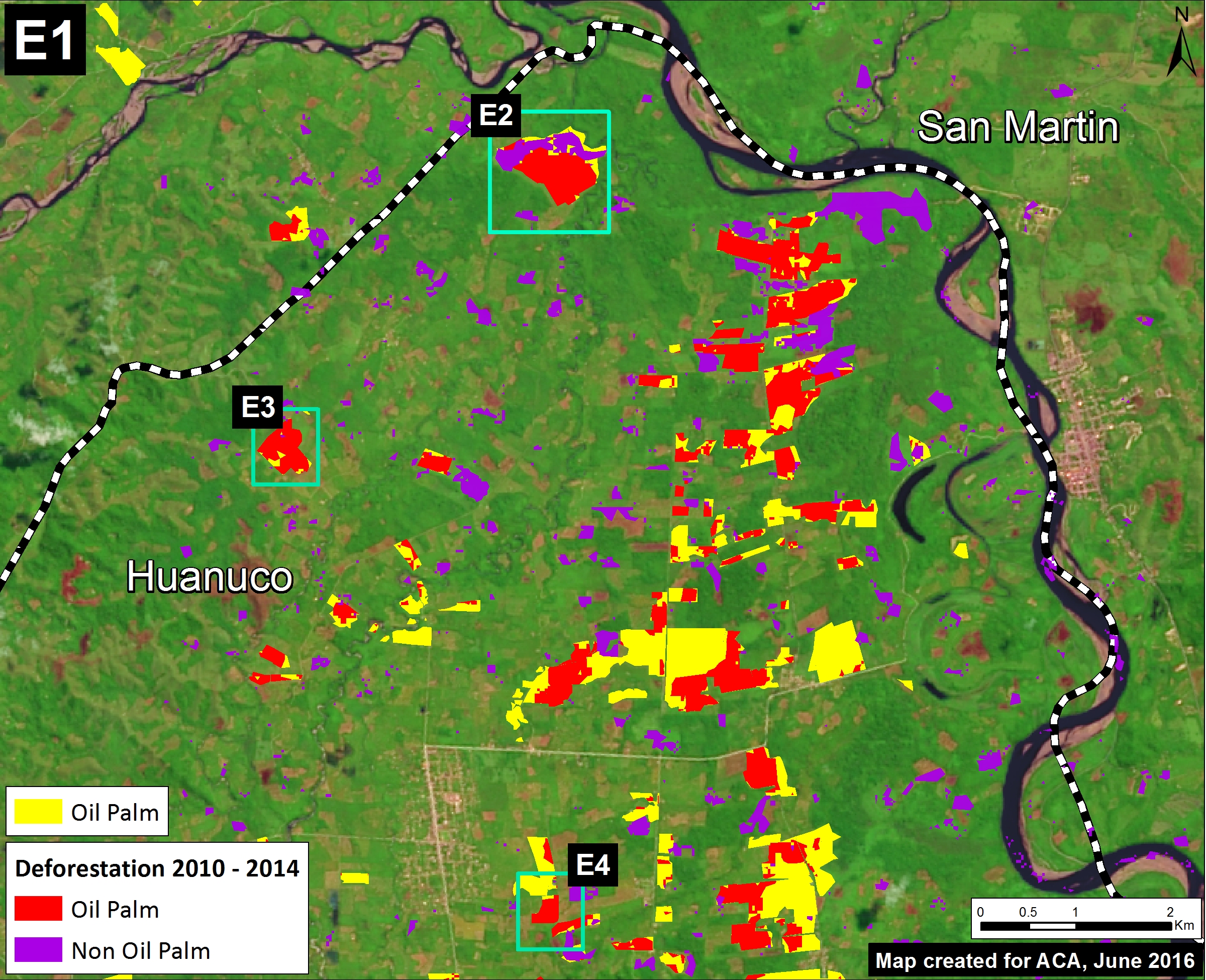
Image 48c shows a zoom of our area of interest.

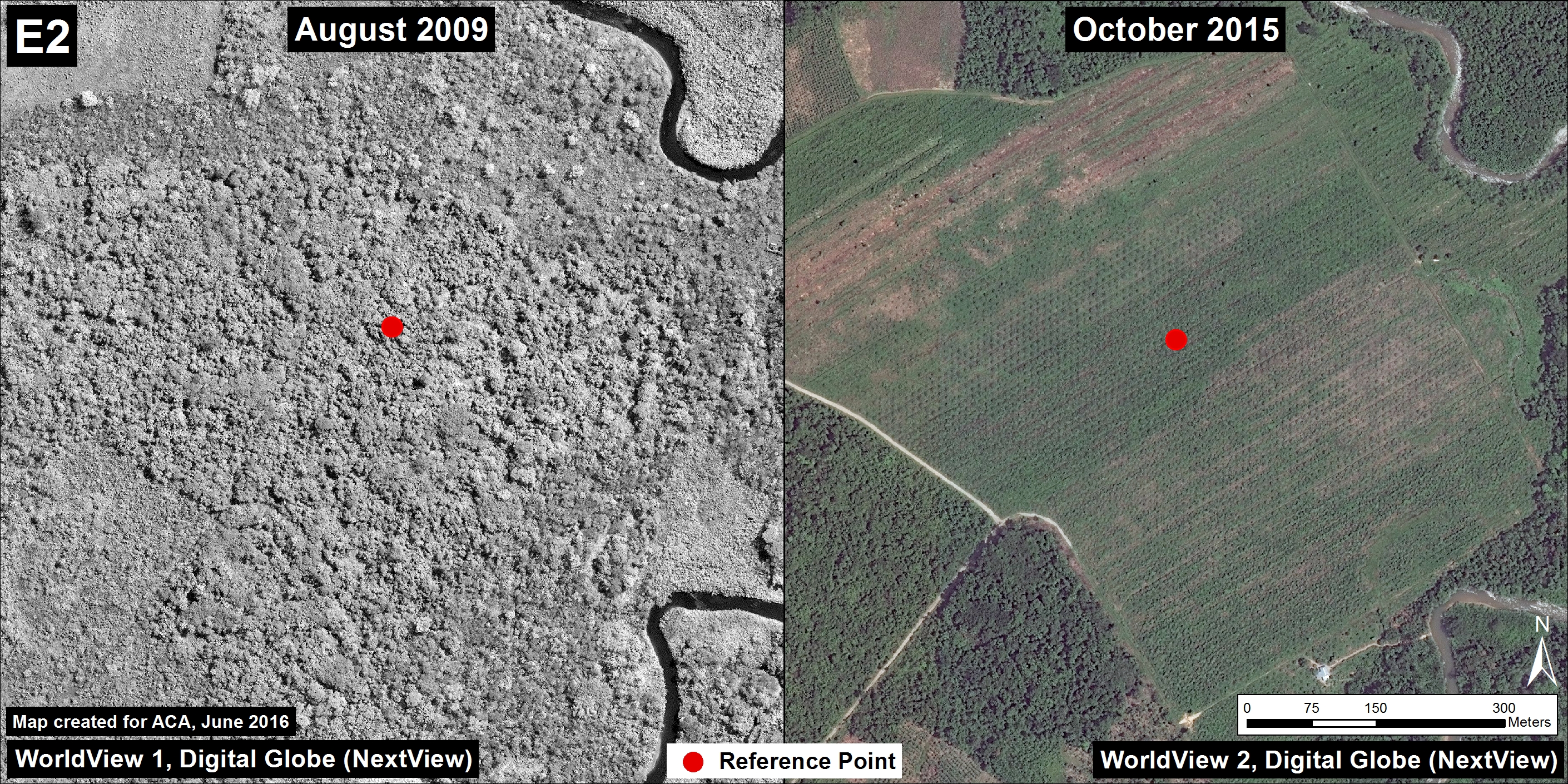
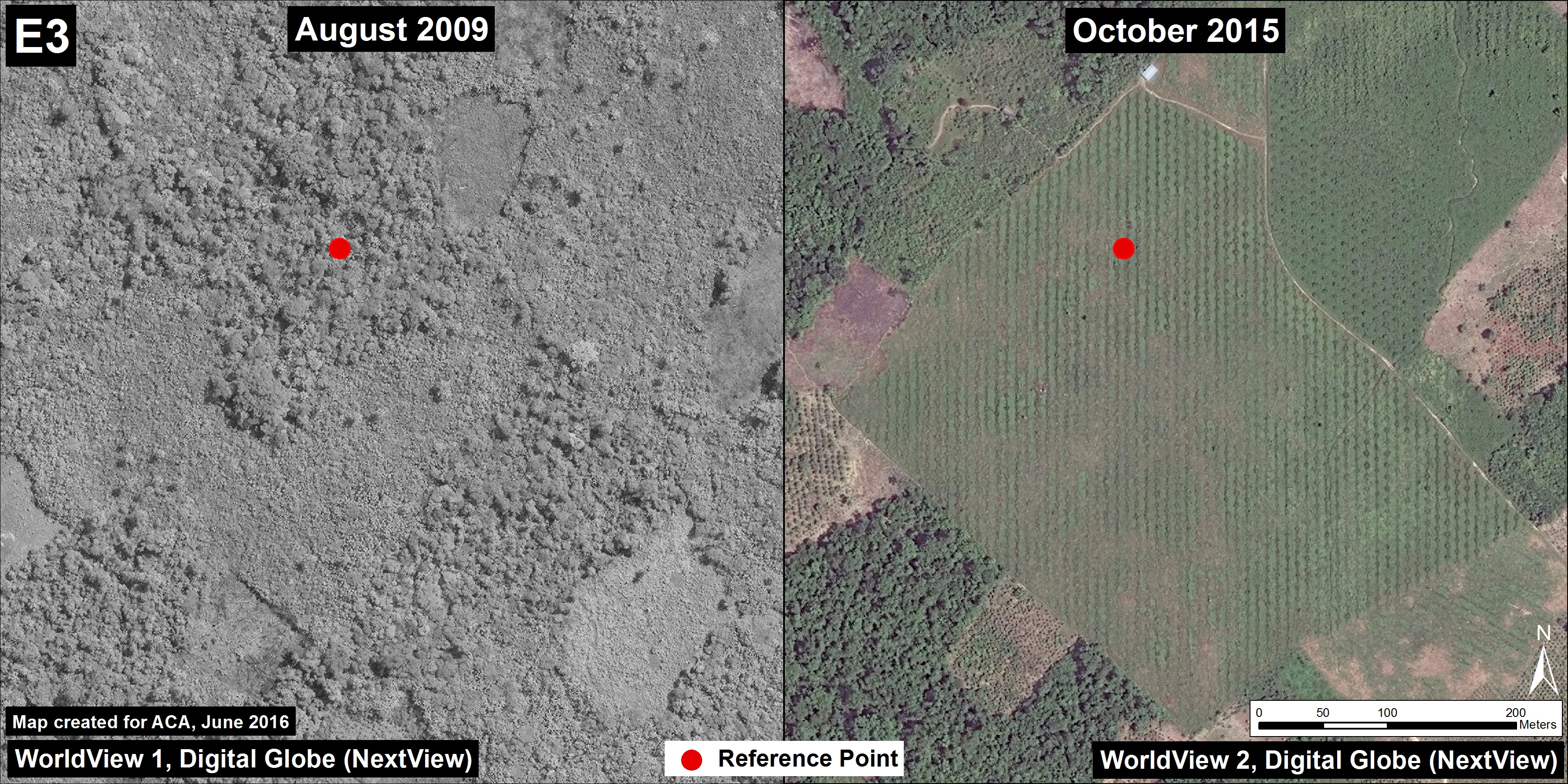
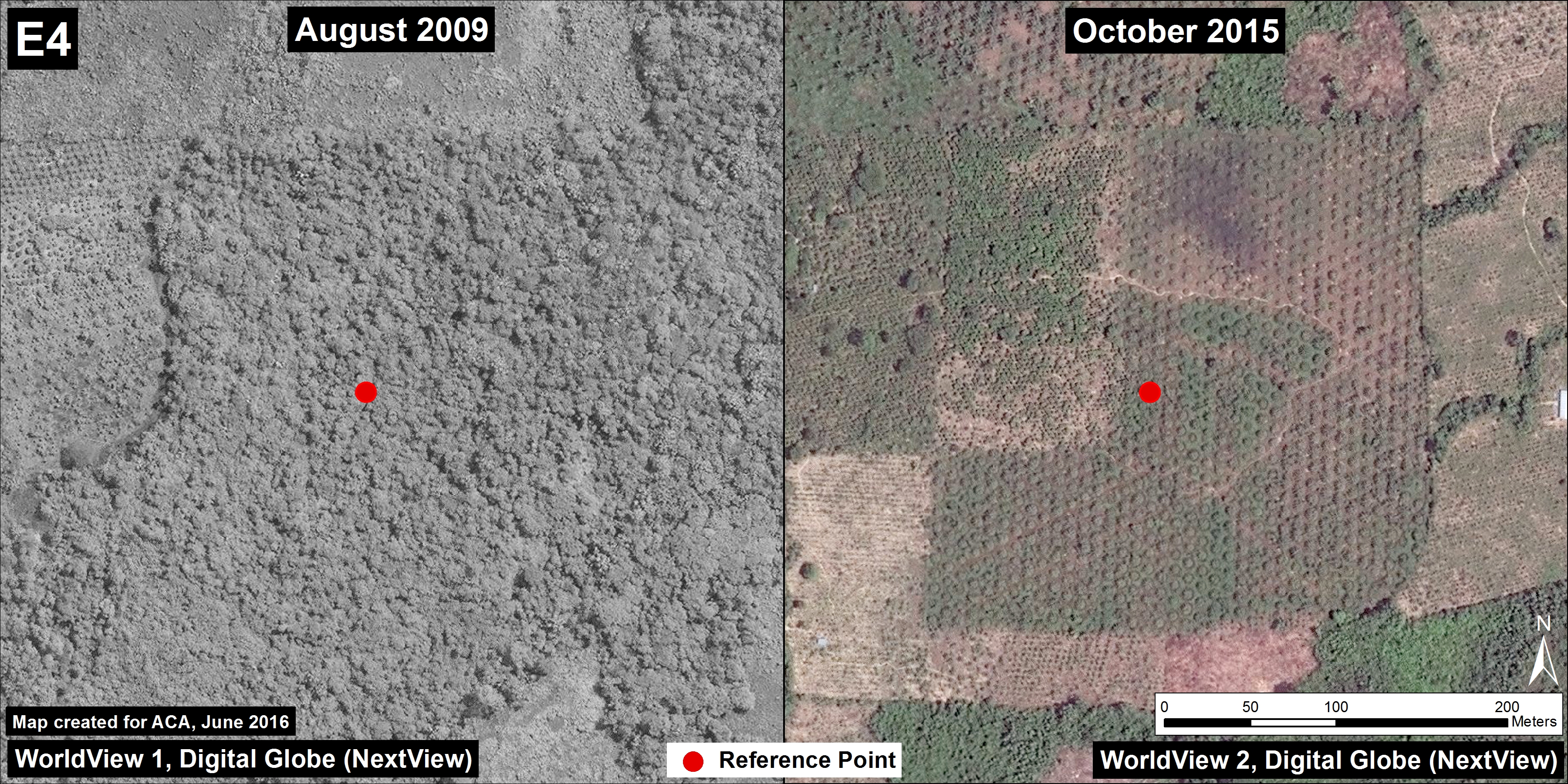
The insets indicate the areas shown below with satellite imagery from August 2009 (left panel) and October 2015 (right panel).

Each image shows the existence of forest in 2009 replaced by oil palm in 2015 (the red dot is a point of reference indicating the same spot across time).

huanucooilpalm_zoome2_engver3

Image 48d. Data: Digital Globe (Nextview)
huanucooilpalm_zoome4_eng
Image 48e. Data: Digital Globe (Nextview)

Citation

Finer M, Olexy T (2016) Oil Palm Deforestation in the central Peruvian Amazon. MAAP: 48.

MAAP #42: Papaya – New Deforestation Driver in Peruvian Amazon

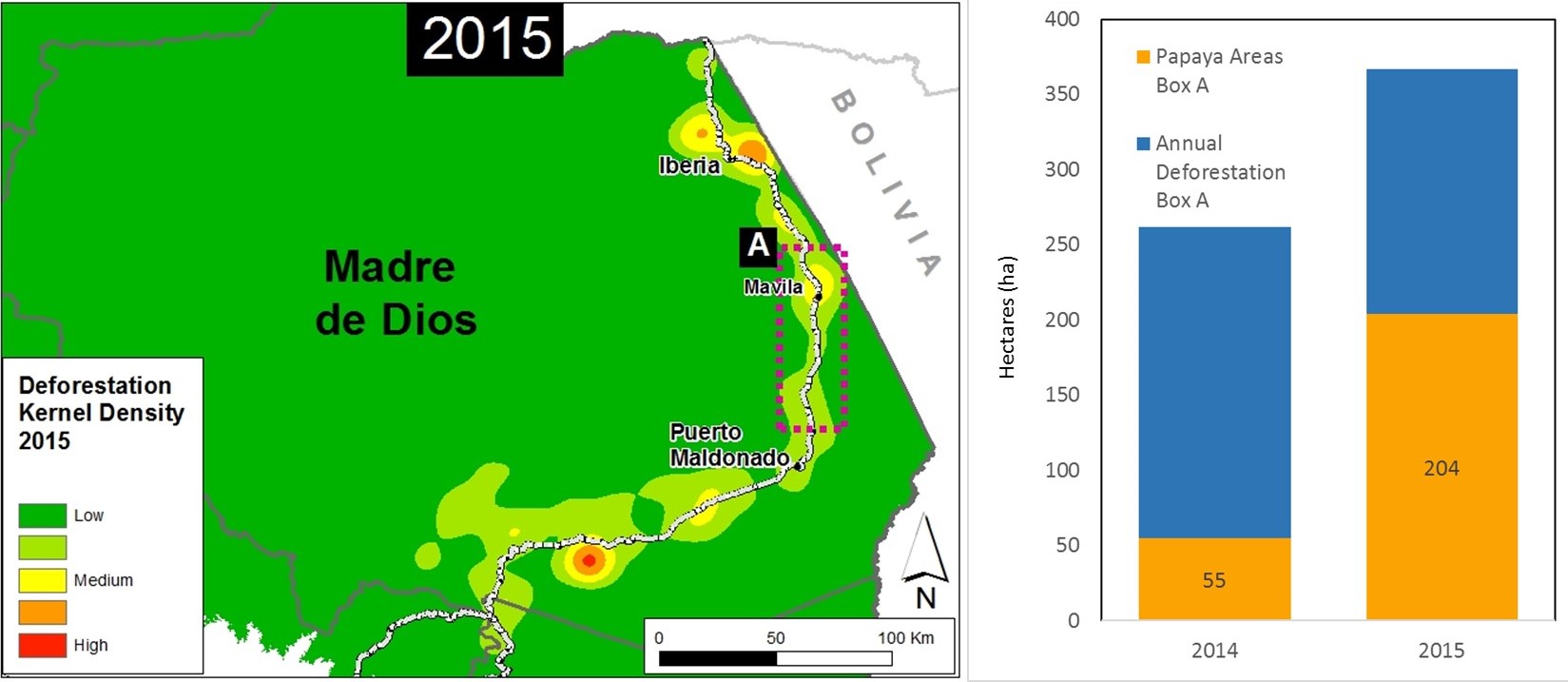
In the previous MAAP #26, we published a preliminary map of Deforestation Hotspots in the Peruvian Amazon for 2015. Subsequently in 2016, we have been compiling information to improve understanding on the potential causes (drivers) of deforestation in the identified hotspots. In this article, we focus on a medium-intensity hotspot located along the newly paved Interoceanic Highway in the eastern part of the Madre de Dios region (see Inset A in Image 42a).

Image 42a. Data. UMD/GLAD, MTC, MAAP

The analysis in this article is based on field work carried out by the Peruvian Ministry of Environment, in collaboration with Terra-i. This team has verified the presence of papaya plantations in the area indicated by Inset A and shared their photos and coordinates with MAAP to allow us to search for and analyze relevant satellite imagery.

Synthesizing all of the available information, we found that the establishment of papaya plantations was an important deforestation driver in the area in 2015. Within the focal area (Inset A), we estimate the deforestation of 204 hectares (504 acres) for papaya plantations in 2015, a major increase relative to 2014 (see bar graph in Image 42a).

All of the papaya deforestation is small (< 5 hectares) or medium (5-50 hectares) scale. According to the analysis presented in MAAP #32, these two scales represented 99% of the deforestation events in Peru in 2015. Approximately 90% of the observed deforestation is within areas zoned for agricultural activity. Therefore, the legality of the deforestation in not known (i.e. if all the required permits were obtained).

Below, we show satellite images and field photos of 5 examples of the recent deforestation caused by papaya cultivation.

Example #1

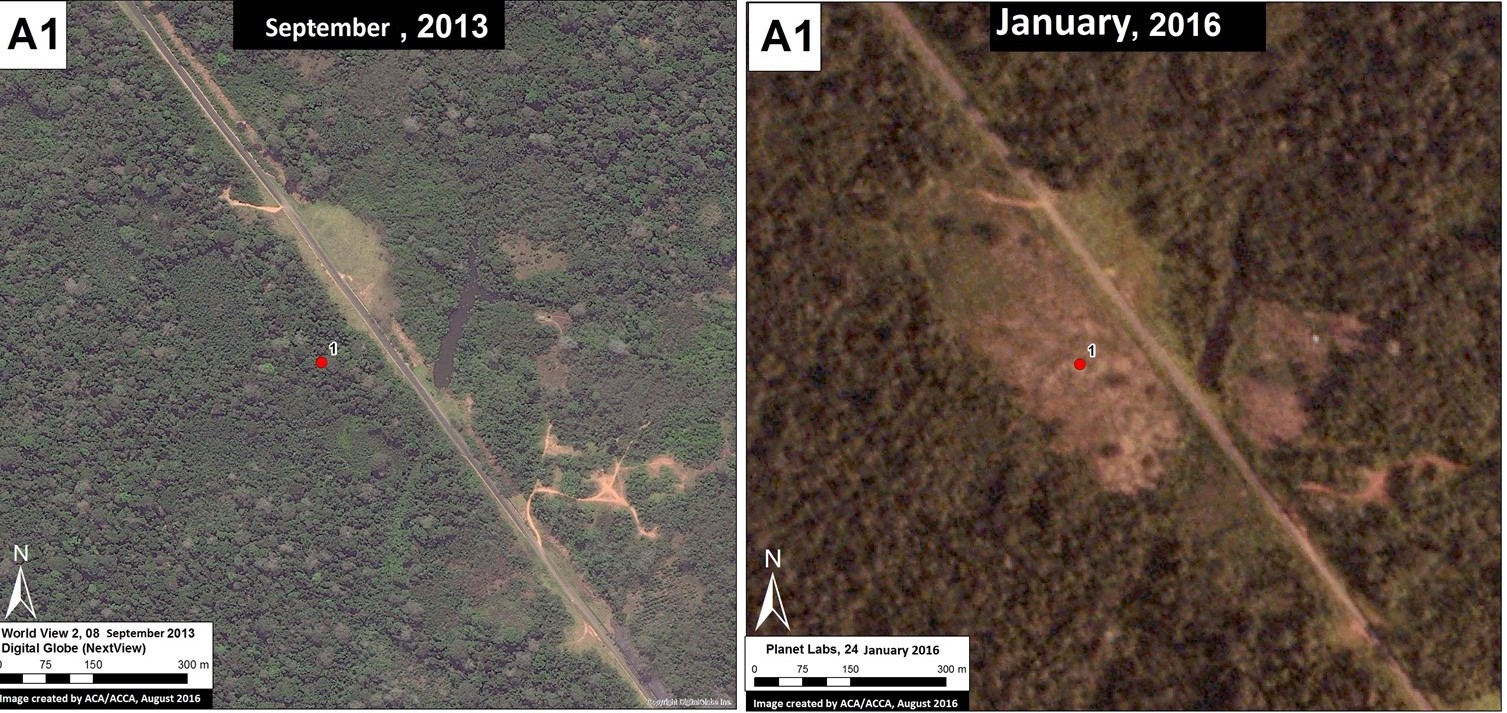
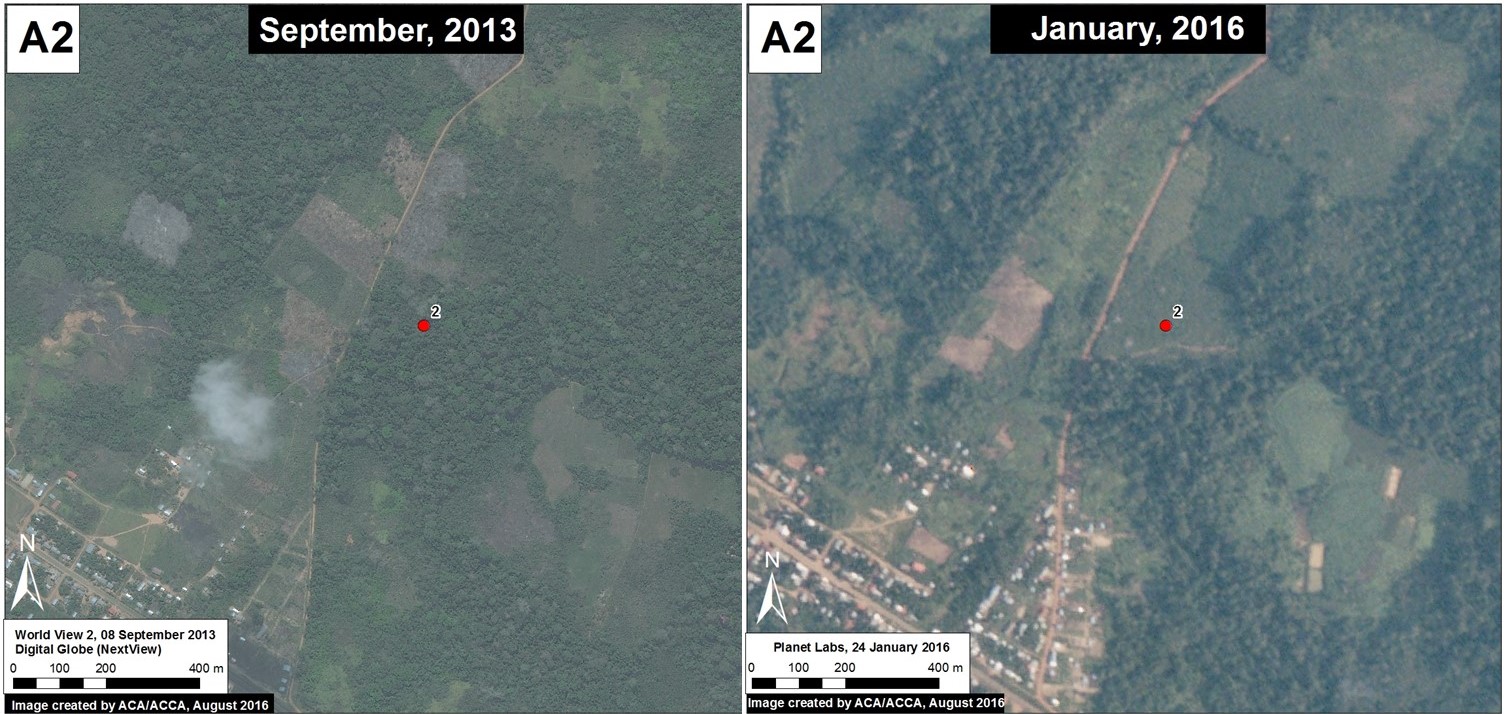
Image 42b shows the deforestation of 12 hectares between September 2013 (left panel) and January 2016 (right panel). The red point indicates the same place in both images. Image 42c is a photo of the new papaya plantation in this area.

Image 42b. Data: Digital Globe (Nextview), Planet Labs
c. point-37-source-minam---dgot-detection-by-terra-i-8132014-driver-papaya_25582479922_o
Image 42c. Photo: MINAM/DGOT, Terra-i

Example #2

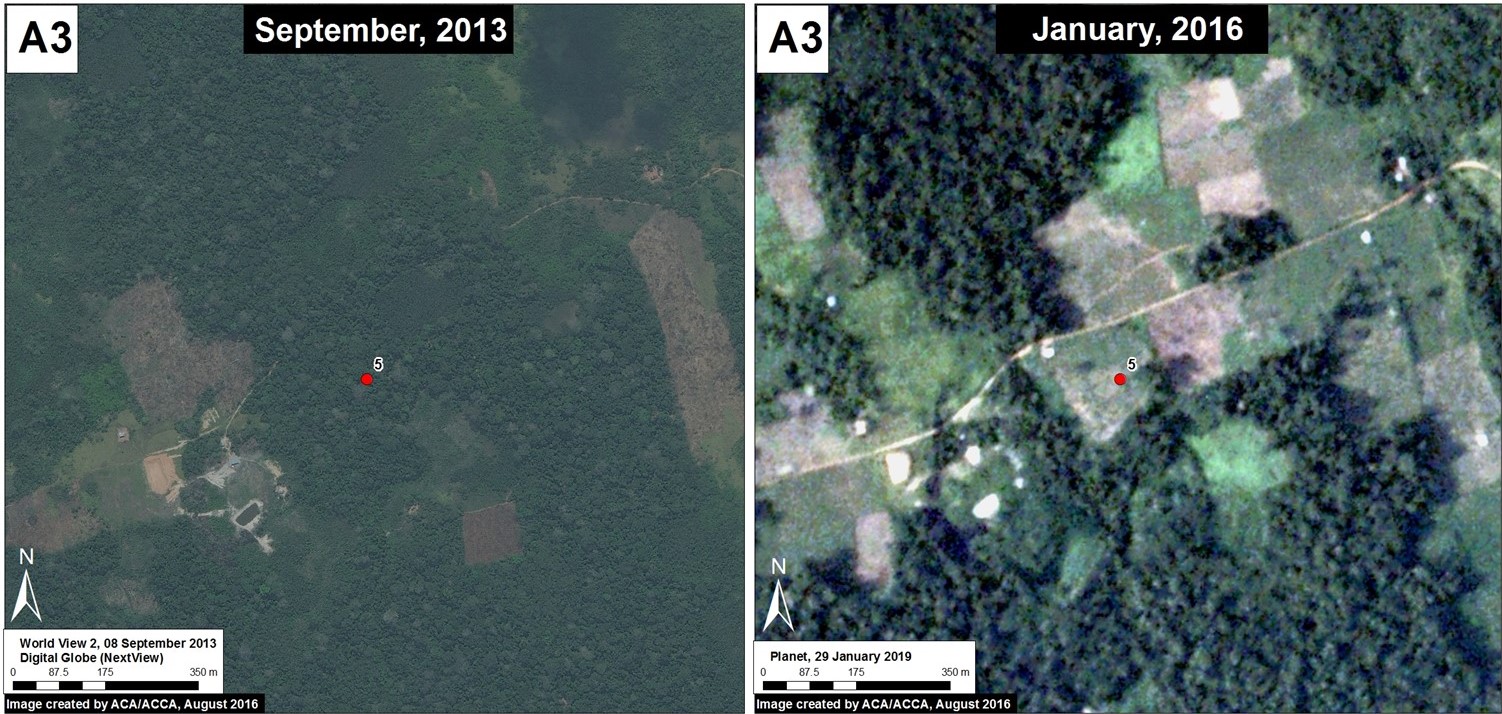
Image 42d shows the deforestation of 5 hectares between September 2013 (left panel) and January 2016 (right panel). The red point indicates the same place in both images. Image 42e is a photo of the new papaya plantation in this area.

Image 42d. Digital Globe (Nextview), Planet Labs
e. point-11-source-minam-detection-by-terra-i-112015-driver-papaya_25051222004_o
Image 42e. Photo: MINAM/DGOT, Terra-i

Example #3

Image 42f shows the deforestation of 5 hectares between September 2013 (left panel) and January 2016 (right panel). The red point indicates the same place in both images. Image 42g is a photo of the new papaya plantation in this area.

Image 42f. Digital Globe (Nextview), Planet Labs
Imagen G. MINAM/DGOT, Terra-i
Image 42g. MINAM/DGOT, Terra-i

Example #4

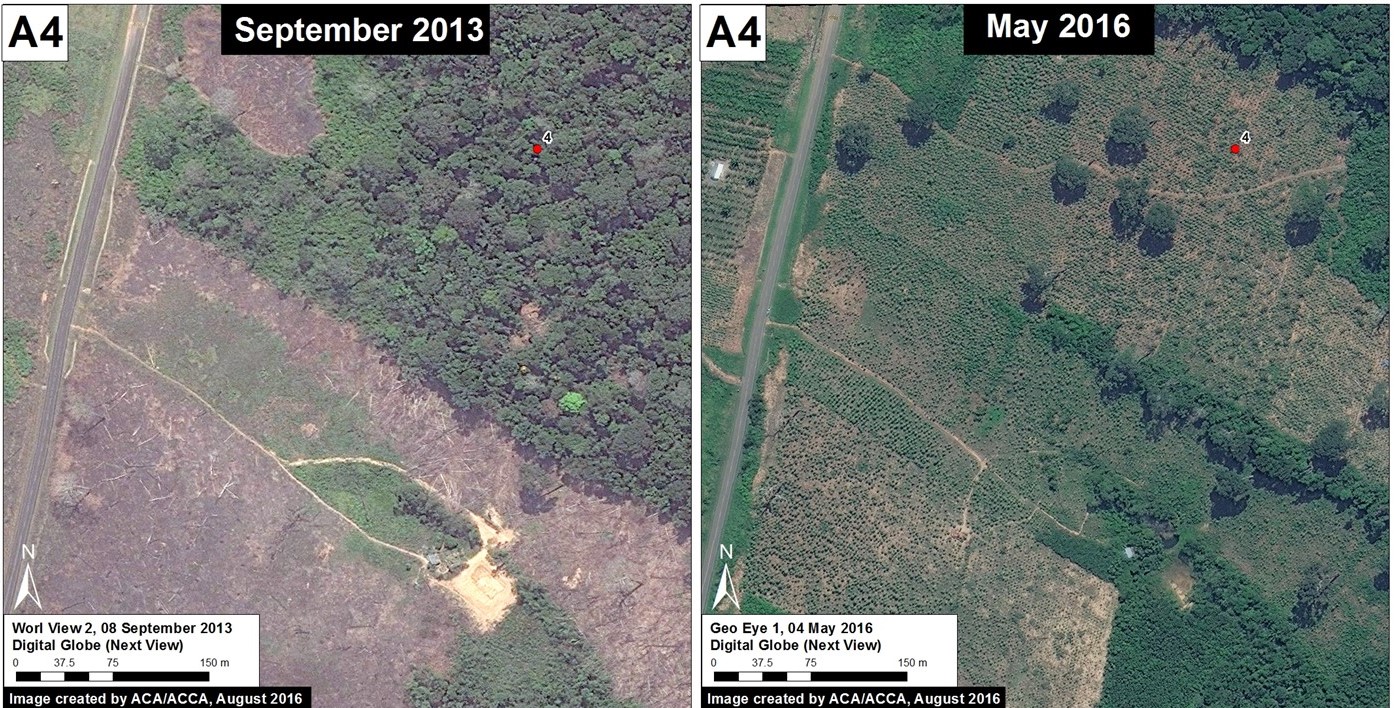
Image 42h shows the deforestation of 12 hectares between September 2013 (left panel) and May 2016 (right panel). The red point indicates the same place in both images. Image 42i is a photo of the new papaya plantation in this area.

Image 42h. MINAM/DGOT, Terra-i
Imagen I. MINAM/DGOT, Terra-i
Image 42i. Photo: MINAM/DGOT, Terra-i

Example #5

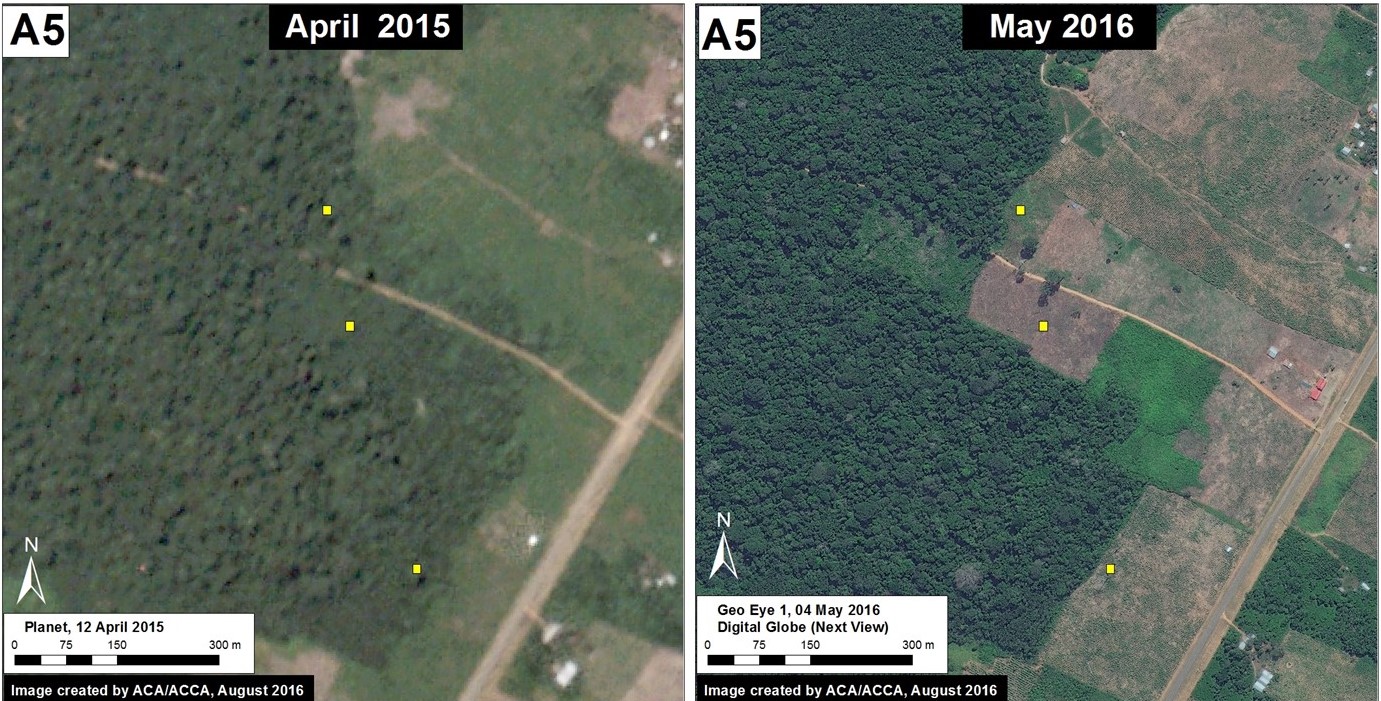
Image 42j shows the deforestation of 9 hectares between April 2015 (left panel) and May 2016 (right panel). The yellow boxes indicate the same place in both images. Image 42k is a photo of the new papaya plantation in this area.

Image 42j. MINAM/DGOT, Terra-i
Imagen J. MINAM/DGOT, Terra-
Image 42k. Photo: Farah Carrasco

Citation

Finer M, Novoa S, Carrasco F (2016) Papaya – Potential New Driver of Deforestation in Madre de Dios. MAAP: 42.

MAAP #37: Deforestation Hotspot in the central Peruvian Amazon driven by Cattle Pasture

Image 36a. Data: UMD/GLAD
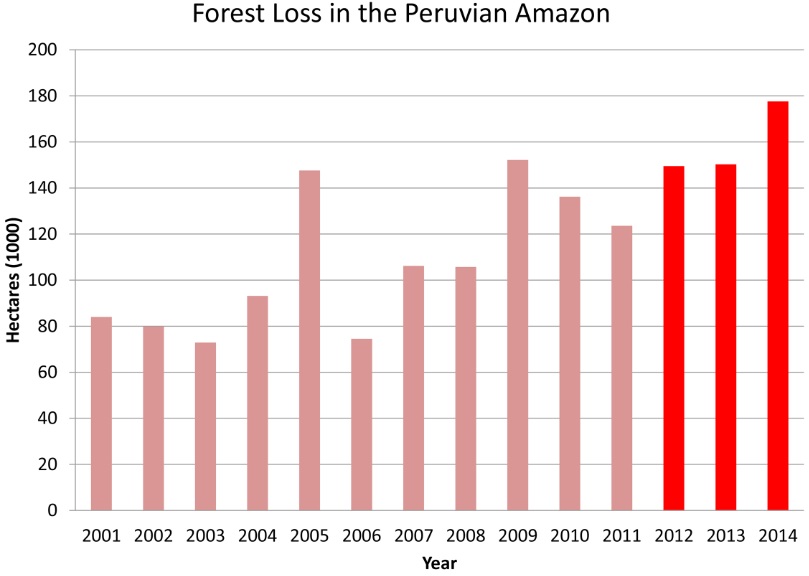
Image 37a. Data: UMD/GLAD

In the previous MAAP #26, we presented a map of Deforestation Hotspots in the Peruvian Amazon during 2015*. This analysis showed that the highest concentration of deforestation is in the central Peruvian Amazon.

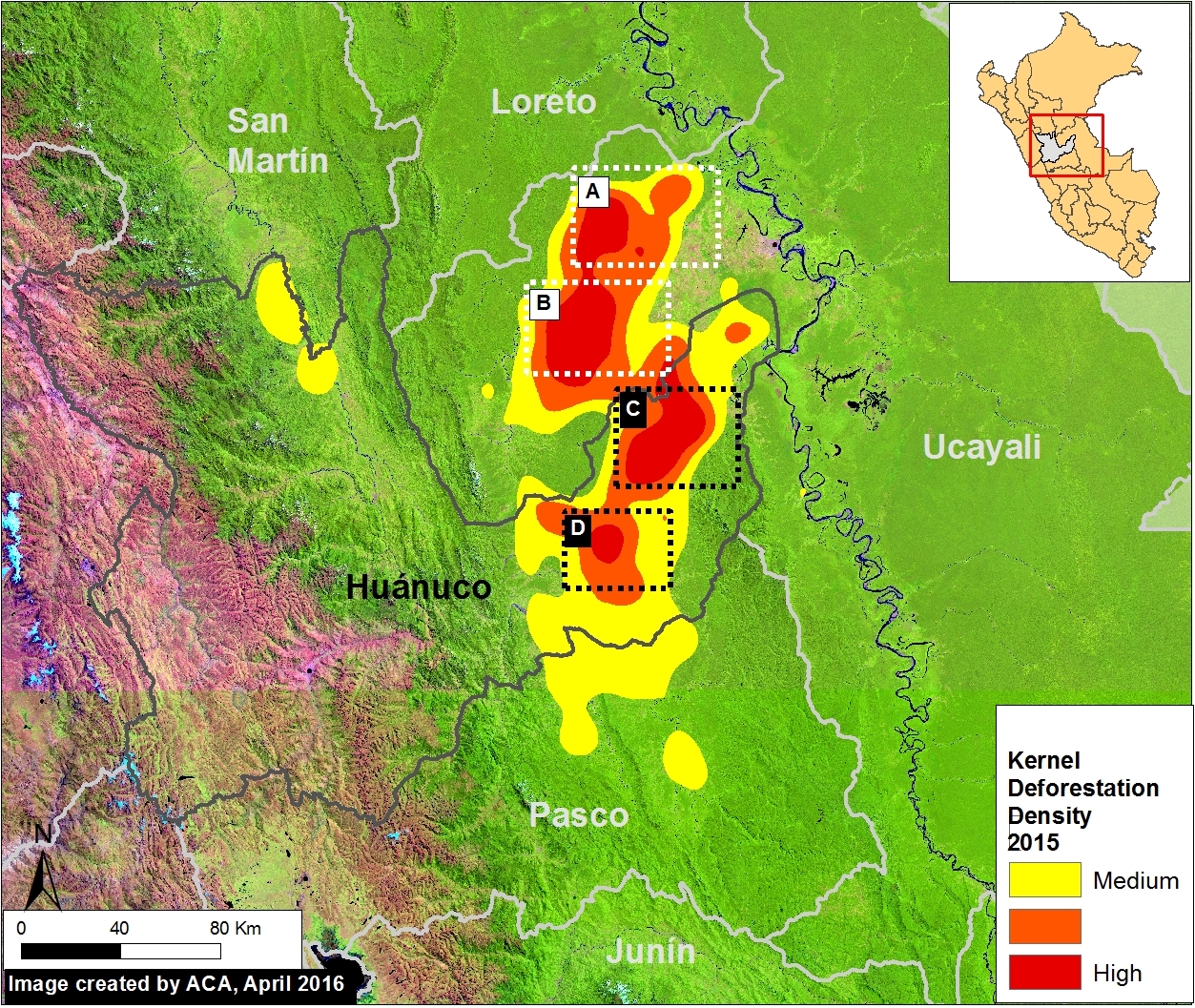
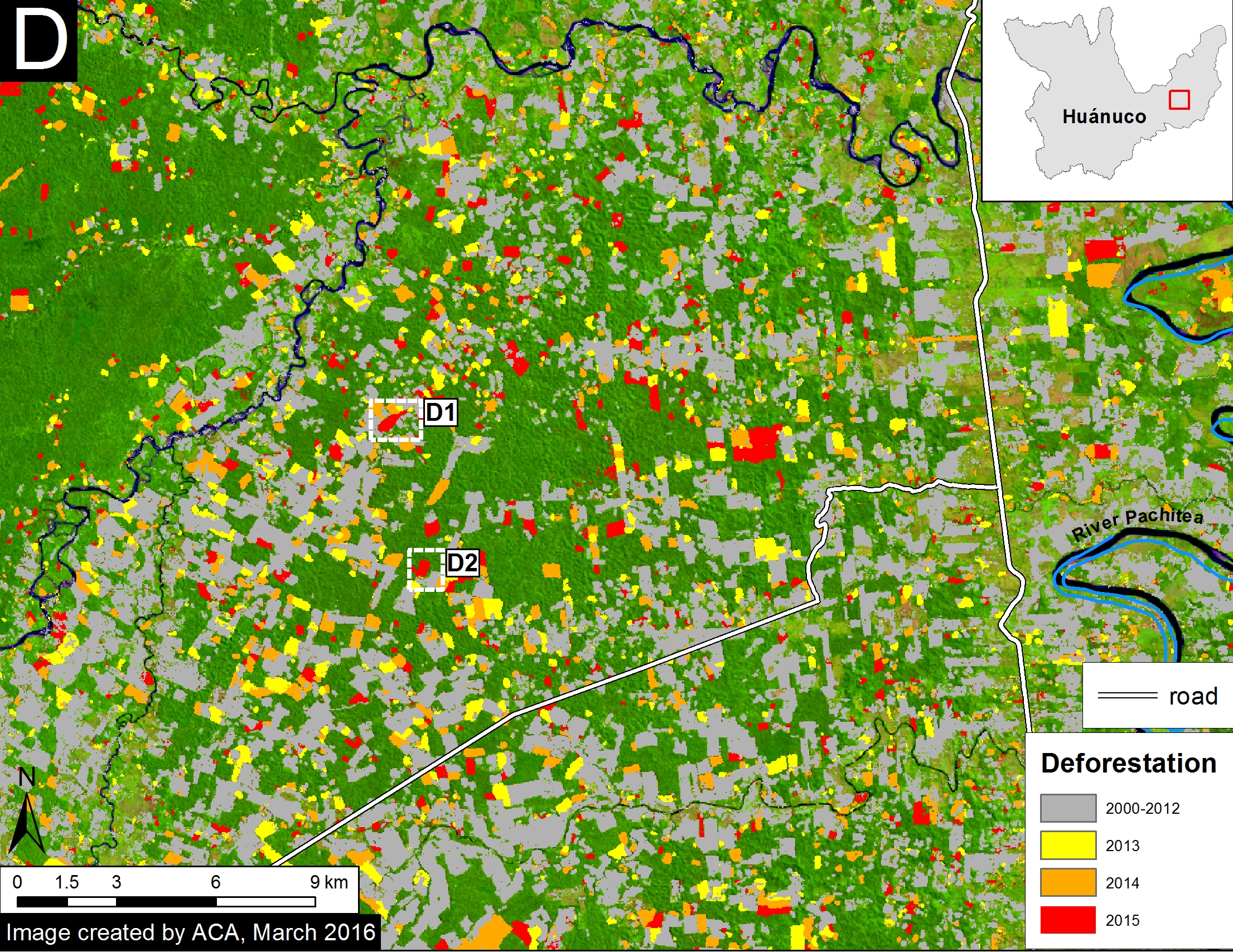
Here in MAAP #37, we focus on this region, as indicated by Image 37a. Specifically, we analyze the hotspots shown in Insets C and D, located in the eastern section of the department of Huanuco.

(Note that we previously described the hotspots indicated by Insets A and B, located in northwest Ucayali department, in MAAP #26).

For 2015, we calculated a total deforestation of 7,930 hectares (19,595 acres) in the area indicated by these two insets. The main deforestation driver is likely cattle pasture (see below). It is worth noting that the vast majority of the deforested area (87%) is outside of areas zoned for agriculture use.

We calculated an additional deforestation of 16,590 hectares (41,000 acres) in 2013 and 2014. Again, the vast majority of the forest loss appears to be outside areas zoned for agriculture use.


Deforestation Driver: Cattle Pasture

The predominant land use in the area is cattle pasture, so that is likely the leading driver of the documented deforestation.

We took a sample (1,500 hectares) of areas that were deforested in 2014, and found that 76% (1,140 hectares) were converted to cattle pasture in 2015. All sample areas were greater than 5 hectares and had available high-resolution imagery from September 2015. Based on an analysis of the imagery, we estimate that a similar amount of area was being cleared for pasture in 2015.

Below, we show a series of high-resolution images of this deforestation (click each image to enlarge).

Inset C Hotspot

Huanuco_zoomC_v5
Image 37b. Data: PNCB/MINAM, UMD/GLAD, MTC

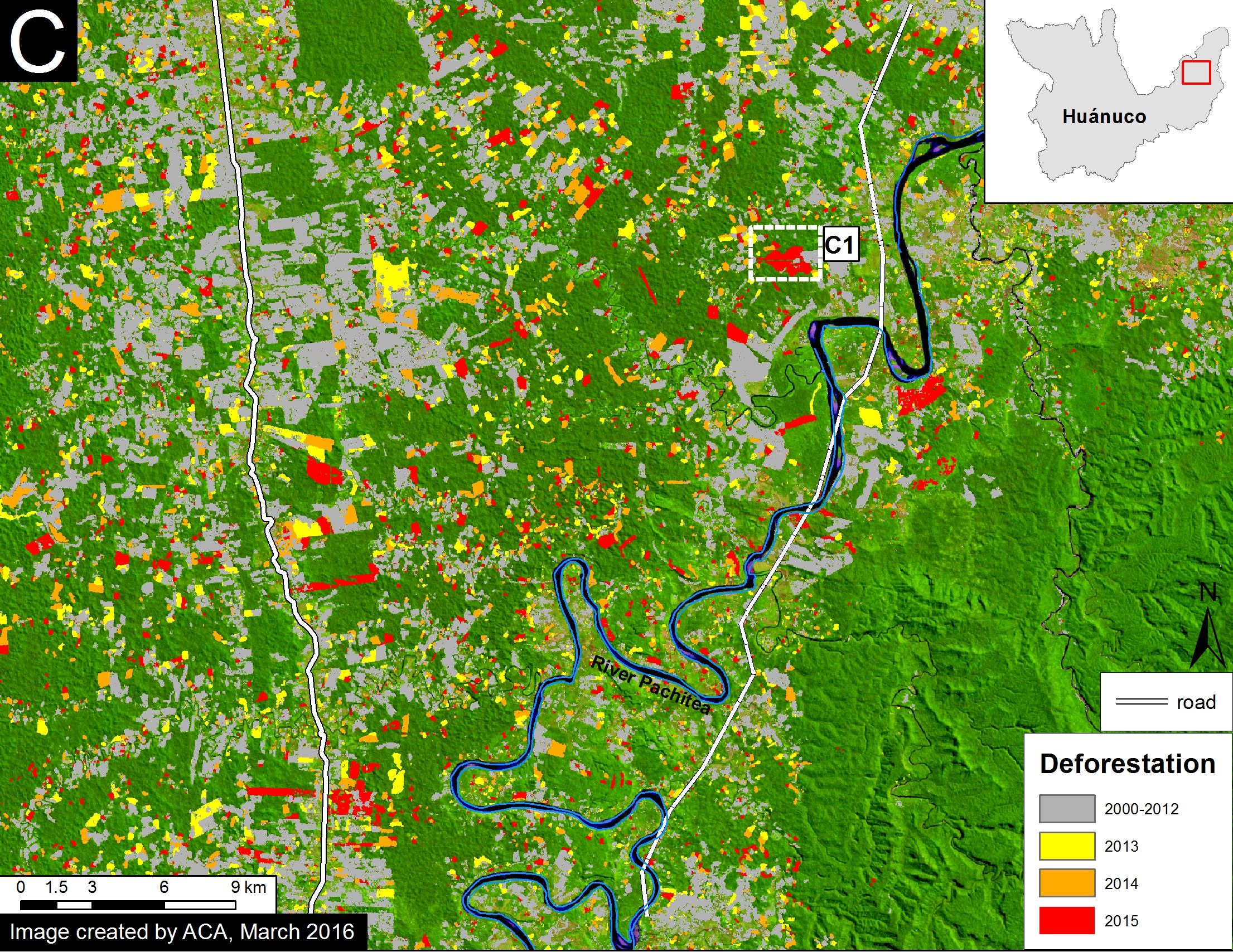
Image 37b shows a detailed view of the deforestation inside the area indicated by Inset C.

In this area, we documented deforestation of 5,050 hectares in 2015. Of this total, 46% of the deforestation events were small-scale (<5 ha), 43% were medium-scale (5-50 ha), and 12% were large-scale (>50 ha).

We calculated an additional deforestation 0f 9,940 hectares in 2013 and 2014.

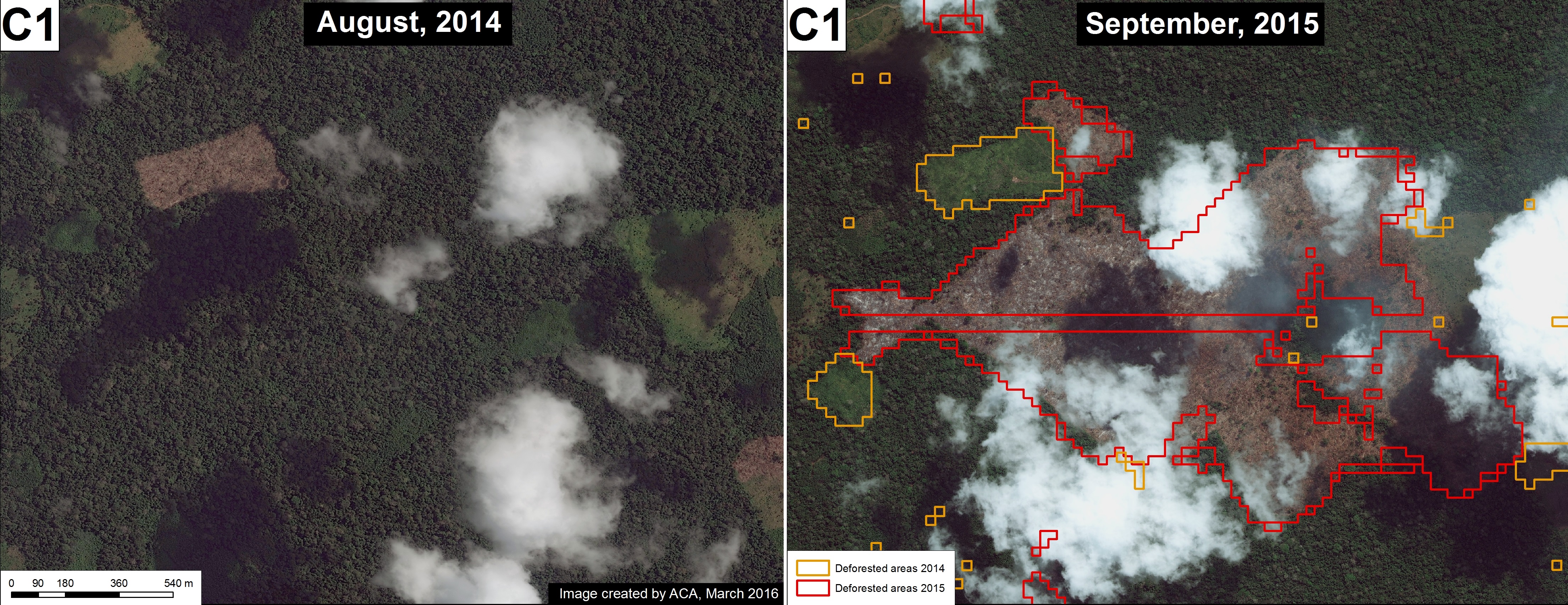
In Image 37c we show, in high resolution, an example of the recent deforestation in this area between August 2014 (left panel) and September 2015 (right panel). See Inset C1 for context.

Huanuco_C1_v5_DG
Image 37c. Data: WorldView of Digital Globe (NextView).

Inset D Hotspot

Huanuco_zoomD_v5
Image 37d. Data: PNCB/MINAM, UMD/GLAD, MTC

Image 37d shows a detailed view of the deforestation inside the area indicated by Inset D.

In this area, we documented deforestation of 2,883 hectares in 2015. Of this total, 44% of the deforestation events were small-scale (<5 ha), 51% were medium-scale (5-50 ha), and 6% were large-scale (>50 ha).

We calculated an additional deforestation of 6,650 hectares in 2013 and 2014.

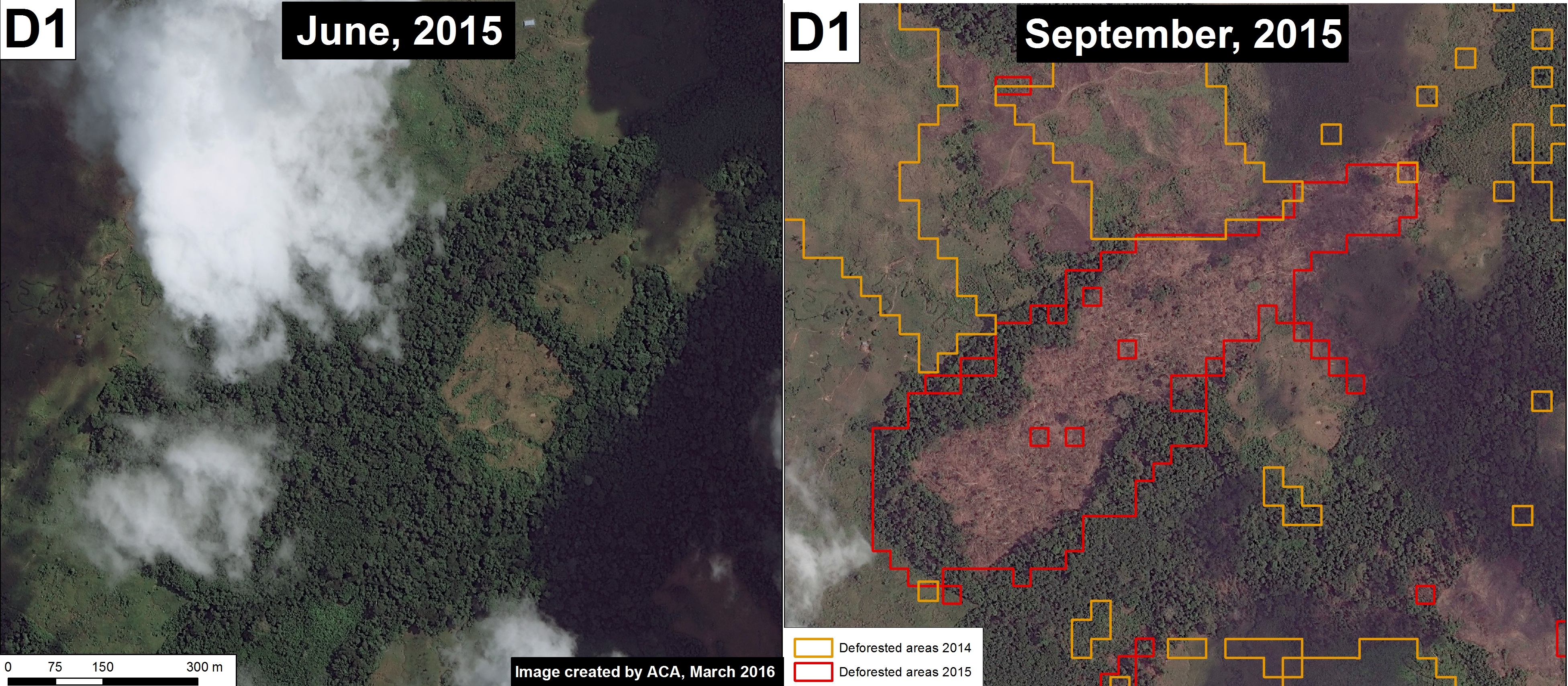
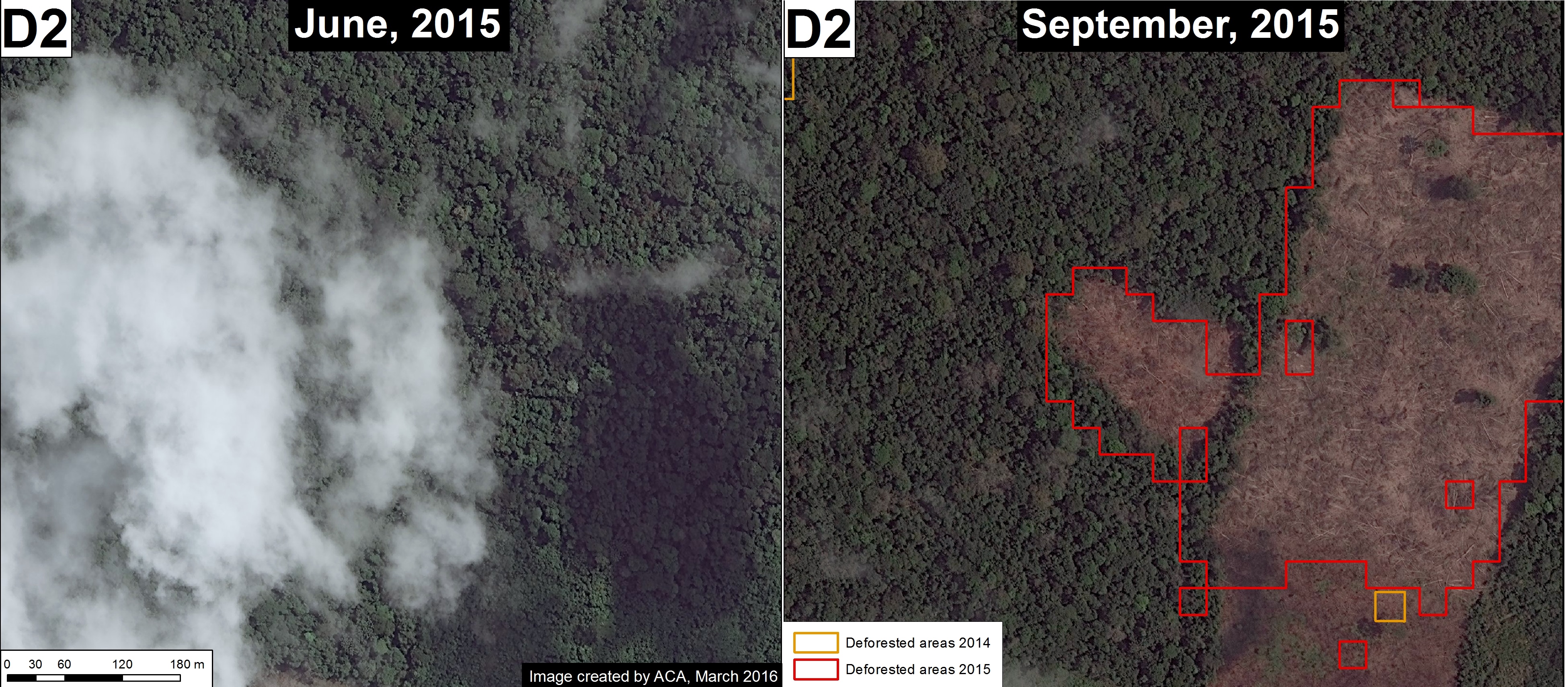
In Images 37e – 37f, we show, in high resolution, two examples of the recent deforestation in this area between June (left panel) and September (right panel) of 2015. See Insets D1 and D2 for context.

Huanuco_D1_v3_DG
Image 37e. Data: WorldView of Digital Globe (NextView).
Huanuco_D2_v2_DG
Image 37f. Data: WorldView of Digital Globe (NextView).

References

* Based on the data from the GLAD alerts, produced by the University of Maryland, Google, and Global Forest Watch. http://www.globalforestwatch.org/map/5/-9.31/-75.01/PER/grayscale/umd_as_it_happens

*Hansen, M.C., A. Krylov, A. Tyukavina, P.V. Potapov, S. Turubanova, B. Zutta, S. Ifo, B. Margono, F. Stolle, and R. Moore. Humid tropical forest disturbance alerts using Landsat data. Environ. Res. Lett. 11: 034008.


Citation

Finer M, Novoa S, Cruz C, Peña N (2016) Deforestation Hotspot in the central Peruvian Amazon. MAAP: 37.

MAAP #32: Large-scale vs. Small-scale Deforestation in the Peruvian Amazon

Graph 32a. Data: PNCB/MINAM, UMD/GLAD

In the previous MAAP #25 and MAAP #26, we illustrated deforestation hotspots in the Peruvian Amazon for the periods 2012-2014 and 2015*, respectively. Here in MAAP #32, we present a complementary analysis based on the size of deforestation events.

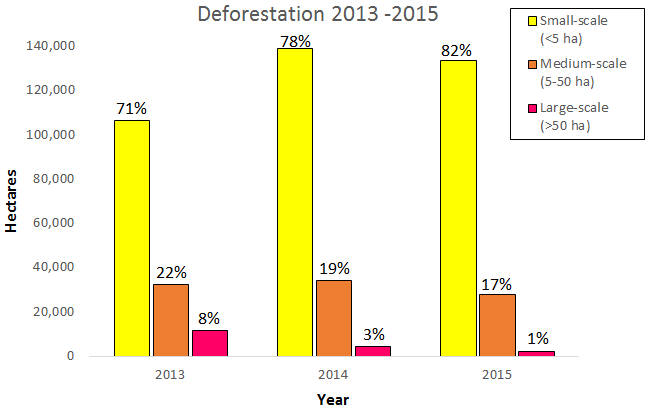
Graph 32a shows the comparative results of deforestation patterns between 2013 and 2015, indicating that:
Small-scale (< 5 hectares) accounted for the vast majority of deforestation events (70-80%) each year.
Medium-scale (5-50 hectares) accounted for approximately 20% of the deforestation events each year.
Large-scale (> 50 hectares) deforestation was variable. In 2013, the year with the most activity of new cacao and oil palm plantations, it accounted for 8% of the deforestation events. In 2015 it was only 1%.

In summary, small- and medium-scale deforestation events represent more than 90% of the total and a constant threat, while large-scale deforestation events represents a latent threat. As described below, large-scale projects can quickly cause massive deforestation events, and should therefore remain a high priority.

*We have increased our deforestation estimate for 2015 to 163,238 hectares (403,370 acres), the second highest on record (behind only 2014). This estimate is based on GLAD alerts, produced by University of Maryland, Google, and Global Forest Watch.

Base Map

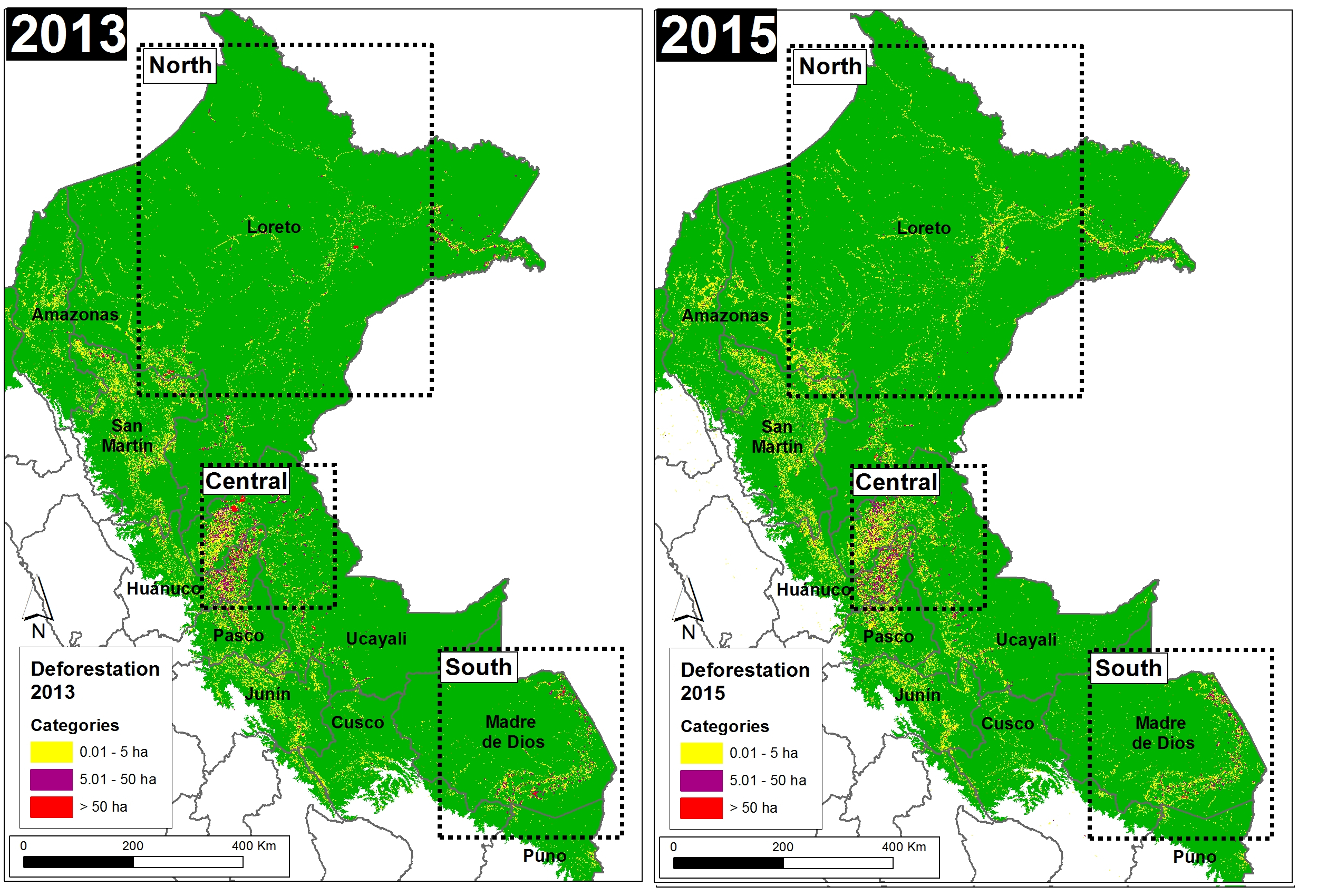
Image 32a shows, in graphic form, the deforestation patterns described above for 2013 (left panel) and 2015 (right panel). Further below, we show zooms for three key zones in the north, central, and south, respectively.

Categ_13_15_v1_en
Image 32a. Data: PNCB/MINAM, UMD/GLAD

Northern Peruvian Amazon

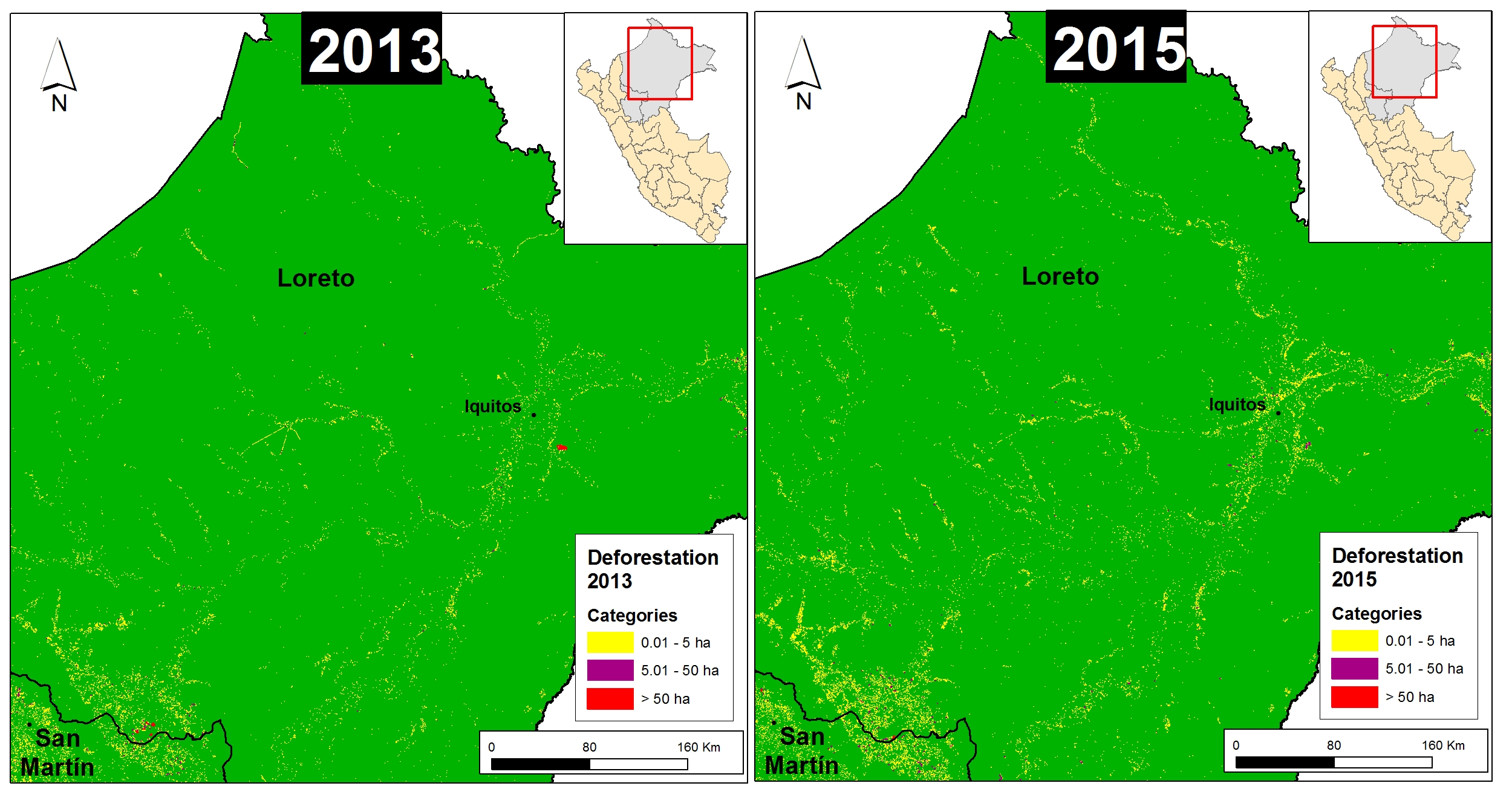
Image 32b shows a zoom of the northern Peruvian Amazon for 2013 (left panel) and 2015 (right panel). In general, there is a pattern of small-scale deforestation along the rivers of Loreto. Additionally, in 2013, there were large-scale deforestation events for a cacao project located to the southeast of the city of Iquitos (see MAAP #27 for more details) and for oil palm plantations along the border of Loreto and San Martin regions (see MAAP #16 for more details). In 2015, the expansion of deforestation continued in these areas, but at a medium-scale.

Categ_13_15_n_v1_en
Image 32b. Data: PNCB/MINAM, UMD/GLAD

Central Peruvian Amazon

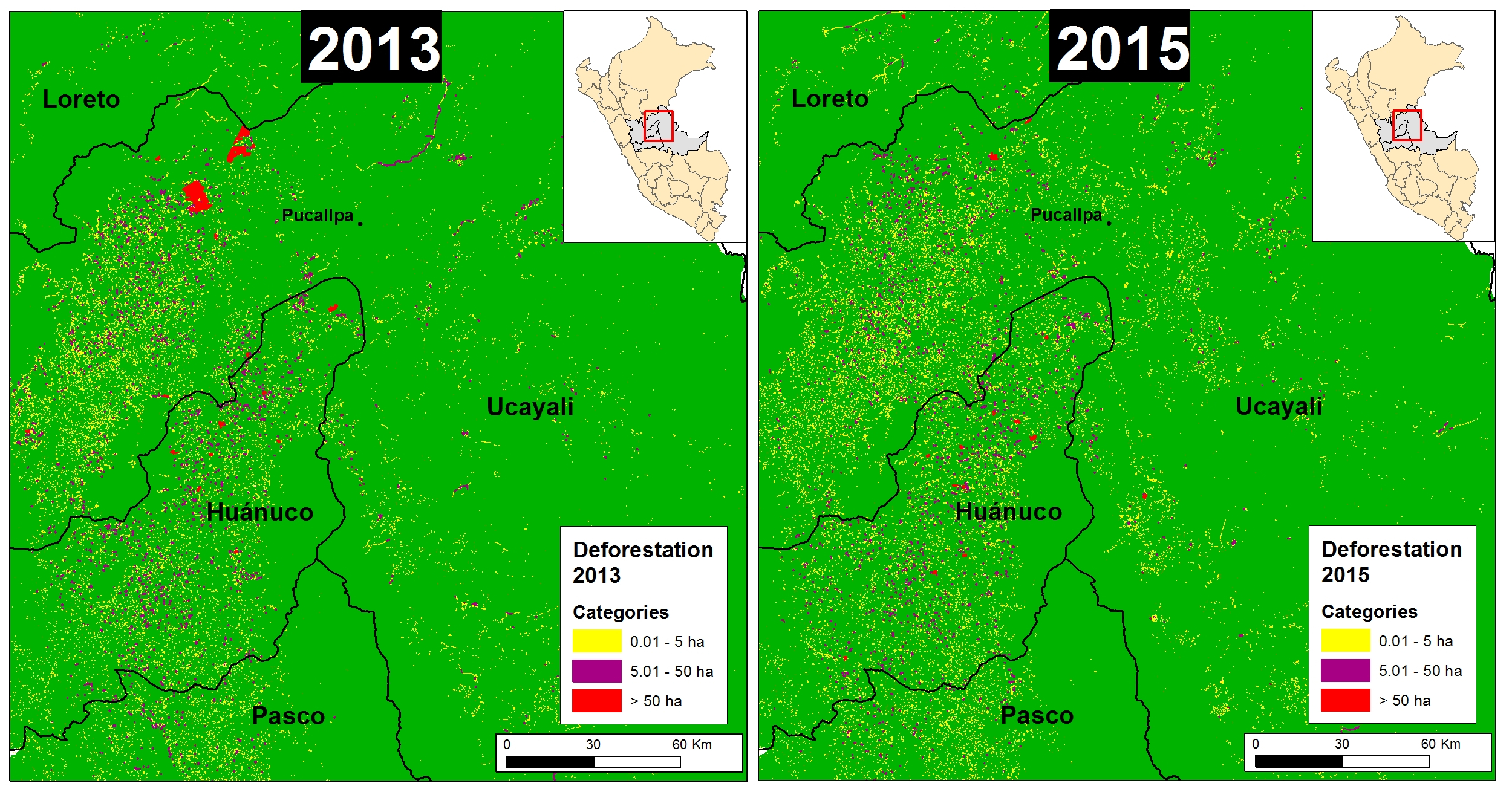
Image 32c shows a zoom of the central Peruvian Amazon for 2013 (left panel) and 2015 (right panel). In general, there is a concentration of small- and medium-scale deforestation between northwest Ucayali and southeast Huánuco. Additionally, in 2013, there is large-scale deforestation for two new oil palm plantations located northeast of the city of Pucallpa (see MAAP #4 for more details).

Categ_13_15_c_v1_en
Image 32c. Data: PNCB/MINAM, UMD/GLAD

Southern Peruvian Amazon

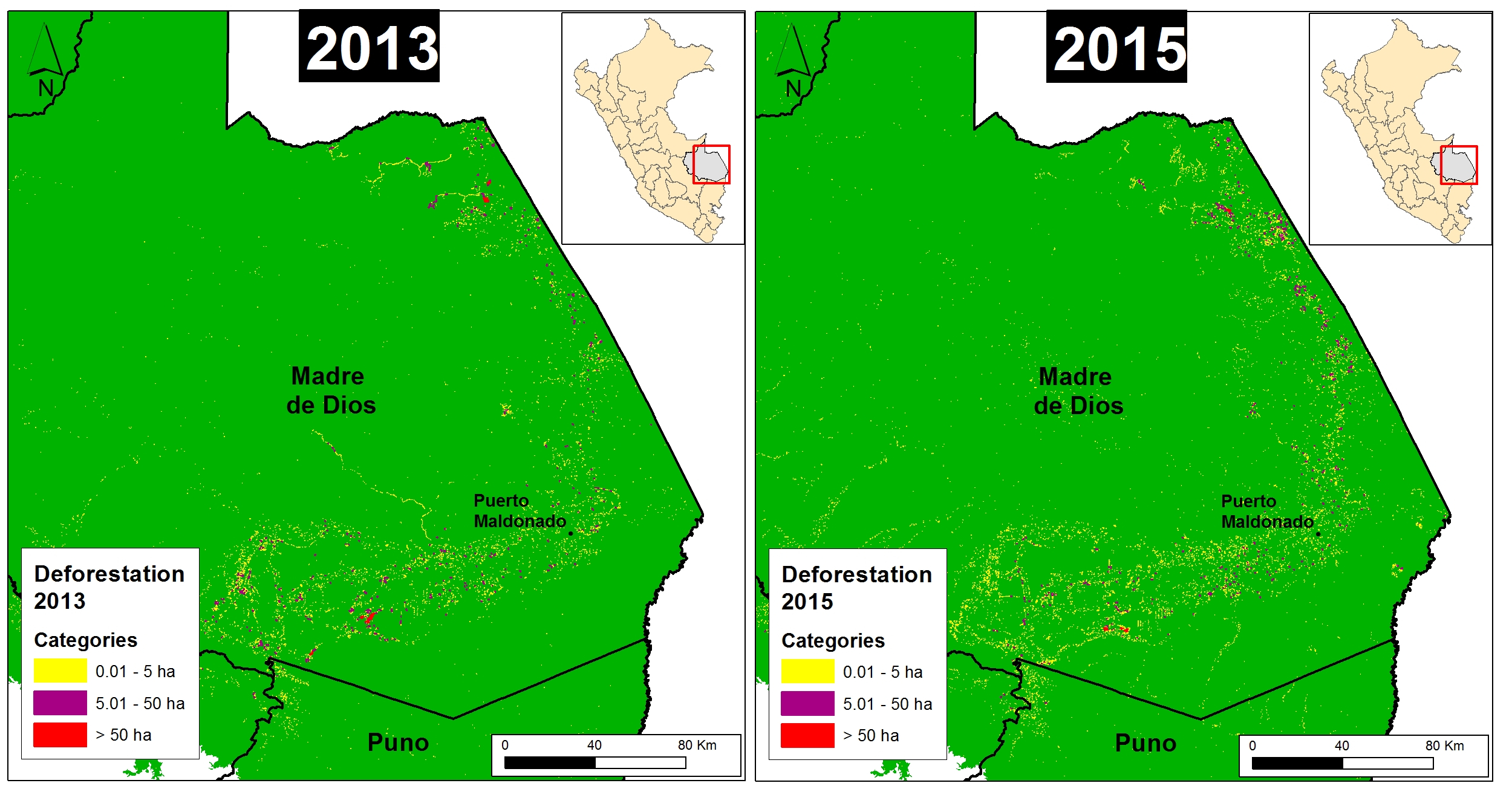
Image 32d shows a zoom of the southern Peruvian Amazon for 2013 (left panel) and 2015 (right panel). In general, there is a pattern of small- and medium-scale deforestation along the Interoceanic highway in Madre de Dios. Additionally, there is the persistence of large-scale deforestation in southern Madre de Dios related to illegal gold mining (see MAAP #12 for more details).

Categ_13_15_s_v1_en
Image 32d. Data: PNCB/MINAM, UMD/GLAD

Citation

Finer M, Novoa S (2016) Large-scale vs. Small-scale Deforestation in the Peruvian Amazon. MAAP: 32.

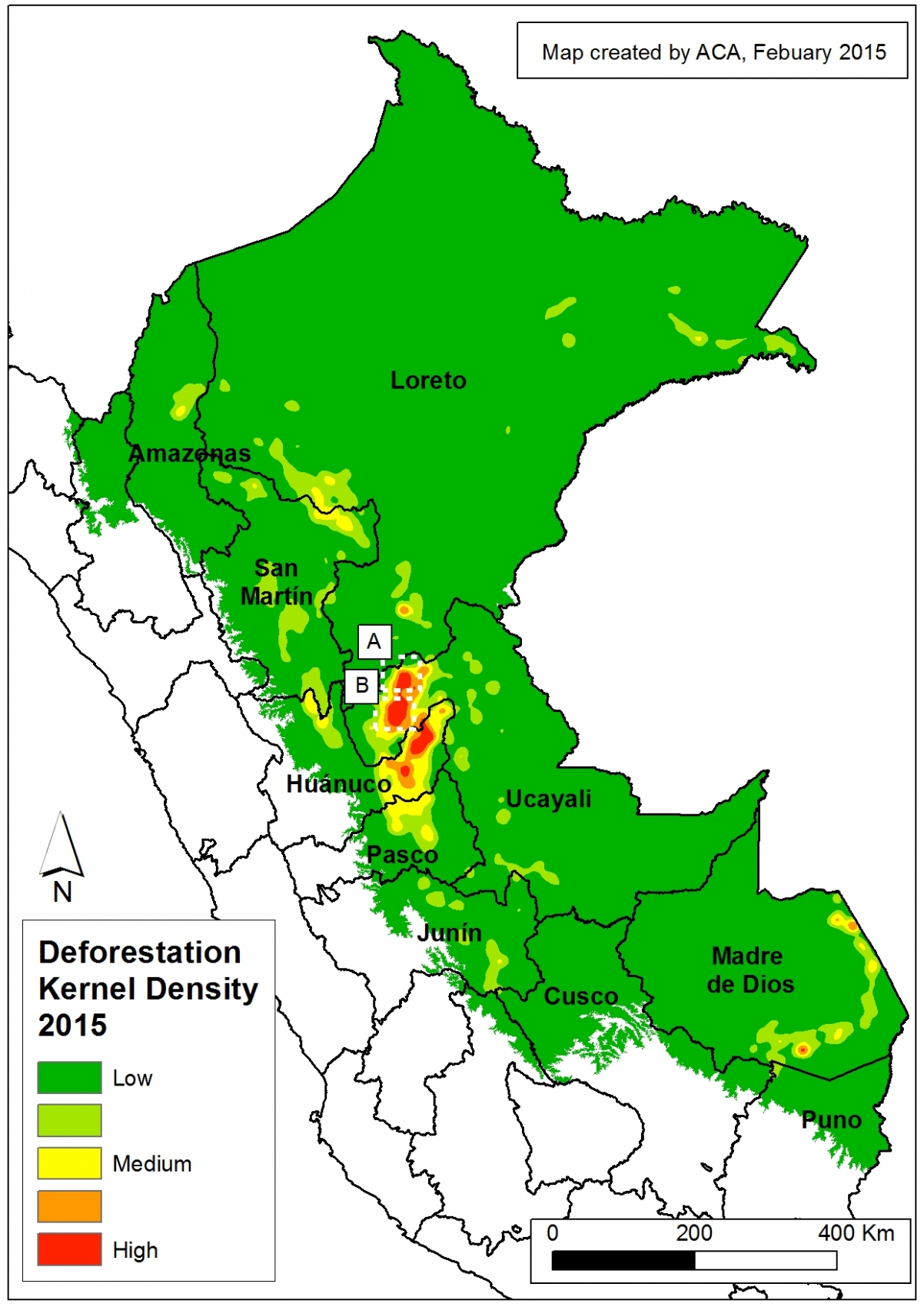
MAAP #26: Deforestation Hotspots in the Peruvian Amazon, 2015

Thanks to the newly launched GLAD alerts (developed by the University of Maryland and Google1, and presented by Global Forest Watch), we now have weekly access to high-resolution forest loss data across Peru. Here in MAAP #26, we analyze the first batch of this data to better understand deforestation patterns in the Peruvian Amazon in 2015. In the coming weeks and months, we will use this map as a base for investigating major hotspots of forest loss in the country.

Kernell_2015a_v1_en
Image 26a. Kernel density map for forest loss in the Peruvian Amazon in 2015. Data: Hansen et al 2016 (ERL).

According to the GLAD alert data, total estimated forest loss in Peru in 2015 was 158,658 hectares (392,050 acres). If confirmed, that represents the second highest total on record, behind only 2014 (177,500 hectares).

To better understand where the GLAD alert data was concentrated in 2015, we conducted kernel density estimation, a type of analysis that calculates the magnitude per unit area of a particular phenomenon (in this case, forest loss). Image 26a shows the kernel density map for forest loss in the Peruvian Amazon in 2015. It reveals that recent deforestation was concentrated in a number of hotspots in the departments of Huánuco, Madre de Dios, and Ucayali.

Note that in MAAP #25, we conducted this same type of analysis for 2012 – 2014 forest loss data. Thus, with this latest analysis we can see how deforestation trends shifted in 2015.

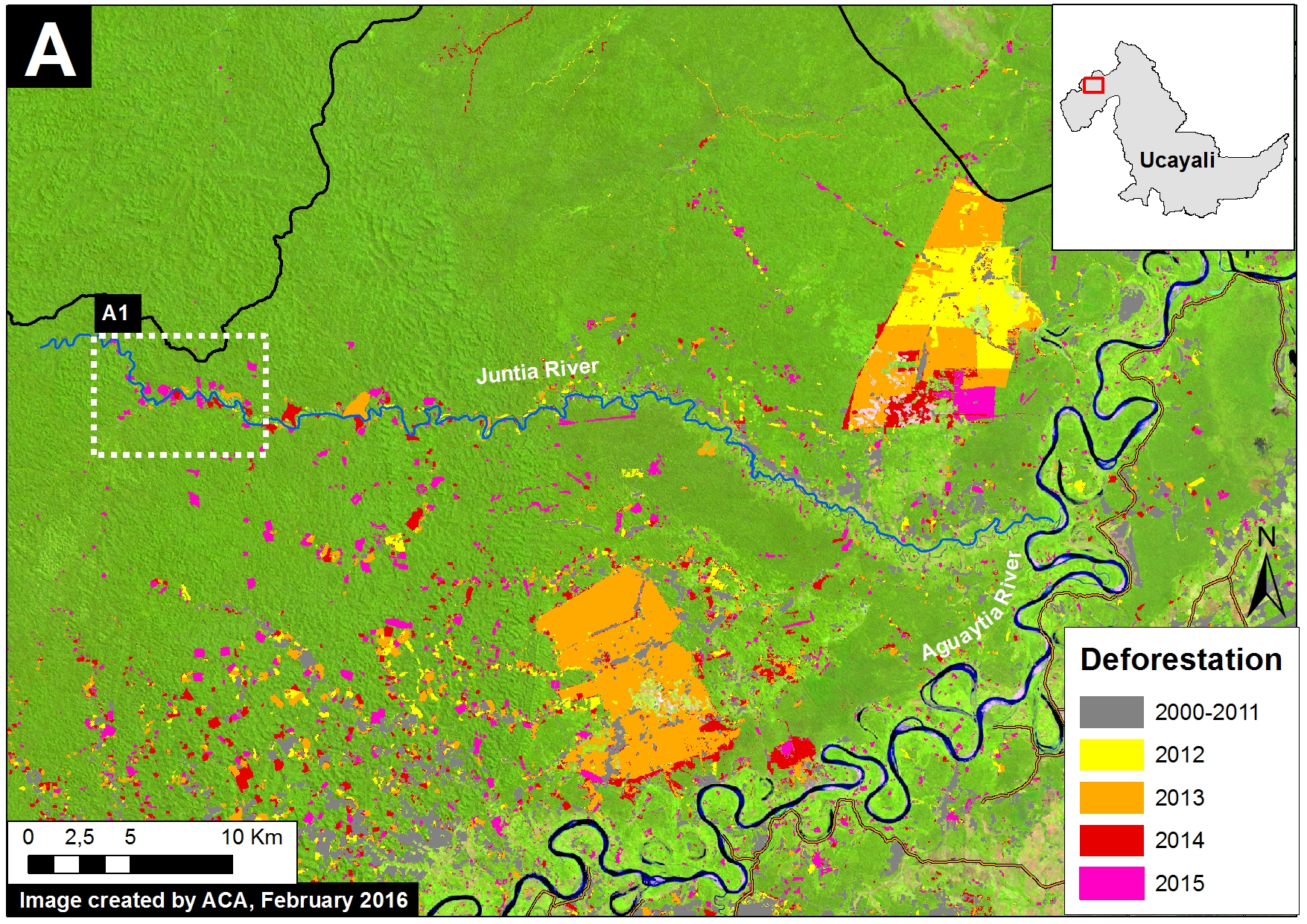
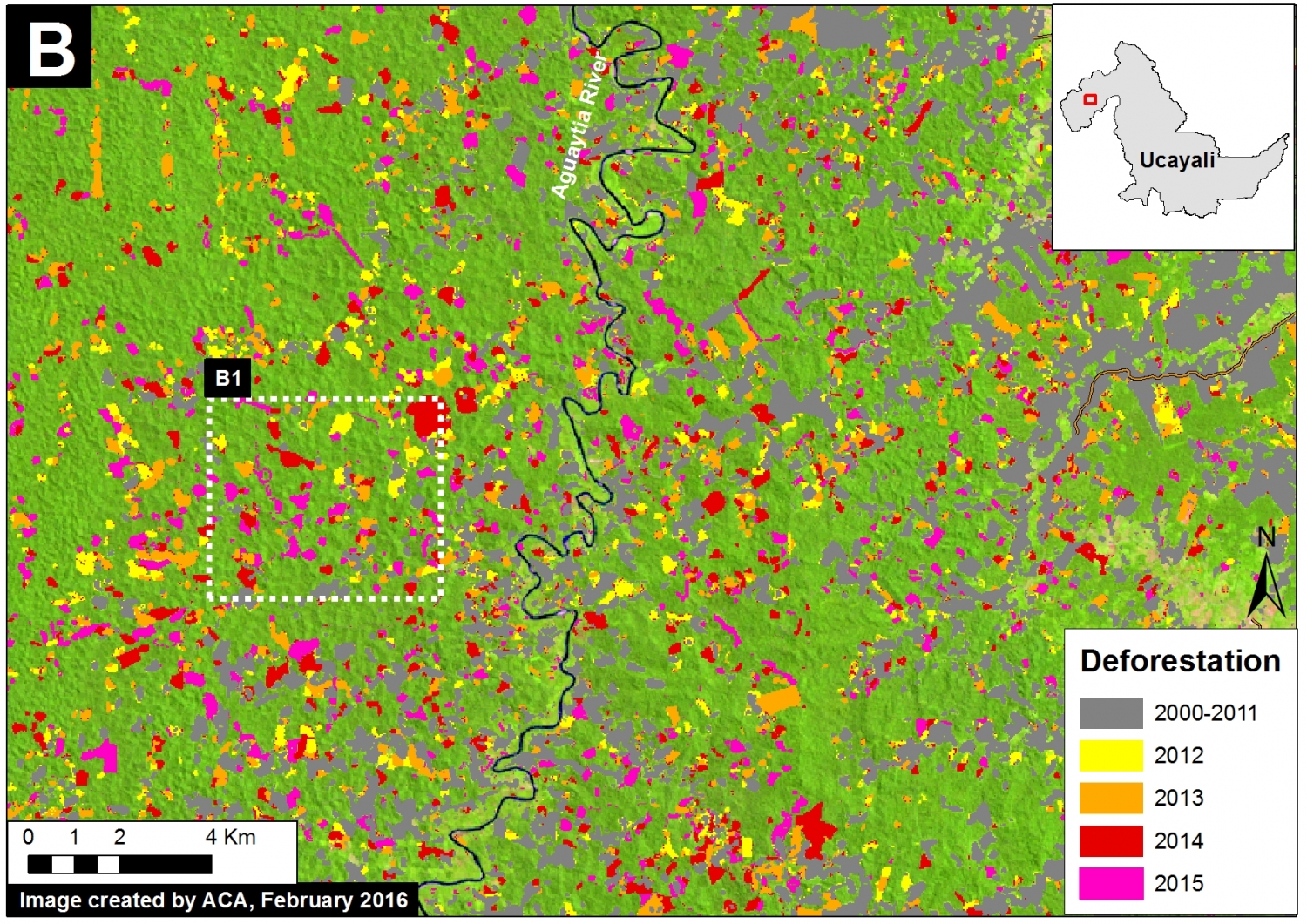
Insets A and B highlight an area in central Peru (department of Ucayali) where deforestation intensified in 2015. See below for high-resolution images showing the deforestation in these areas. In the coming weeks and months, we will be publishing additional articles highlighting other key 2015 deforestation hotspots.


Inset A

MAAP_Coronel_Portillo_29a_v1_en
Image 26b. 2000-15 deforestation for area in Inset A. Data: Hansen et al 2016 (ERL), PNCB/MINAM, Hansen/UMD/Google/USGS/NASA, USGS (Landsat 8)

Image 26b shows detailed deforestation information for the area indicated in Inset A (from Image 26a). Note the extensive 2015 deforestation just to the west of two large-scale oil palm plantations (201 hectares, see pink areas).

Further below, Image 26c shows a high-resolution satellite image of the area in Inset A1 before (left panel) and after (right panel) the recent deforestation events.


MAAP_Coronel_Portillo_29b_v1_m_en
Image 26c. High-resolution view of area in Inset A1 before (left panel) and after (right panel) recent deforestation events. Data: WorldView-2 de Digital Globe (NextView).


Inset B

MAAP_Coronel_Portillo_29d_v1_en
Image 26d. 2000-15 deforestation for area in Inset B from Image Xa. Data: Hansen et al 2016 (ERL), PNCB/MINAM, Hansen/UMD/Google/USGS/NASA, USGS (Landsat 8)

Image 26d shows detailed deforestation information for the area indicated in Inset B (from Image 26a). Note the extensive 2015 deforestation along the Aguaytia River (164 hectares, see pink areas). Recent deforestation (2012-14) appears to be associated with agricultural and logging activities.

Further below, Image 26e shows a high-resolution satellite image of the area in Inset B1 before (left panel) and after (right panel) the recent deforestation events.

MAAP_Coronel_Portillo_29c_v1_m_en
Image 26e. High-resolution view of area in Inset B1 before (left panel) and after (right panel) recent deforestation events. Data: WorldView-2 de Digital Globe (NextView).


Methodology

We conducted this analysis using the Kernel Density  tool from Spatial Analyst Tool Box of ArcGis 10.1 software. Our goal was to emphasize local concentrations of deforestation in the raw data while still representing overarching patterns of deforestation between 2012 and 2014. We accomplished this using the following parameters:

Search Radius: 15000 layer units (meters)

Kernel Density Function: Quartic kernel function

Cell Size in the map: 200 x 200 meters (4 hectares)

Everything else was left to the default setting.

Reference

1 Hansen, M.C., A. Krylov, A. Tyukavina, P.V. Potapov, S. Turubanova, B. Zutta, S. Ifo, B. Margono, F. Stolle, and R. Moore. Humid tropical forest disturbance alerts using Landsat data. Environmental Research Letters, in press. Accessed through Global Forest Watch on March 2, 2016. www.globalforestwatch.org

Citation

Finer M, Novoa S, Snelgrove C (2015) 2015 Deforestation Hotspots in the Peruvian Amazon. MAAP: 26.

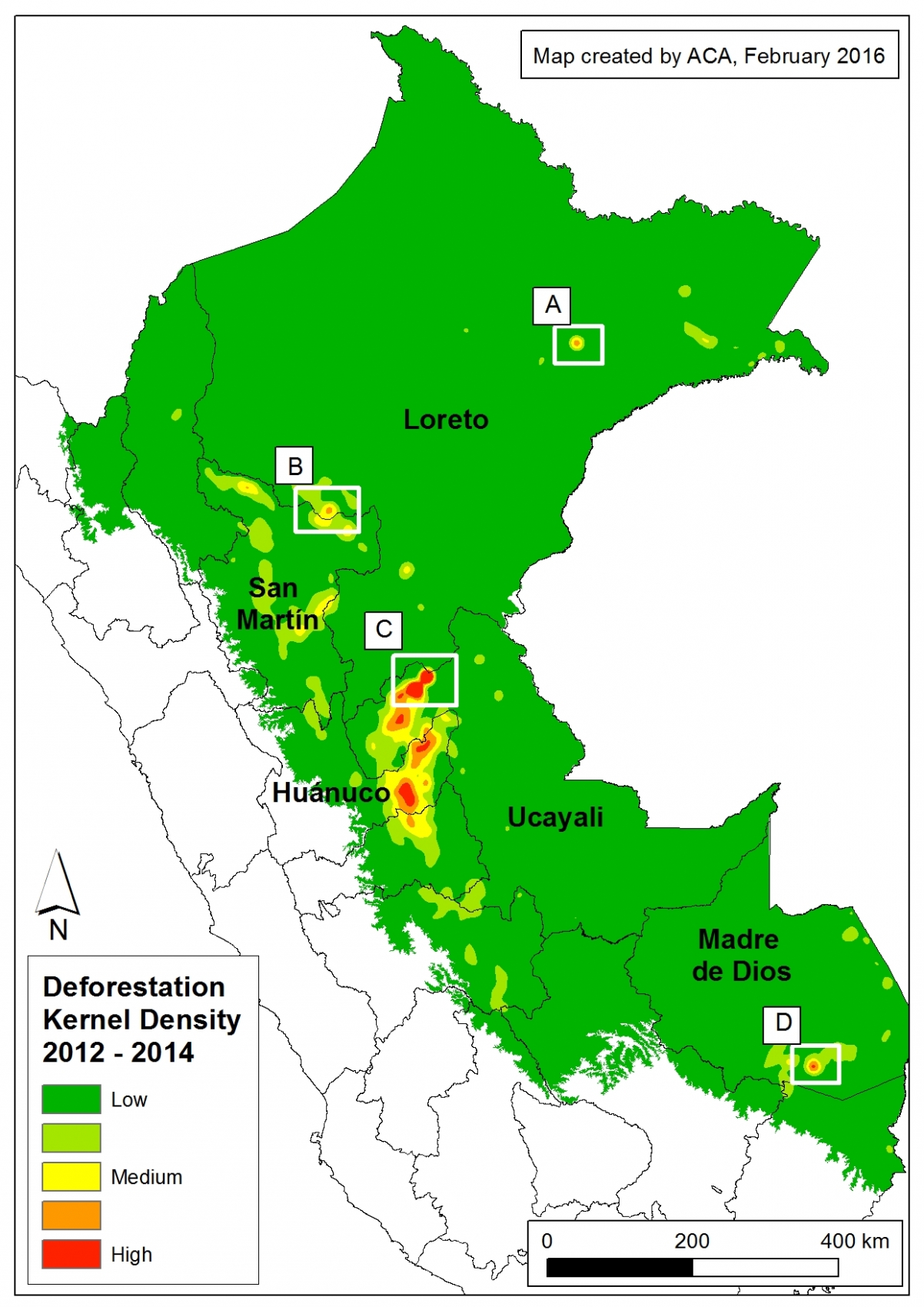
MAAP #25: Deforestation Hotspots in the Peruvian Amazon, 2012-2014

Deforestation continues to increase in the Peruvian Amazon. According to the latest information from the Peruvian Environment Ministry1, 2014 had the highest annual forest loss on record since 2000 (177,500 hectares, or 438,600 acres per year). 2013 and 2012 had the third and fourth-highest annual forest loss totals, respectively (behind only 2009).

Source: PNCB/MINAM
Source: PNCB/MINAM

To better understand where this deforestation is concentrated, we conducted kernel density estimation. This type of analysis calculates the magnitude per unit area of a particular phenomenon (in this case, forest loss).

Image 25a shows the kernel density map for forest loss in the Peruvian Amazon between 2012 and 2014 and reveals that recent deforestation is concentrated in a number of “hotspots” in the departments of Loreto, San Martin, Ucyali, Huanuco, and Madre de Dios.

Insets A-D highlight four areas with high densities of forest loss described in previous MAAP articles. We are currently studying the other high density deforestation areas not included in the insets.


Inset A: Cacao in Loreto

Image 25a. Kernel density map for forest loss in the Peruvian Amazon between 2012 and 2014. Data: PNCB/MINAM, Hansen/UMD/Google/USGS/NASA.
Image Xb.
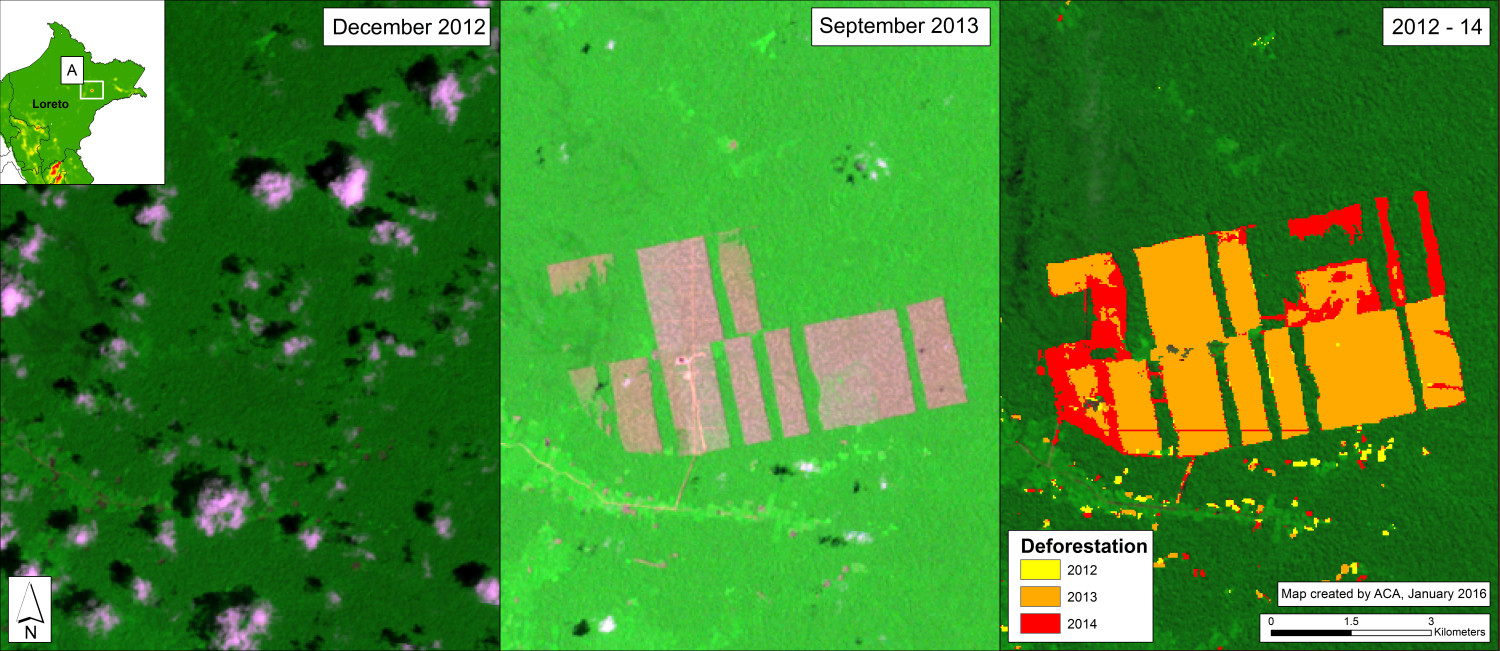
Image 25b. Deforestation for cacao in northern Peru between December 2012 (left panel) and September 2013 (center panel) and cumulative 2012-14 (right panel). Data: USGS, PNCB/MINAM, Hansen/UMD/Google/USGS/NASA

Inset A (from Image 25a) indicates the deforestation of over 2,000 hectares (4,940 acres) on property owned by the company United Cacao (through its wholly owned Peruvian subsidiary, Cacao del Peru Norte) near the town of Tamshiyacu in the department of Loreto. MAAP #9 demonstrated that much of this deforestation took place at the expense of primary forest. Image 25b highlights this area, showing the forest loss between December 2012 (left panel) and September 2013 (center panel; the pinkish areas indicate recently cleared forests). The right panel shows the cumulative deforestation between 2012 and 2014. See MAAP #9 and MAAP #2 for more details.


Inset B: Oil Palm in Loreto/San Martin

Peru_KD_B_3panel_v1
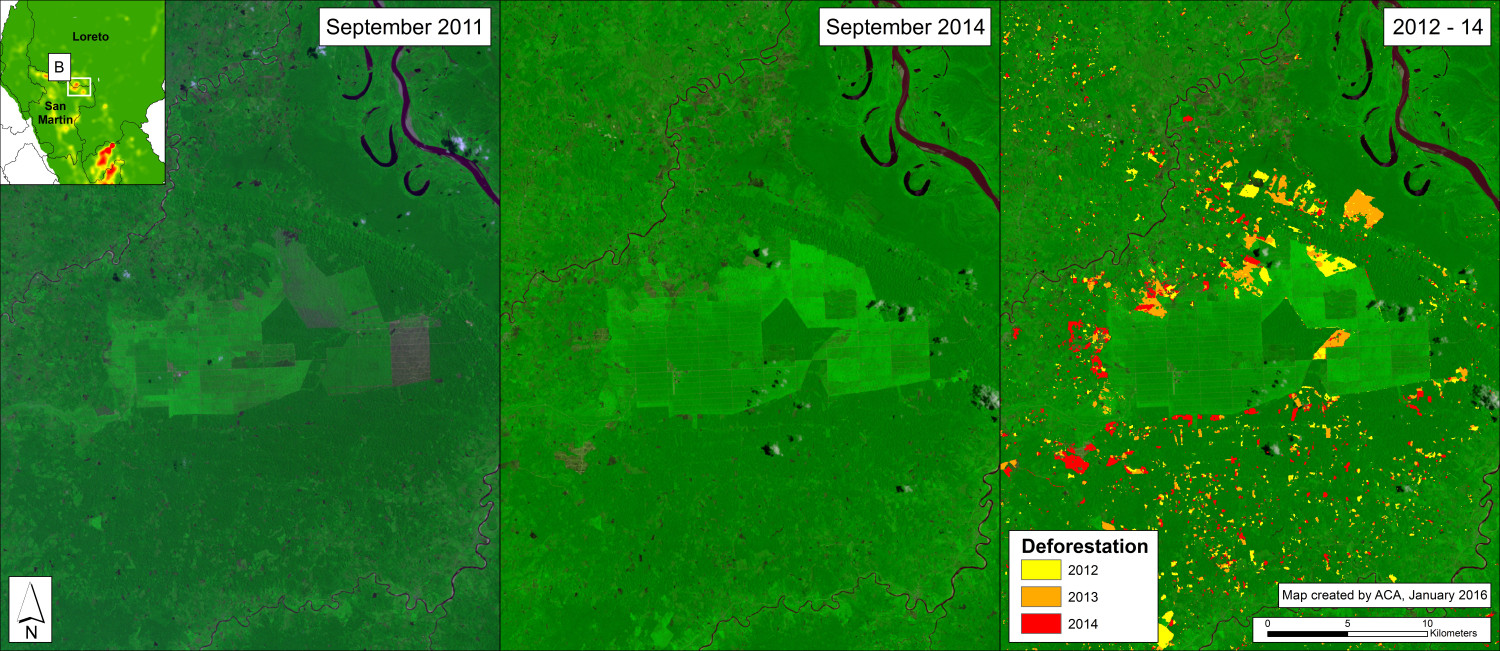
Image 25c. Deforestation for oil palm in northern Peru between September 2011 (left panel) and September 2014 (center panel) and cumulative 2012-14 (right panel). Data: USGS, PNCB/MINAM, Hansen/UMD/Google/USGS/NASA

Inset B (from Image 25a) indicates expanding deforestation within and around two large-scale oil palm plantations along the Loreto-San Martin border. Image 25c highlights this area, showing the forest loss between Setpember 2011 (left panel) and September 2014 (center panel). The right panel shows the cumulative deforestation between 2012 and 2014 (6,363 hectares, or 15,700 acres). See MAAP #16 for more details.

Inset C: Oil Palm in Ucayali

Image Xd.
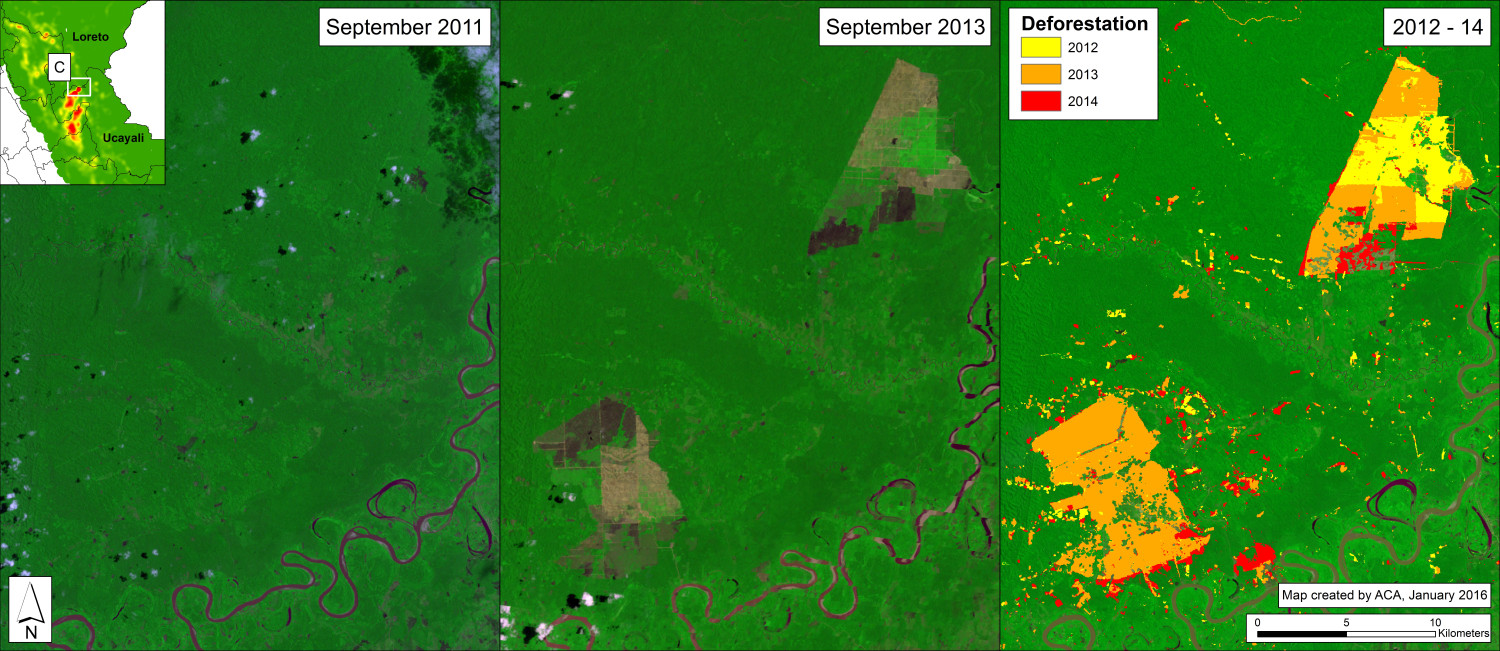
Image 25d. Deforestation for oil palm in central Peru between September 2011 (left panel) and September 2013 (center panel) and cumulative 2012-14 (right panel). Data: USGS, PNCB/MINAM, Hansen/UMD/Google/USGS/NASA

Inset C (from Image 25a) indicates the deforestation of 9,400 hectares (23,200 acres) of primary forest for two large-scale oil palm plantations in the department of Ucayali. Image 25d highlights this area, showing the forest loss between September 2011 (left panel) and September 2013 (center panel; the pinkish-black areas indicate recently cleared forests). The right panel shows the cumulative deforestation between 2012 and 2014. See MAAP #4 for more details.

Inset D: Gold Mining in Madre de Dios

Peru_KD_D_3panel_v1
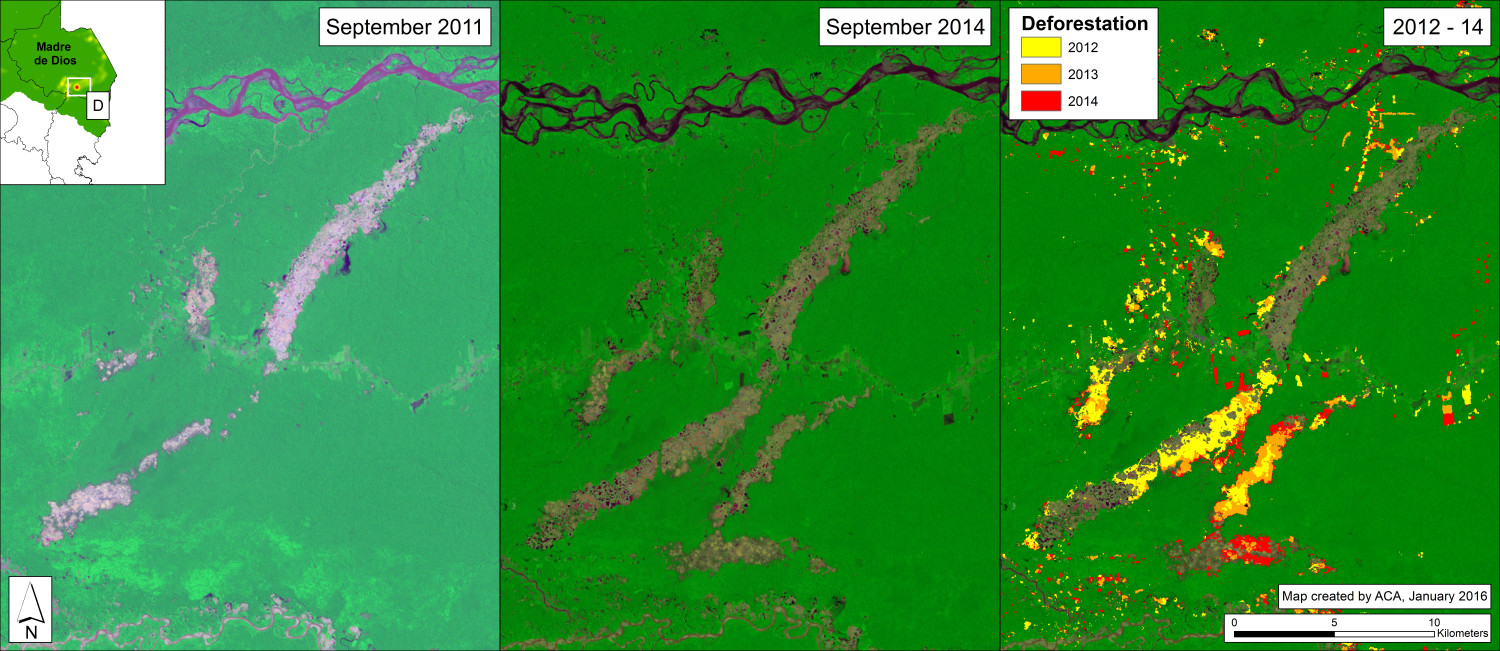
Image 25e. Deforestation for gold mining in southern Peru between September 2011 (left panel) and September 2014 (center panel) and cumulative 2012-14 (right panel). Data: USGS, PNCB/MINAM, Hansen/UMD/Google/USGS/NASA

Inset D (from Image 25a) indicates the extensive illegal gold mining deforestation in the buffer zone of Tambopata National Reserve in the department of Madre de Dios. Image 25e highlights this area, showing the forest loss between September 2011 (left panel) and September 2014 (center panel; the lighter areas indicate recently cleared forests). The right panel shows the cumulative deforestation between 2012 and 2014 (4,738 hectares, or 11,700 acres). See MAAP #1 for more details.

It is important to emphasize that in this case, extensive deforestation continued in 2015. See MAAP #12 and MAAP #24 for more details.

Methodology

We conducted this analysis using the Kernel Density  tool from Spatial Analyst Tool Box of ArcGis 10.1 software. Our goal was to emphasize local concentrations of deforestation in the raw data while still representing overarching patterns of deforestation between 2012 and 2014. We accomplished this using the following parameters:

Search Radius: 15000 layer units (meters)

Kernel Density Function: Quadratic

Cell Size in the map: 200 x 200 meters (4 hectares)

Everything else was left to the default setting.

References

1MINAGRI-SERFOR/MINAM-PNCB (2015) Compartiendo una visión para la prevención, control y sanción de la deforestación y tala ilegal.

Citation

Finer M, Snelgrove C, Novoa S (2015) Deforestation Hotspots in the Peruvian Amazon, 2012-2014. MAAP: 25.

MAAP #23: Increasing Deforestation along lower Las Piedras River (Madre de Dios, Peru)

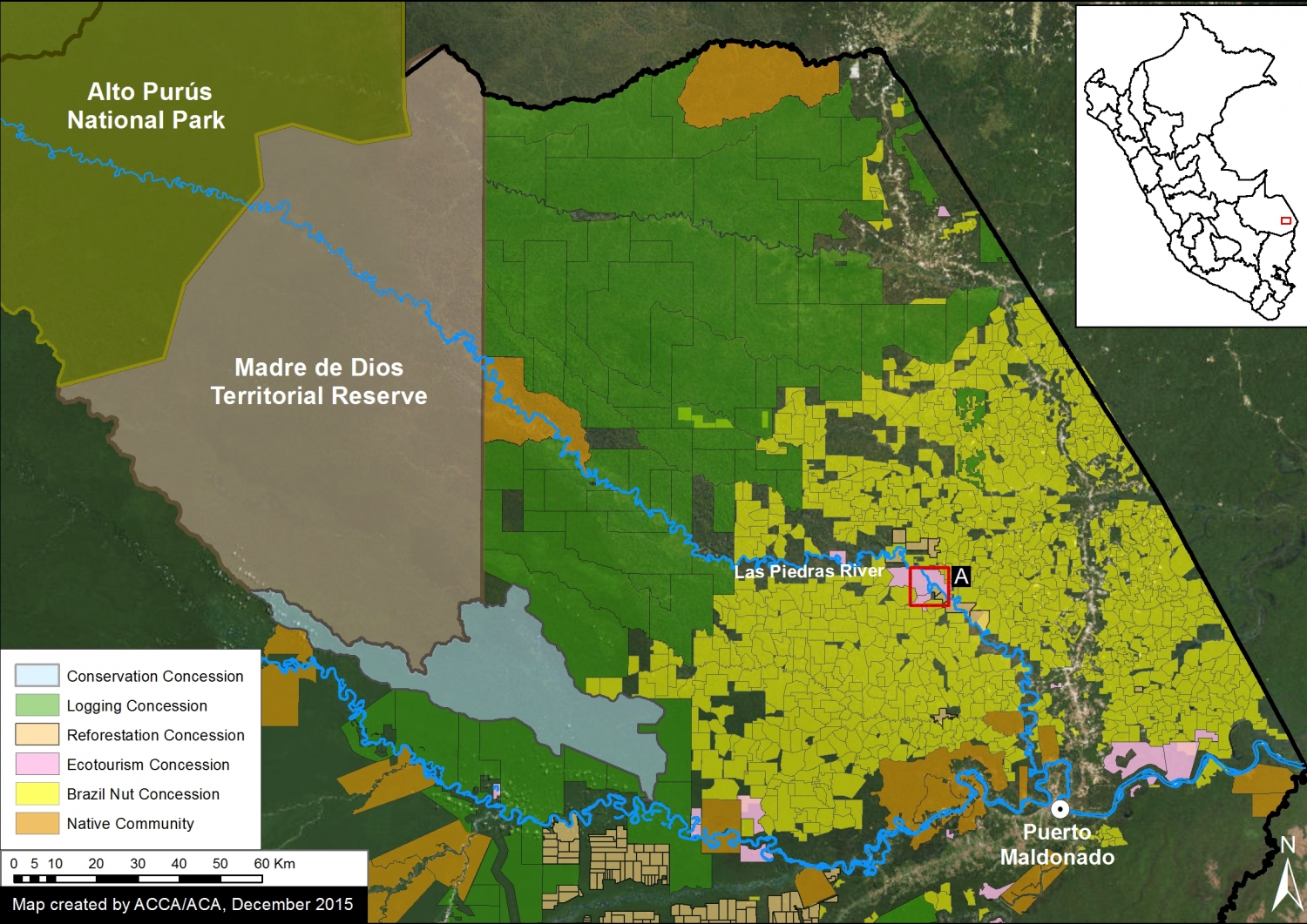
The Las Piedras River in the southern Peruvian Amazon (department of Madre de Dios) is increasingly recognized for its outstanding wildlife (for example, see this video by naturalist and explorer Paul Rosolie, and this trailer for the upcoming film Uncharted Amazon). As seen in Image 23a, its headwaters are born in the Alto Purus National Park, but the lower Las Piedras is surrounded by a mix of different types of forestry concessions (logging, Brazil nut harvesting, ecotourism, and reforestation).

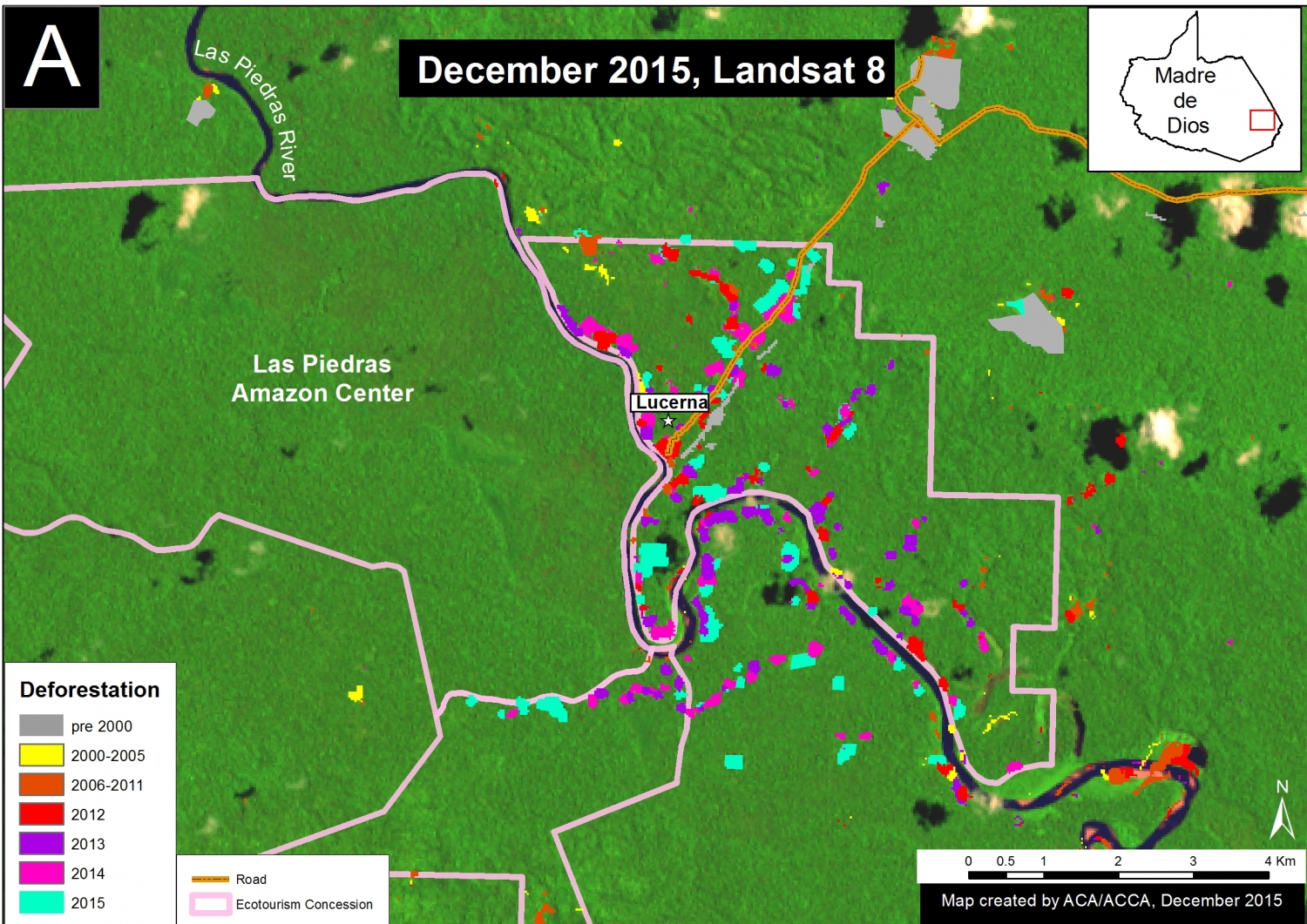
Here in MAAP #23, we document the growing deforestation on the lower Las Piedras River in the area surrounding the community of Lucerna (see red box in Image 23a for context).

Image Xa. Las Piedras River and surrounding designations. Data: MINAGRI, IBC, SERNANP.
Image 23a. Las Piedras River and surrounding designations. Data: MINAGRI, IBC, SERNANP.

Deforestation Analysis

Image 23b shows our deforestation analysis for an area along the lower Las Piedras River near the community of Lucerna (see red box in Image 23a for context). We found a sharp increase in deforestation starting in 2012. In the 11 years between 2000 and 2011, we detected the deforestation of 88 hectares (218 acres). In contrast, in the 4 years between 2012 and 2015, we detected the deforestation of 472 hectares (1,166 acres). 2015 had the highest deforestation total with 155 hectares (383 acres).

Image Xb. Lower Las Piedras River deforestation analysis. Data: MINAGRI, PNCB/MINAM, Hansen/UMD/Google/USGS/NASA.
Image 23b. Lower Las Piedras River deforestation analysis. Data: MINAGRI, CLASlite, PNCB/MINAM, Hansen/UMD/Google/USGS/NASA.

Note that the Las Piedras Amazon Center (LPAC) Ecotourism Concession represents an effective barrier to deforestation. However, note that two other, less active, ecotourism concessions are experiencing extensive deforestation. The 4,460 hectare LPAC concession (which was created in 2007 and transferred to ARCAmazon in March 2015) hosts an active tourist lodge, research center,  and Forest Ranger Protection Program, which employs local people to patrol the area while monitoring wildlife and human impacts.

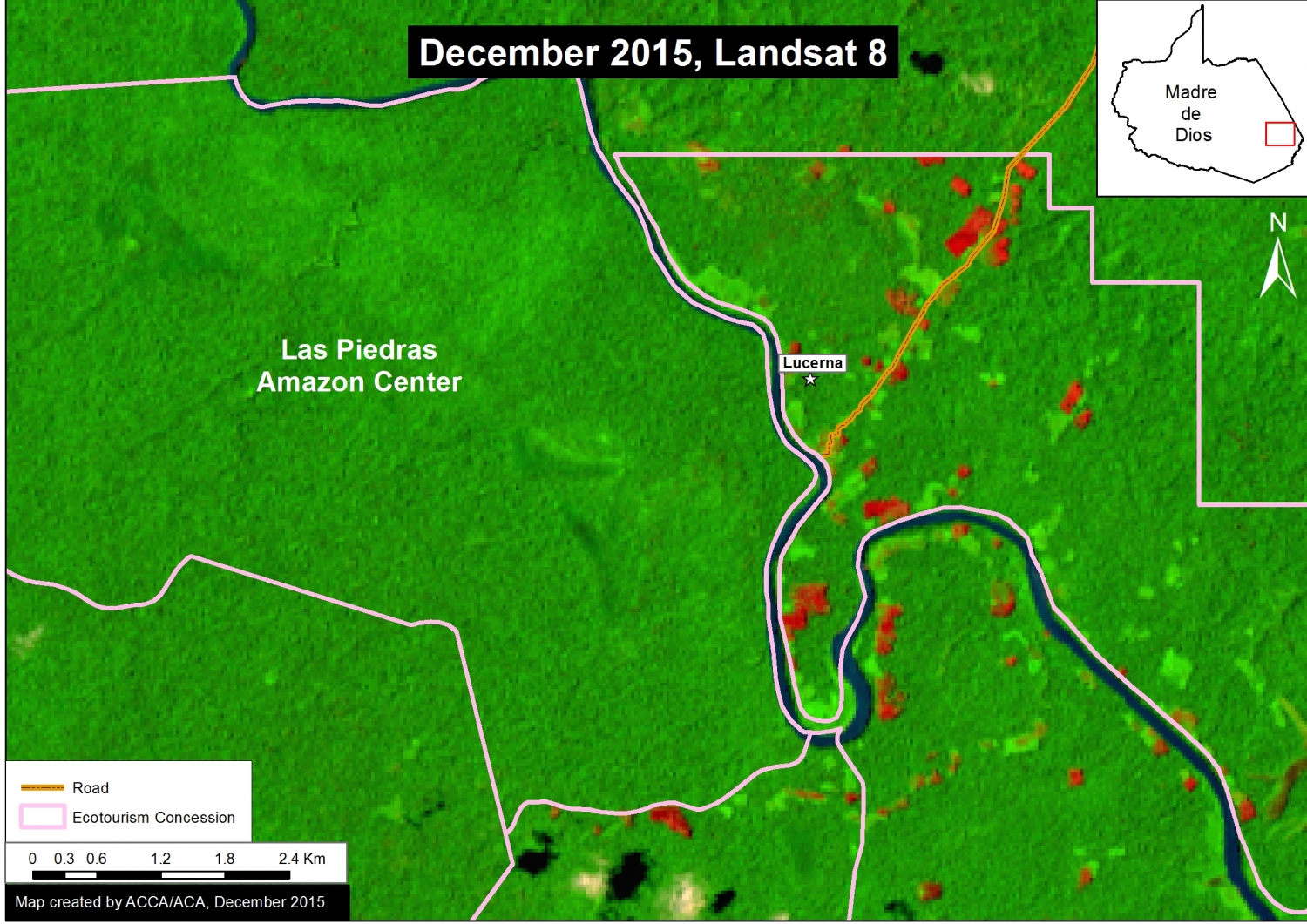
Image Xc. Recent Landsat image showing deforestation along lower Las Piedras. Data: USGS,MINAGRI.
Image 23c. Recent Landsat image showing deforestation along lower Las Piedras. Data: USGS,MINAGRI.

Image 23c shows a very recent (December 2015) Landsat image of the deforestation highlighted in Image 23b. The pinkish-red areas indicate the most recently cleared forests. We have received information indicating that much of this new deforestation is associated with cacao plantations. Cacao is of course used to produce chocolate.

Citation

Finer M, Pena N (2015) Increasing Deforestation along lower Las Piedras River (Madre de Dios, Peru). MAAP #23

MAAP Synthesis #1: Patterns and Drivers of Deforestation in the Peruvian Amazon

We present a preliminary analysis of current patterns and drivers of deforestation in the Peruvian Amazon. This analysis is largely based on the first 15 articles published on MAAP between April and September 2015, but also incorporates information from other relevant sources. We describe this analysis as preliminary because as MAAP research continues, we will be able to improve and refine our synthesis in subsequent editions.

MAAP_Synthe_Sa_v4_en
Image S1a. Recent patterns and drivers of deforestation in the Peruvian Amazon. Numbers indicate relevant MAAP article. Data: SERNANP, IBC, MINAM-PNCB/MINAGRI-SERFOR, MAAP.

Introduction & Summary of Key Results

Image S1a illustrates recent (2000 – 2013) patterns of deforestation in the Peruvian Amazon based on data from the Peruvian Ministries of Environment[i] and Agriculture[ii]. These two Ministries have documented a total forest loss of around 1.65 million hectares (ha) in the Peruvian Amazon between 2001 and 2014, with an increasing trend in recent years (2014 had the highest forest loss on record with 177,571 ha)[iii],[iv]. Another recent report by the Peruvian government stated that the majority (75%) of the Amazonian deforestation is due to small-scale clearings related to agriculture and livestock activities, usually near roads or rivers[v].

Building off of that historical and annual information, our goal at MAAP is to monitor deforestation in near real-time. Since April 2015, we have published numerous articles analyzing areas in the northern, central, and southern Peruvian Amazon. In this initial analysis, we have found that three of the most important drivers of deforestation are large-scale oil palm (and cacao) plantations, gold mining, and coca cultivation. We also found a growing network of logging roads that contribute to forest degradation. Image S1a displays the general geographic distribution of these drivers of deforestation and degradation.

We estimate that around 30,000 hectares of primary forest was cleared since 2000 for large-scale oil palm and cacao plantations. Cacao has recently joined oil palm as a deforestation driver due to the arrival of the company United Cacao and their implementation of the large-scale agro-industrial model in place of traditional small-scale plantations on previously degraded lands.

Gold mining has directly caused the deforestation of over 43,000 ha since 2000, mostly in the region of Madre de Dios. In recent years, this deforestation has been concentrated in the Tambopata National Reserve buffer zone.

Although coca cultivation is reportedly declining in Peru, we found that it remains a major driver of deforestation, particularly within and around remote protected areas. For example, we documented 143 ha of coca related deforestation within the Sierra del Divisor Reserved Zone, and an additional 2,638 ha related to shifting agricultural cultivation, which includes coca, within and around Bahuaja Sonene National Park.

We also documented a recent expansion of logging roads in the central Peruvian Amazon. This finding is significant because it is difficult to detect selective logging in satellite imagery, but now we can at least detect the roads that indicate that selective logging is taking place in a given area.

We identified some important geographic patterns related to the four drivers described above. For example, large-scale oil palm (and cacao) are concentrated in the northern Peruvian Amazon, while gold mining deforestation has largely been in the south. Coca-driven deforestation appears to be particularly problematic in the southern Peruvian Amazon, but also exists in the north. The construction of new logging roads is currently most active in the central Peruvian Amazon.

The documented deforestation is caused by both illegal and legal means. For the former, there is extensive deforestation from illegal gold mining and coca cultivation. Regarding the latter, oil palm and cacao companies are exploiting loopholes in the Peruvian legal framework that facilitate large-scale deforestation for agricultural projects.

Large-scale Agriculture (Oil Palm and Cacao)

MAAP_Synthe_Sb_v4_en
Image S1b. Large-scale agriculture deforestation in the northern Peruvian Amazon. Numbers indicate relevant MAAP article. Data: SERNANP, IBC, MINAM-PNCB/MINAGRI-SERFOR, MAAP.

Image S1b illustrates that large-scale agriculture (namely oil palm and cacao) is an important cause of deforestation in northern Peru.

Importantly, several oil palm and cacao companies are changing the production model in Peru from small-scale to large-scale agro-industrial. For example, in a recent interview, United Cacao CEO Dennis Melka stated that his company is trying to replicate the agro-industrial model used by oil palm companies in Southeast Asia[vi].

This shift is noteworthy because large-scale plantations usually come at the expense of forests, while small-scale plantations are better able to take advantage of previously cleared lands[vii]. We estimate that over 30,000 hectares of primary forest was cleared since 2000 for large-scale oil palm and cacao plantations (see below). Much less primary forest, around 575 ha, was cleared for small-scale oil palm (we have yet to evaluate small-scale cacao).

Note that we emphasize the clearing of primary forest. We conducted an additional analysis to determine whether oil palm (both small and large-scale) and cacao (just large-scale) plantations were originally sited on lands with primary forest, secondary forest, or already deforested. We defined primary forest as an area that from the earliest available Landsat, in this case 1990, was characterized by dense closed canopy forest cover.

The following is a concise breakdown of how we calculated the 30,000 ha of primary forest loss from large-scale plantations.

MAAP articles #2, #9, and #13 demonstrated that 2,276 ha of primary forest was cleared by United Cacao between May 2013 and September 2015 outside of the town of Tamshiyacu in the northern Peruvian Amazon (Loreto region).

MAAP article #4 detailed the deforestation of 9,400 ha of primary forest (plus an additional 2,350 ha of secondary forest) between 2011 and 2015 for two large-scale oil palm projects near the town of Nueva Requena in the central Peruvian Amazon (Department of Ucayali).

In addition, yet unpublished MAAP analysis shows that in Palmas de Shanusi/Oriente (oil palm projects operated by the company Grupo Palmas), 6,974 ha of primary forest were cleared between 2006 and 2011, although the legally mandated 30% forest cover reserves were maintained. An additional 8,225 ha of primary forest was cleared in areas immediately surrounding the concessions.

Finally, although not yet published on MAAP, we also documented nearly 3,500 ha of primary forest loss in other large-scale oil palm projects in San Martin and Ucayali regions.

It is important to emphasize that several oil palm and cacao companies are exploiting various loopholes in the Peruvian legal framework that facilitate large-scale deforestation for agricultural projects[viii]. In fact, these companies argue that according to Peruvian law, they are engaged in legal “forest clearing”, not illegal “deforestation”[ix].

Gold Mining

MAAP_Synthe_Sc_v4_en
Image S1c. Gold mining deforestation in the Peruvian Amazon. Numbers indicate relevant MAAP article. Data: SERNANP, IBC, MINAM-PNCB/MINAGRI-SERFOR, MAAP.

Image S1c illustrates that gold mining-driven deforestation is largely concentrated in the southern Peruvian Amazon, particularly in the region of Madre de Dios and adjacent Cusco.

According to the scientific literature, gold mining deforestation in Madre de Dios increased from 10,000 ha in 2000 to 50,000 ha in 2012[x]. MAAP articles #1, #5, and #12 documented the deforestation of an additional 2,774 ha between 2013 and 2015 in two gold mining hotspots (La Pampa and Upper Malinowski), both of which are located within the buffer zone of the Tambopata National Reserve. In addition, MAAP #6 showed gold mining deforestation expanding from another Madre de Dios gold mining hotspot (Huepetuhe) into the tip of Amarakaeri Communal Reserve (11 ha).

Much of the Madre de Dios gold mining deforestation described above is illegal because it is occurring within and around protected areas where mining is not permitted under the government-led formalization process.

MAAP articles #6 and #14 detailed recent gold mining deforestation in the region of Cusco. Specifically, we documented the deforestation of 967 ha along the Nuciniscato River and its major tributaries since 2000 (with the vast majority occurring since 2010). Much of this deforestation appears to be linked to gold mining.

Thus, the total documented gold mining deforestation in Madre de Dios and adjacent Cusco is at least 53,750 ha[xi], over 80% of which has occurred since 2000. This total is an underestimate since we have not yet done detailed studies for 2013 – 2015 deforestation in all of the known gold mining zones in these two regions.

In addition, MAAP #7 showed two gold mining zones in the region of Ucayali (along the Sheshea and Abujao Rivers, respectively). Much of this deforestation occurred between 2000 and 2012.

Finally, there are also reports of extensive gold mining in northern Peru (the regions of Amazonas and Loreto) but we do not yet have data showing that it is causing deforestation.

Coca

MAAP_Synthe_Sd_v4_en
Image S1d. Coca cultivation areas in the Peruvian Amazon. Numbers indicate relevant MAAP article. Data: UNODC 2014, MINAM-PNCB/MINAGRI-SERFOR, SERNANP, NatureServe.

Although the most recent report from the United Nations Office on Drugs and Crime (UNODC) indicates that overall coca cultivation is declining in Peru[xii], our research finds that it remains a major driver of deforestation in certain areas, particularly within and around several remote protected areas.

Image S1d displays the distribution of current coca-cultivation areas (in relation to protected areas) based on the data from the latest United Nations report. Of these areas, we have thus far focused on the three detailed below.

MAAP articles #7 and #8 show recent coca-related deforestation within the southern section of the Sierra del Divisor Reserved Zone. This area is particularly important because it is soon slated to be upgraded to a national park. Specifically, we documented coca-related deforestation of 130 ha between 2013 and 2014 within the southwestern section of the reserve, and, most recently, a new plantation of 13 ha during June 2015 within the southeast section.

MAAP article #10 revealed that shifting agricultural cultivation, that includes coca, is also a major issue within and around Bahuaja Sonene National Park, located in the southern Peruvian Amazon. Specifically, we found the recent deforestation of 538 hectares within the southern section of the Park, and an additional 2,100 hectares in the surrounding buffer zone. Much of this deforestation is likely linked to coca cultivation since the latest United Nations report indicates these areas contain high coca plantation densities.

MAAP article #14 documents the deforestation of 477 ha along the Nojonunta River in Cusco since 2000 (with a major peak since 2010). Much of this deforestation is likely linked to coca cultivation since the latest United Nations report indicates these areas contain medium to high coca plantation densities. 

Logging Roads

MAAP_Synthe_Se_v4_en
Image S1e. Logging roads in the Peruvian Amazon. Numbers indicate relevant MAAP article. Data: SERNANP, IBC, MINAM-PNCB/MINAGRI-SERFOR, MINAGRI, MAAP.

One of the major advances discovered in this work is the ability to identify the expansion of new logging roads. This advance is important because it is extremely difficult to detect illegal logging in satellite imagery because loggers in the Amazon often selectively cut high value species and do not produce large clearings. But now, although it remains difficult to detect the actual selective logging, we can detect the roads that indicate that selective logging is taking place in that area.

Image S1e illustrates the likely logging roads that we have recently detected. Of these areas, we have thus far focused on the two detailed below.

MAAP article #3 shows the rapid proliferation of two new road networks in the northern Peruvian Amazon (Loreto region). Most notably, it highlights the construction of 148 km of new roads, possibly illegal logging roads, through mostly primary forest between 2013 and 2014. One of the roads is within the buffer zone of the Cordillera Azul National Park.

In addition, MAAP article #7 shows the expansion of new logging roads near both the southern and northwestern sections of the Sierra del Divisor Reserved Zone. In both cases, the expansion is very recent (between 2013 and 2015).


[i] National Program of Forest Conservation for the Mitigation of Climate Change – PNCB.

[ii] Servicio Nacional Forestal y de Fauna Silvestre – SERFOR

[iii] MINAGRI-SERFOR/MINAM-PNCB (2015) Compartiendo una visión para la prevención, control y sanción de la deforestación y tala ilegal.

[iv] Note that some of the documented forest loss may come from natural causes, such as landslides or meandering rivers.

[v] MINAM (2013) Fondo Cooperativo Para El Carbono de los Bosques (FCPF) Plantilla de Propuesta para la Fase de Preparación para REDD+ (Readiness Plan Proposal – RPP). Link: http://www.minam.gob.pe/cambioclimatico/wp-content/uploads/sites/11/2014/03/R-PP-Per%C3%BA-Final-Dec-2013-RESALTADO_FINAL_PUBLICADA-FCPF_24-febrero.pdf

[vi] NF Joan (2015) United Cacao replicates Southeast Asia’s plantation model in Peru, says CEO Melka. The Edge Singapore.Link: http://www.unitedcacao.com/images/media-articles/20150713-the-edge-united-cacao.pdf

[vii] Gutiérrez-Vélez VH, DeFries R, Pinedo-Vásquez M, et al. (2011) High-yield oil palm expansion spares land at the expense of forests in the Peruvian Amazon. Environ. Res. Lett., 6, 044029. Link: http://iopscience.iop.org/article/10.1088/1748-9326/6/4/044029/pdf

[viii] Environmental Investigation Agency (2015) Deforestation by Definition. Washington, DC. Link: http://eia-global.org/news-media/deforestation-by-definition

[ix] Tello Pereyra R (2015) Situacion legal, judicial, y administrativa de  Cacao del Peru Norte SAC. Link: https://www.youtube.com/watch?v=p_YIe70u1oA

[x] Asner GP, Llactayo W, Tupayachia R, Ráez Luna E (2013) PNAS 110 (46) 18454-18459. Link: http://www.pnas.org/content/110/46/18454.abstract

[xi] That is, 50,000 ha from the literature and 3,750 ha from MAAP analysis.

[xii] UNODC (2015) Monitoreo de cultivos ilícitos Perú 2014. Link: https://www.unodc.org/documents/crop-monitoring/Peru/Peru_Informe_monitoreo_coca_2014_web.pdf

Citation

Finer M, Novoa S (2015) Patterns and Drivers of Deforestation in the Peruvian Amazon. MAAP Synthesis #1. Link: https://www.maapprogram.org/2015/09/maap-synthesis1/