MAAP #97: Deforestation Surge in the Colombian Amazon, 2018 update

Deforestation trends in the Colombian Amazon. Data: UMD/GLAD, Hansen/UMD/Google/USGS/NASA, RAISG


The Colombian Amazon is currently experiencing a deforestation surge (see graph).

The surge started three years ago (2016) and peaked in 2017 with the highest annual deforestation on record (214,744 hectares).*

Deforestation remains high in 2018: 156,722 hectares (based on early warning alert data).* If this estimate is confirmed, it would be the second highest on record (behind just 2017).

National experts indicate that land grabbing (acaparamiento de tierras) is an increasingly dominant direct driver of deforestation.

*Data from the University of Maryland. Annual data from Hansen et al (2013) [citation below] and 2018 data from GLAD alerts.

MAAP Colombia is a collaboration between Amazon Conservation and Amazon Conservation Team., funded by the MacArthur Foundation.


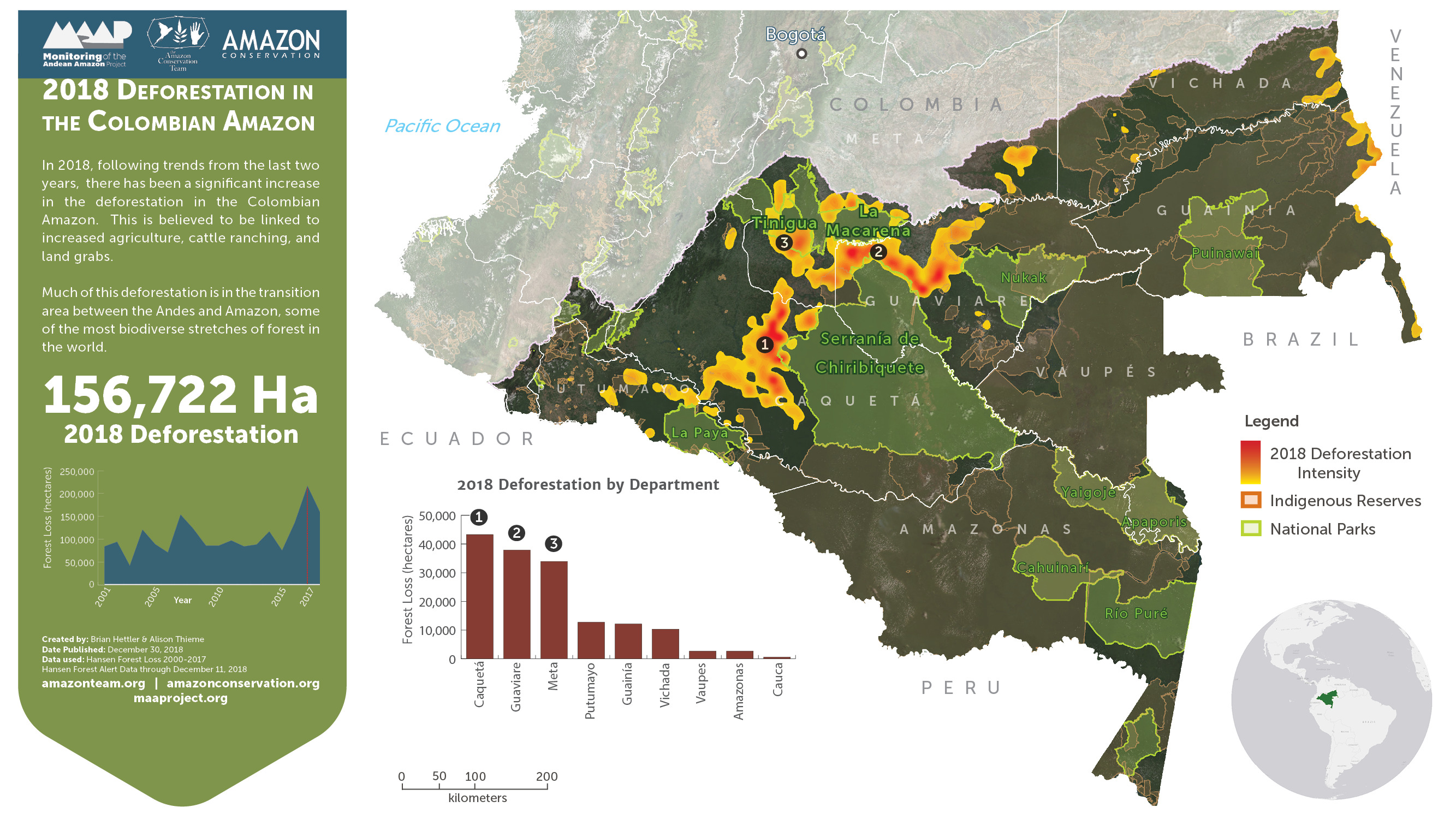
We also present a Base Map that shows the 2018 deforestation hotspots. Note that the deforestation is concentrated in three departments located in the transition area between the Amazon and Andes: Guaviare, Caqueta, and Meta.

We highlight the location of three critical areas that are examined in greater detail below: 1) Llanos de Yari, 2) Chiribiquete- La Macarena, and 3) Tinigua National Park.

For the Base Map and Zooms below, please click on the image to enlarge or download.

Base Map. Deforestation hotspots in the Colombian Amazon. Click to enlarge. Data: UMD/GLAD, Hansen/UMD/Google/USGS/NASA, PNN, SIAC, RAISG

Zoom 1: Llanos de Yari

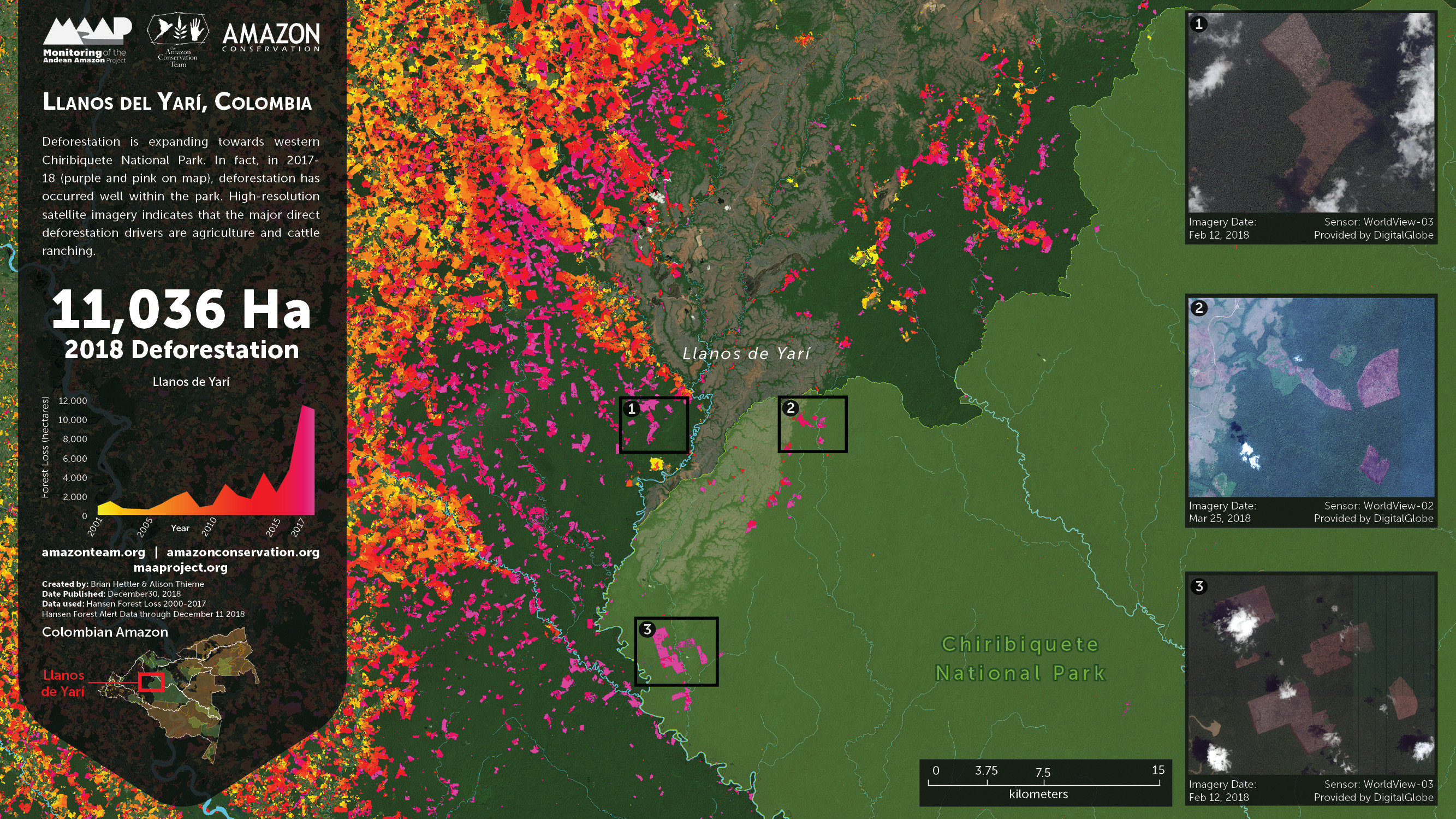
Zoom 1 shows deforestation expanding towards western Chiribiquete National ParkIn fact, in 2017-18 (purple and pink on map), deforestation has occurred well within the park. 

Zoom 1. Llanos de Yari. Click to enlarge. Data: DigitalGlobe, UMD/GLAD, Hansen/UMD/Google/USGS/NASA, PNN, SIAC, RAISG

Zoom 2: Chiribiquete – La Macarena

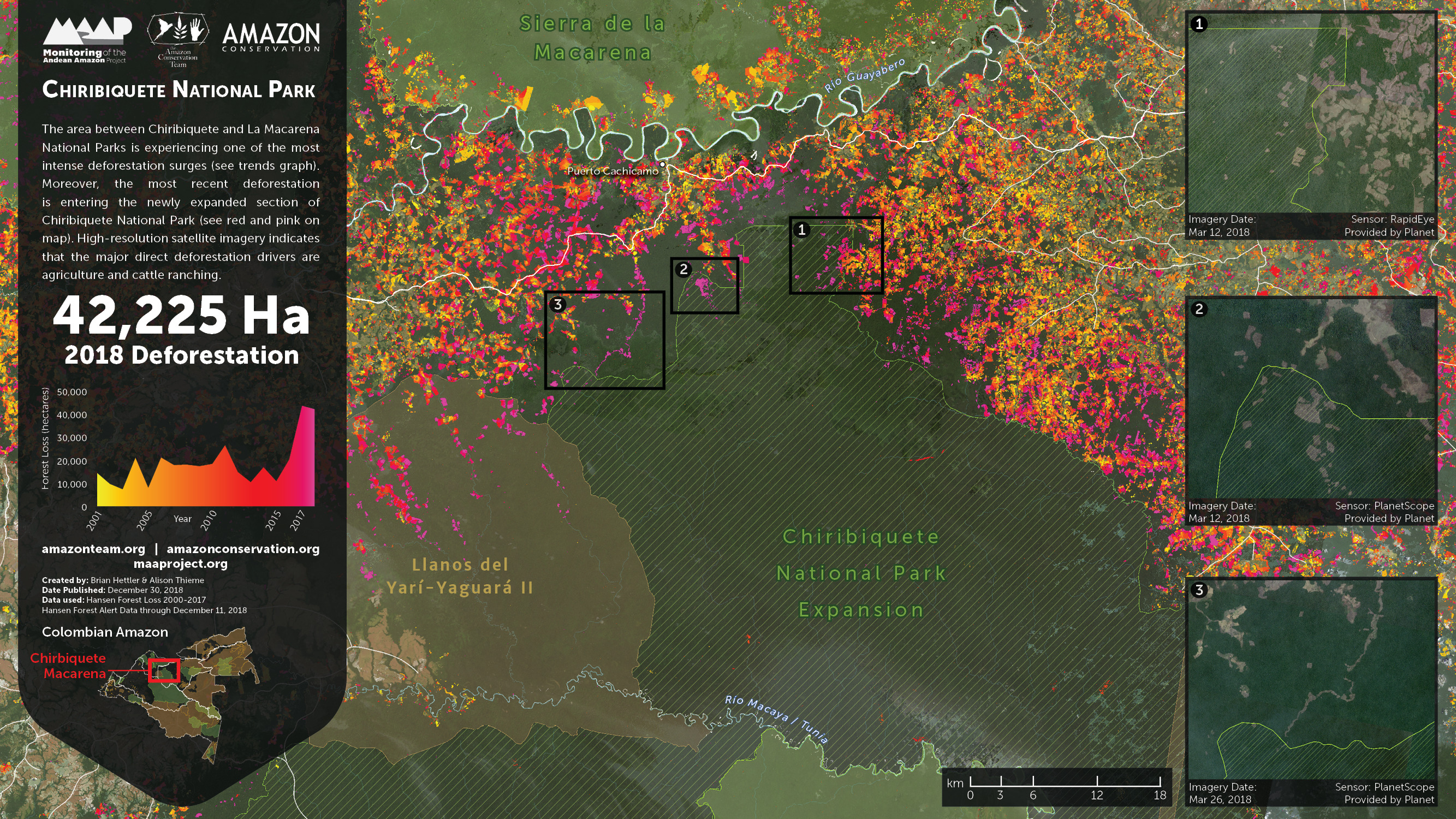
As we first reported in MAAP #86, the area between Chiribiquete and La Macarena National Parks is currently experiencing one of the most intense deforestation surges. Zoom 2 shows the most recent deforestation (indicated in red and pink) is entering the newly expanded section of Chiribiquete National Park. 

Zoom 2. Chiribiquete – La Macarena. Click to enlarge. Data: Planet, UMD/GLAD, Hansen/UMD/Google/USGS/NASA, PNN, SIAC, RAISG.

Zoom 3: Tinigua National Park

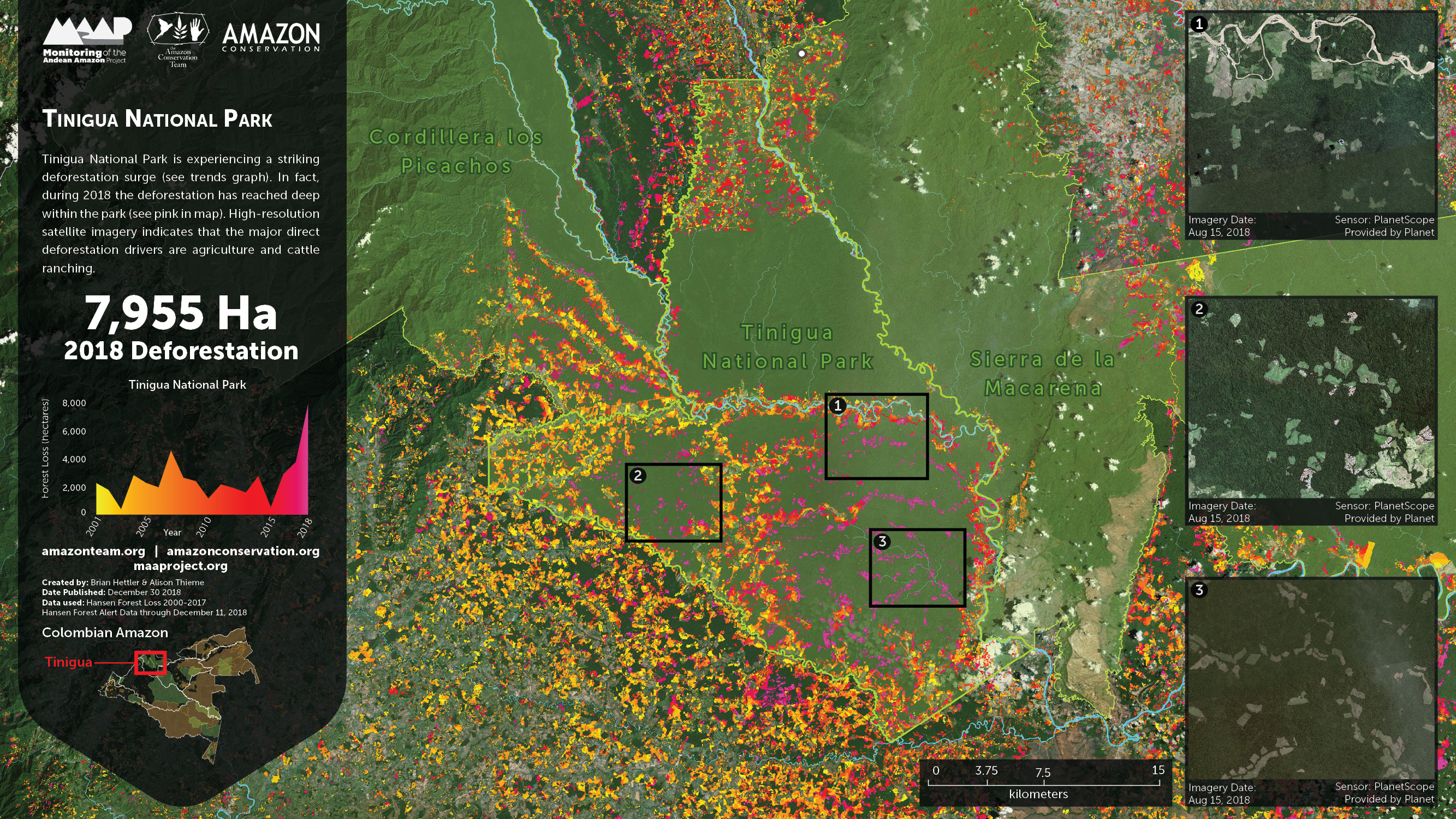
Zoom 3 shows how 2018 has seen a surge of deforestation deep within Tinigua National Park (see pink). 

Zoom 3. Tinigua National Park. Click to enlarge. Data: Planet, UMD/GLAD, Hansen/UMD/Google/USGS/NASA, PNN, SIAC, RAISG

References

Planet Team (2017). Planet Application Program Interface: In Space for Life on Earth. San Francisco, CA. https://api.planet.com
Hansen, M. C., P. V. Potapov, R. Moore, M. Hancher, S. A. Turubanova, A. Tyukavina, D. Thau, S. V. Stehman, S. J. Goetz, T. R. Loveland, A. Kommareddy, A. Egorov, L. Chini, C. O. Justice, and J. R. G. Townshend. 2013. “High-Resolution Global Maps of 21st-Century Forest Cover Change.” Science 342 (15 November): 850–53. Data available on-line from:http://earthenginepartners.appspot.com/science-2013-global-forest.

Citation

Hettler B, Thieme A, Finer M (2018) Deforestation Surge in the Colombian Amazon: 2018 update. MAAP: #96.

MAAP Synthesis #3: Deforestation in the Andean Amazon (Trends, Hotspots, Drivers)

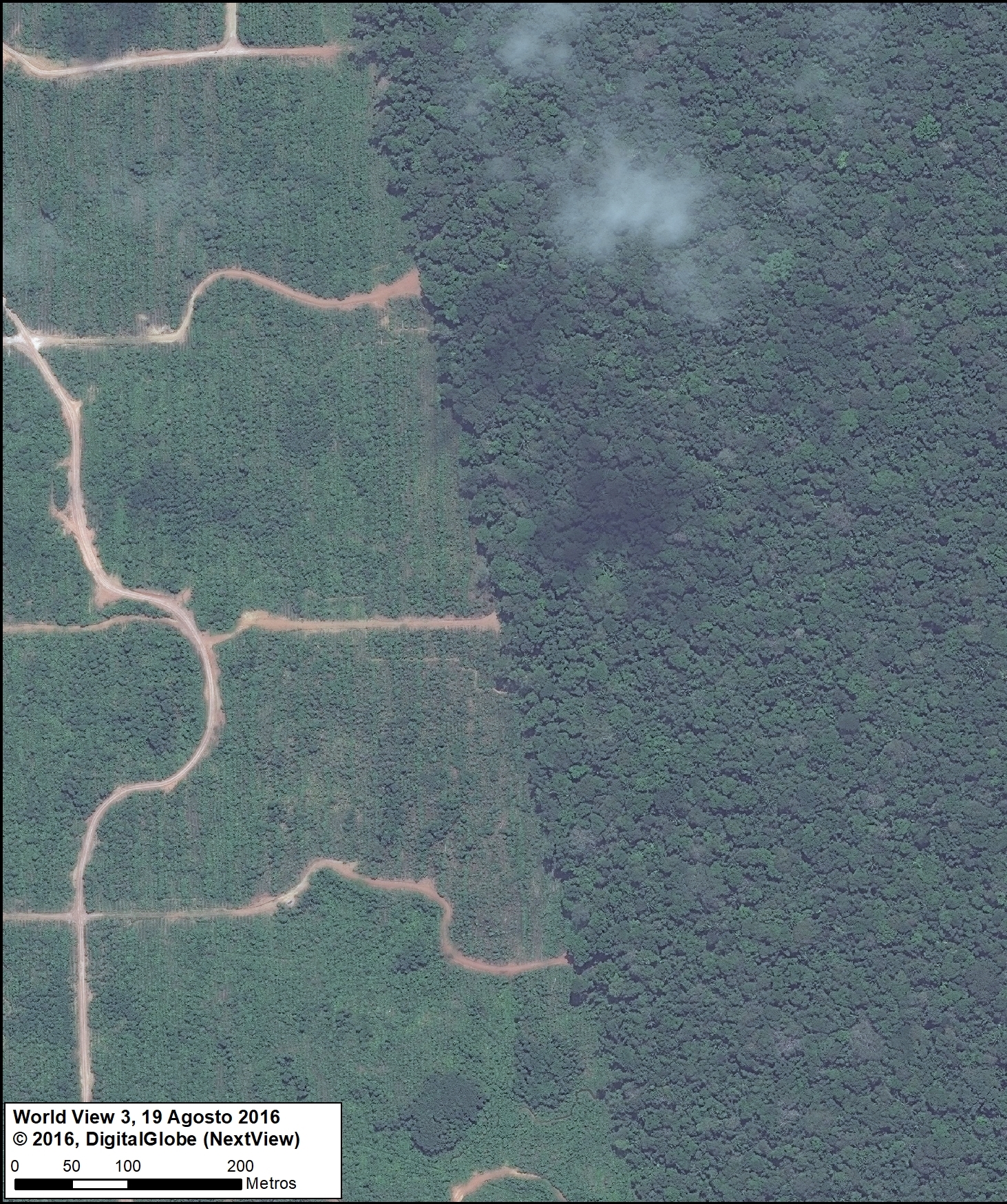
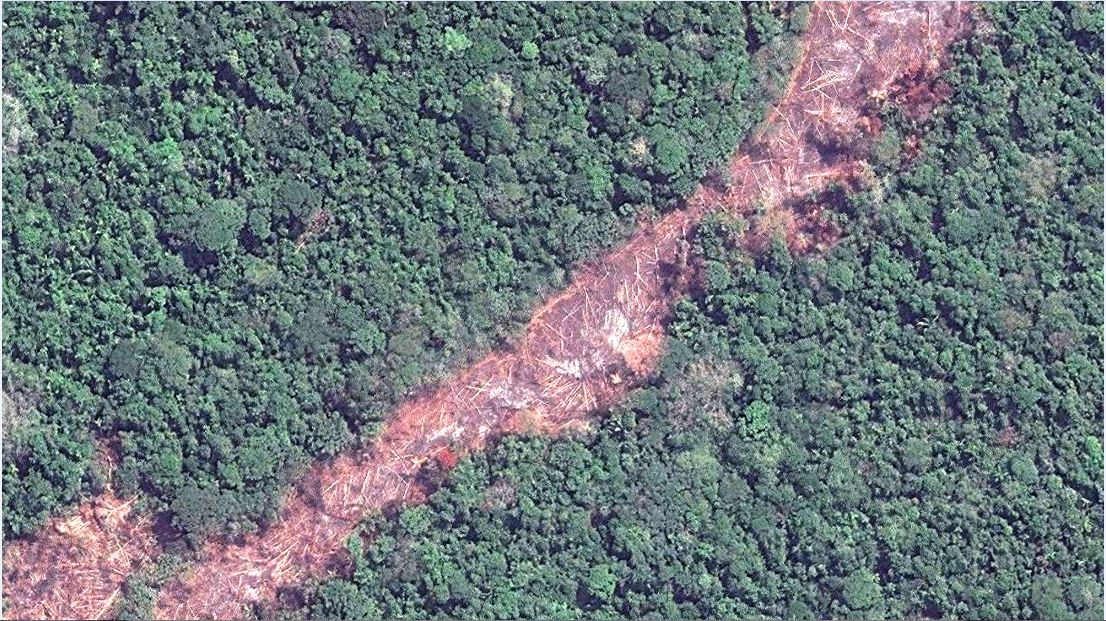
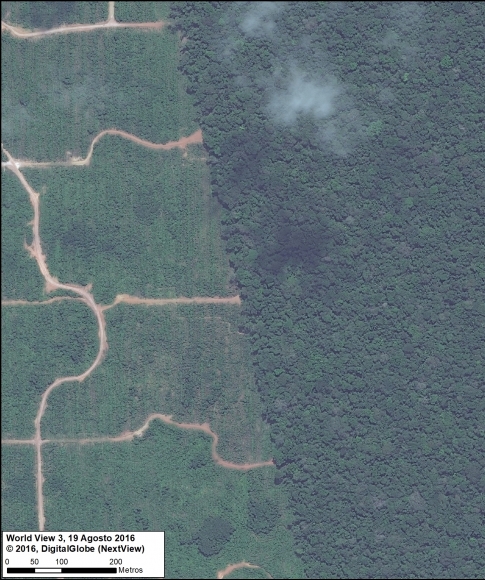
Satellite image of the deforestation produced by United Cacao. Source: DigitalGlobe (Nextview)

MAAP, an initiative of the organization Amazon Conservation, uses cutting-edge satellite technology to monitor deforestation in near real-time in the megadiverse Andean Amazon (Peru, Colombia, Ecuador, and Bolivia).

The monitoring is based on 5 satellite systems: Landsat (NASA/USGS), Sentinel (European Space Agency), PeruSAT-1, and the companies Planet and DigitalGlobe. For more information about our innovative methodology, see this recent paper in Science Magazine.

Launched in 2015, MAAP has published nearly 100 high-impact reports on the major Amazonian deforestation issues of the day.

Here, we present our third annual synthesis report with the objective to concisely describe the bigger picture: Deforestation trends, patterns, hotspots and drivers across the Andean Amazon.

Our principal findings include:

Trends: Deforestation across the Andean Amazon has reached 4.2 million hectares (10.4 million acres) since 2001. Annual deforestation has been increasing in recent years, with a peak in 2017 (426,000 hectares). Peru has had the highest annual deforestation, followed by surging Colombia (in fact, Colombia surpassed Peru in 2017). The vast majority of the deforestation events are small-scale (‹5 hectares).

Hotspots: We present the first regional-scale deforestation hotspots map for the Andean Amazon, allowing for spatial comparisons between Peru, Colombia, and Ecuador.  We discuss six of the most important hotspots.

Drivers: We present MAAP Interactive, a dynamic map with detailed information on the major deforestation drivers: gold mining, agriculture (oil palm and cacao), cattle ranching, logging, and dams. Agriculture and ranching cause the most widespread impact across the region, while gold mining is most intense southern Peru.

Climate Change. We estimated the loss of 59 million metric tons of carbon in the Peruvian Amazon during the last five years (2013-17) due to forest loss. In contrast, we also show that protected areas and indigenous lands have safeguarded 3.17 billion metric tons of carbon.

I. Deforestation Trends

Image 1 shows forest loss trends in the Andean Amazon between 2001 and 2017.*  The left graph shows data by country, while the right graph shows data by forest loss event size.
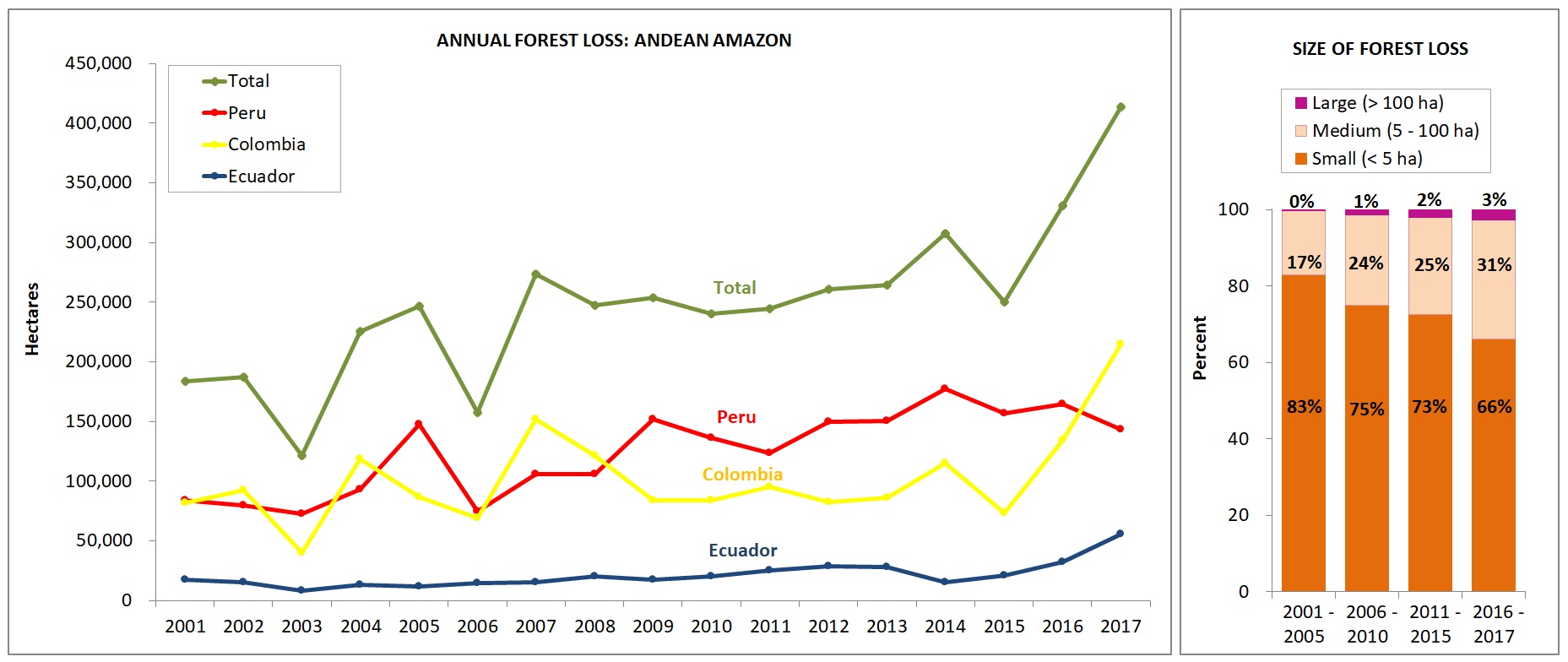
Image 1. Annual forest loss by country and size. Data: Hansen/UMD/Google/USGS/NASA, UMD/GLAD, Global Forest Watch, MINAM/PNCB, RAISG.

Trends by Country

Over the past 17 years (2001-2017), deforestation has surpassed 4.2 million hectares (10.4 million acres) in the Andean Amazon (see green line). Of this total, 50% is Peru (2.1 million hectares/5.2 million acres), 41% Colombia (1.7 million hectares/4.27 million acres), and 9% Ecuador (887,000 acres/359,000 hectares). This analysis did not include Bolivia.

Since 2007, there has been an increasing deforestation trend, peaking during the past two years (2016-17). In fact, 2017 has the highest annual forest loss on record with 426,000 hectares (over one million acres), more than double the total forest loss in 2006.

Peru had the highest average annual Amazonian deforestation between 2009 and 2016. The past four years have the highest annual deforestation totals on record in the country, with peaks in 2014 (177,566 hectares/439,000 acres) and 2016 (164,662 hectares/406,888 acres). According to new data from the Peruvian Environment Ministry, there was an important decline in 2017 (155,914 hectares/385,272 acres), but it is still the fourth highest annual total on record.

There has been a surge of deforestation in Colombia during the past two years. Note that in 2017, Colombia surpassed Peru with a record high of 214,700 hectares (530,400 acres) deforested.

Deforestation is also increasing in Ecuador, with highs of 32,000 hectares (79,000 acres) in 2016 and 55,500 hectares (137,000) acres in 2017.

For context, Brazil has had an average deforestation loss rate of 639,403 hectares (1.58 million acres) over the past several years.

* Data: Colombia & Ecuador: Hansen/UMD/Google/USGS/NASA; Peru: MINAM/PNCB, UMD/GLAD. While this information includes natural forest loss events, it serves as our best estimate of deforestation resulting from anthropogenic causes.  It is estimated that the non-anthropic loss comprises approximately 3.5% of the total loss. Note that the analysis does not include Bolivia.

Trends by Size

The pattern related to the size of deforestation events in the Andean Amazon remained relatively consistent over the last 17 years. Most noteworthy: the vast majority (74%) of the deforestation events are small-scale (‹5 hectares). Only 2% of deforestation events are large-scale (>100 hectares). The remaining 24% are medium-scale (5-100 hectares).

These results are important for conservation efforts.  Addressing this complex situation – in which most of the deforestation events are small-scale – requires significantly more attention and resources.  In addition, while large-scale deforestation (usually associated with agro-industrial practices) is not that common, it nonetheless represents a serious latent threat, due to the fact that only a small number of agro-industrial projects (for example, oil palm) are able to rapidly destroy thousands of acres of primary forest.

II. Deforestation Hotspots
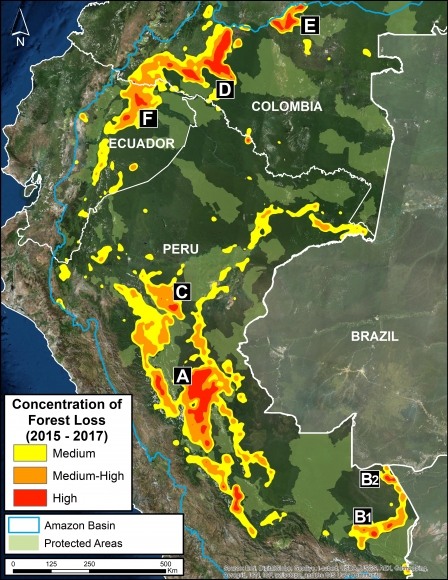
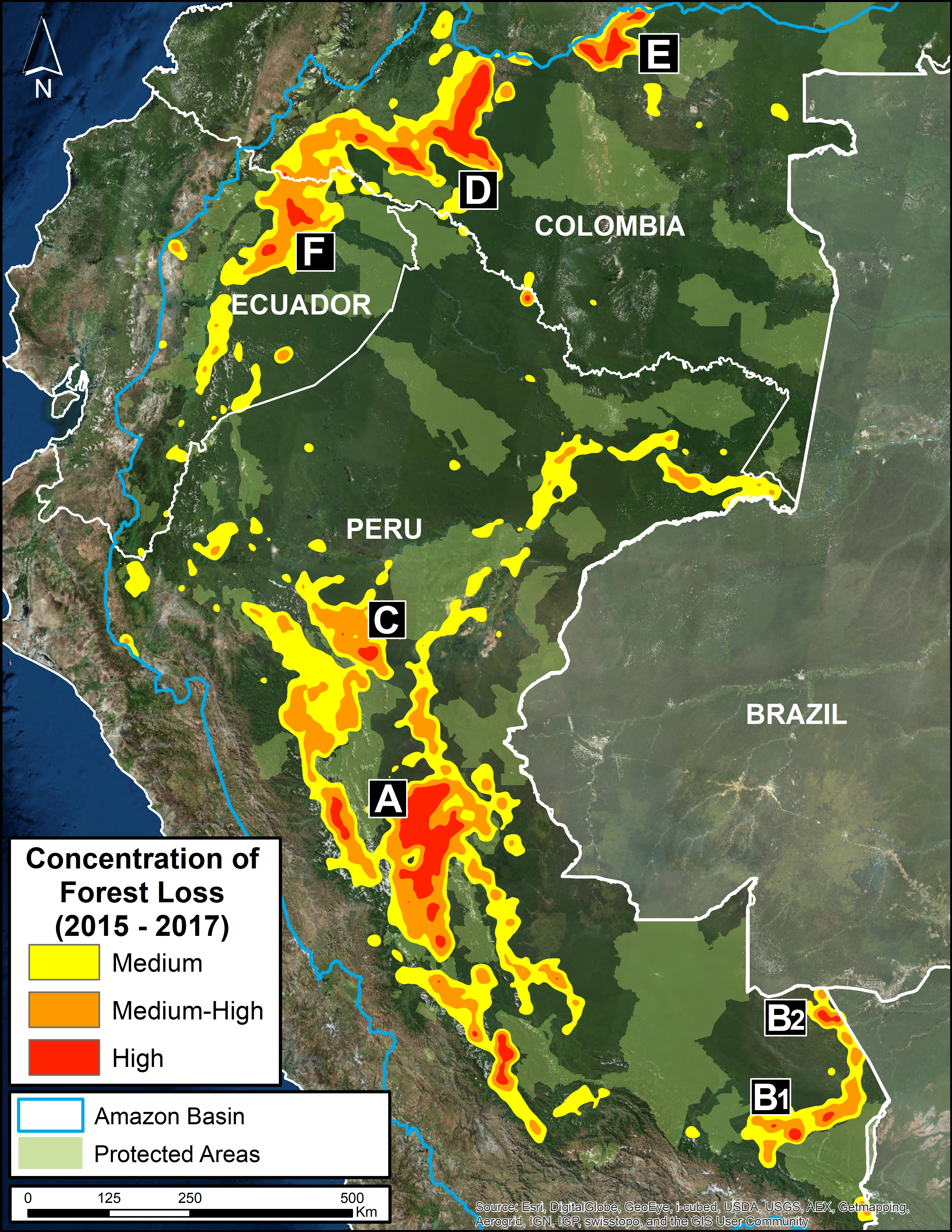
Image 2: Deforestation hotspots 2015-2017. Data: Hansen/UMD/Google/USGS/NASA.

We present the first regional-scale deforestation hotspots map across the Andean Amazon (Colombia, Ecuador, Peru).  Image 2 shows the results for the past three, 2015 – 2017.

The most critical zones (“high” deforestation density) are indicated in red. They include:

A. Central Peruvian Amazon: Over the last 10 years, this zone, located in the Ucayali and Huánuco regions, has consistently had one of the largest concentrations of deforestation in Peru (Inset A).  Its principal drivers include oil palm and cattle grazing.

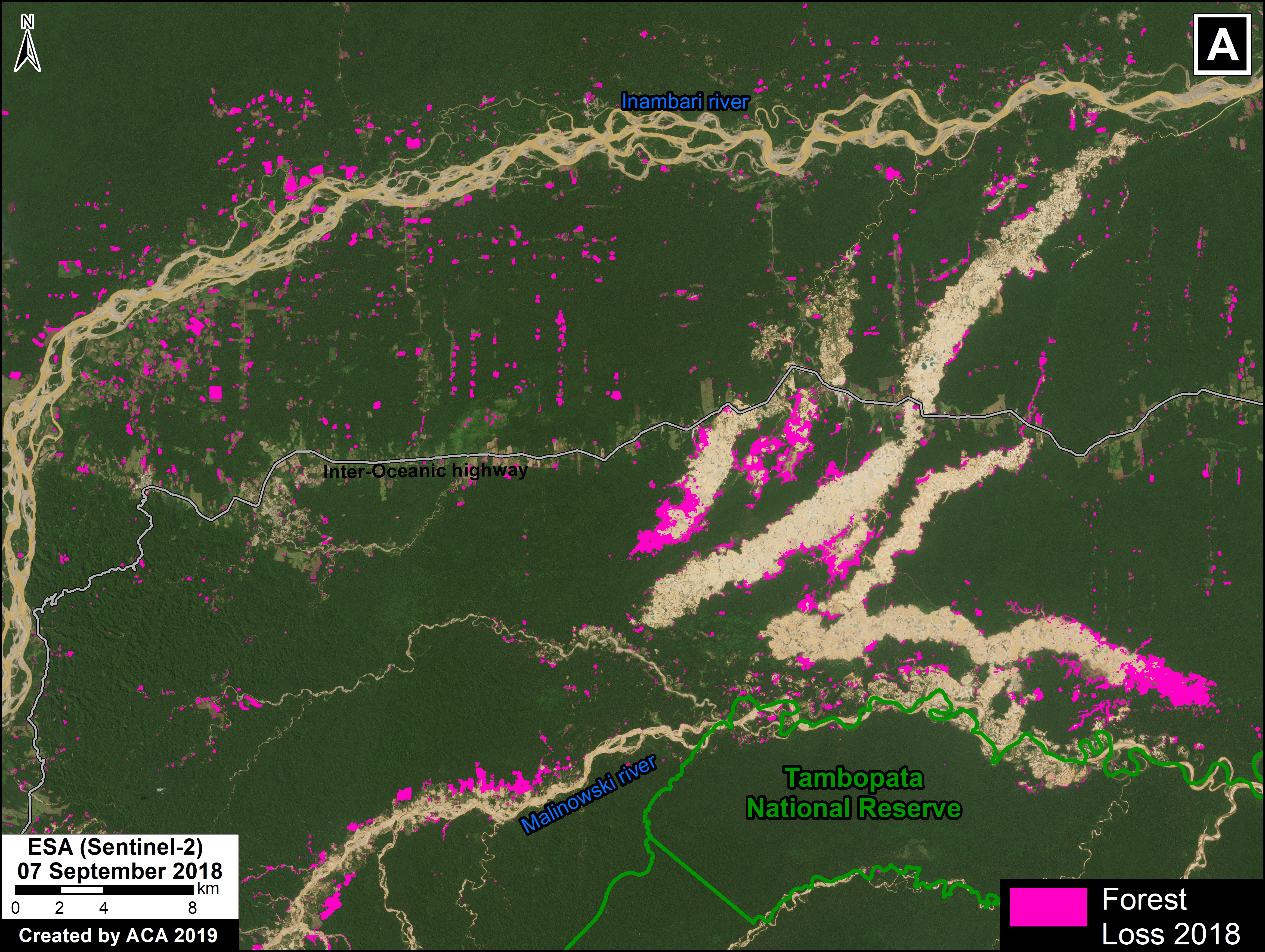
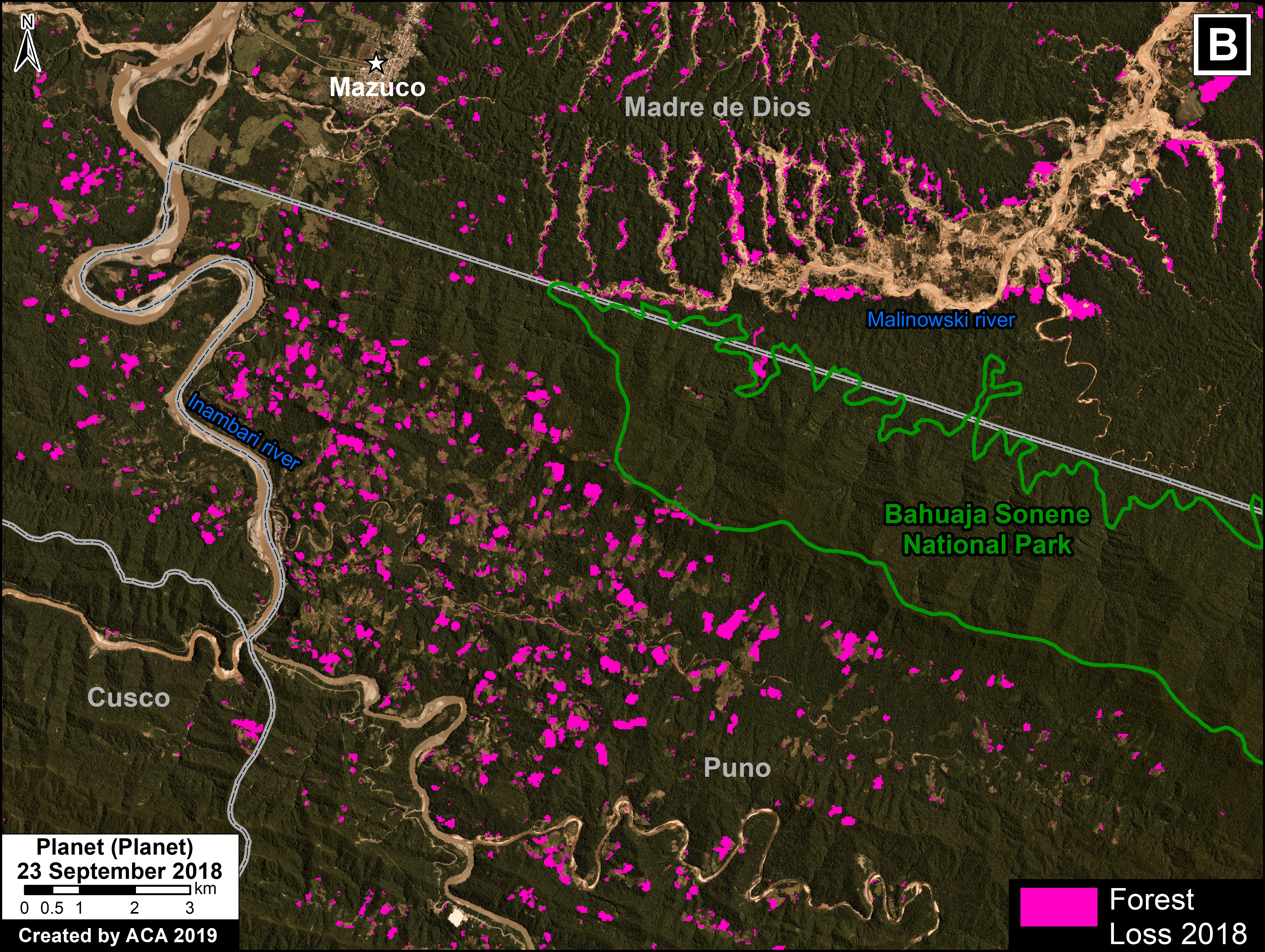
B. Southern Peruvian Amazon: This zone, located in the Madre de Dios region, is impacted by gold mining (Inset B1), and increasingly by small- and medium-scale agriculture along the Interoceanic Highway (Inset B2).

C. Central Peruvian Amazon: A new oil palm plantation located in the San Martín region has been identified as a recent large-scale deforestation event in this zone (Inset C).

D. Southwestern Colombian Amazon: Cattle grazing is the principal deforestation driver documented in this zone, located in the departments of Caquetá and Putumayo (Inset D).

E. Northern Colombian Amazon: There is expanding deforestation along a new road in this zone, located in the department of Guaviare (Inset E).

F. Northern Ecuadoran Amazon: This zone is located in the Orellana province, where small- and medium-scale agriculture, including oil palm, is the principal driver of deforestation (Inset F).


III. Drivers of Deforestation     
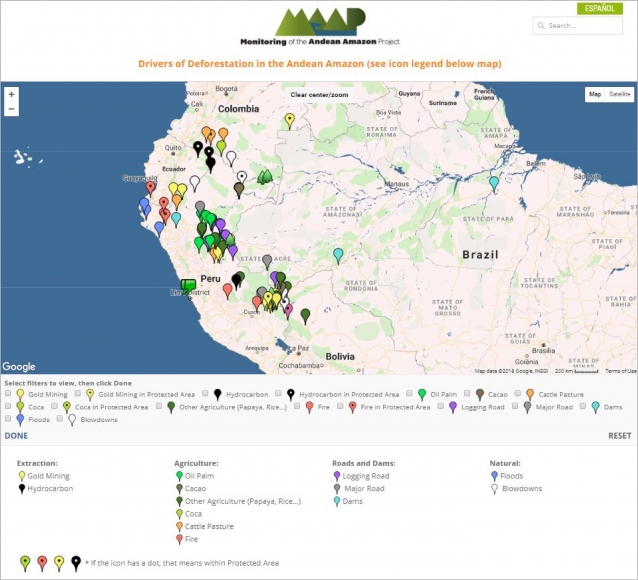
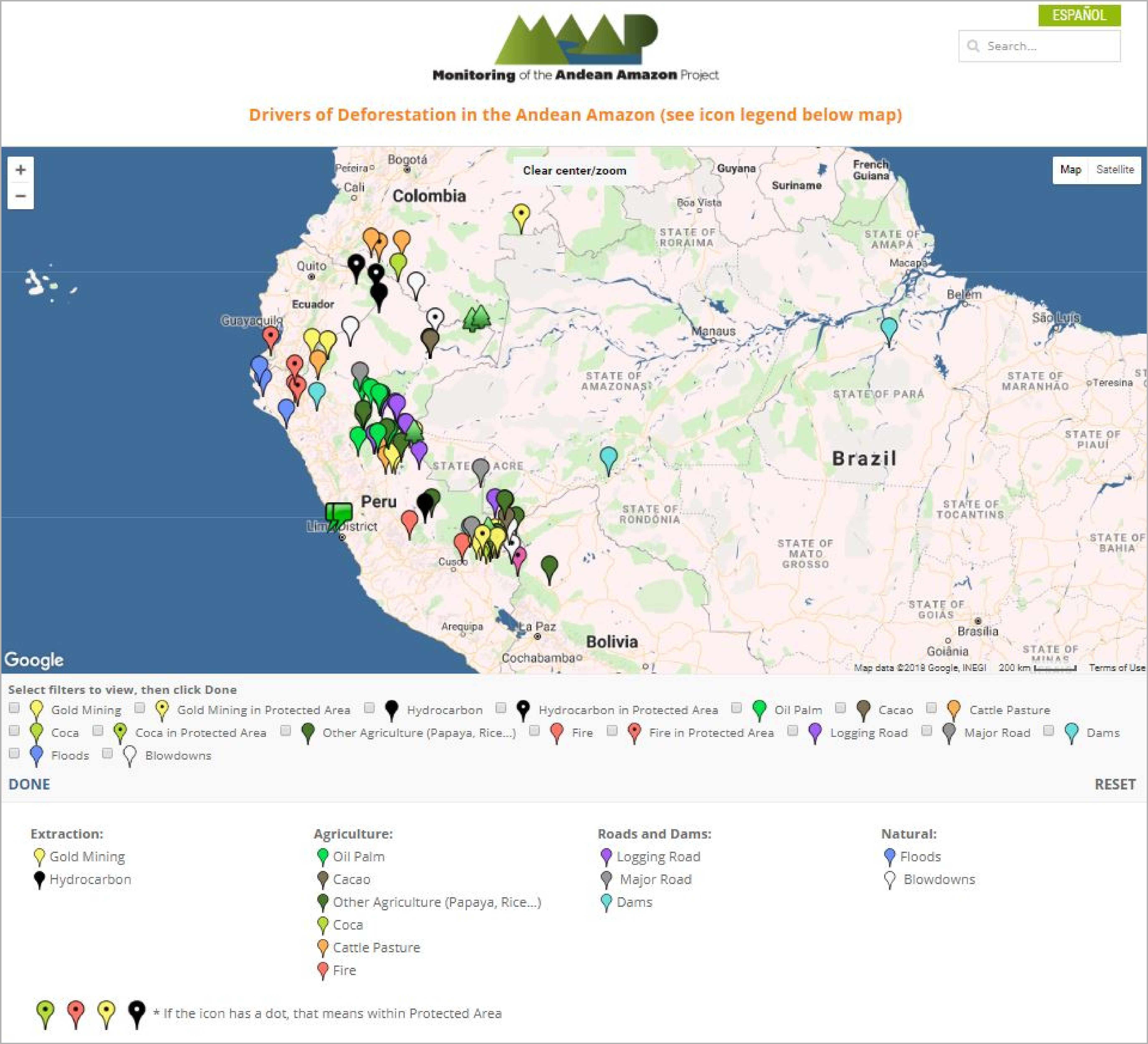
MAAP Interactive (screenshot)

One of the main objectives of MAAP is to improve the availability of precise and up-to-date information regarding the current drivers (causes) of deforestation in the Andean Amazon.  Indeed, one of our most important advances has been the use of high-resolution imagery to identify current deforestation drivers.

In order to improve the analysis and understanding of the identified drivers, we have created an Interactive Map that displays the spatial location of each driver associated with every MAAP report.  An important characteristic of this map is the ability to filter the data by driver, by selecting the boxes of interest.

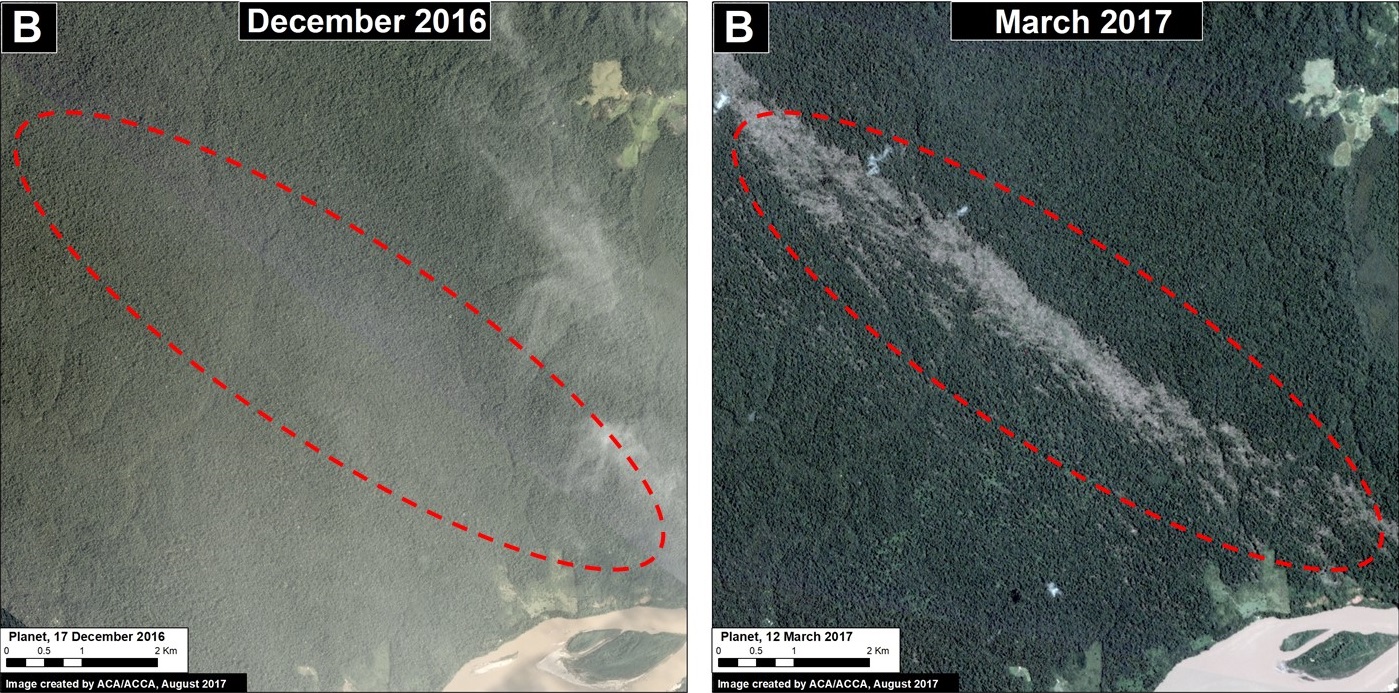
Image 3 shows a screenshot of the Interactive Map.  Note that it contains detailed information on these principal drivers: gold mining, oil palm, cacao, small-scale agriculture, cattle pasture, logging roads, and dams.  It also includes natural causes such as floods, forest fires, and blowdowns.  In addition, it highlights deforestation events in protected areas.

Below, we discuss the principal drivers of deforestation and degradation in greater detail.


Agriculture  oil palm, cacao, and other crops

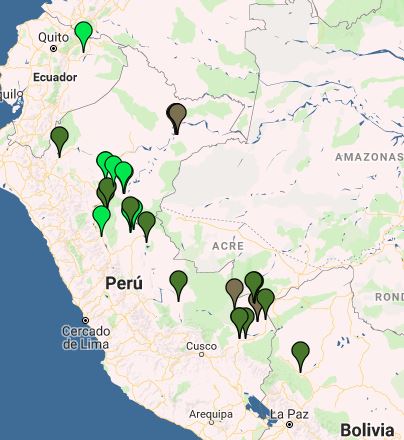
Image 4: Interactive Map, agriculture. Data: MAAP.

Image 4 shows the results of the interactive map when applying the agriculture-related filters.

Legend:
Oil palm (bright green)
Cacao (brown)
Other crops (dark green)

Agricultural activity is one of the principal causes of deforestation in the Andean Amazon.

The majority of agriculture-related deforestation is caused by small- and medium-scale plantations (‹50 hectares).

Deforestation for large-scale, agro-industrial plantations is much less common, but represents a critical latent threat.


Large-scale Agriculture

We have documented five major deforestation events produced by large-scale plantations since 2007:  four of these occurred in Peru (three of which are related to oil palm and one to cacao) and one in Bolivia (resulting from sugar cane plantations).

First, between 2007 and 2011, two large-scale oil palm plantations caused the deforestation of 7,000 hectares on the border between Loreto and San Martín (MAAP #16).  Subsequent plantations in the surrounding area caused the additional deforestation of 9,800 hectares.

It is importnat to note that the Peruvian company Grupo Palmas is now working towards a zero deforestation value chain and has a new sustainability policy (see Case C of MAAP #64).

Next, between 2012 and 2015, two other large-scale oil palm plantations deforested 12,000 hectares in Ucayali  (MAAP #4, MAAP #41).

Between 2013 and 2015, the company United Cacao deforested 2,380 hectares for cacao plantations in Loreto (MAAP #9, MAAP #13, MAAP #27, MAAP #35).

Deforestation from large-scale agriculture decreased in Peru between 2016 and 2017, but there was one notable event: an oil palm plantation of 740 hectares in San Martín (MAAP #78).

Another notable case of deforestation related to large-scale agriculture has been occurring in Bolivia, where a new sugarcane plantation has caused the deforestation of more than 2,500 hectares in the department of La Paz.

Additionally, we found three new zones in Peru characterized by the deforestation pattern produced by the construction of organized access roads which have the potential of becoming large-scale agriculture areas (MAAP #69).

Small and Medium-scale Agriculture

Deforestation caused by small- and medium-scale agriculture is much more widespread, but it is often difficult to identify the driver from satellite imagery.

We have identified some specific cases of oil palm in Huánuco, Ucayali, Loreto, and San Martín (MAAP #48, MAAP #26, MAAP #16).

Cacao and papaya are emerging drivers in Madre de Dios.  We have documented cacao deforestation along the Las Piedras River (MAAP #23, MAAP #40) and papaya along the Interoceanic Highway (MAAP #42).

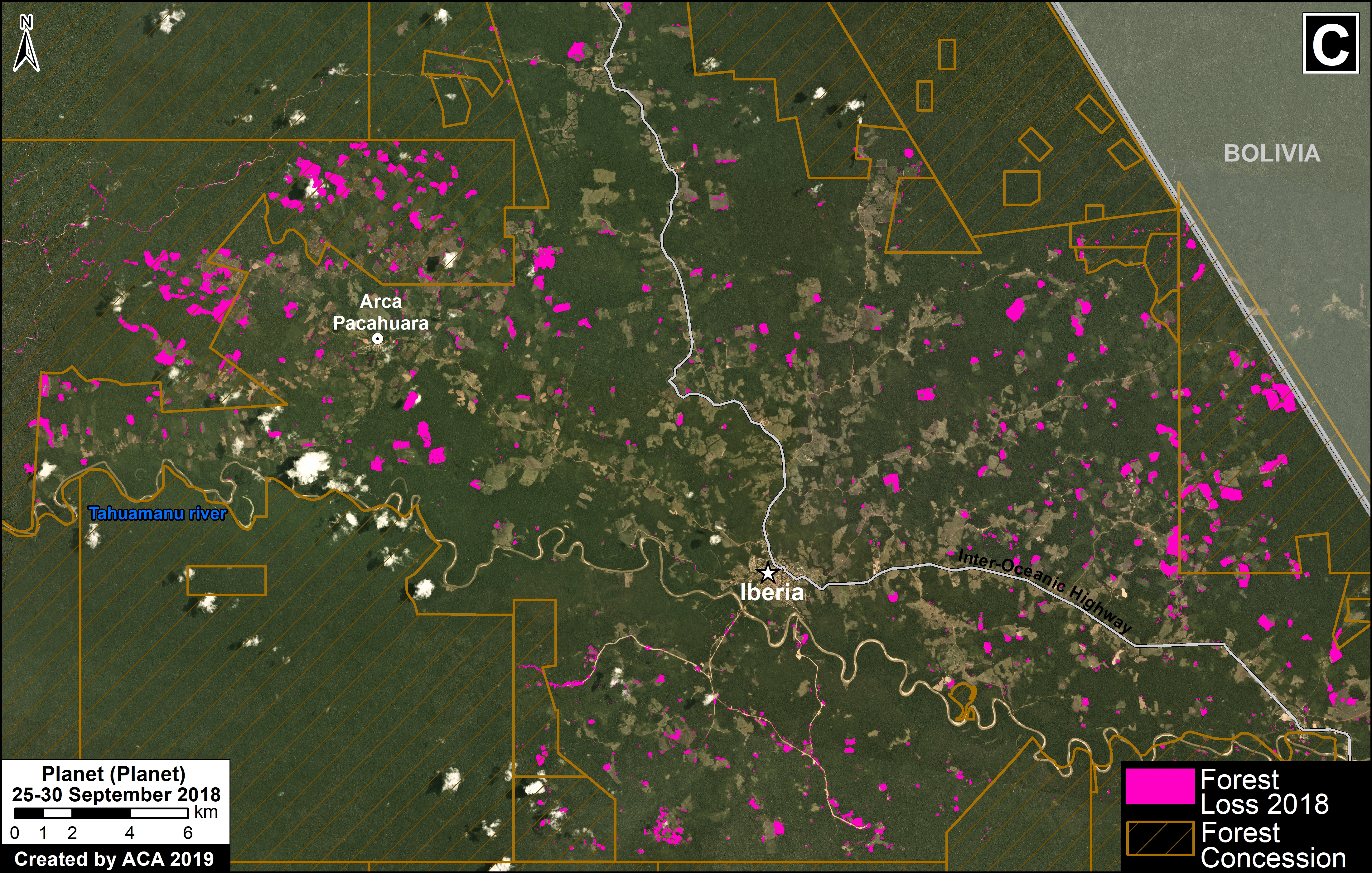
Corn and rice cultivation appear to be turning the area around the town of Iberia into a deforestation hotspot (MAAP #28).  In other cases, we have documented deforestation resulting from small- and medium-scale agriculture, though it has not been possible to identify the type of crop (MAAP #75, MAAP #78).

Additionally, small-scale agriculture is possibly a determining factor in the forest fires that degrade the Amazon during the dry season (MAAP #45, MAAP #47).

The cultivation of illicit coca is a cause of deforestation in some areas of Peru and Colombia.  For example, in southern Peru, the cultivation of coca is generating deforestation within the Bahuaja Sonene National Park and its surrounding areas.

Cattle Ranching
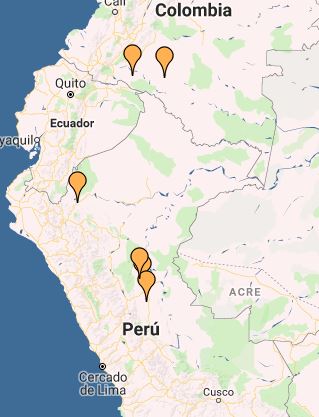
Image 5: Interactive Map, cattle ranching. Data: MAAP.

By analyzing high-resolution satellite imagery, we have developed a methodology for identifying areas deforestated by cattle ranching.*

Image 5 shows the results of the Interactive Map when applying the “Cattle pasture” filter, indicating the documented examples in Peru and Colombia.

Legend:
Cattle ranching (orange)

Cattle ranching is the principal driver of deforestation in the central Peruvian Amazon (MAAP #26, MAAP #37, MAAP #45, MAAP #78). We also identified recent deforestation from cattle ranching in northeastern Peru (MAAP #78).

In the Colombian Amazon, cattle ranching is one the primary direct drivers in the country’s most intense deforestation hotspots (MAAP #63, MAAP #77).

* Immediately following a major deforestation event, the landscape of felled trees is similar for both agriculture and cattle pasture.  However, by studying an archive of images and going back in time to analyze older deforestation cases, it is possible to distinguish between the drivers.  For example, after one or two years, agriculture and cattle pasture appear very different in the images. Ther former tends to have organized rows of new plantings, while the latter is mostly grassland.


Gold Mining
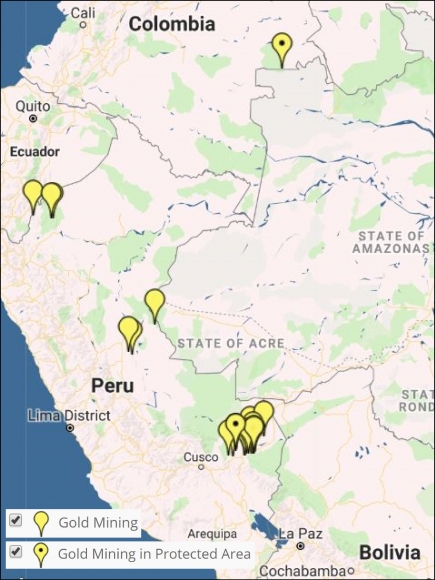
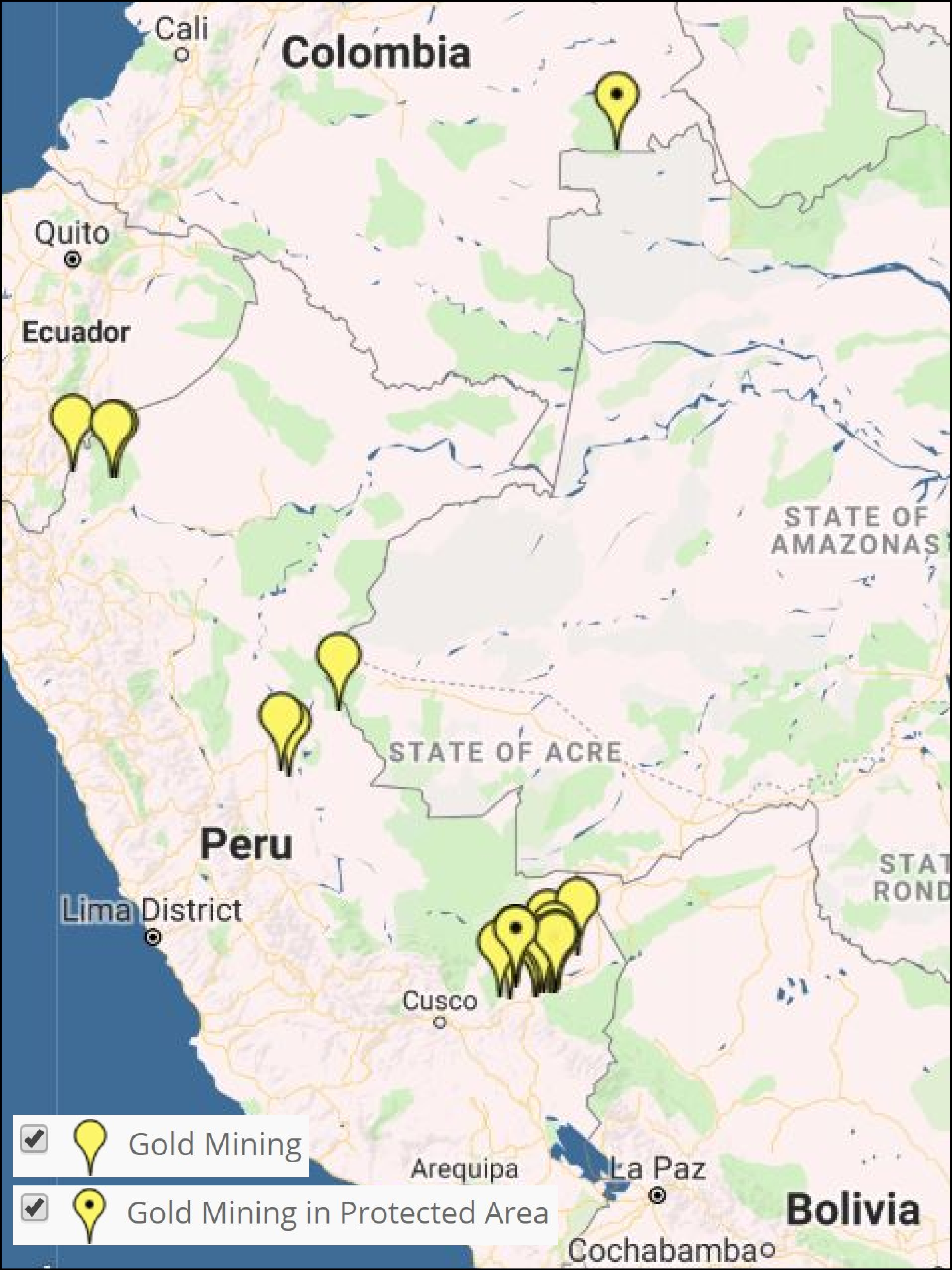
Image 6: Interactive Map, gold mining. Data: MAAP.

Image 6 shows the results of the Interactive Map when applying the “Gold mining” filter.

Legend:
Gold Mining (yellow)
*With dot indicates within protected area

The area that has been most impacted by gold mining is clearly the southern Peruvian Amazon, where we estimate the total deforestation of more than 63,800 hectares. Of this, at least 7,000 hectares have been lost since 2013.  The two most critical zones are La Pampa and Alto Malinowski in Madre de Dios (MAAP #87, MAAP #75, MAAP #79).  Another critical area exists in Cusco in the buffer zone of the Amarakaeri Communal Reserve, where mining deforestation is now less than one kilometer from the boundary of the protected area (MAAP #71).

It is important to highlight two important cases in which the Peruvian government has taken effective actions to halt illegal mining within protected areas (MAAP #64).  In September 2015, illegal miners invaded Tambopata National Reserve and deforested 550 hectares over the course of a two-year period.  At the end of 2016, the government intensified its interventions and the invasion was halted in 2017. In regards to Amarakaeri Communal Reserve, in June 2015 we revealed the mining invasion deforestation of 11 hectares.  Over the course of the following weeks, SERNANP and ECA Amarakaeri implemented measures and rapidly halted the illegal activity.

Other small gold-mining fronts are emerging in the northern and central Peruvian Amazon (MAAP #45, MAAP #49).

In addition, we have also documented deforestation linked to illegal gold-mining activities in the Puinawai National Park in the Colombian Amazon.

Logging
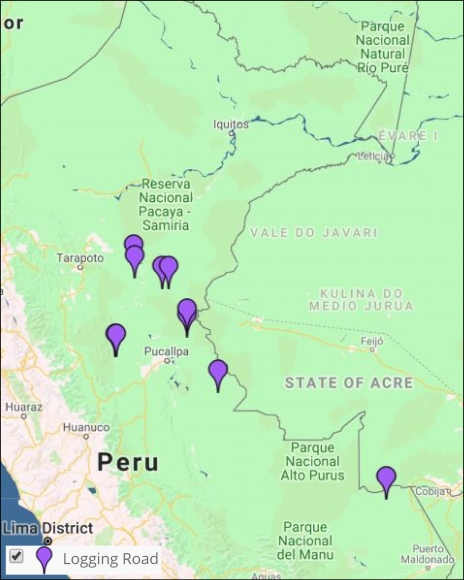
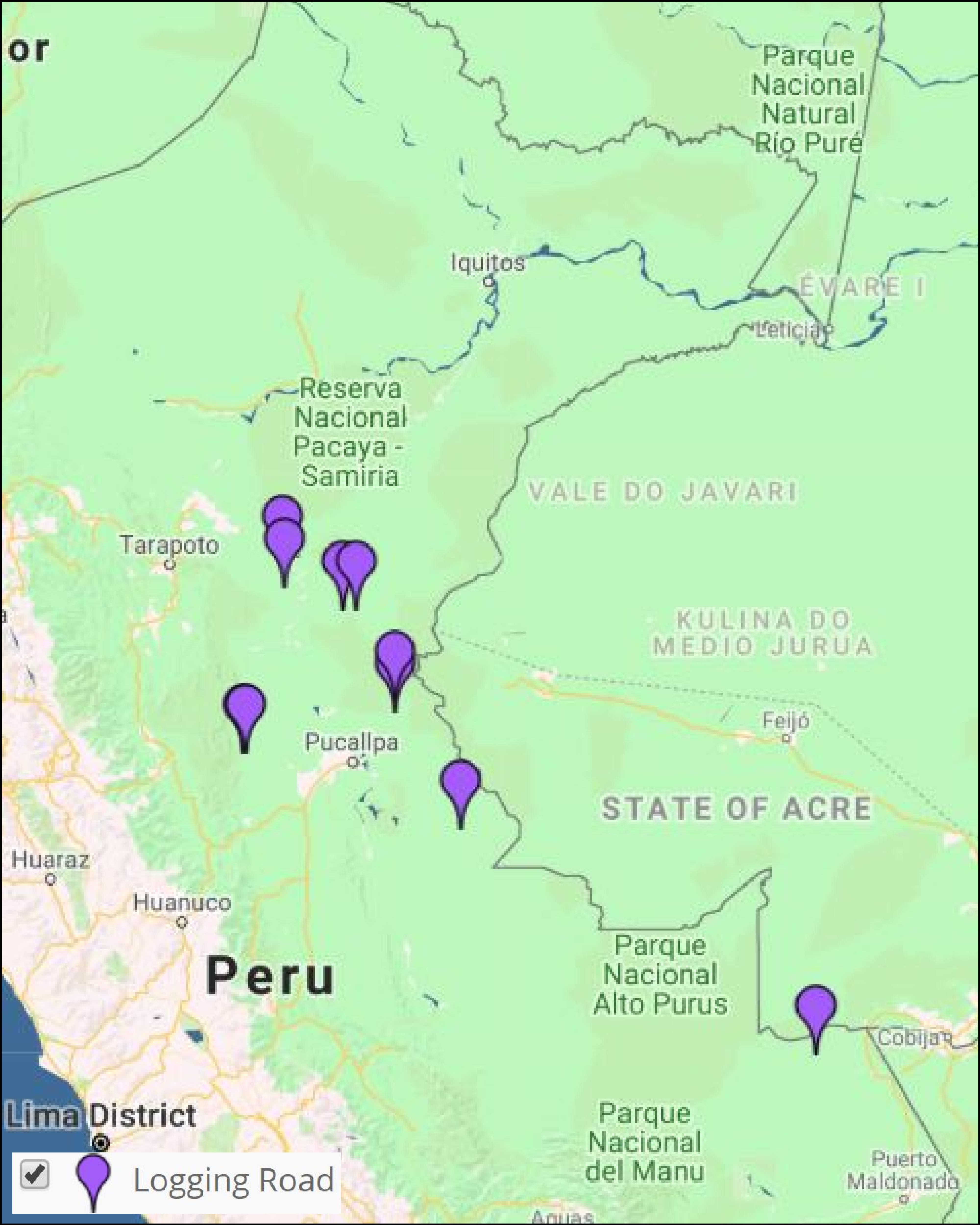
Image 7: Interactive Map, logging roads. Data: MAAP.

In MAAP #85 we proposed a new tool to address illegal logging in the Peruvian Amazon: utilize satellite imagery to monitor construction of logging roads in near real-time.

Image 7 shows the results of the Interactive Map when applying the “Logging roads” filter.

Legend:
Logging Road (purple)

We estimate that 2,200 kilometers of forest roads have been constructed in the Peruvian Amazon during the last three years (2015-2017).  The roads are concentrated in southern Loreto, Ucayali, and northwestern Madre de Dios.


Roads
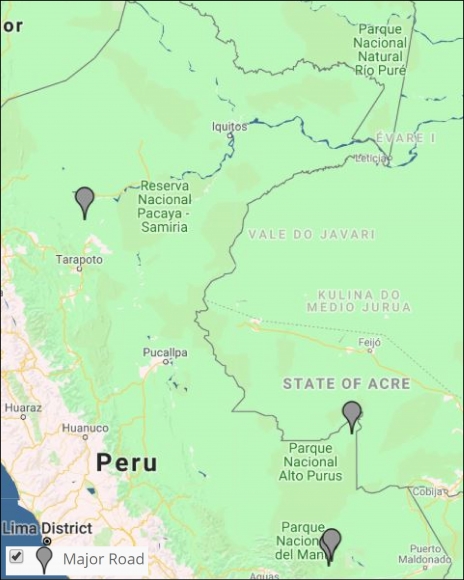
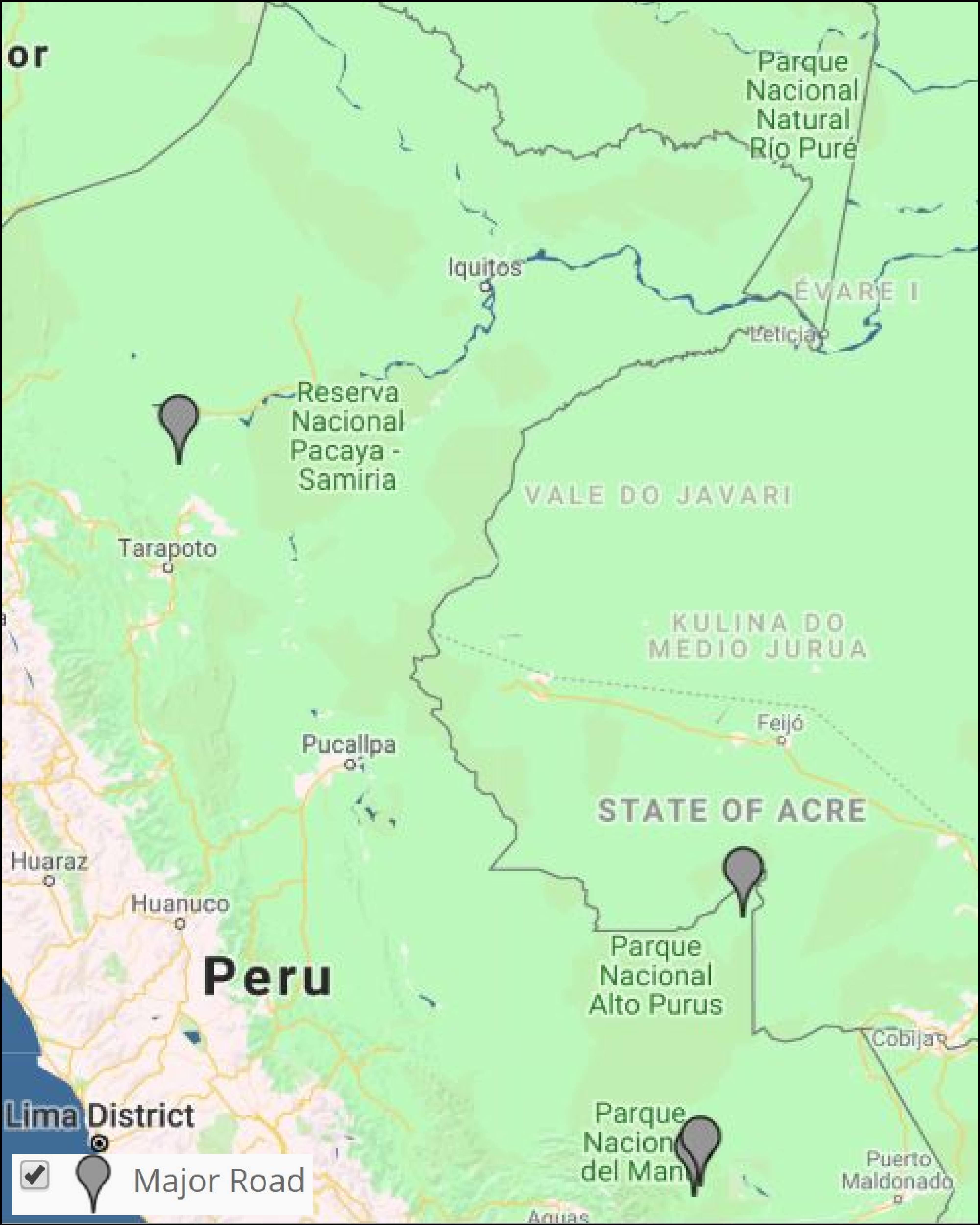
Image 8: Interactive map, roads. Data: MAAP.

It has been well-documented that roads are one of the most important drivers of deforestation in the Amazon, particularly due to the fact that they facilitate human access and activities related to agriculture, cattle ranching, mining, and logging.

Image 8 shows the results of the Interactive Map when applying the “Roads” filter.

Legend:
Road (gray)

We have analyzed two controversial proposed roads in Madre de Dios, Peru.

The Nuevo Edén – Boca Manu – Boca Colorado road would traverse the buffer zone of two protected areas: Amarakaeri Communal Reserve and Manu National Park (MAAP #29).

The other, the Puerto Esperanza-Iñapari road, would traverse the Purús National Park and threaten the territory of the indigenous peoples in voluntary isolation who live in this remote area (MAAP #76).


Hydroelectric dams

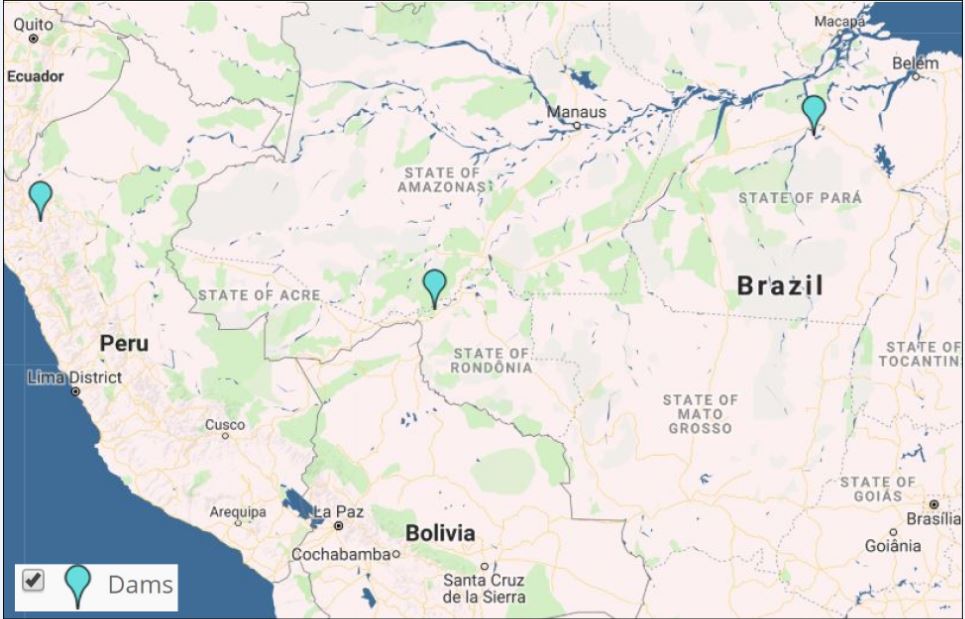
Image 9 shows the results of the Interactive Map when applying the “Dams” filter.

Legend:
Hydroelectric Dam (light blue)
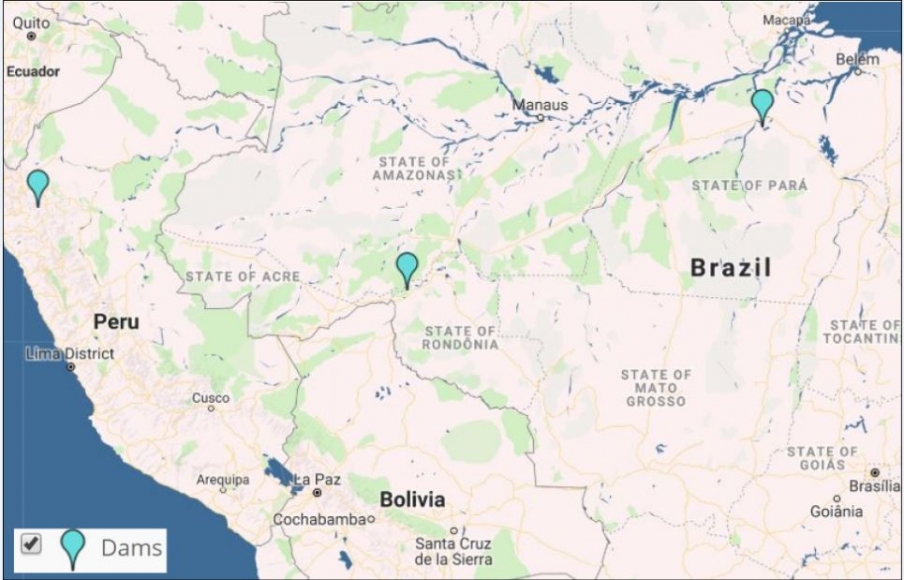
To date, we have analyzed three hydroelectric dams located in Brazil.  We have documented the loss of 36,100 hectares of forest associated with flooding produced by two dams (San Antonio and Jirau) on the Madeira River near the border with Bolivia (MAAP #34).  We also analyzed the controversial Belo Monte hydroelectrical complex located on the Xingú River, adn estimate that 19,880 hectares of land have been flooded. According to the imagery, this land is a combination of forested areas and agricultural areas (MAAP #66).

Additionally, we show a very high-resolution image of the exact location of the proposed Chadín-2 hydroelectric dam on the Marañón River in Peru (MAAP #80).

Hydrocarbon (oil and gas)
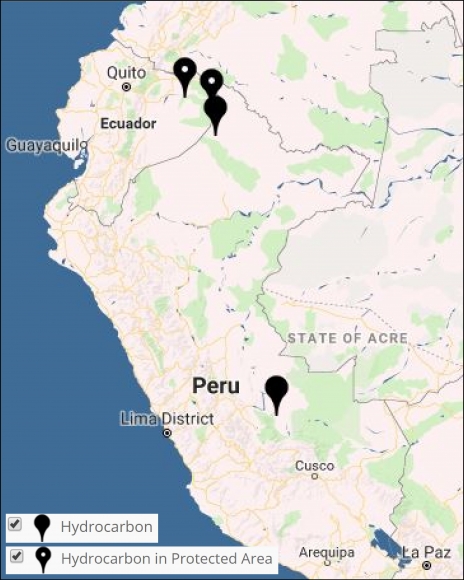
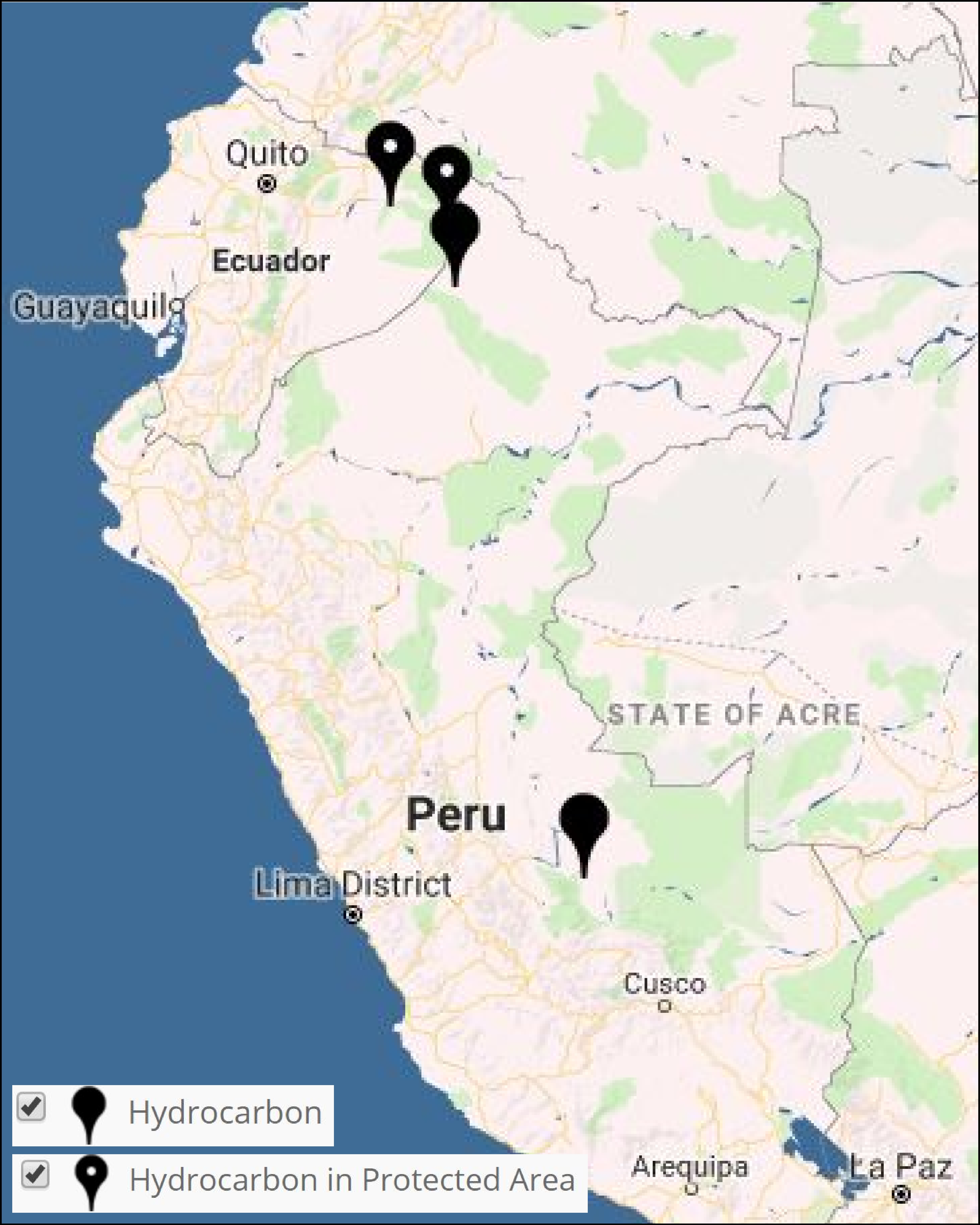
Image 10: Interactive map, hidrocarbon. Data: MAAP.

Image 10 shows the results of the Interactive Map when applying the “Hydrocarbon filter.

Legend:
Hydrocarbon (black)

Our first report on this sector focused on Yasuní National Park in the Ecuadorian Amazon.  We documented the direct and indirect deforestation amounts of 417 hectares (MAAP #82).

We also show the location of recent deforestation in two hydrocarbon block in Peru: Block 67 in the north and Blocks 57 in the south.


Climate Change

Tropical forests, especially the Amazon, sequester huge amounts of carbon, one of the main greenhouse gases driving climate change.

In MAAP #81, we estimated the loss of 59 million metric tons of carbon in the Peruian Amazon during the last five years (2013-17) due to forest loss, especially deforestation from mining and agricultural activities. This finding reveals that forest loss represents nearly half (47%) of Peru’s annual carbon emissions, including from burning fossil fuels.

In contrast, in MAAP #83 we show that protected areas and indigenous lands have safeguarded 3.17 billion metric tons of carbon, as of 2017. That is the equivalent to 2.5 years of carbon emissions from the United States.

The breakdown of results are:
1.85 billion tons safeguarded in the Peruvian national protected areas system;
1.15 billion tons safeguarded in titled native community lands; and
309.7 million tons safeguarded in Territorial Reserves for indigenous peoples in voluntary isolation.

Citation

Finer M, Mamani N (2018) Deforestation in the Andean Amazon (Trends, Hotspots, Drivers). MAAP Synthesis #3.
MAAP #88: Deforestation Hotspots in the Ecuadorian Amazon

MAAP #88:
Deforestation Hotspots in the Ecuadorian Amazon
https://www.maapprogram.org/ecuador-hotspots/

Hotspots de deforestación en la Amazonía Ecuatoriana

Here, we highlight deforestation hotspots, the areas with the highest deforestation densities, in the mega-diverse Ecuadorian Amazon.
We then zoom in and focus on a dynamic area in the north that is located between three important protected areas (Sumaco, Yasuní y Cuyabeno).

We show a series of satellite images that indicate that the primary deforestation drivers (causes) in these hotspots are oil palm and other agricultural activities.

*The Ecuador series is a collaboration between Amazon Conservation, Amazon Conservation Team, and EcoCiencia, funded by the MacArthur Foundation

MAAP #88: Deforestation Hotspots in the Ecuadorian Amazon
https://www.maapprogram.org/ecuador-hotspots/


MAAP Colombia: Chiribiquete – Deforestation Hotspots in the Colombian Amazon, part 3

MAAP #86: Deforestation Hotspots in the Colombian Amazon, part 3: Chiribiquete-Macarena

We present our third report* in a series investigating deforestation hotspots in the Colombian Amazon. Here, we focus on the “Chiribiquete-Macarena” hotspot, located between the Chiribiquete and La Macarena National Parks.

The Colombian government is finalizing plans to expand the boundaries of Chiribiquete National Park, an important step for conservation. However, we show (with high-resolution images) that deforestation is surging in the area and rapidly expanding towards these new boundaries. In fact, in 2018, deforestation has entered the newly expanded park.

MAAP #86: Deforestation Hotspots in the Colombian Amazon, part 3: Chiribiquete-Macarena

https://www.maapprogram.org/chiribiquete/


*The first report focused on the “Caguan” hotspot in the department of Caquetá. The second report focused on the “La Paya” hotspot in the department of Putumayo.

MAAP #78: Deforestation Hotspots in the Peruvian Amazon, 2017

Base Map (Image 78). Data: PNCB/MINAM, UMD/GLAD, SERNANP

As we begin a new year, we make an initial assessment of 2017, estimating deforestation hotspots in the Peruvian Amazon based on early warning alert data.*

We estimate the annual forest loss of 354,410 acres (143,425 hectares) across Peru in 2017. If confirmed, this total represents the lowest in 5 years (average of 394,600 acres since 2012), and a decrease of 13% from last year.**

Deforestation, however, is still widespread. The base map shows the most intense hotspots (areas with highest density of forest loss).

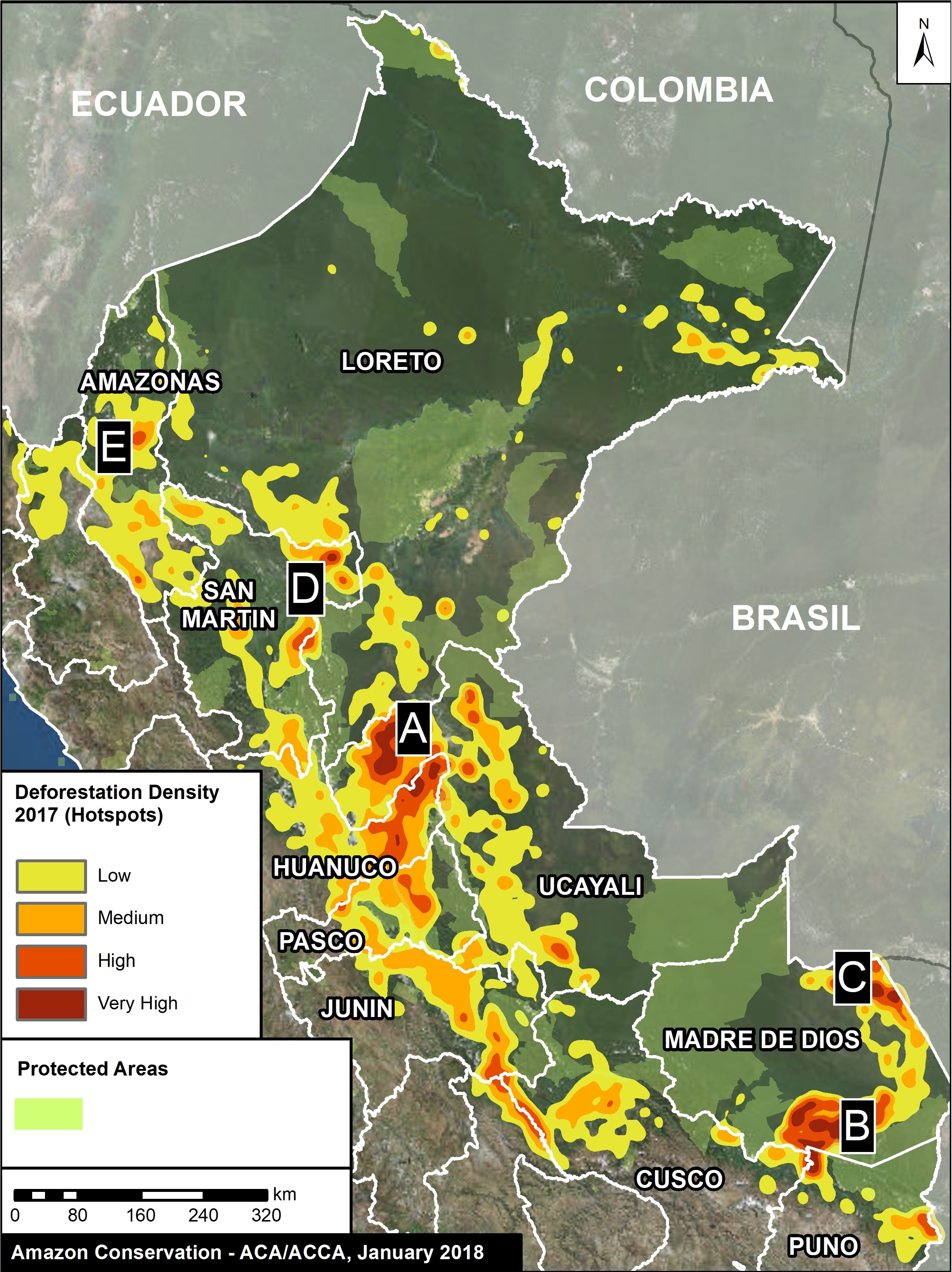
The two main deforestation areas are clearly seen: the central Amazon (Ucayali/Huánuco regions) and the southern Amazon (Madre de Dios). Also, there are several additional hotspots scattered throughout the country.

We present satellite images (slider format) of the most intense hotspots. The images reveal that the main deforestation drivers include gold mining, oil palm, and general agriculture (crops and livestock).

The hotspots detailed below are:

A. Central Amazon (Ucayali/Huánuco)
B. Southern Madre de Dios
C. Iberia (Madre de Dios)
D. Northeast San Martín
E. Nieva (Amazonas)


A. Central Amazon (Ucayali/Huánuco)

As in previous years, there is a concentration of high intensity hotspots in the central Peruvian Amazon (Ucayali and Huánuco regions). We estimate the deforestation of 57,430 acres (23,240 hectares) in this hotspot during 2017. The images show that the main drivers are likely cattle ranching and oil palm plantations. Image 78a is a slider showing an example of the deforestation in this hotspot during 2017.

[twenty20 img1=”6875″ img2=”6876″ width=”78%” offset=”0.5″]

Image 78a. Central Amazon. Data: Planet, NASA/USGS

B. Southern Madre de Dios

As described in MAAP #75, Madre de Dios has become one of the regions with the highest rates of deforestation in Peru, with a concentration along the Interoceanic highway. We estimate the deforestation of 27,465 acres (11,115 hectares) in southern Madre de Dios during 2017. Image 78b is a slider showing the extensive deforestation that occurred in this area during 2017. The images show that the main drivers are gold mining (south of the highway) and small to medium-scale agriculture (north of the road).

[twenty20 img1=”6877″ img2=”6878″ width=”78%” offset=”0.5″]

Image 78b. South Madre de Dios. Data: Planet

C. Iberia (Madre de Dios)

On the other side of Madre de Dios, near the border with Brazil, another hotspot is located around the town of Iberia. We estimate the deforestation of 7,955 acres (3,220 hectares) in this hotspot during 2017.  Image 78c is a slider showing deforestation in the area of the hotspot west of Iberia (known as Pacahuara). The images show that the main deforestation driver is small to medium-scale agriculture (according to local sources, the main crops include corn, papaya, and cacao).

[twenty20 img1=”6880″ img2=”6879″ width=”78%” offset=”0.5″]

Image 78c. Iberia. Data: Planet

D. Northeast of San Martín

A new hotspot emerged in the northeast corner San Martin due to a large-scale agriculture plantation. Image 78d is a slider that shows the deforestation of 1,830 acres (740 hectares) during the last several months of 2017. The Peruvian Environment Ministry has confirmed that the cause is a new oil palm plantation. Indeed, this new deforestation is close to an area that has experienced extensive deforestation for oil palm plantations in recent years (see MAAP #16).

[twenty20 img1=”6882″ img2=”6881″ width=”78%” offset=”0.5″]

Image 78d. San Martin. Data: Planet

E. Nieva (Amazonas)

In northwestern Peru, there is a new isolated hotspot along a road connecting the towns of Bagua and Saramiriza in the district of Nieva (Amazonas region). We estimate the deforestation of 2,805 acres (1,135 hectares) in this hotspot during 2017. Image 78e is a slider that shows an example of the recent deforestation. The images show that the cause of deforestation is mostly small-scale agriculture and cattle pasture.

[twenty20 img1=”6884″ img2=”6883″ width=”78%” offset=”0.5″]

Image 78e. Nieva. Data: Planet

Notes

*We emphasize that the data presented in this report are estimates based on early warning alert data generated by: 1) GLAD/UMD (Hansen et al 2016 ERL 11: (3)), and 2) the National Program for Forest Conservation for Climate Change Mitigation of the Ministry of the Environment of Peru (PNCB/MINAM). The official forest loss data are produced annually by  PNCB/MINAM.

**According to official PNCB/MINAM data, forest loss in 2016 was 164,662 hectares. The average of the last 5 years (2012-16) was 159,688 hectares.

Coordinates

A. -8.289977,-75.415649
B. -12.969013,-69.918365; -12.872639,-70.263062
C. -11.304257,-69.635468
D. -6.26539,-75.800171
E. -4.972954,-78.21167

References

Planet Team (2017). Planet Application Program Interface: In Space for Life on Earth. San Francisco, CA. https://api.planet.com

Citation

Finer M, Mamani N, García R, Novoa S (2018) Deforestation Hotspots in the Peruvian Amazon, 2017. MAAP: 78.

MAAP #77: Deforestation Hotspots in the Colombian Amazon, part 2

We present the second in a series of story maps investigating deforestation hotspots in the Colombian Amazon. Our goal is to identify the most critical hotspots (areas with the highest densities of deforestation) and use satellite imagery to identify the primary deforestation drivers.

The first report focused on a hotspot approaching Chiribiquete National Park in Caquetá department, and the  deforestation was largely driven by cattle pasture.

Here, we move to the south and focus on a hotspot surrounding La Paya National Park in Putumayo Department. We show high-resolution satellite imagery that reveals the major driver is again cattle pasture.

Please follow this link to view the Story Map: Deforestation Hotspots in the Colombian Amazon, part 2


This work reflects an important collaboration with our colleagues at Amazon Conservation Team, funded by the MacArthur Foundation.

MAAP #75: Pope to visit Madre de Dios, region with Deforestation Crisis (Peru)

Table 76. Data: PNBC/MINAM (2001-16), UMD/GLAD (2017, until the first week of November).

Pope Francis, as part of his upcoming visit to Peru in January, will visit the Madre de Dios region in the southern Peruvian Amazon. He is expected to address issues facing the Amazon and its indigenous communities, including deforestation.

In this article, we show that Madre de Dios is experiencing a deforestation crisis, due mainly to impacts from gold mining, small-scale agriculture, and roads.

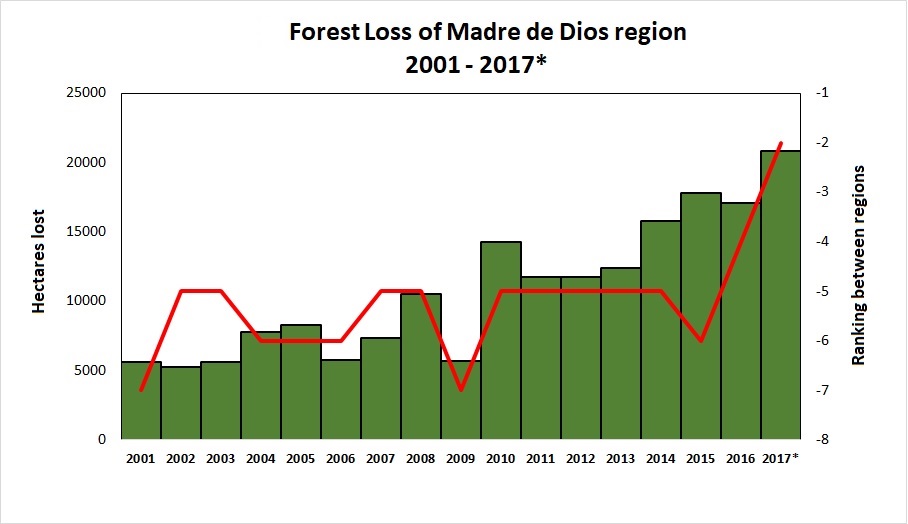
Table 76 shows the increasing trend of annual forest loss since 2001, peaking in 2017. In fact, in 2017 forest loss exceeded 20,000 hectares (49,000 acres) for the first time, doubling the loss in 2008.*

The table also shows the ranking of Madre de Dios in respect to the annual forest loss compared to all other regions of the Peruvian Amazon (see red line). For the first time, Madre de Dios is the region with the second highest forest loss total, behind only Ucayali.

Next, we present a map of deforestation hotspots in Madre de Dios in 2017, along with satellite images of a number of the most intense hotspots.

*The total estimated forest loss in 2017 was based on early warnings alerts generated by the University of Maryland (GLAD alerts) and the Peruvian Environment Ministry (PNCB/MINAM). The estimate is 20,826 hectares as of the first week of November.

Deforestation Hotspots in Madre de Dios

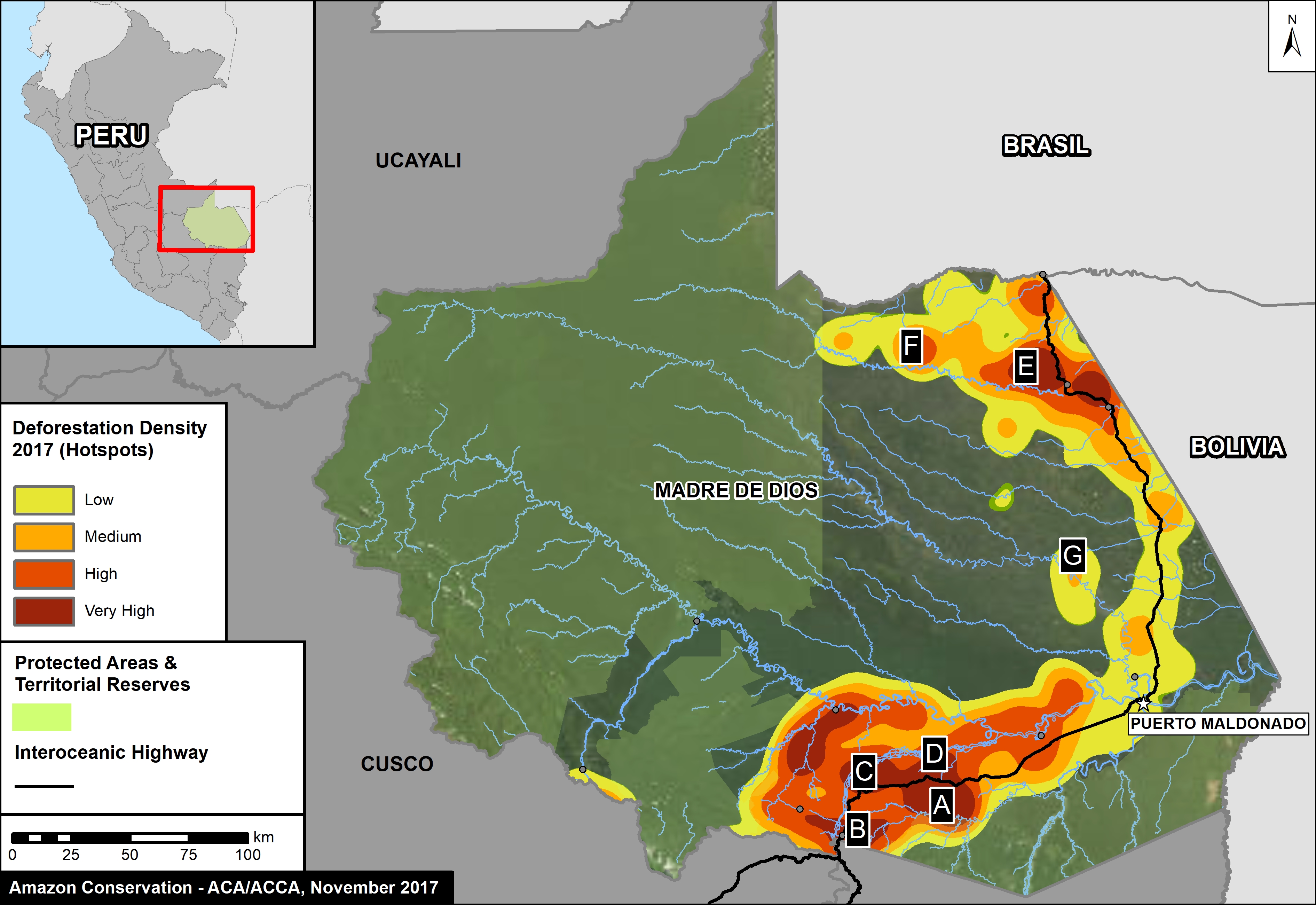
Image 76 shows a map of deforestation hotspots in Madre de Dios in 2017, based on early warning forest loss data. The colors yellow (low), orange (medium/high), and red (very high) correspond to the areas with the highest concentration of alerts, i.e. the main deforestation hotspots of 2017. Note how the majority of the forest loss is concentrated along the recently paved Interoceanic highway.

Next, we show satellite imagery for 7 hotspots (Insets A-G) that together account for the deforestation of 6,000 hectares (15,000 acres). We show that the main deforestation drivers are gold mining and small-scale agriculture.

Image 76. Base Map of Hotspots in Madre de Dios in 2017. Data: PNBC/MINAM, UMD/GLAD

La Pampa (Inset A)

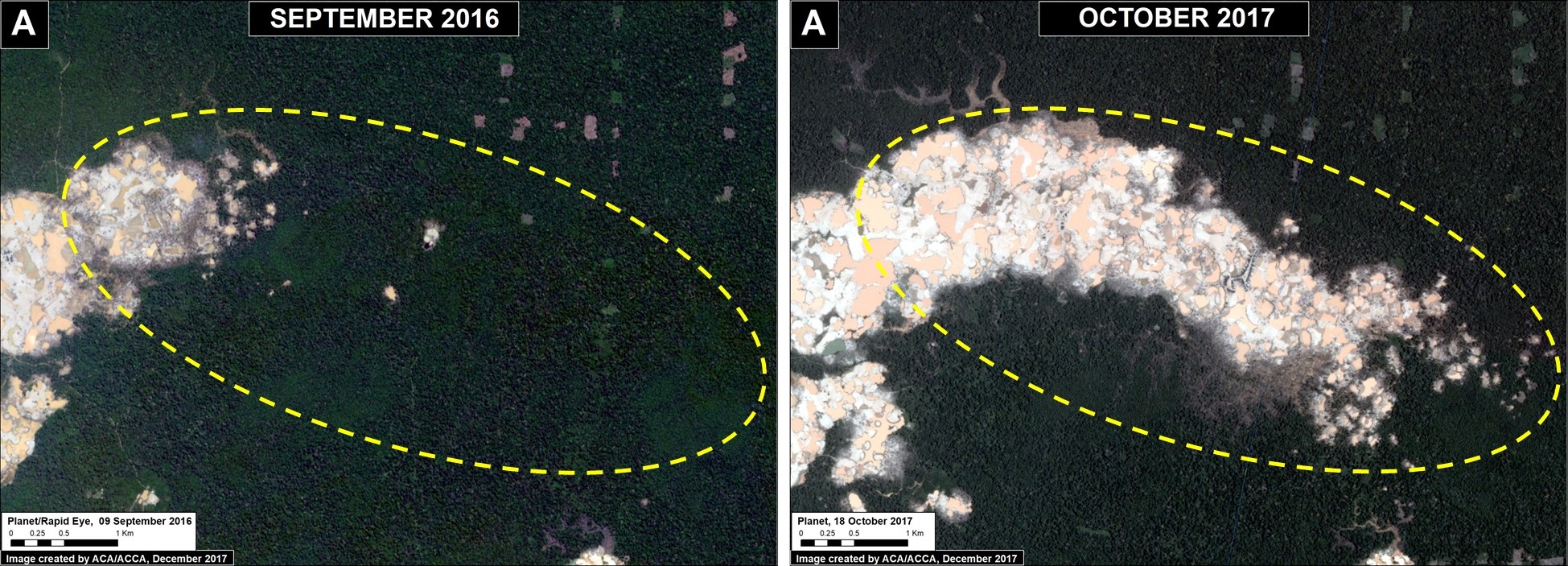
The area known as La Pampa continues to experience significant deforestation due to the advance of gold mining. Despite a series of field interventions by the Peruvian Government, we documented the deforestation of 1,385 acres (560 hectares) in 2017 (Image 76a). Since 2013, the total deforestation in La Pampa is 11,270 acres (4,560 hectares).

Image 76a. Data: Planet

Upper Malinowski (Inset B)

Upstream of La Pampa, the headwaters of the Malinowski River represent a second area devastated by the recent advance of gold mining. We documented the deforestation of 1,795 acres (726 hectares) in 2017 along the upper Malinowski (Image 76b). Since 2015, the total deforestation along the upper Malinowski is 5,260 acres (2,130 hectares).

Image 76b. Data: Planet

Santa Rita and Guacamayo (Insets C y D)

To the north of the La Pampa and Upper Malinowski mining areas, and on the other side of the Interoceanic highway, are two areas with significant recent deforestation due to small-scale agriculture. In these two areas, we documented the deforestation of 2,890 acres (1,170 hectares) in 2017 (Images 76c, 76d). Additional research focused on the exact type of crops is required, but local sources indicate an increase in papaya and cacao in the area.

Image 76c. Data: Planet, ESA
Image 76d. Data: Planet

Iberia (Inset E)

On the other side of Madre de Dios, along the Interoceanic Highway near the border with Brazil and Bolivia, is the town of Iberia. This area has become a major deforestation hotspot in recent years. We documented the deforestation of 2,250 acres (910 hectares) in 2017 (Image 76e). Since 2014, the total deforestation around Iberia is 6,795 acres (2,750) hectares. A large part of the deforestation is within forestry concessions, indicating that these concessions have been invaded. The cause of the deforestation is small-scale agriculture (specifically, according to local sources, corn, papaya, and cacao).

Image 76e. Data: Planet

Tahuamanu (Inset F)

To the west of Iberia, an isolated hotspot emerged caused by the rapid proliferation of logging roads. This hotspot is located within a forestry concession, but its impact is troubling due to the extension and density of the new road network. We estimate the construction of 130 km of new logging forest roads in this area in 2017 (Image 76f).

Image 76f. Data: Planet

Las Piedras (Inset G)

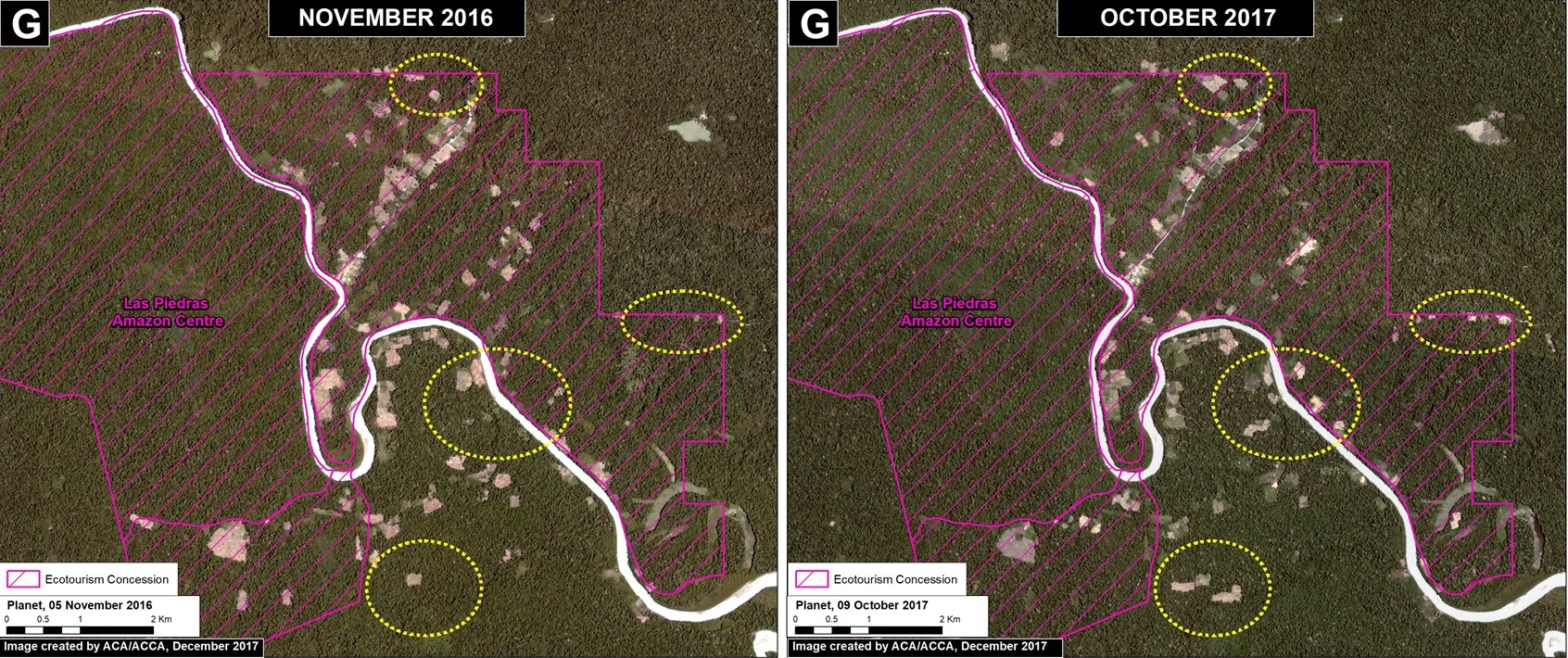
Finally, deforestation continues within two ecotourism concessions along the Las Piedras River, a remote area famous for its exceptional wildlife (see this video). We documented the deforestation of 300 acres (134 hectares) in 2017 (Image 76g). Since 2013, the total deforestation along the Las Piedras River is 1,495 acres (605 hectares). Note that the Las Piedras Amazon Center Ecotourism Concession represents an effective barrier against deforestation impacting the surrounding concessions. According to local sources, the main causes of deforestation are cacao plantations and cattle pasture.

Image 76g. Data: Planet

Coordinates

Zona A: -12.99, -69.90
Zona B: -13.05, -70.17
Zona C: -12.85, -70.26
Zona D: -12.84, -69.99
Zona E: -11.31, -69.61
Zona F: -11.23, -70.05
Zona G: -11.601711, -70.477295

References

Planet Team (2017). Planet Application Program Interface: In Space for Life on Earth. San Francisco, CA. https://api.planet.com

Citation

Finer M, Novoa S, Garcia R (2017) Pope to visit Madre de Dios (Peru), region with Deforestation Crisis. MAAP: 75.

MAAP #68: 2017 DEFORESTATION HOTSPOTS IN THE PERUVIAN AMAZON (Part 2)

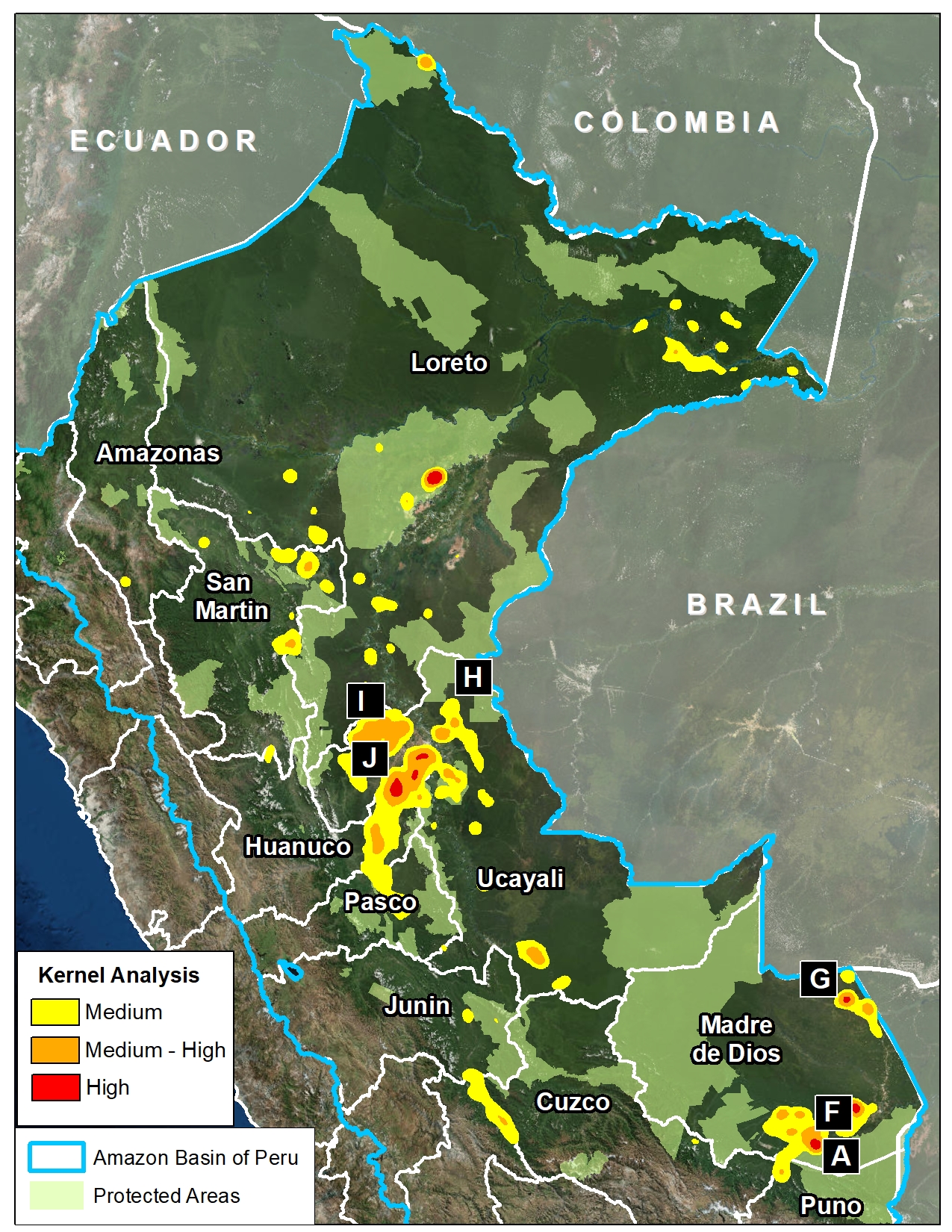
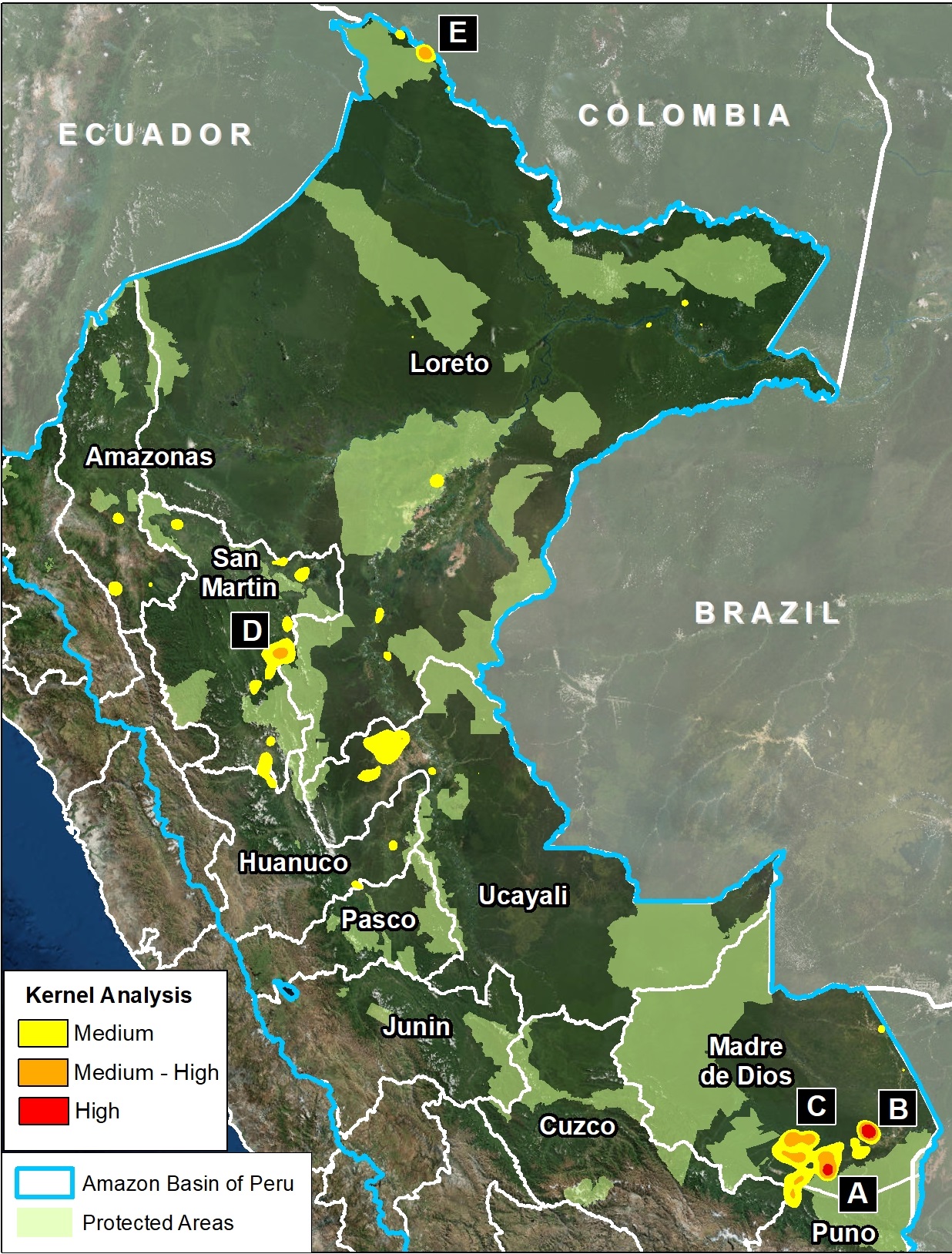
Image 68. Base map. Data: PNCB/MINAM, UMD/GLAD, SERNANP.

In a previous report, MAAP #65, we presented information about deforestation hotspots in 2017 in the Peruvian Amazon, based on early warning alert data from January until mid-July.

Between July and August, the amount of alerts greatly increased, likely due to arrival of the dry season. Thus, this report includes new updated data until mid-August.*

We find new deforestation hotspots in the regions of Madre de Dios and Ucayali (see base map).** At the national level, we now estimate the forest loss of 111,200 acres (45,000 hectares) thus far in 2017 (thru August 17).***

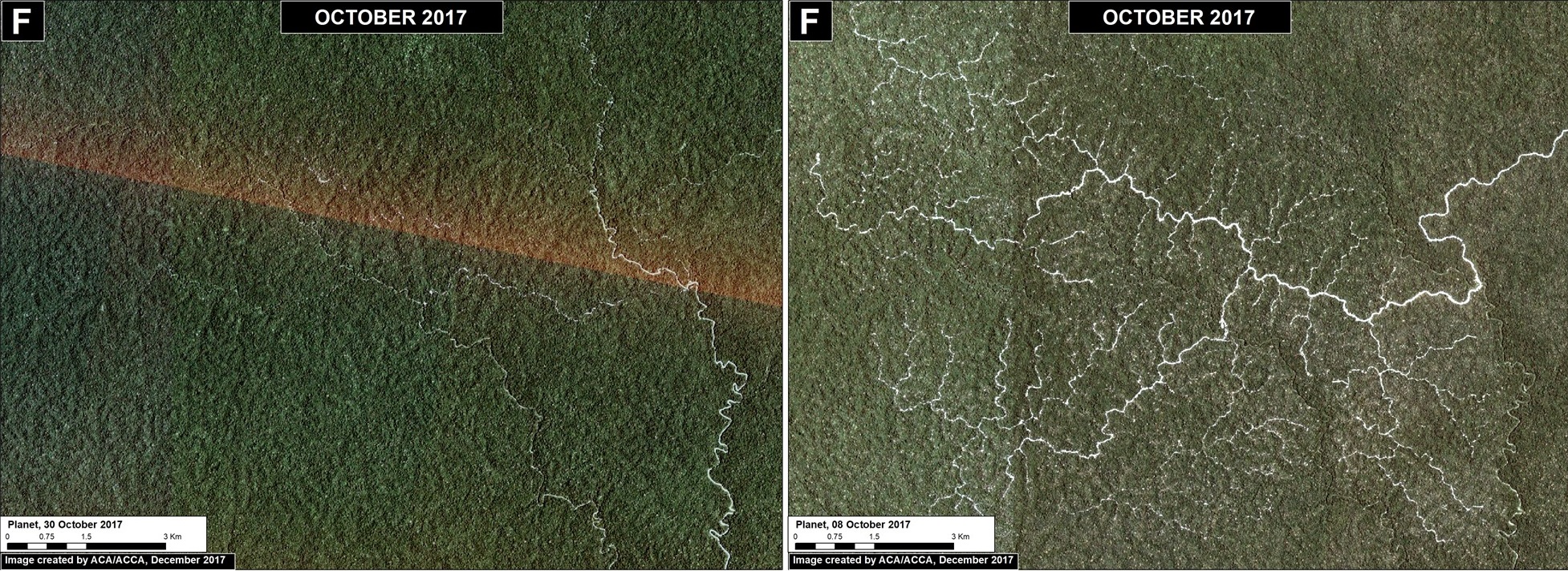
Below, we present satellite imagery of the following hotspots:

– La Pampa, Madre de Dios (Inset A)
– Guacamayo, Madre de Dios (Inset F)
– Iberia, Madre de Dios (Inset G)
– South of Sierra del Divisor, Ucayali (Inset H)
– Nueva Requena, Ucayali (Inset I)

**The data were generated by the National Program of Forest Conservation for Climate Change Mitigation, Peruvian Ministry of Environment (PNCB/MINAM).

**See Hotspots A-E in MAAP #65

***We emphasize that our calculations are just estimates. Official forest loss data are produced annually by the Peruvian Ministry of Environment.


La Pampa, Madre de Dios (Inset A)

Illegal gold mining deforestation continues to expand in the buffer zone of Tambopata National Reserve in the southern Peruvian Amazon. The Peruvian Government has conducted several interventions this year, most notably in July. However, between July and August we documented the additional loss of 67 acres (27 hectares), increasing the 2017 total deforestation in this zone to 1,280 acres (517 hectares). Image 68a is a GIF illustrating the gold mining deforestation from January to September 2017.

Image 68a. Data: Planet

Guacamayo, Madre de Dios (Inset F)

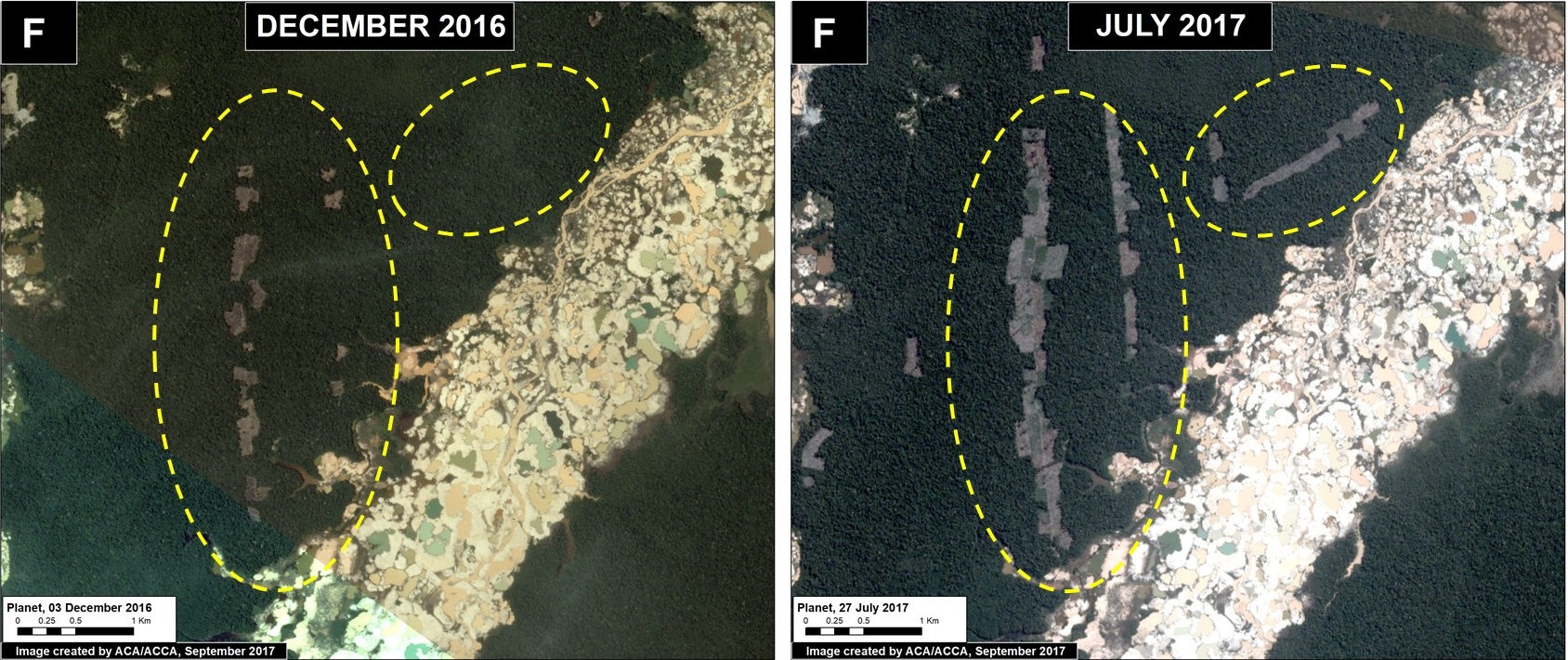
North of La Pampa, in another gold mining zone, known as Guacamayo, we have documented the rapid deforestation of 182 acres (74 hectares). This newly deforested area is located next to the mining zone (within a forestry concession), and appears to be caused by agricultural activity.

Image 68f. Data: Planet

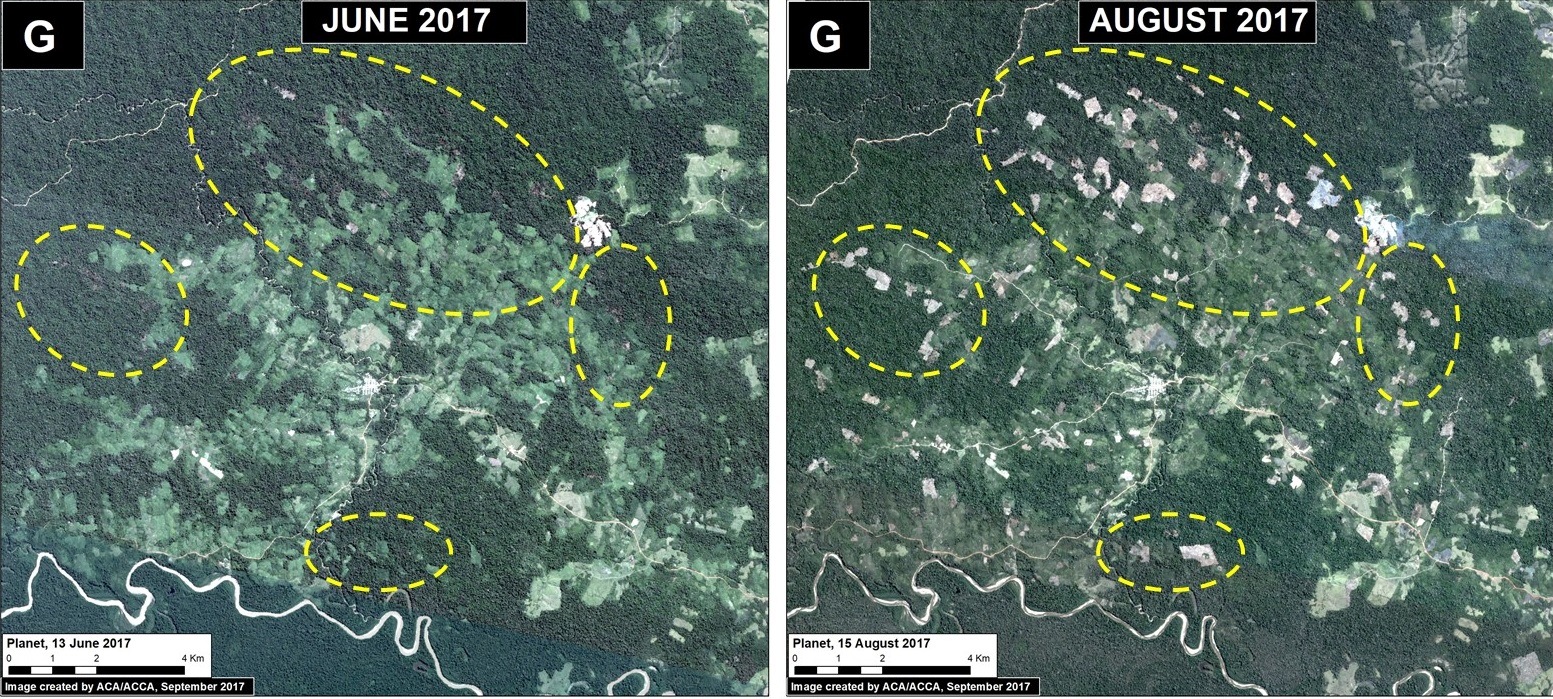
Iberia, Madre de Dios (Inset G)

Around the  town of Iberia, located along the Interoceanica highway near the border with Brazil, has recently become a major deforestation hotspot (see MAAP #28 and MAAP #47). Between June and August 2017, we detected the deforestation of 1,075 acres (435 hectares). Much of this deforestation is within forestry concessions, indicating that the concessions have been invaded. The deforestation appears  to be caused by agriculture (according to local sources, the clearing is for corn plantations).

Image 68g. Data: Planet.

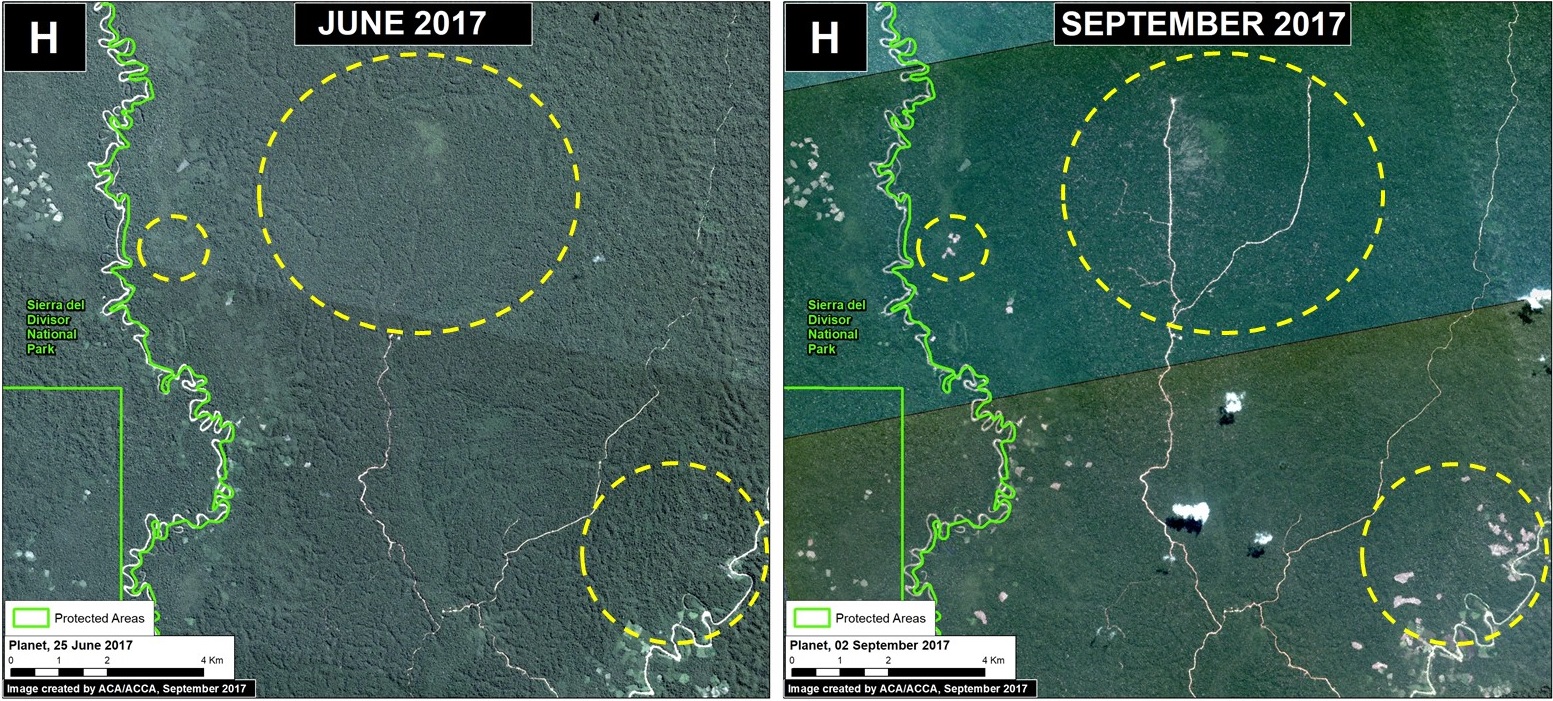
South of Sierra del Divisor, Ucayali (Inset H)

In the central Peruvian Amazon, just south of Sierra del Divisor National Park, we detected the new construction of 25 km of logging roads in the forestry concessions surrounding the park. We also detected the deforestation of 138 acres (56 hectares), close to the National Park’s limit for what appears to be agricultural activity.

Image 68h. Data: Planet, SERNANP

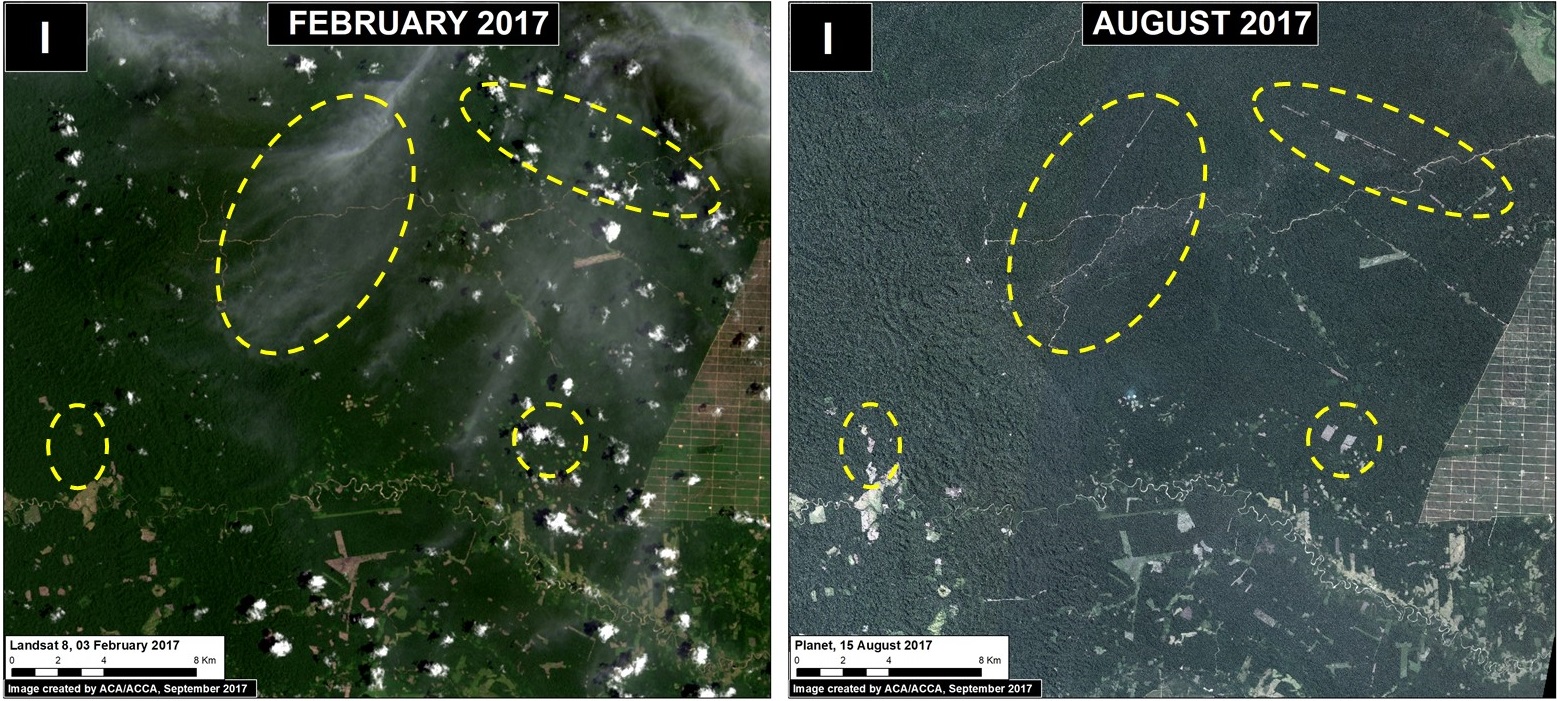
Nueva Requena, Ucayali (Inset I)

Also in the central Peruvian Amazon, in the Nueva Requena district near two controversial oil palm plantations (MAAP #41), we detected the deforestation of 1,130 acres (457 hectares) in state forestry lands (known as Permanent Production Forest). This includes 26 km of new logging and agricultural roads. It is important to note that this area was recently in the news regarding the killing of six farmers over land rights dispute.

Image 68i. Data: Planet

References

Planet Team (2017). Planet Application Program Interface: In Space for Life on Earth. San Francisco, CA. https://api.planet.com.

Citation

Finer M, Novoa S, Olexy T (2017) 2017 Deforestation Hotspots in the Peruvian Amazon (Part 2). MAAP: 68.

MAAP #65: Deforestation Hotspots of 2017 in the Peruvian Amazon

Image 65. Data: MINAM/PNCB, UMD/GLAD, SERNANP, MAAP

In an earlier report, MAAP #40, we highlighted the power of combining early warning GLAD* alerts with analysis of high-resolution satellite images (for example, from the company Planet), as part of a comprehensive near real-time deforestation monitoring system.

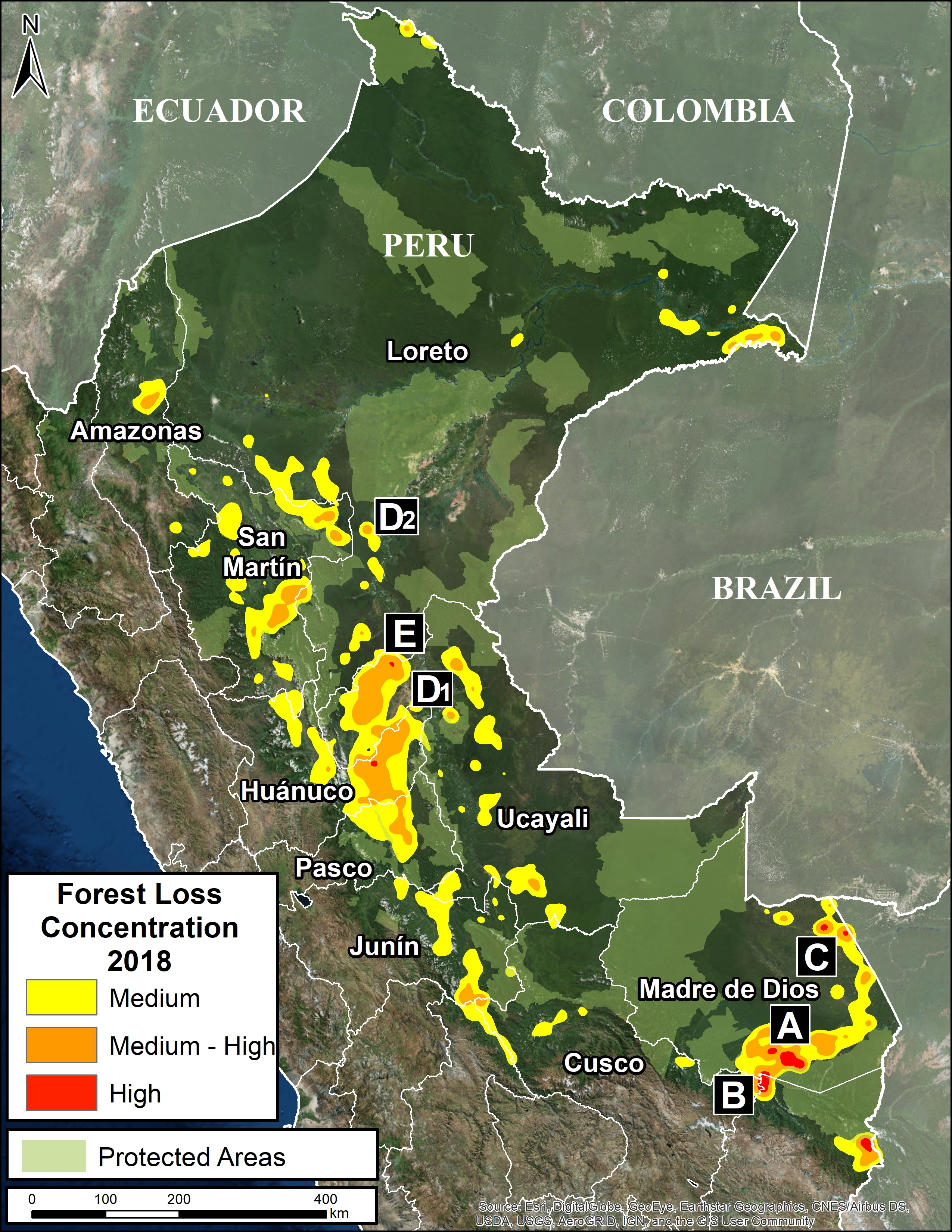
In the current report, we analyze the GLAD alerts for the first half of 2017 (through July 17) to identify current deforestation hotspots in the Peruvian Amazon.** These alerts indicate an estimated total forest loss of 37,000 acres (15,000 hectares) thus far during the year.

Image 65 (see right) highlights the 2017 deforestation hotspots, defined here as areas with medium to high density of forest loss.

Below, we describe and show images of the most intense hotspots, indicated in red and orange.

These areas include:

  • Buffer zones of Tambopata National Reserve and Cordillera Azul National Park
  • Natural loss due to blowdowns from “hurricane winds,” in the Madre de Dios region
  • Northwest border with Colombia


Buffer Zone of Tambopata National Reserve 

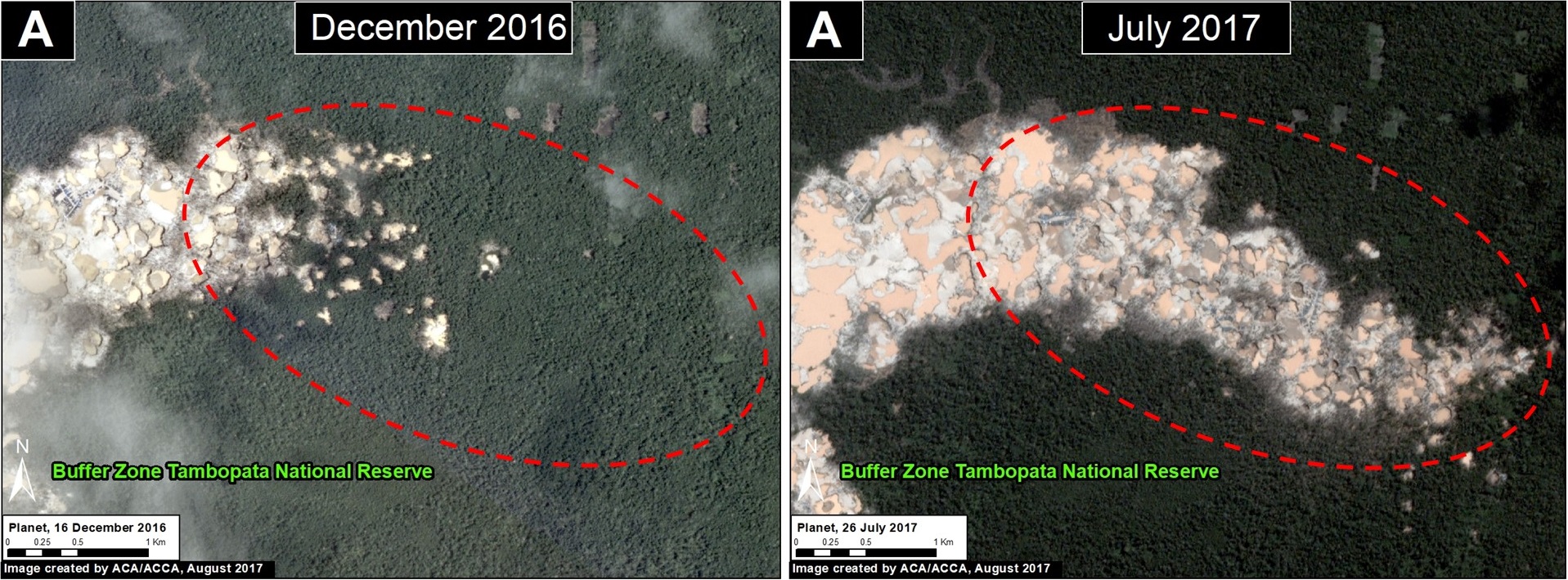
Inset A indicates an area of high intensity deforestation due to gold mining activity in the buffer zone of Tambopata National Reserve in the southern Peruvian Amazon (Madre de Dios region). Image 65a shows the deforestation of 1,210 acres (490 hectares) in this area in 2017. The Peruvian government recently (early July) led a major raid in this area. However, the most recent satellite images (late July – early August) indicate that mining camps are still present in the area.

Image 65a. Data: Planet

Hurricane Winds

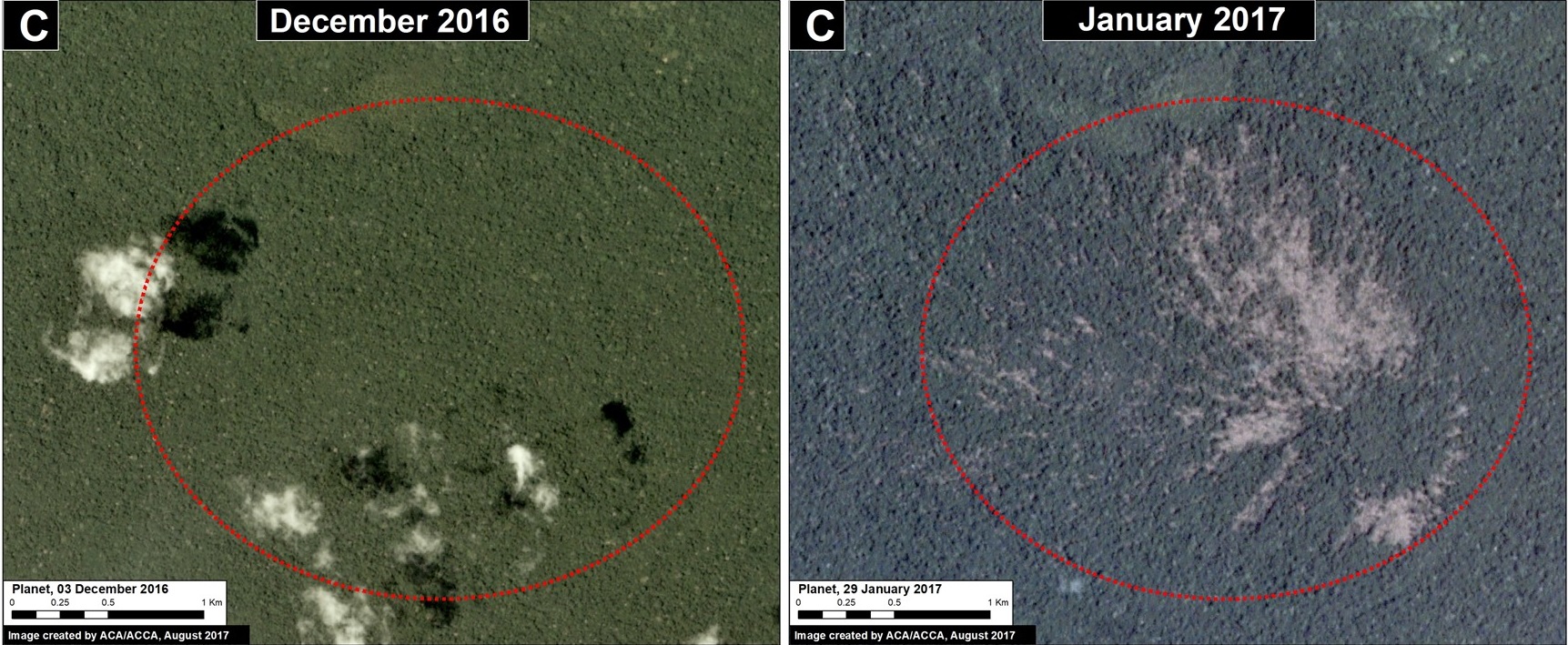
Insets B and C indicate two areas in the southern Peruvian Amazon (Madre de Dios region) that experienced the natural forest loss of 980 acres (400 hectares) caused by hurricane winds, localized thunderstorms with strong winds. Images 65b and 65c show the recent 2017 forest loss. See MAAP #54 and MAAP #55 for more details about hurricane winds.

Image 65b. Data: Planet
Image 65c. Data: Planet

Buffer Zone of Cordillera Azul National Park

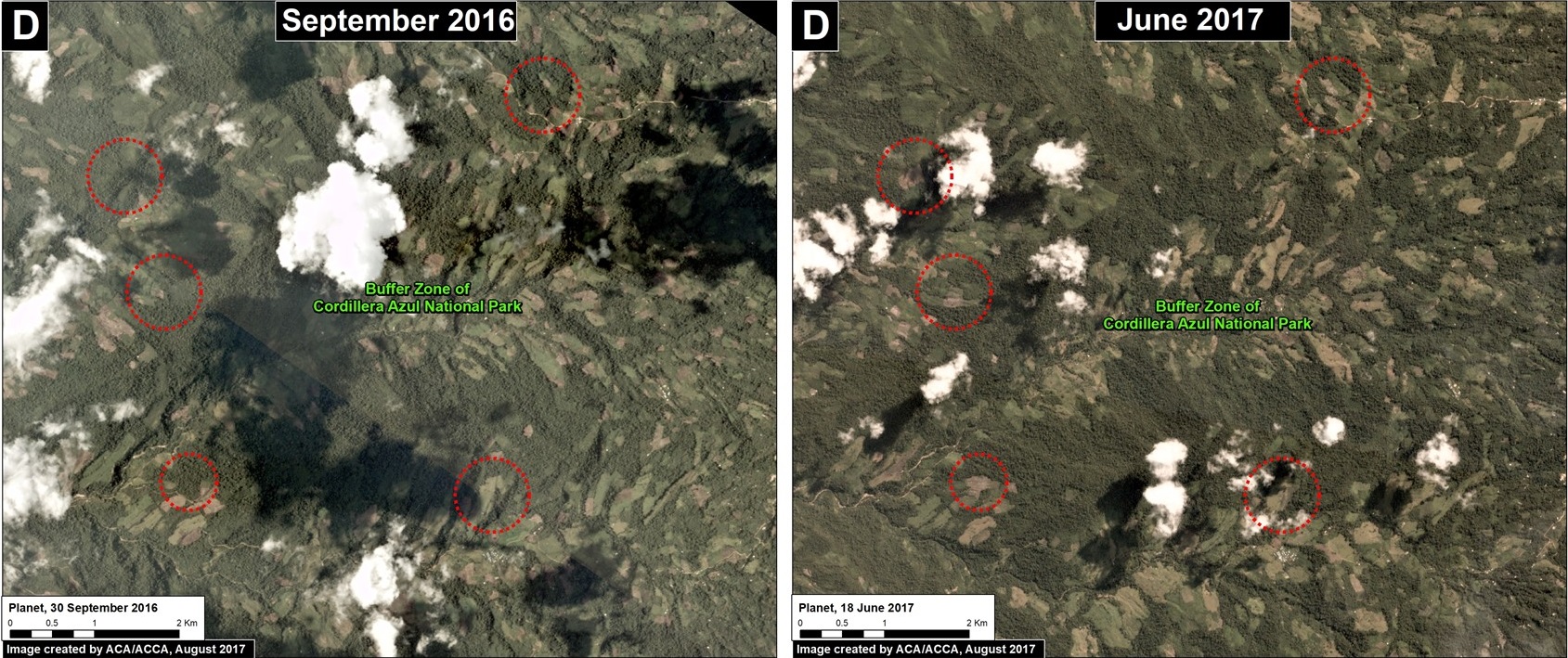
Inset D shows an area of medium intensity deforestation in the buffer zone of Cordillera Azul National Park, in the central Peruvian Amazon (San Martin region). Image 65d shows an example of the deforestation (138 acres) in this area in 2017. The main cause of the deforestation appears to be agricultural activity.

Image 65d. Data: Planet

Northwest Border with Colombia

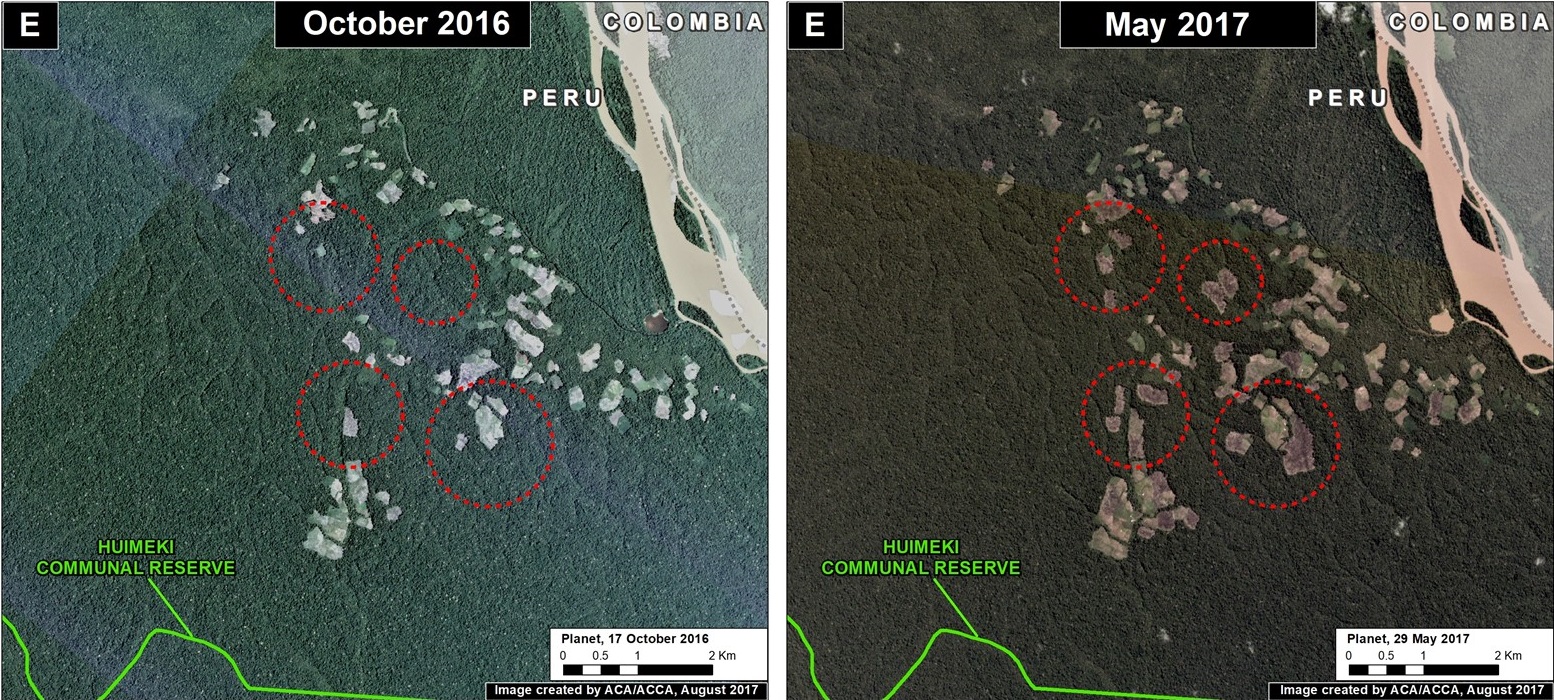
Inset E indicates a medium intensity hotspot in the extreme northern Peruvian Amazon (Loreto region), along the border with Colombia. The deforestation is approaching the limit of the Huimeki Communal Reserve. Image 65e shows the deforestation of 390 acres (158 hectares) in this area in 2017. The driver appears to be linked to agricultural activities and illicit crops (The United Nations has confirmed coca in this area).

Image 65e. Data: Planet

Notes

*GLAD alerts are a powerful new tool to monitor tropical forest loss in near real-time. This early warning system, created by the GLAD (Global Land Analysis and Discovery) laboratory at the University of Maryland and supported by Global Forest Watch, was launched in March 2016 as the first Landsat-based (30-meter resolution) forest loss alert system (previous systems were based on lower-resolution imagery). The alerts are updated weekly and can be accessed through Global Forest Watch.

**We performed a kernel density estimation, an analysis that calculates the magnitude per unit area of a particular phenomenon, in this case, forest loss.

Reference

Planet Team (2017). Planet Application Program Interface: In Space for Life on Earth. San Francisco, CA. https://api.planet.com.

Citation

Novoa S, Finer M (2017) Deforestation Hotspots in the Peruvian Amazon in 2017. MAAP: 65.


MAAP #63: Patterns of Deforestation in the Colombian Amazon

We are excited to present our initial analysis of the Colombian Amazon, a work that reflects an important collaboration with our colleagues at Amazon Conservation Team. It is also our first report in the more interactive “Story Map” format.

This report has two objectives: 1) Illustrate the major deforestation hotspots in the Colombian Amazon between 2001 and 2015 and 2) Focus in on one of the most important hotspots, located in the Caquetá department. In short, we show satellite imagery of the expanding forest loss in one of the most important deforestation hotspots in the Colombian Amazon.

Please follow this link to view the Story Map: https://www.maapprogram.org-deforestation-patterns-colombian-amazon/